Your utility company wants to pay you to insulate your home. That might sound too good to be true, but utility rebate programs exist because it’s cheaper for energy providers to help customers use less power than to build new generation capacity. The result is a system where homeowners can collect $50 to $800 or more in rebates on qualifying insulation projects, often on top of the 30% federal tax credit available through 2032 under the Inflation Reduction Act.
The catch is that not every insulation job qualifies, and the rules vary significantly by utility and state. Attic insulation is the most universally eligible upgrade, but programs also cover wall insulation, air sealing, crawl space encapsulation, and duct insulation depending on where you live. Miss the pre-approval step and you could forfeit the rebate entirely, even on an otherwise qualifying project.
This post covers the insulation upgrades most commonly eligible for utility rebates, how to find and apply for your local program, and how to approach the project whether you’re a committed DIYer or planning to hire a contractor. Real payback periods and savings figures are included so you can prioritize the upgrades that make the most financial sense for your home.
What You’ll Need
Click on an item below to shop for the recommended items for this recipe on Amazon.
As an Amazon Associate, we earn from qualifying purchases.
How to Do It
- Go to energystar.gov/rebate-finder or dsireusa.org and enter your zip code to see all available federal, state, and utility incentives for insulation in your area.
- Call your electric and gas utility companies directly and ask for their ‘energy efficiency rebate program’ or ‘home performance program.’ Utility websites often lag behind current offerings, so a phone call confirms active programs.
- Ask specifically about: attic insulation, air sealing, wall insulation, crawl space insulation, and duct insulation. Each may have a separate rebate amount and application form.
- Request the pre-approval application if required, and ask whether you need an energy audit first. Some programs provide free or discounted audits that can add additional rebate eligibility.
- Submit your pre-approval application and wait for written confirmation before scheduling any work or purchasing materials. File the confirmation number with your project records.
- Verify whether the federal 25C tax credit applies to your project (it covers 30% of costs up to $1,200 per year for insulation and air sealing as of 2024) and save all receipts and contractor invoices for your tax preparer.
- Confirm your current attic insulation level by measuring existing depth. Most older homes have R-11 to R-19 (3 to 6 inches of fiberglass). The DOE recommends R-38 to R-60 for most U.S. climate zones.
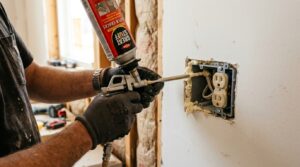
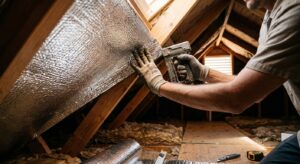
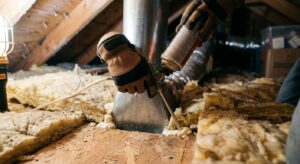
- Before adding insulation, seal all air bypasses: recessed light housings, top plates, attic hatch, plumbing and wire penetrations. Use canned spray foam for gaps under 3 inches and fire-rated caulk or rigid foam board for larger openings. This step is critical and often a rebate requirement.
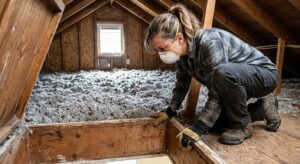
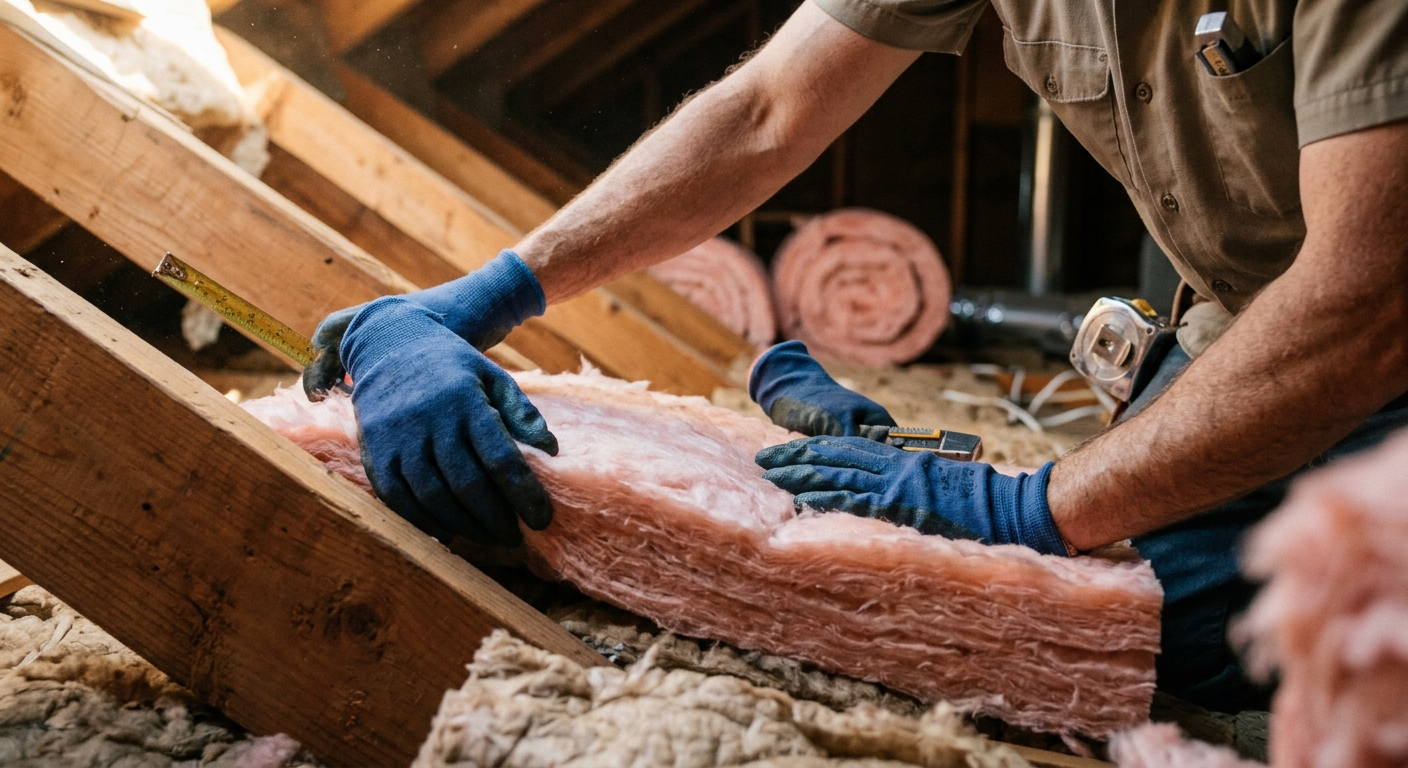
- Calculate how many bags of blown-in cellulose or fiberglass you need using the coverage chart on the bag or the manufacturer’s online calculator. For R-38 starting from R-11, plan for roughly 8 to 10 inches of added depth.
- Install cardboard or foam baffles at each eave vent to keep insulation from blocking soffit ventilation. Blocking soffits causes moisture problems and can void your rebate.
- Rent the blower machine at the store where you purchased the insulation (usually free with purchase). Work from the far corners of the attic toward the hatch, using depth markers stapled to joists to ensure consistent coverage.
- Take before-and-after photos of the insulation depth and the air sealing work. Utility rebate applications almost always require this documentation along with material receipts.
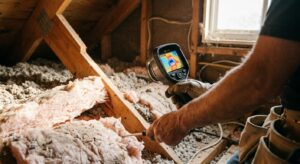
- Schedule a professional energy audit with a BPI-certified auditor, which many utility programs offer for free or at a subsidized cost of $100 to $200. The audit uses a blower door test and thermal imaging to find air leaks and insulation gaps invisible to the naked eye.
- Review the audit report and prioritize upgrades by rebate availability and payback period. Attic insulation typically has the shortest payback (1 to 3 years). Wall insulation (dense-pack blown-in) and crawl space encapsulation typically have 3 to 6 year paybacks but qualify for significant rebates.
- Get at least three quotes from certified contractors on your utility’s approved vendor list. Ask each contractor to itemize material costs separately since the 25C tax credit applies to materials, not labor.
- Confirm with each contractor that they will handle the rebate paperwork and submit it on your behalf. Many approved contractors manage the utility rebate application as part of their service.
- During installation, ensure the contractor provides a certificate of completion specifying the R-value installed, square footage covered, and materials used. This document is required for both the utility rebate and the federal tax credit.
- After project completion, submit any remaining rebate forms within the utility’s deadline (commonly 60 to 90 days post-installation) and provide copies to your tax preparer for the 25C credit filing.
Why It Works: The Benefits
Utility rebates typically range from $50 to $800 per project, with some state programs offering up to $1,500 for comprehensive air sealing and insulation packages. Stacked with the 30% federal tax credit, a $2,000 attic insulation job could net $1,000 or more in combined incentives.
The DOE estimates that proper attic insulation alone reduces heating and cooling costs by 10 to 20% annually. Homes with multiple upgrades, including wall insulation and crawl space encapsulation, can see reductions of 25 to 30% per year.
Proper insulation eliminates the cold floors, drafty rooms, and uneven temperatures that make conditioned spaces uncomfortable. Homeowners with crawl space encapsulation commonly report 5 to 10 degree floor temperature improvements in winter.
A well-insulated home requires the heating and cooling system to run 15 to 25% less to maintain setpoint temperatures. Reduced runtime lowers wear on the equipment and can extend system life by several years, delaying a costly replacement.
Energy-efficient homes with documented insulation upgrades sell for 2 to 6% more on average according to data from the National Association of Realtors and Lawrence Berkeley National Laboratory. Utility rebate completion certificates and contractor documentation provide evidence for buyers.
💰 Savings Impact by Action
Upgrading attic insulation to R-38 to R-49 reduces annual heating and cooling costs by 10 to 20% in most U.S. climate zones according to DOE data.
Professional air sealing to reduce infiltration below 5 ACH50 can cut heating and cooling energy use by up to 15% by eliminating convective bypass around insulation.
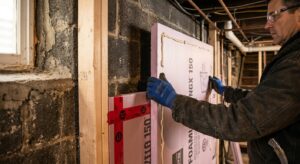
Dense-pack blown-in wall insulation in a previously uninsulated home reduces wall heat loss by up to 70%, translating to 10 to 12% whole-home energy savings.
Full crawl space encapsulation with rigid foam insulation (R-10 to R-19) reduces floor heat loss and moisture infiltration, cutting heating energy use by 15 to 18% in cold climates.
Insulating and sealing ducts running through unconditioned spaces recovers 10 to 20% of conditioned air that would otherwise be lost before reaching living areas.
🏠 Key Concepts Explained
The Science Behind It
Heat moves in three ways: conduction (through solid materials), convection (through moving air), and radiation (through electromagnetic waves). Insulation primarily resists conductive heat flow, which is why R-value measures resistance to conduction. But in a real home, convection through air leaks is often responsible for 30 to 40% of total energy loss, which is why air sealing and insulation must work together. Adding R-38 attic insulation over an unsealed top plate is like putting a thick blanket over a leaky tent: the blanket helps, but the gaps limit its effectiveness significantly.
The stack effect explains why the attic and crawl space are the highest-priority locations for insulation upgrades. In winter, warm interior air rises and escapes through the top of the building while cold exterior air is drawn in at the bottom. This creates a continuous pressure-driven air exchange that bypasses your HVAC system entirely. Sealing the attic floor and insulating it to R-38 or higher dramatically reduces this stack-driven loss, while crawl space encapsulation addresses the cold air entry point at the base. Together, these two upgrades address the primary entry and exit points of the stack loop.
Blown-in cellulose and fiberglass are the dominant rebate-qualifying materials because they conform to irregular joist bays and provide continuous coverage without gaps. Cellulose, made from recycled paper treated with borate, has a slightly higher density that provides modest air resistance in addition to thermal resistance. Both materials are rated by the same R-value scale, but cellulose performs closer to its rated value at temperature extremes. Spray polyurethane foam (SPF) offers the highest R-value per inch (R-6 to R-7 per inch for closed-cell) and provides an air barrier simultaneously, but material costs are higher and professional installation is typically required for utility rebate eligibility.
Frequently Asked Questions
▼ I already finished the insulation project. Can I still get the rebate?
It depends on your utility’s specific rules. Some programs accept post-installation applications if you submit within 30 to 60 days and have all receipts and documentation. Call your utility immediately and ask whether retroactive claims are accepted. If the program required pre-approval, the rebate is likely forfeited, but you may still qualify for the federal 25C tax credit, which does not require pre-approval.
▼ My contractor said they would handle the rebate but I never received anything. What should I do?
Contact your utility company directly with your contractor’s name, the project completion date, and your account number to check if a rebate application was ever submitted. If it was not, request the forms and submit them yourself immediately, as most programs have a 60 to 90 day post-installation deadline. Get written confirmation from the utility on the status and follow up in writing so you have a paper trail.
▼ Does DIY installation qualify for utility rebates?
It varies by program. Many utilities offer material rebates for DIY installation as long as you purchase qualifying products and provide receipts, but some require licensed or certified contractor installation for the full rebate amount. Check your utility’s program rules before purchasing anything. If DIY is allowed, be prepared to submit photos, material receipts, and sometimes an energy audit report as part of the application.
▼ What if my attic already has some insulation? Does it still qualify?
Yes, most programs rebate the upgrade cost of adding insulation to reach the qualifying R-value threshold, not just starting from zero. You need to document your existing R-value (measure current depth and identify the material type) and show that the completed project meets or exceeds the program’s minimum, typically R-38 to R-49. Topping off from R-11 to R-38 is a very common qualifying project.
▼ Are there income-based programs with larger rebates or free installation?
Yes. The Weatherization Assistance Program (WAP) administered through the DOE provides free insulation and air sealing to income-qualified households with no cost to the homeowner. Many states and utilities also offer enhanced rebates for low-to-moderate income customers. Call 211 or visit weatherization.energy.gov to find your local WAP provider and eligibility requirements.
Quick Tips
- Check both your electric and gas utility programs separately since they often have independent rebate budgets and you may qualify for both on the same project.
- Ask your utility if they offer a ‘tiered rebate’ that increases the payout when you combine air sealing with insulation. Many programs pay 20 to 30% more for combined projects.
- Take date-stamped photos of your attic before starting and place a ruler in the frame to document existing insulation depth, which is often required for the rebate application baseline.
- Schedule your insulation project in spring or fall when contractor demand is lower. You will get better pricing and faster scheduling, and the rebate funds are less likely to be exhausted for the year.
Variations for Your Situation
- Apartment/Rental: Renters cannot modify building insulation but can benefit indirectly by requesting that the landlord apply for utility rebates on qualifying upgrades. Some states, including California and New York, have tenant-initiated rebate pathways where the landlord applies and the savings are documented in lease agreements. Renters can address their own comfort with interior window insulation film ($15 to $30 per window) and draft stoppers for doors, neither of which require landlord approval.
- Tight Budget (under $50): Start with the rebate research step since it costs nothing and identifies what is available before you spend a dollar. If budget is truly limited, prioritize air sealing with a $10 to $15 can of spray foam and a tube of caulk, targeting the attic hatch, electrical outlets on exterior walls, and plumbing penetrations. Air sealing alone can reduce energy loss by 10 to 20% and is often a standalone rebate category with lower documentation requirements than insulation upgrades.
- Older Home (pre-1980): Homes built before 1980 commonly have little or no wall insulation, uninsulated crawl spaces, and attic insulation well below current standards. Before starting any insulation project, test for vermiculite attic insulation (which may contain asbestos) using a certified lab kit ($30 to $50) and check for knob-and-tube wiring in the attic and walls, both of which require professional remediation before insulation can be added. Many utility programs offer enhanced rebates or priority audit scheduling for older housing stock, so mention your home’s age when you call.