Insulation is one of those home systems that works quietly in the background, and most homeowners assume it just keeps doing its job forever. But introduce moisture, and that silent workhorse can turn into a silent problem. Whether from a slow roof leak, a sweating pipe, a foundation seep, or just high indoor humidity, wet insulation loses its ability to resist heat transfer almost immediately. In some cases, it also becomes a breeding ground for mold within 24 to 48 hours.
The frustrating part is that moisture damage to insulation is almost always hidden. It sits inside your walls, under your floors, or above your ceiling in an attic you visit once a year. By the time you notice musty smells, soft drywall, or unusually high heating and cooling bills, the damage may already be extensive. According to the Department of Energy, compromised insulation in an attic or crawl space can increase heating and cooling costs by 15 to 30% depending on how much material is affected.
This guide covers exactly what happens to fiberglass batts, cellulose, spray foam, and rigid foam when they get wet, how to inspect your home for moisture-damaged insulation even without professional tools, and the step-by-step process for addressing it yourself or knowing when to call a pro. Whether you noticed a stain on the ceiling or just want to be proactive, this post gives you the information you need to act before a small problem becomes a structural one.
What You’ll Need
Click on an item below to shop for the recommended items for this recipe on Amazon.
As an Amazon Associate, we earn from qualifying purchases.
How to Do It
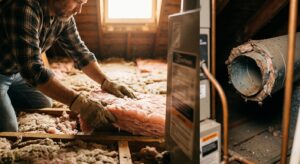
- Check your attic after any significant rain event. Bring a flashlight and look for discoloration, sagging batts, dark staining on roof sheathing or rafters, and any compression or matting of insulation material.
- In a crawl space, look for insulation hanging down between floor joists, visible mold on the paper facing of batts, standing water, or efflorescence (white mineral deposits) on concrete or block walls that signals chronic moisture intrusion.
- Press your hand firmly into accessible fiberglass batts in attic or crawl space areas near any known leak points. Wet batts feel dense, cold, and heavy compared to dry insulation. Dry fiberglass should feel light and springy.
- Smell the space carefully. A persistent musty or earthy odor in an enclosed space almost always indicates active mold growth on insulation or framing, even if you cannot see visible growth.
- Inspect drywall ceilings and walls for water staining, bubbling paint, or soft spots. These surface signs often reveal wet insulation directly behind or above them.
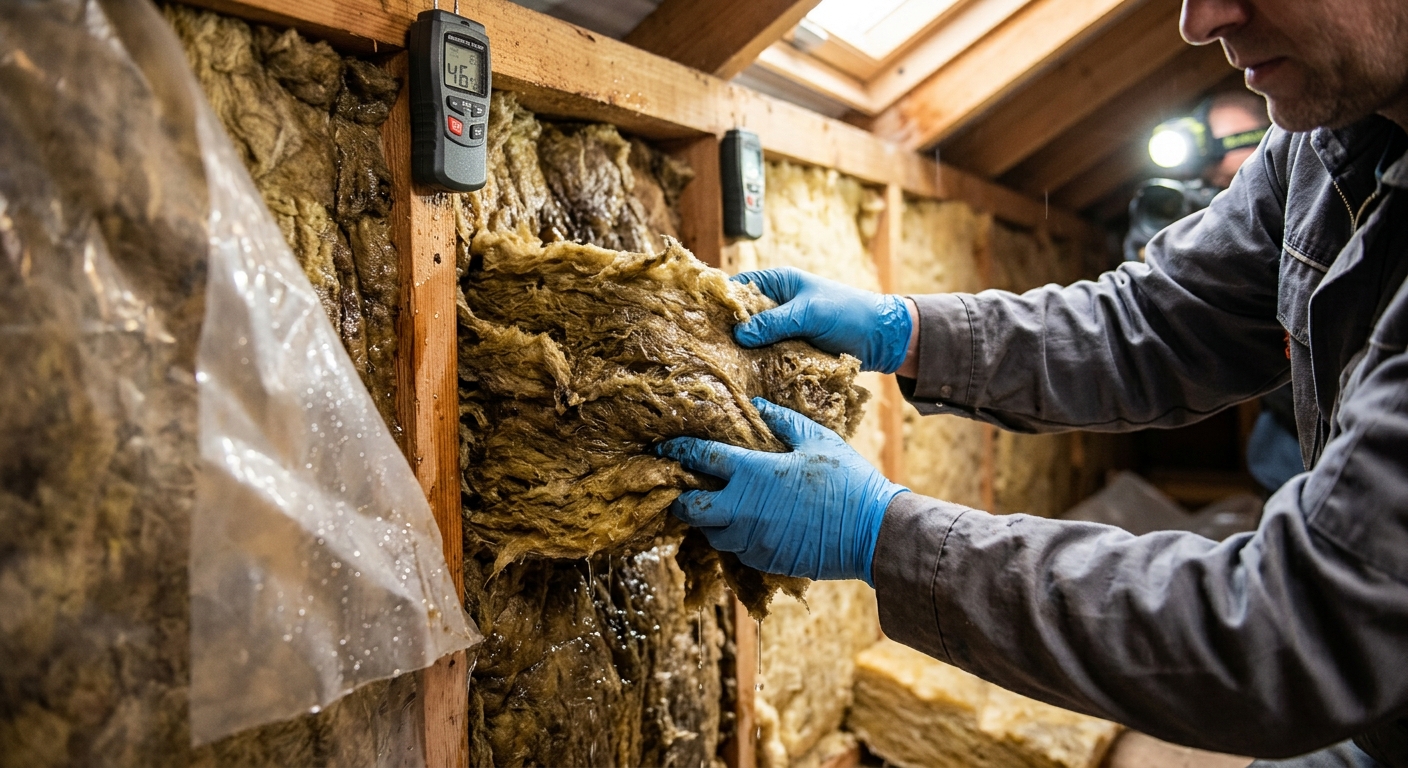
- Use a $15 to $25 pin-type moisture meter on wood framing adjacent to insulation. Readings above 19% on dimensional lumber indicate conditions wet enough to support mold and warrant insulation removal.
- Gather protective equipment before starting: N95 or P100 respirator, safety glasses, disposable gloves, and a Tyvek-style coverall or clothes you can wash immediately. Disturbing wet insulation releases mold spores and fiberglass particles.
- Fix the moisture source before touching any insulation. Replacing insulation without addressing the root cause (a leaking pipe, failed flashing, cracked foundation, or missing vapor barrier) guarantees the same problem returns within months.
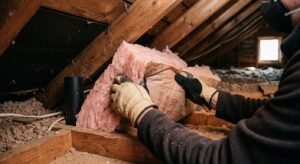
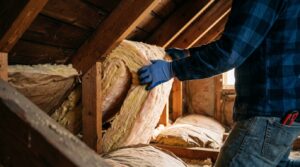
- Remove wet or visibly moldy insulation carefully and bag it immediately in 6-mil contractor bags. Do not shake or tear batts apart in the space. Roll them up and slide them into bags while minimizing disturbance.
- Allow framing and sheathing to dry completely before installing new insulation. In a well-ventilated attic, this typically takes 3 to 5 days in warm weather. Verify with a moisture meter that framing reads below 16% before proceeding.
- Treat affected wood framing with a borate-based mold inhibitor like Bora-Care or Tim-bor and allow it to dry fully. This kills residual surface mold and provides lasting protection without toxic off-gassing.
- Install new unfaced or kraft-faced batts to the correct R-value for your climate zone. In most attics, DOE recommends R-38 to R-60. Ensure batts fill the cavity fully without gaps, compression, or voids at framing edges, since any air bypass path will reduce real-world performance significantly.
- Contact two or three licensed insulation or mold remediation contractors for written estimates. Ask each one specifically whether they will address the moisture source or whether that is a separate scope of work.
- Request a thermal imaging scan of your walls and ceiling as part of the assessment. Infrared cameras reveal wet insulation inside closed wall cavities by showing temperature differences that are invisible to the naked eye, and this step costs $200 to $400 as a standalone service.
- Ensure the remediation contractor follows EPA guidelines for mold removal, including containment barriers and negative air pressure to prevent spore spread to unaffected parts of your home.
- After removal and drying, ask about blown-in insulation like dense-pack cellulose or fiberglass for wall cavities. These materials fill voids completely and outperform batts in walls because they eliminate the air bypass paths around imperfectly fitted batts.
- Request a final moisture meter reading and a written report documenting pre- and post-remediation conditions. This protects you if issues arise later and provides documentation for insurance claims or future home sales.
Why It Works: The Benefits
Replacing moisture-damaged insulation restores your wall or attic assembly to its rated R-value. Homeowners who replace saturated attic insulation report heating and cooling bill reductions of 15 to 30%, with the higher end typical of older homes in climate extremes.
Addressing wet insulation within 48 to 72 hours of a moisture event dramatically reduces the risk of mold colonization and wood rot in framing. Structural repairs from unchecked rot can cost $5,000 to $20,000 or more, making early detection one of the highest-ROI home maintenance habits available.
Moldy or damp insulation releases spores and musty volatile organic compounds into your living space through small gaps in drywall and subfloor assemblies. Removing contaminated material eliminates this ongoing source of indoor air pollution.
Wet insulation inside walls raises indoor relative humidity, making your home feel warmer and clammier in summer. Restoring a dry, intact thermal envelope helps your HVAC system maintain consistent temperatures and humidity levels without working overtime.
Home inspectors routinely flag moisture-damaged insulation and associated mold during real estate transactions. Addressing the issue proactively can prevent renegotiation or sale failure, protecting tens of thousands of dollars in home equity.
💰 Savings Impact by Action
Replacing severely moisture-damaged attic insulation restores up to 28% of lost heating and cooling efficiency based on DOE data for homes with compromised thermal envelopes.
Sealing top plate penetrations and attic bypasses during insulation replacement reduces conditioned air loss by up to 15% annually.
Installing a continuous 6-mil ground vapor barrier in a vented crawl space reduces moisture-driven floor assembly heat loss and humidity infiltration by up to 18%.
Re-insulating wet wall cavities with dense-pack blown-in material eliminates air bypass paths and restores thermal resistance, cutting wall heat loss by up to 12%.
🏠 Key Concepts Explained
The Science Behind It
Insulation works by trapping millions of tiny air pockets inside a fibrous or foam matrix. Air is an excellent thermal insulator with a conductivity of about 0.024 W/mK. Water, by contrast, has a conductivity of 0.6 W/mK, roughly 25 times higher. When water displaces those air pockets in fiberglass or cellulose, the insulation’s ability to resist heat flow collapses almost immediately. A saturated fiberglass batt does not just perform slightly worse. It can perform at less than half its rated R-value while also adding conductive thermal mass that actively transfers heat into your living space.
Cellulose insulation behaves somewhat differently because it is made from densified paper fibers. In addition to losing R-value when wet, cellulose compacts under the added weight of absorbed water. A 12-inch-deep attic application of loose-fill cellulose at R-44 can settle to 8 or 9 inches at R-29 after a significant wetting event, even after it eventually dries. The lost loft and density do not return on their own. Spray foam is the most moisture-resistant option because closed-cell foam has a very low permeability rating (less than 1 perm), but even spray foam can fail at its adhesion edges when framing swells and contracts from repeated wetting, creating bypass pathways that short-circuit the thermal barrier.
The building science concept of the thermal envelope explains why even a small area of wet or missing insulation has an outsized effect on energy use. Heat follows the path of least resistance, and a cold bridge through a wall assembly, even one covering only 5% of the total surface area, can account for 20 to 30% of total heat loss through that assembly. This is why addressing wet insulation promptly is not just about avoiding mold. It is about preserving the continuous thermal boundary that your heating and cooling system depends on to maintain a stable indoor environment efficiently.
Frequently Asked Questions
▼ My insulation got wet but it dried out. Is it still okay to leave in place?
It depends entirely on the material and how long it was wet. Closed-cell spray foam can often be left in place after drying if there is no mold growth and it is still fully adhered. Fiberglass batts that dried quickly (within 24 to 48 hours) and show no mold or odor may be usable, but check for permanent compression or matting. Cellulose that got wet should almost always be replaced because it compacts permanently and its R-value does not recover fully even after drying. Verify with a moisture meter that adjacent framing is below 16% before deciding to leave any insulation in place.
▼ How do I know if my walls have wet insulation without opening them up?
A thermal imaging camera is the most reliable non-invasive method. Many professional energy auditors offer infrared scans for $200 to $400, and some utility companies offer them free or subsidized. You can also rent thermal imaging attachments for smartphones for around $200 to $300 per day. Indirect signs include cold spots on interior walls during winter, localized musty smells near baseboards or outlets, and paint bubbling or peeling from interior wall surfaces. If you find any of these, a professional scan is worth the cost before opening drywall speculatively.
▼ Can I just dry out wet insulation with a fan or dehumidifier instead of replacing it?
You can dry the space with fans and dehumidifiers, and this is always the right first step to stop ongoing damage. But drying alone does not restore lost R-value in compacted cellulose, does not eliminate mold spores that have already colonized fibers, and does not address any structural moisture damage to framing behind the insulation. If the insulation was wet for more than 48 hours, or if you can smell mold, replacement is the safer and more energy-efficient long-term choice even if the material feels dry.
▼ My energy bills went up after a roof leak was repaired. Could wet insulation be the cause?
Yes, and this is a very common scenario. Roof repairs address the water entry point but leave behind saturated insulation that may look intact from below. A 10 to 30% increase in heating or cooling costs after a roof event is a common indicator of compromised attic insulation. Pull back insulation near the former leak site and press it by hand: wet insulation will feel dense and cold even if the roof has been dry for weeks. Use a moisture meter on nearby sheathing and rafters. If readings are above 16%, you likely need to replace the affected section.
Quick Tips
- Run your bathroom and kitchen exhaust fans during and for 20 minutes after showers and cooking. Indoor-generated humidity is a primary cause of vapor-driven moisture accumulation inside wall cavities.
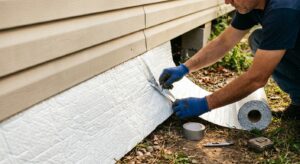
- In crawl spaces, a continuous ground vapor barrier of 6-mil polyethylene is as important as the insulation above it. Without it, ground moisture evaporates upward into floor joist cavities and wets insulation from below regardless of what you do above.
- After any plumbing leak, roof repair, or major storm, do a targeted inspection of the insulation nearest to the event within 48 hours. Early intervention prevents mold and typically means replacing a few batts instead of an entire attic.
- If you have cathedral ceilings or a low-slope roof with insulation against the roof deck, make sure there is a ventilation gap between the insulation and the sheathing. Without this, even normal vapor diffusion can condense at the cold roof deck and slowly destroy the insulation below it over several heating seasons.
Variations for Your Situation
- Apartment/Rental: Renters cannot access or replace insulation themselves, but they can document moisture problems and request action from their landlord in writing. If you notice musty smells, soft ceiling spots, or visible mold, photograph everything with timestamps and submit a formal written maintenance request. In most states, landlords are legally required to maintain habitable conditions, which includes addressing mold. A $15 to $25 indoor humidity monitor is a renter-safe tool that documents chronically high indoor humidity (above 60% RH) as evidence supporting your maintenance request.
- Tight Budget (under $50): Start with a $15 to $25 pin moisture meter and do a systematic inspection of your attic and crawl space. This zero-to-minimal-cost step tells you the actual scope of the problem before you spend anything on materials or labor. If you find only a small affected area of accessible batts, a utility knife, contractor bags, gloves, and an N95 respirator total about $20 to $30. Buying replacement batts in the exact size you need from a home center typically runs $25 to $60 for a small section. Address the moisture source with rope caulk ($5) or flashing tape ($10) if the leak is minor and accessible.
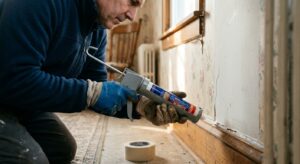
- Older Home (pre-1980): Homes built before 1980 present two important complications. First, attic insulation may include vermiculite, which can be contaminated with asbestos. Do not disturb any granular gray-green loose-fill material without having a $25 to $50 lab sample test done first. Second, older homes typically have more air leakage through gaps in top plates and around penetrations, which accelerates moisture-driven wetting of insulation even without a visible leak. Any insulation replacement project in a pre-1980 home should include air sealing of top plate penetrations with fire-rated caulk or foam before new insulation is installed, or the replacement insulation will face the same moisture exposure cycle as the material you removed.