Ductless mini-splits are genuinely impressive machines. They deliver cooling with efficiency ratings (SEER2) that blow traditional central air systems out of the water, and they give you room-by-room temperature control that ducted systems simply cannot match. Yet most homeowners install one, point the remote at it, and call it done. That leaves real money and comfort on the table.
The gap between a poorly optimized mini-split and a well-tuned one can easily be 20 to 30% on your monthly cooling bill. That difference comes down to a handful of factors: filter cleanliness, airflow direction, temperature setpoints, and how well the space itself supports the unit. None of these require an HVAC technician or special tools. Most take under an hour and cost nothing.
This guide covers everything from quick zero-cost setting tweaks you can do right now, to hands-on DIY maintenance that keeps your system running at peak efficiency all season, to knowing when a professional tune-up is worth the investment. Whether you installed your mini-split last year or five years ago, you will find something actionable here.
What You’ll Need
Click on an item below to shop for the recommended items for this recipe on Amazon.
As an Amazon Associate, we earn from qualifying purchases.
How to Do It
- Set your target temperature to 76 to 78 degrees F rather than blasting at 68 or 70. Mini-splits with inverter compressors run far more efficiently maintaining a moderate setpoint than repeatedly recovering from a large temperature swing.
- Switch the fan to Auto mode rather than a fixed speed. Auto lets the inverter logic control the blower based on actual load, which cuts electricity use compared to running the fan at high speed continuously.
- Adjust the louver angle to horizontal or 15 degrees below horizontal. Cool air will naturally descend as it travels across the room, reaching the far corners without forcing the unit to blast cold air straight downward.
- Enable the Follow Me or i-Feel sensor feature if your remote has it. This uses the remote’s built-in thermistor to sense temperature at your location rather than at the unit on the wall, so the system cools the occupied area instead of the corner by the ceiling.
- Turn on Dry mode for an hour if the room feels humid but not hot. This drops the fan to its lowest speed and runs the compressor intermittently to maximize moisture removal without overcooling, which is especially useful on mild humid days when full Cool mode is overkill.
- Close doors to uncooled adjacent spaces. Mini-splits are sized for a defined area, and an open door to a hallway or garage doubles the effective load instantly.
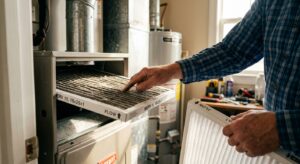
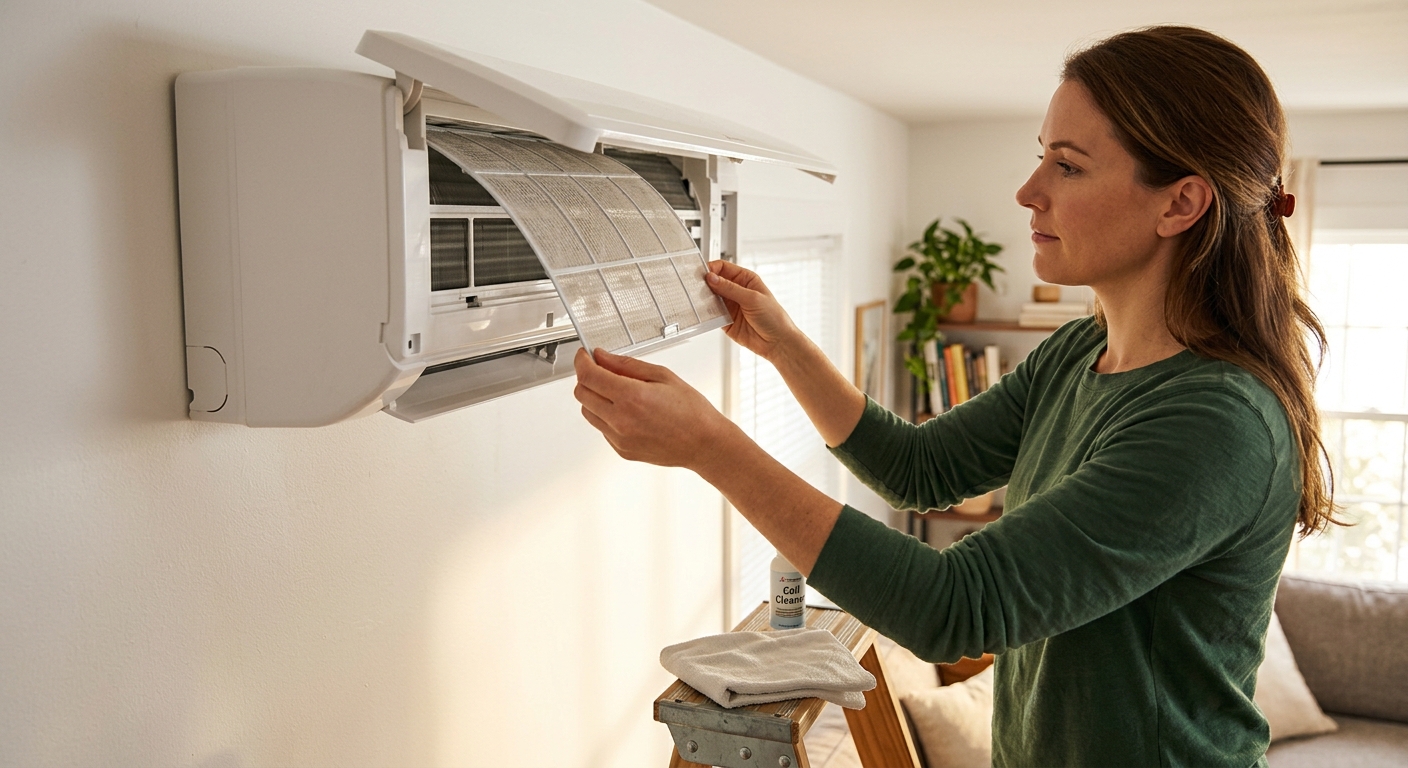
- Power the unit off at the breaker before cleaning. Open the front panel of the indoor head by lifting the cover upward until it clicks open, then slide out both mesh filter panels. Rinse them under warm running water, let them dry fully, and reinstall. Do this every 4 to 6 weeks during heavy use. A clean filter alone can recover 10 to 15% of lost efficiency.
- With the filters removed, use a soft brush or a can of compressed air to gently clean the visible fins of the evaporator coil. Do not bend the fins. If the coil looks gray or has visible buildup, apply a no-rinse evaporator coil cleaner spray ($12 to $18 at hardware stores), let it foam and drip into the drain pan, and wipe the drain pan clean with a damp cloth.
- Check the condensate drain line by pouring a cup of water into the drain pan and watching it exit through the line outside. If drainage is slow, use a wet-dry vacuum to clear the line from the outdoor end or carefully flush it with a 50-50 water and white vinegar mix.
- Go outside and clear the area around the outdoor condenser unit. Remove leaves, mulch, and any debris from the fins. Use a garden hose at low pressure to rinse fin debris from the inside out. Maintain at least 12 inches of clearance on all sides and 24 inches above the unit for adequate airflow.
- Check and tighten the line set insulation on the refrigerant pipes running between indoor and outdoor units. If the foam insulation is cracked, torn, or missing, replace it with pipe insulation foam sleeves from a hardware store ($8 to $15). Degraded insulation causes the refrigerant lines to absorb heat from outside air, reducing the efficiency of every cooling cycle.
- Add window film or exterior shading to any large south or west-facing windows in the cooled room. Solar control window film ($25 to $40 per window) blocks 50 to 70% of solar heat gain and directly reduces the load your mini-split must handle, often dropping runtime by 20 to 25% during afternoon peak hours.
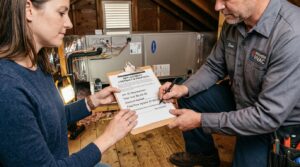
- Book an HVAC technician who has experience specifically with ductless mini-split systems, ideally one certified by the manufacturer of your unit. Ask them explicitly to check refrigerant charge, not just clean the filters.
- Request a refrigerant pressure check. The technician will attach manifold gauges to verify that the system is charged to the manufacturer’s specification. An under-charged system can lose 20 to 30% efficiency and a recharge typically costs $50 to $150 on top of the service call.
- Ask for a coil cleaning of both the indoor evaporator and outdoor condenser using commercial coil cleaner and a low-pressure rinse. Professional cleaning reaches deeper into the coil than DIY methods and can restore 5 to 10% of capacity in older units.
- Have the technician verify that all electrical connections are tight, the capacitors are within spec, and the inverter drive board shows no fault codes. Mini-splits log error histories that a technician can read to identify intermittent issues before they become failures.
- Ask for a load calculation review if the room has changed (added walls, new windows, a home office with lots of equipment). A mini-split that was correctly sized 5 years ago may now be undersized, and no amount of optimization will compensate for a genuine capacity mismatch.
Why It Works: The Benefits
Optimizing filter cleanliness, airflow settings, and thermostat behavior can reduce electricity consumption by 15 to 30%, which translates to $30 to $90 per month in typical households running a mini-split as a primary cooling source during summer.
Correct louver angle and fan speed settings eliminate the hot-and-cold-spot problem that frustrates most mini-split owners, distributing conditioned air across the full room rather than overcooling the area directly below the unit.
A clean, properly configured mini-split runs less frequently at high compressor speeds, reducing wear on the inverter drive and compressor. Regular maintenance can extend system life from the average 12 to 15 years toward 20 years or more.
Mini-splits remove humidity most effectively when the evaporator coil stays clean and airflow is unrestricted. A dirty system can reduce moisture removal by up to 25%, leaving rooms feeling clammy even when the temperature reads correctly.
A clogged filter forces the blower to spin faster to move the same volume of air, increasing noise noticeably. Cleaning the filters typically drops indoor unit noise back to the near-silent 19 to 26 dB operation the system was designed for.
💰 Savings Impact by Action
Cleaning clogged mesh filters restores airflow and heat transfer efficiency, recovering up to 15% of cooling capacity lost to fouling.
Raising the cooling setpoint from 70 to 76 degrees F reduces compressor runtime significantly, cutting electricity use by approximately 12% per degree raised above 70.
Adding window film or exterior shading to south and west windows reduces solar heat gain by up to 70%, cutting afternoon cooling load by 20 to 25%.
Professional or DIY evaporator and condenser coil cleaning removes buildup that insulates the coil surface, restoring up to 10% of rated heat exchange capacity.
Replacing cracked or missing refrigerant line insulation prevents heat absorption from outdoor air, preserving 3 to 5% of system efficiency on every cooling cycle.
🏠 Key Concepts Explained
The Science Behind It
Mini-splits operate on the same vapor-compression refrigeration cycle as all air conditioners, but the inverter-driven compressor changes the efficiency equation dramatically. A conventional AC compressor runs at one fixed speed, which means it can only be on or off. The system cycles between those two states to maintain temperature, and each startup draws a surge of current. An inverter compressor runs at any speed between roughly 15% and 100% of capacity, finding the precise output needed to hold the room at setpoint without cycling. This modulation is where the efficiency advantage lives, and it only works properly when the system is clean and the load is predictable.
Heat transfer across the evaporator coil follows Fourier’s law: the rate of heat exchange depends on the temperature difference between the refrigerant and the air, the surface area available, and how easily heat can conduct through any material between them. A layer of dust or biofilm on the coil fins acts as insulation, increasing thermal resistance and reducing the effective surface area. Even a 0.1-millimeter film of particulate matter can cut heat transfer efficiency by 10 to 15%, which forces the compressor to run faster and longer to compensate. Keeping that coil clean is not cosmetic maintenance, it is the most direct way to preserve rated efficiency.
The airflow direction setting matters because of natural convection. Cool air at 55 to 60 degrees F leaving the indoor unit is roughly 3% denser than the 78-degree room air it displaces. That density difference causes the cool air to fall as it travels, so a louver aimed horizontally will naturally reach floor level by the time it crosses a 12 to 15 foot room. Aiming the louver downward at a steep angle drops the cool air too quickly, chilling the floor beneath the unit while the rest of the room stratifies with warm air near the ceiling. Horizontal airflow works with physics rather than against it, which is why manufacturers include that as the default recommendation for cooling mode.
Frequently Asked Questions
▼ My mini-split runs constantly but the room never gets as cool as I set it. What is wrong?
The three most common causes are a dirty evaporator coil reducing heat transfer capacity, a refrigerant charge that has drifted low (losing 20 to 30% of capacity), or a thermal load in the room that exceeds what the unit was sized for. Start by cleaning the filters and coil yourself, then observe performance over 48 hours. If the unit still cannot hit setpoint on a moderate day (under 90 degrees F outdoor temperature), call a technician to check the refrigerant charge and run an efficiency test.
▼ Why is water dripping from my indoor mini-split unit?
Dripping inside the room almost always means the condensate drain is clogged. The drain pan fills with water from normal dehumidification and overflows when the line is blocked by algae, dirt, or a kink in the tubing. Turn the unit off, clear the drain line with a wet-dry vacuum from the outdoor end, and flush with a diluted white vinegar solution. If the dripping continues after clearing the drain, the indoor unit may be installed at an incorrect angle (it needs to slope slightly toward the drain), which requires a technician to fix.
▼ My mini-split makes a rattling or vibrating noise it did not make when it was new. Is this serious?
A new rattle is often a loose panel screw, a filter that was not fully seated after cleaning, or a small piece of debris caught in the blower wheel. Open the cover, reseat the filters firmly, and listen again. If the noise persists, it may be the outdoor unit vibrating against its mounting bracket as fasteners loosen over time, which is an easy fix with a wrench. A grinding or screeching noise from the outdoor unit is more serious and indicates a bearing issue in the fan motor that needs professional attention before the motor fails.
▼ Can I use my mini-split in a room larger than it is rated for?
You can run it in a larger space, but the unit will run continuously at full compressor speed trying to meet demand it cannot satisfy, driving up electricity bills and wearing out the compressor faster than normal. A 9,000 BTU unit is typically rated for 350 to 400 square feet under standard conditions. In a 600-square-foot space, you would be better served by adding a second smaller unit or choosing a multi-zone system than by expecting a single undersized head to cool the whole area efficiently.
▼ How do I know if my mini-split needs a refrigerant recharge?
Signs include ice forming on the indoor unit or the refrigerant lines, the system blowing air that feels less cold than it used to, and the unit running at high capacity without reaching setpoint on mild days. You cannot check refrigerant charge yourself since it requires manifold gauges and EPA certification. If you suspect a low charge, have a technician verify it rather than guessing, because overcharging is as damaging as undercharging and the refrigerant itself is not cheap.
Quick Tips
- Clean the indoor filters every 4 to 6 weeks during peak cooling season, not just at the start of the season. Most manufacturers design the filter indicator light to come on after 250 hours of operation, which in summer can be every 6 to 8 weeks.
- Use a ceiling fan on low speed in the same room to help distribute the cooled air. The fan does not cool the air itself, but it reduces stratification and can let you raise the mini-split setpoint by 2 to 4 degrees without any change in perceived comfort.
- Keep the outdoor condenser in the shade if possible. A condenser in direct afternoon sun can raise the refrigerant condensing temperature by 5 to 10 degrees F, which reduces efficiency by 5 to 10% during the hottest hours of the day when you need cooling most.
- Do not block the indoor unit with curtains, furniture, or shelving within 18 inches. Even partial obstruction disrupts the airflow pattern and forces the blower to work harder to move the same volume of air through the room.
Variations for Your Situation
- Apartment or Rental with Portable or Window Unit: If your lease does not allow a wall-mounted mini-split, focus on the same core principles applied to your portable or window AC. Keep the filter clean every 2 weeks, use the unit’s Dry mode on humid days, and block solar gain with reflective window inserts ($15 to $30) on south and west windows. The efficiency gains from good habits and solar control apply to any cooling system.
- Tight Budget (Under $30): Skip the coil cleaner and window film for now and focus on the free wins first. Adjust louver angle to horizontal, switch fan to Auto mode, raise setpoint from 70 to 76 degrees F, and clean the mesh filters with tap water. These zero-cost steps alone can recover 10 to 20% of lost efficiency and cost nothing but 30 minutes of your time.
- Older Mini-Split (Over 8 Years Old): Units in this age range often have degraded drain pan coatings, worn blower wheels, and compressor efficiency that has dropped from the rated SEER2 value. Prioritize a professional coil cleaning and refrigerant verification at least once every 2 years. Also consider whether the unit is still the right size for the space, as changes in insulation, window replacements, or room use patterns may mean the sizing assumptions from the original install no longer apply.