If your glasses come out of the dishwasher looking like they were washed in a puddle, you are not alone. Spotty, cloudy, and filmy dishes are one of the most common dishwasher complaints homeowners have, and most people assume the appliance is failing or the detergent is cheap. In reality, the culprit is almost always hard water, and the fix takes about two minutes once you know where to look.
Hard water contains dissolved calcium and magnesium minerals. When hot water evaporates inside your dishwasher, those minerals get left behind on every surface, including your dishes, glasses, and the interior of the machine itself. Over time, this buildup also reduces your dishwasher’s efficiency, forces longer cycles, and can clog spray arms, costing you more on your utility bill than you might expect.
This post walks you through exactly why spots happen, the one rinse aid setting most people never touch, and a few simple upgrades that can restore your dishes to streak-free clarity without calling a repair technician or buying a new machine.
What You’ll Need
Click on an item below to shop for the recommended items for this recipe on Amazon.
As an Amazon Associate, we earn from qualifying purchases.
How to Do It
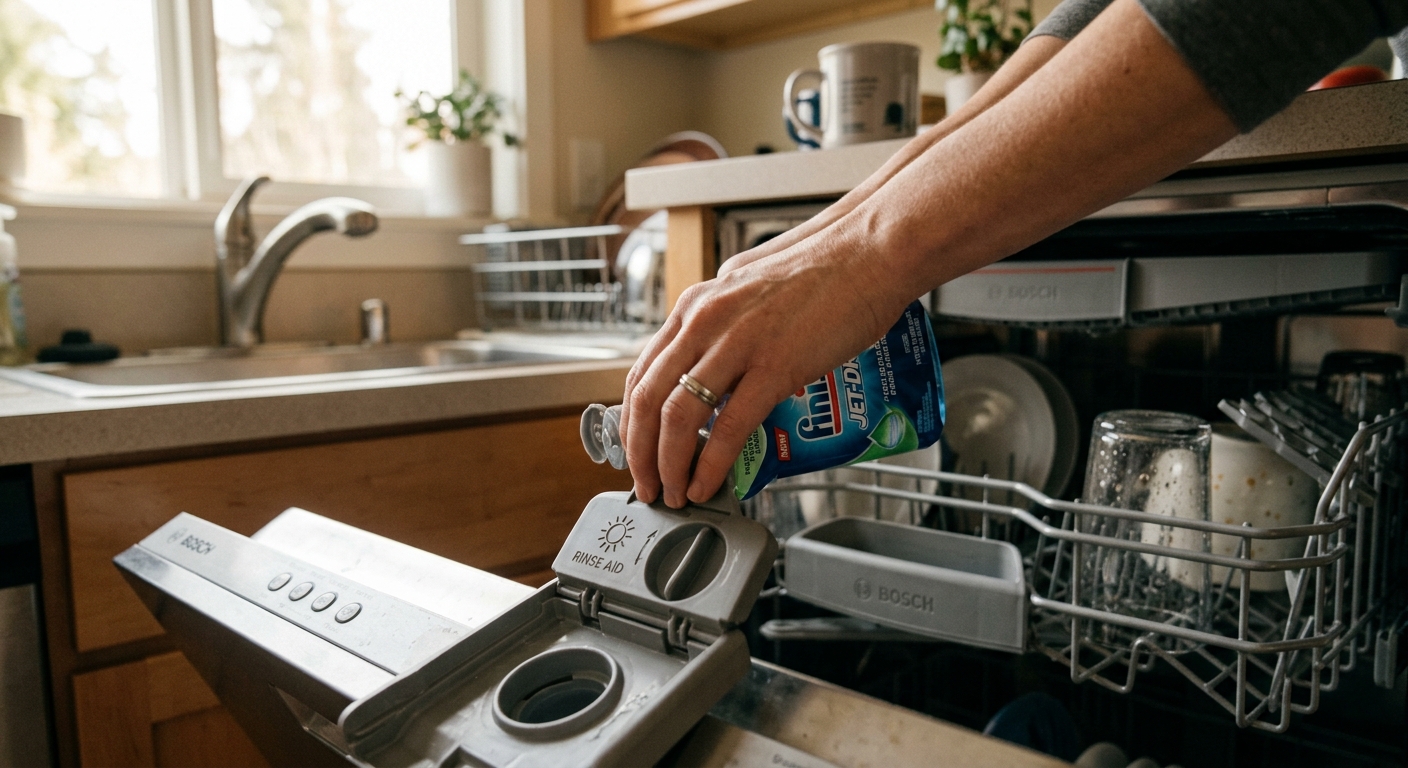
- Open your dishwasher door and locate the rinse aid dispenser on the inside of the door, usually a small circular cap near the detergent compartment. Twist or pop it open.
- Look for a dial or slider inside the cap with settings numbered 1 through 5 or 1 through 6. Most dishwashers ship with this set to 2 or 3, which is too low for typical U.S. water hardness.
- If you have moderately hard water (7 to 14 grains per gallon), set the dial to 4. If you have very hard water (over 14 grains per gallon, common in the Southwest, Midwest, and Great Plains), set it to 5 or 6.
- If you do not know your water hardness, pick up a free water hardness test strip at any hardware store or request a free report from your municipal water utility online.
- Fill the rinse aid reservoir if it is low or empty. Standard rinse aid (any brand) costs about $4 to $8 and lasts 1 to 3 months depending on usage.
- Run a normal wash cycle and check your glasses when done. Adjust up one more notch if spotting persists, or down one notch if you see a blue or streaky residue on glasses.
- Remove the bottom rack and pull out the dishwasher filter (usually a twist-out cylinder in the floor of the tub). Rinse it under hot running water and scrub away debris with an old toothbrush. A clogged filter is a top cause of poor rinsing.
- Remove the spray arms (usually unscrew counterclockwise or pull straight up) and use a toothpick or thin wire to clear any blocked holes. Mineral-clogged spray arms reduce water pressure and coverage dramatically.
- Place a dishwasher-safe bowl filled with 2 cups of white distilled vinegar on the bottom rack. Run a hot water cycle with no detergent. The acetic acid dissolves mineral deposits from the tub walls, heating element, and spray arms.
- After that cycle finishes, sprinkle 1 cup of baking soda across the floor of the empty tub and run a short hot cycle. This neutralizes odors and lifts any remaining residue loosened by the vinegar step.
- Alternatively, use a commercial dishwasher cleaner tablet (Affresh or similar, about $5 to $8 per tablet). These are more effective on heavy scale than vinegar and are safe for all dishwasher components.
- Adjust your rinse aid dispenser setting as described in the Quick Fix approach, refill the reservoir, and run a test load with your normal detergent. Check spray arm holes again after this cycle to confirm water pressure is restored.
- Test your water hardness precisely using a mail-in kit (about $15 to $30) from a lab or your local water utility. This tells you whether a softener is genuinely cost-justified versus whether better rinse aid management will suffice.
- For a budget-friendly option, add a dishwasher-specific water softener salt or LemiShine Booster (citric acid based, about $8 to $12) directly to the detergent compartment with each load. This binds hard water minerals in the wash water before they can deposit on dishes.
- For a mid-range upgrade, install an under-sink inline water filter or scale inhibitor on the hot water line feeding the dishwasher (about $50 to $150 plus 1 to 2 hours of DIY plumbing with basic tools). These use template-assisted crystallization to neutralize minerals without salt.
- For a whole-home solution, hire a licensed plumber to install a salt-based ion exchange water softener on your main water line. Costs range from $800 to $2,500 installed. At hard water levels above 20 grains per gallon, this investment typically pays back in reduced appliance repairs and detergent costs within 4 to 6 years.
- If you choose a whole-home softener, set your dishwasher rinse aid dispenser back down to level 2 or 3 since softened water needs far less rinse aid to sheet properly.
Why It Works: The Benefits
Adjusting rinse aid dispenser output to the correct hardness level for your water typically eliminates visible spots and cloudiness within the very next wash, with no cost beyond the rinse aid you likely already own.
A clean, scale-free dishwasher with properly functioning spray arms uses 5 to 15% less energy per cycle by running shorter, more effective wash cycles rather than re-washing loads or running heated dry on high unnecessarily.
Mineral scale buildup is a leading cause of dishwasher pump and heating element failure. Descaling and maintaining rinse aid levels can add years to appliance life, deferring a $600 to $1,200 replacement cost.
Monthly citric acid or dishwasher cleaner treatments dissolve mineral deposits from the tub, filter, and spray arms, eliminating the musty or sour smell that develops when scale traps food residue.
Hard water minerals bind with surfactants in detergent and neutralize them before they can clean. Rinse aid and softening additives free up detergent to do its actual job, meaning you can often use up to 20% less detergent and still get better results.
💰 Savings Impact by Action
Correct rinse aid dispenser settings reduce re-wash cycles and allow shorter dry cycles, cutting per-load energy use by up to 10%.
Disabling heated dry and air drying instead reduces dishwasher electricity consumption by 15 to 50% per cycle depending on model.
Cleared spray arm holes restore full water pressure and coverage, reducing the need for extended or repeated wash cycles by up to 8%.
Removing mineral scale from the heating element restores its thermal efficiency, cutting the energy needed to heat wash water by up to 12%.
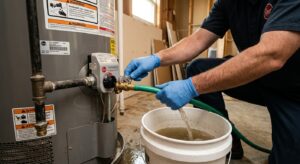
Pre-flushing the supply line so the dishwasher fills with hot water immediately eliminates one cold-water heating cycle per load, saving 5% per run.
🏠 Key Concepts Explained
The Science Behind It
Spotting is fundamentally a mineral precipitation problem. Hard water carries dissolved calcium bicarbonate and magnesium sulfate in stable ionic form while it is cool and pressurized. The moment that water heats up inside your dishwasher and then evaporates during the drying cycle, those minerals lose their solubility and precipitate out as solid calcium carbonate and magnesium hydroxide, which are the white chalky compounds you see on glass. This is the same chemistry that forms limescale inside kettles and pipes.
Rinse aid works by adsorbing onto dish surfaces and lowering the contact angle of water droplets. Instead of beading up (high surface tension), treated water spreads into a thin, even film that rolls off the dish surface during the final drain, carrying dissolved minerals with it rather than leaving them behind as evaporation residue. The dispenser output setting controls how much rinse aid is released per cycle. Most factory settings are calibrated for soft water markets in Europe, where many of these appliances originate, and they are simply too low for the harder water found in most of North America.
Citric acid and acetic acid (vinegar) descalers work by shifting the pH of the water below 4.5, which converts insoluble calcium carbonate back into soluble calcium acetate or citrate that can be rinsed away. This is why a single descale cycle can dramatically improve spray arm performance: the mineral plugs dissolve and restore the original spray hole diameter. Maintaining this over time is far cheaper than replacing clogged spray arms or a scaled-up heating element, which can reduce heating efficiency by up to 30% when heavily coated.
Frequently Asked Questions
▼ I filled the rinse aid and turned up the setting but my glasses are still coming out cloudy. What am I missing?
Persistent cloudiness on glassware is often etching, not spotting. Etching is permanent micro-abrasion of the glass surface caused by too-soft water combined with high heat and excess detergent, and it cannot be removed. Test by putting a few drops of white vinegar on a cloudy spot: if the cloudiness dissolves, it is mineral scale you can fix. If it does not change, the glass is etched and unfortunately that damage is irreversible. To prevent further etching, reduce water temperature slightly and cut your detergent dose by 20 to 25%.
▼ My dishwasher smells bad even after I clean it. What is causing that?
Odor that persists after a descale cycle usually comes from a food-clogged filter or a standing water issue in the drain. Remove and scrub the filter thoroughly with dish soap and a brush, and check that the drain hose has a proper high loop or air gap so dirty water cannot siphon back into the tub. If the smell is sulfurous or sewage-like, the drain may be connected too close to the garbage disposal knockout or the P-trap under the sink may be dry, which are plumbing issues worth a call to a plumber.
▼ Can I use white vinegar every wash instead of buying rinse aid?
Vinegar works in a pinch but is not a reliable long-term replacement for rinse aid. Its acidity can gradually degrade the rubber door gasket and internal seals with frequent exposure, and it evaporates before the drying phase where rinse aid does most of its work. Use it for monthly descaling cycles, but stick with commercial rinse aid for daily use. A $6 bottle of rinse aid typically lasts 30 to 90 days and costs less than $0.10 per load.
▼ My dishwasher has a built-in water softener compartment. Do I still need rinse aid?
Yes. The built-in salt softener (common on European brands like Bosch and Miele) softens the wash water to prevent scale, but rinse aid still serves its distinct role of reducing surface tension during the final rinse and drying phases. You need both. Refill the salt compartment with dishwasher-specific regeneration salt (not table salt) and keep the rinse aid reservoir topped up separately.
▼ How do I know if my water is hard enough to actually matter for my dishwasher?
Pick up a water hardness test strip at any hardware store for about $5 to $10, or look up your municipal water quality report online at your city utility’s website, which lists hardness in grains per gallon or parts per million. Anything above 7 grains per gallon (120 ppm) is considered hard and will cause visible spotting without adequate rinse aid. Above 14 grains per gallon, you will likely also benefit from a descaling additive or water softener.
Quick Tips
- Always keep the rinse aid reservoir filled. The indicator light on most machines only triggers when the reservoir is nearly empty, by which point you may have already run several spotty cycles.
- Use a dishwasher-specific detergent with built-in rinse aid and hard water enzymes (look for citric acid or EDTA in the ingredients) if you want to simplify the process to a single product.
- Load glasses and cups at an angle so water does not pool inside them. Standing water increases contact time between minerals and glass surfaces, worsening spots.
- Skip the heated dry setting and open the door slightly at the end of the wash cycle instead. Air drying eliminates the high-heat evaporation phase where most spotting actually occurs, and it reduces dishwasher energy use by 15 to 50% per cycle.
Variations for Your Situation
- Apartment/Rental: Renters cannot modify plumbing or install whole-home softeners, but they can adjust the rinse aid dispenser setting freely and add LemiShine Booster or a citric acid additive to each detergent compartment for under $10 at any grocery store. These two steps alone resolve spotting for most apartment dwellers without touching any appliance settings the landlord would notice or object to.
- Tight Budget (under $50): Start with the free steps: adjust the rinse aid dispenser dial, run a vinegar descale cycle, and clean the filter with a toothbrush. If you need to buy anything, a $4 bottle of rinse aid and a $5 pack of water hardness test strips are the only purchases required. Together these two items address 90% of spotting problems for most households and cost less than a single box of specialty detergent.
- Older Home (pre-1990): Older homes may have galvanized pipes that leach iron and sediment into the water supply, which causes orange or brown staining that looks like hard water scale but requires iron-specific treatment. Test specifically for iron hardness with a water test kit that includes an iron panel. Also check that your water heater is still maintaining 120 degrees Fahrenheit, as older units often drift lower and cause dishwashers to underperform significantly on cleaning and rinsing.