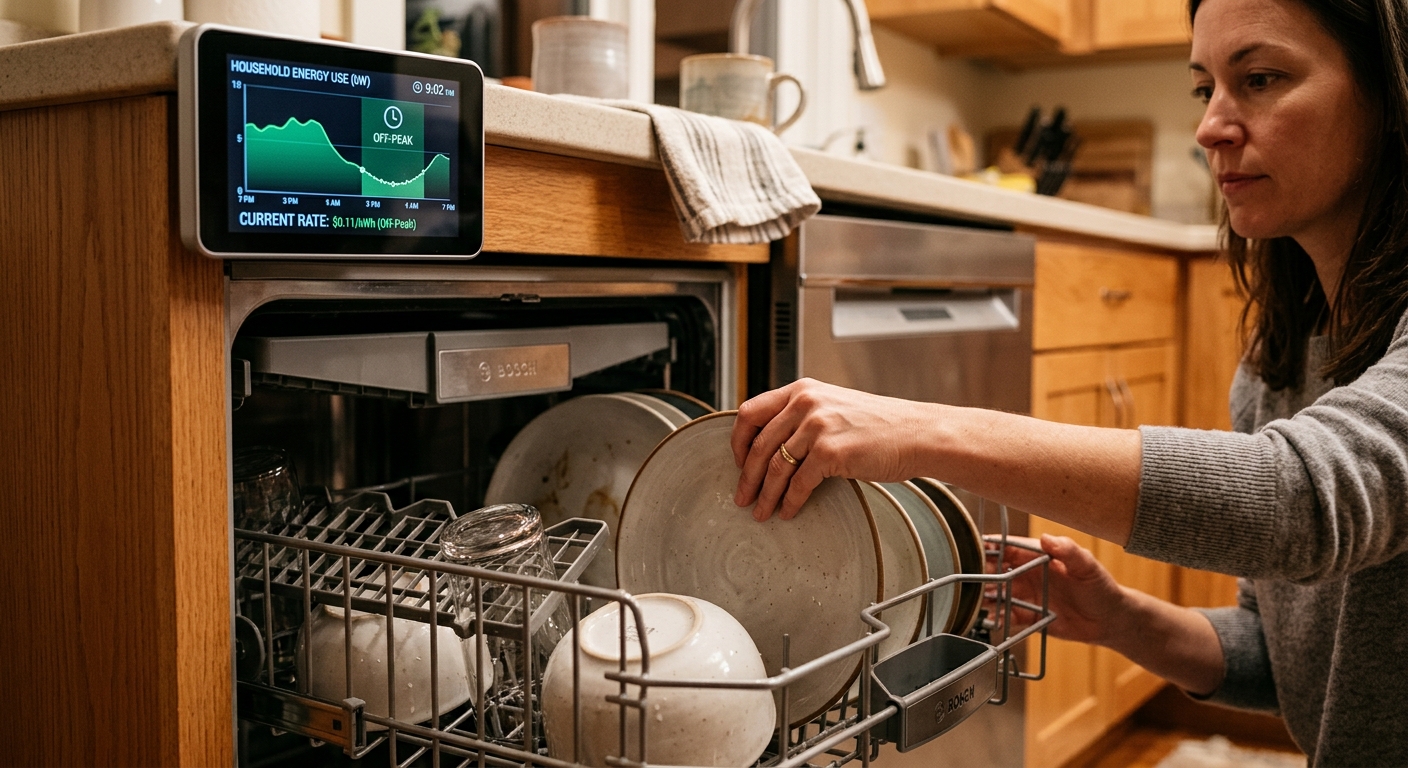
Most homeowners focus on big-ticket energy upgrades like insulation or new HVAC systems, but one of the easiest wins is completely free: simply changing when you run your dishwasher, washing machine, and dryer. Utilities in most parts of the country charge more for electricity during peak demand hours, typically weekday afternoons and early evenings when everyone is home cooking, cooling, and doing laundry at the same time. Running your heaviest appliances during those windows costs you more than it should.
Time-of-Use (TOU) electricity pricing is now available to customers at hundreds of utilities across the United States, and even if you are not on a TOU rate yet, many utilities are moving in that direction. On a TOU plan, off-peak rates can be 30 to 50% lower per kilowatt-hour than peak rates. That gap translates directly into real monthly savings on the appliances that run the longest and pull the most watts. A standard electric dryer draws 4,000 to 5,000 watts per cycle. Run it during peak hours every day and you are paying a premium for every load.
This post breaks down exactly which hours are cheapest, how to shift your laundry and dishwasher routines to take advantage, and how to use built-in delay-start features most homeowners never touch. Whether you spend zero dollars or a little on a smart plug or smart appliance, there is a strategy here that fits your situation.
What You’ll Need
Click on an item below to shop for the recommended items for this recipe on Amazon.
As an Amazon Associate, we earn from qualifying purchases.
How to Do It
- Call your utility or log into your account online to find out if you are on a Time-of-Use rate and identify your off-peak hours. Common off-peak windows are 9 PM to 7 AM on weekdays and all day on weekends.
- Load your dishwasher after dinner as usual, but instead of pressing Start, press the Delay Start button and set it to run at 9 PM or later. Consult your manual for the exact button sequence.
- Set your washing machine the same way. Load it in the evening, add detergent, and use the delay feature to start the wash cycle at 9 PM or after. This works best if you can transfer clothes to the dryer before you go to bed or first thing in the morning.
- Run the dryer either late at night (after 9 PM) or first thing in the morning before peak hours begin. If your dryer does not have a delay-start feature, simply make it part of your morning routine to start it before 8 AM.
- Switch your washing machine to cold water for all loads that do not require hot water. Cold-water detergents work well for most everyday laundry and eliminate the water-heater energy cost entirely, saving an additional 75 to 90% of the washing machine energy that normally goes to heating water.
- Log into your utility’s website or app and look for a Time-of-Use rate option or a demand-response program enrollment. Many utilities offer a bill credit of $25 to $100 per year just for enrolling in load-shift programs.
- Purchase a smart plug rated for at least 15 amps (1,800 watts) for your dishwasher or washing machine. Brands like Kasa, Wyze, and Amazon Smart Plug are all compatible with Alexa and Google Home and cost $15 to $25 each.
- Plug the smart plug into the outlet, then plug the appliance into the smart plug. Open the manufacturer’s app or your smart home app and set a schedule so the appliance can only activate during off-peak hours.
- In your smart home app, create an automation that sends you a reminder at 9 PM if any of the target appliances are plugged in and have not yet run that day. This removes the need to remember manually.
- Monitor your electricity usage through your utility’s app for two billing cycles. Compare the cost of appliance-heavy days against the previous month to confirm the savings are registering. Adjust the schedule if your utility’s peak window differs from your initial setup.
- Request a Time-of-Use rate switch from your utility. In most states this is free and can be done online. Ask for your last 12 months of usage data to understand your current peak consumption baseline.
- Map out your household’s load schedule on paper or in a notes app: how many dishwasher loads per week, washer loads per week, and dryer loads per week, and what time they currently run.
- Program delay-start settings on every applicable appliance. Set the dishwasher to run at 10 PM nightly, the washer to run at 10 PM, and plan to transfer laundry to the dryer at bedtime or start the dryer at 6 AM.
- Install smart plugs on the dishwasher and washing machine as a backup enforcement layer so that even if someone in the household presses Start manually during peak hours, the plug’s schedule prevents the circuit from energizing until the off-peak window.
- After your first full billing cycle on the TOU rate, compare your bill against the same month in the prior year. Most households see a 15 to 30% reduction in the energy cost attributed to these three appliances. If savings are lower than expected, check whether your water heater is also running during peak hours and add a timer to it for an additional 5 to 10% reduction.
Why It Works: The Benefits
Households on TOU rates that shift all laundry and dishwasher use to off-peak hours typically save $10 to $40 per month depending on utility rates, household size, and number of loads. That adds up to $120 to $480 per year with no equipment purchase required.
Running the dryer during off-peak morning or nighttime hours instead of peak afternoon hours prevents adding 4,000 to 5,000 watts of heat into your home when your AC is already working hardest, reducing cooling energy use by a small but measurable amount each cycle.
Dryers and dishwashers that run during cooler nighttime hours operate in a slightly lower-temperature environment, which reduces thermal stress on motors, heating elements, and seals over the long term.
Shifting high-wattage loads off-peak reduces strain on local grid infrastructure. Some utilities offer rebates or bill credits to customers who participate in demand-response programs, adding a direct financial reward on top of rate savings.
Unlike insulation or appliance upgrades, time-shifting costs nothing. The savings begin the first billing cycle after you change your habits or program the delay-start function, making payback truly immediate.
💰 Savings Impact by Action
Shifting all laundry and dishwasher loads to off-peak TOU hours reduces the per-kWh cost by 30 to 50%, directly cutting the dollar cost of every cycle.
Switching from hot to cold water washing eliminates up to 90% of the washing machine’s energy use per cycle, since nearly all of that energy goes to heating water.
Turning off the heated-dry function on your dishwasher saves roughly 15% of the appliance’s total energy use per cycle by skipping the electric heating element.
Running only full loads instead of half loads reduces the total number of cycles by up to 50%, cutting total appliance energy use by up to 20% per week for a typical household.
Enrolling in a utility demand-response program can add 5 to 10% in bill credits on top of rate savings by receiving direct incentives for shifting load off-peak.
🏠 Key Concepts Explained
The Science Behind It
Electricity grids are not static. Demand fluctuates hour by hour, and utilities must always have enough generating capacity online to meet the highest point of demand at any moment. During peak hours, typically weekday afternoons between 4 and 9 PM, demand spikes sharply as industrial facilities run at full capacity and millions of households simultaneously run HVAC systems, cook dinner, and use high-draw appliances. To meet this surge, utilities activate peaker plants, which are gas turbines and oil-fired generators that are expensive to run and emit more carbon per kWh than baseload plants. The elevated cost of generating peak power is passed directly to customers on Time-of-Use rate plans in the form of a higher per-kWh price during those hours.
Off-peak electricity, by contrast, is generated primarily by baseload plants like nuclear, hydro, and combined-cycle natural gas, which operate at high efficiency around the clock. These plants produce cheaper electricity per kWh because their fuel and maintenance costs are spread over continuous operation rather than short bursts. When you shift your dishwasher or washer to run at midnight, you are drawing from this cheaper, more efficient generation mix. The physics of your appliance do not change, but the cost per unit of energy drops by 30 to 50% depending on your utility’s rate structure.
There is also a secondary thermal benefit to consider. A standard electric dryer converts nearly all of its 4,000 to 5,500 watts into heat, and in an attached laundry room, a meaningful fraction of that heat migrates into the living space. In summer, your air conditioner must remove that heat, consuming additional energy on top of what the dryer already used. Running the dryer at night, when outdoor temperatures are lower and the AC is cycling off, reduces this compounding thermal load. Building scientists refer to this as internal heat gain, and it is one of the reasons that clustering high-heat appliance use in cooler parts of the day contributes to measurable reductions in whole-home cooling energy use.
Frequently Asked Questions
▼ I am not on a Time-of-Use rate. Is it still worth shifting when I run appliances?
Yes, for two reasons. First, many utilities are transitioning all residential customers to TOU rates within the next few years, so building the habit now means you are ready when the switch happens. Second, running the dryer during cooler hours still reduces your home’s cooling load in summer, saving a small amount on AC costs even on a flat rate. Check your utility’s website for any available TOU or demand-response options, since many utilities offer these programs without proactively telling customers.
▼ My dishwasher does not have a delay-start button. What can I do?
Use a mechanical or smart outlet timer rated for at least 15 amps. Plug the dishwasher into the timer, set the active window to start at 9 or 10 PM, load the dishwasher and press Start before you go to bed. The timer will cut power to the dishwasher until the scheduled window, at which point it will receive power and begin the cycle automatically. Smart plugs with scheduling apps like Kasa or Wyze cost $15 to $20 and give you more flexibility than a mechanical timer.
▼ Will leaving wet laundry in the washer overnight cause mold or mildew?
Clothes left in a closed washer drum for more than 8 to 12 hours in warm conditions can begin to develop a musty smell, especially in front-loading washers with rubber gaskets that trap moisture. To avoid this, time the wash cycle to finish close to when you wake up, or run the washer late at night and transfer clothes to the dryer immediately before bed. If your dryer has a delay-start feature, you can queue up both machines sequentially.
▼ How do I find my utility’s peak and off-peak hours?
Log into your utility account online and look for sections labeled ‘Rate Plans,’ ‘Time-of-Use,’ or ‘Rate Schedule.’ Your current rate plan will be listed, and TOU rate options will show the specific peak hour windows if available. You can also call your utility’s customer service line and ask what TOU options exist for residential customers in your zip code. The peak window varies by utility but most commonly runs from 4 PM to 9 PM on weekdays.
▼ Can I switch back to a flat rate if the TOU rate ends up costing me more?
In most states, yes. Utilities are generally required to allow customers to switch rate plans, though some impose a waiting period of 60 to 90 days before you can switch again. Before enrolling, ask your utility if they offer a bill protection period, which some utilities provide for the first 6 to 12 months to ensure you do not pay more than you would have on your old rate. This makes enrolling essentially risk-free if your utility offers it.
Quick Tips
- Set a recurring reminder on your phone for 9 PM labeled ‘Start dishwasher and washer’ so the habit forms automatically without relying on memory.
- Wash full loads only. A half-empty dishwasher or washing machine uses nearly the same energy as a full one, so consolidating loads reduces total cycles and total energy use regardless of timing.
- Use the air-dry or heated-dry-off setting on your dishwasher. Skipping the electric heating element during the drying phase saves roughly 15% of the dishwasher’s total energy use per cycle.
- If your utility has a mobile app with real-time pricing, glance at it before starting any major appliance. Some utilities show live grid conditions and flag when rates are especially low, which can reveal savings windows beyond the standard schedule.
Variations for Your Situation
- Apartment/Rental: Renters with in-unit washers and dryers can use all of the delay-start and smart plug strategies described here without any landlord permission. If you use a shared laundry room, target off-peak hours when machines are less likely to be occupied, typically early morning between 6 and 8 AM or after 9 PM. You cannot enroll in a TOU rate if utilities are included in rent, but you can reduce your overall energy use by washing in cold water and using the moisture-sensor cycle on shared dryers to avoid over-drying.
- Tight Budget (under $20): Start with zero-cost changes only. Program the delay-start feature on every appliance that has one, switch all laundry to cold water, and manually start the dryer first thing in the morning. Call your utility and ask about free enrollment in any demand-response or load-shift program that offers bill credits. These steps alone can deliver 10 to 20% savings on appliance energy with no equipment purchase.
- Older Home (pre-1990): Homes with older appliances may not have delay-start features, and older wiring may not be compatible with smart plugs if outlets are two-prong ungrounded. In this case, use mechanical 24-hour outlet timers (available for $8 to $12 at hardware stores) on grounded outlets for the dishwasher and washing machine. Prioritize replacing appliances that are more than 15 years old when your budget allows, since a new ENERGY STAR dryer uses 20% less energy than a 2005 model regardless of what time you run it.