Most homeowners never think about their electrical panel until a breaker trips or the lights flicker when the microwave runs alongside the dishwasher. But your panel’s capacity is one of the most consequential specs in your home. If it was installed decades ago for a smaller house with fewer appliances, it may be quietly struggling to keep up with your modern electrical demands, and that struggle can mean tripped breakers, overheating wires, and real fire risk.
The average American home built before 1990 came with a 100-amp service panel. Today, with electric vehicle chargers, heat pumps, induction ranges, and smart home systems, many households need 150 to 200 amps, and some high-performance homes require 400-amp service. Knowing whether your current capacity is adequate is not just an energy efficiency question, it is a safety and future-planning question with direct financial stakes.
This guide walks you through how to assess your home’s electrical load capacity step by step. You will learn how to read your panel label, calculate your actual load demand using the National Electrical Code method, recognize warning signs of an overloaded system, and understand when a professional evaluation or full panel upgrade is the right call.
What You’ll Need
Click on an item below to shop for the recommended items for this recipe on Amazon.
As an Amazon Associate, we earn from qualifying purchases.
How to Do It
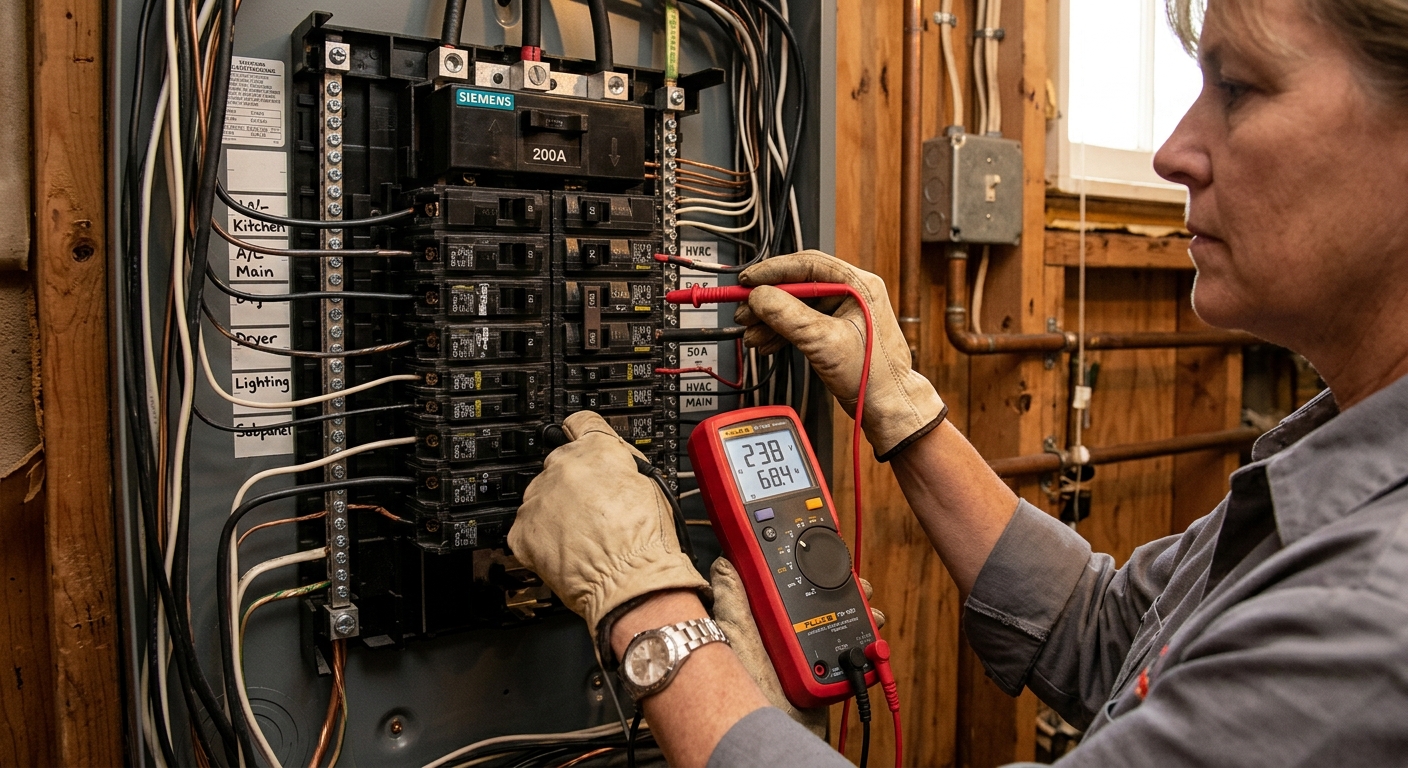
- Locate your main electrical panel, usually in a utility room, garage, or basement. Open the door and find the main breaker at the top. Read the amperage stamped on it: 100, 150, or 200 amps is the most common. This is your total service capacity.
- Look for the panel label or sticker inside the door. It lists the brand, model, and maximum capacity. If the brand is Federal Pacific (Stab-Lok), Zinsco, or Pushmatic, note this immediately, as these brands have documented safety issues and warrant a professional inspection regardless of amperage.
- Count your circuit breakers and add up their ratings. A rough rule of thumb: if the sum of all individual breakers exceeds your main breaker rating by more than 2 to 2.5 times, your panel is likely oversubscribed for simultaneous use.
- List your major appliances and their amperage draw. Use the nameplate on each appliance or look up the wattage and divide by 120 (or 240 for 240V appliances). Key loads to capture: electric range (40 to 50A), dryer (30A), water heater (20 to 30A), AC or heat pump (20 to 50A), EV charger (32 to 48A), refrigerator (6 to 8A), dishwasher (10 to 15A), washer (10 to 15A).
- Add up your major appliance loads. If the total exceeds 80% of your main breaker rating (e.g., more than 80 amps on a 100-amp service), you are operating near the safe limit and should schedule a professional load calculation.
- Check for warning signs while the panel is open: scorch marks, a burning smell, double-tapped breakers (two wires on one breaker terminal), or breakers that feel warm to the touch. Any of these require a licensed electrician before proceeding further.
- Gather your home’s square footage and a list of all 240V appliances with their wattage ratings from nameplates or owner’s manuals. You will need these numbers for the calculation.
- Calculate your general lighting and receptacle load: multiply your home’s square footage by 3 watts per square foot. Example: 1,800 sq ft x 3W = 5,400 watts.
- Add small appliance and laundry circuit loads: NEC requires adding 1,500 watts for each small appliance circuit (typically 2 circuits = 3,000W) and 1,500 watts for the laundry circuit. Running total example: 5,400 + 3,000 + 1,500 = 9,900 watts.
- Apply the NEC demand factor to the general load: the first 3,000 watts count at 100%, the remainder at 35%. Example: 3,000 + (6,900 x 0.35) = 3,000 + 2,415 = 5,415 watts after demand factor.
- Add all fixed appliance loads at their full nameplate wattage: electric range (use 8,000W for ranges up to 12kW per NEC Table 220.55), dryer (5,000W), water heater (4,500W), dishwasher (1,200W), and any other fixed appliances.
- Add your largest HVAC load (heating or cooling, whichever is larger, not both) at 100% of its nameplate amperage converted to watts.
- Sum all loads and divide by 240 volts to get your total demand in amps. If this number exceeds 80% of your main breaker rating, your panel is undersized for your current load profile. Example: 28,000W divided by 240V = 117 amps, which exceeds a 100-amp panel’s 80-amp safe operating threshold and warrants an upgrade consultation.
- Get at least three quotes from licensed electricians. Ask each to perform a full NEC Article 220 load calculation and provide a written report. This calculation should be included in the quote at no extra charge.
- Ask the electrician to assess your service entrance cable from the utility meter to the panel. Upgrading the panel but not the service entrance is a common mistake that limits the real benefit of the upgrade.
- Confirm the electrician will pull a permit and schedule a utility coordination appointment if a service upgrade is needed. Work done without a permit cannot be disclosed or may need to be redone at resale.
- If upgrading, request a 200-amp panel as the minimum. If you plan to add an EV charger, heat pump, or solar inverter within five years, ask about 400-amp service or a load management device like a Span or Leviton smart panel to avoid a second upgrade.
- After installation, verify the electrician labels every circuit in the new panel clearly and provides an as-built diagram. This is required by code and invaluable for future troubleshooting.
- File for applicable utility rebates and tax incentives. The federal Inflation Reduction Act provides a 30% tax credit (up to $600) for panel upgrades that support electrification, and many utilities offer $100 to $500 additional rebates.
Why It Works: The Benefits
Electrical fires account for roughly 51,000 house fires per year in the US according to the NFPA, and overloaded panels are a leading cause. A correctly sized panel with properly rated breakers eliminates a primary ignition risk.
Upgrading from an outdated 100-amp panel or replacing known problem brands like Federal Pacific or Zinsco can reduce homeowners insurance premiums by 5 to 15%, saving $75 to $300 per year depending on your insurer and location.
A 200-amp panel can support an EV charger (40 amps), a heat pump (30 to 40 amps), and a whole-home generator interlock simultaneously, none of which are possible on a maxed-out 100-amp service.
Chronically overloaded circuits cause breakers to trip 2 to 3 times more often and shorten appliance motor life by up to 30% due to heat stress and voltage fluctuation.
Real estate appraisers and home inspectors flag panels under 150 amps as a deficiency in most markets. A 200-amp panel upgrade can return 50 to 80% of its cost at resale and prevent deals from falling through during inspection.
💰 Savings Impact by Action
Replacing a flagged or undersized panel reduces homeowners insurance premiums by 5 to 15% annually by eliminating a primary fire risk classification.
Properly sized circuits reduce heat stress on appliance motors and electronics, extending average appliance lifespan by up to 30% and deferring replacement costs.
Load awareness from a panel assessment combined with smart scheduling can cut peak-hour energy draw by 10 to 20% on time-of-use utility rate plans.
A properly sized dedicated 240V circuit for EV charging is 10 to 15% more efficient than using an overloaded 120V outlet due to reduced line losses and heat.
Identifying and correcting overloaded circuits before failure avoids average electrical repair bills of $500 to $2,000 for wiring damage or appliance burnout.
🏠 Key Concepts Explained
The Science Behind It
Your electrical panel is essentially a traffic controller for electron flow. Electrical power is the product of voltage and current (P = V x I), and your utility delivers power at a fixed voltage of roughly 120/240 volts. The only variable your panel controls is how much current (amps) can flow safely through each circuit. Every wire has a thermal limit based on its cross-sectional area and insulation rating, and exceeding that limit causes resistive heating in the conductor itself, not just at the appliance. This is why overloaded circuits are a fire risk even when the appliance appears to function normally.
The National Electrical Code’s demand factor approach recognizes that not every load in a home runs at full power simultaneously. A household’s coincident peak demand, the moment when the most loads overlap, typically occurs on weekday evenings in summer (AC plus cooking plus EV charging). The NEC’s Standard Method applies conservative demand factors to general lighting and receptacle loads while keeping large fixed appliances at 100%, producing a design load that reflects realistic worst-case conditions without requiring every circuit to be sized for simultaneous full operation.
Voltage drop is a secondary but important phenomenon. As current increases through a wire of fixed resistance, the voltage available at the end of that wire decreases proportionally (Ohm’s Law: V = I x R). A heavily loaded 15-amp circuit serving a room at the far end of a 100-foot run can experience a voltage drop of 5 to 8%, causing lights to dim, motors to run hotter, and sensitive electronics to malfunction. Properly sizing both the panel and individual circuit wire gauges eliminates this hidden efficiency and longevity drain.
Frequently Asked Questions
▼ My breaker keeps tripping but the electrician says my panel is fine. What is going on?
A breaker that trips repeatedly on a single circuit usually points to a problem with that specific circuit, not the overall panel capacity. The circuit may be overloaded with too many devices, have a failing breaker, or have a partial short in the wiring or an appliance. Unplug everything on that circuit and reset the breaker. If it holds, add devices back one at a time to find the culprit. If it trips immediately with nothing plugged in, the breaker or wiring itself is faulty and needs an electrician.
▼ Can I add a subpanel instead of upgrading my main panel?
A subpanel can add circuit capacity in a specific location, like a garage or workshop, but it does not increase your total service amperage from the utility. If your main panel is already pulling close to its rated amps, adding a subpanel just moves the bottleneck without fixing it. Subpanels make the most sense when you have adequate main service but simply need more circuits in a remote location.
▼ How do I know if my 100-amp panel is actually too small for my home?
Run your NEC load calculation using the DIY approach above. If your calculated demand exceeds 80 amps (80% of 100A), your panel is at or beyond its safe operating limit. Also watch for real-world symptoms: lights dimming when large appliances start, frequent trips on the same circuits, or a panel that feels warm on the outside. Any of these in a 100-amp home with central AC, electric cooking, and modern appliances strongly suggests an upgrade is warranted.
▼ Will my insurance company cancel my policy if I have a Federal Pacific or Zinsco panel?
Some insurers will refuse to write or renew policies on homes with these panels, while others charge higher premiums or require inspection. Call your current insurer and ask directly about your panel brand before it becomes a problem at renewal. Replacement typically costs $1,500 to $3,000 but often immediately eliminates the insurance surcharge and reduces your fire risk substantially.
▼ How long does a panel upgrade take and will my power be out the whole time?
A standard 100-amp to 200-amp upgrade typically takes one full day for an experienced electrician. Your power will be off for most of that time, usually 4 to 8 hours, while the old panel is removed and the new one is wired. If a service upgrade from the utility is also required, you may need a separate utility appointment that adds a day and extends the outage window by a few hours.
Quick Tips
- Photograph your panel’s breaker directory and store it in your phone for easy reference when troubleshooting or getting quotes.
- If you are planning any home electrification (EV charger, induction range, heat pump), get your load calculation done before purchasing equipment to avoid surprises.
- A smart electrical panel or load management device can defer non-critical loads automatically and may allow you to add an EV charger without a full panel upgrade, saving $1,000 to $2,500.
- Check your utility’s website for time-of-use rates. A properly sized panel combined with a smart thermostat and EV charge scheduling can cut peak demand charges by 10 to 20% on applicable rate plans.
Variations for Your Situation
- Apartment/Rental: Renters typically have individual unit panels with 60 to 100 amps fed from a building main. You cannot upgrade the panel yourself, but you can request a load calculation from your landlord if you experience frequent trips. Document every trip in writing and report it formally, as chronic overloading is a habitability and code issue the landlord is legally required to address in most states. Portable load monitors like the Sense Home Energy Monitor (around $300) can document your usage patterns as evidence.
- Tight Budget (under $50): Focus on the free self-assessment and NEC load calculation approaches first. A $20 to $30 clamp meter from a hardware store lets you measure actual amperage on your main service conductors, giving you real data without an electrician visit. Use this information to prioritize which circuits are your biggest loads and shift high-draw activities to off-peak times (before 4 p.m. or after 9 p.m.) to reduce simultaneous demand while you save for a formal evaluation.
- Older Home (pre-1980): Homes of this era frequently have 60-amp or 100-amp service, aluminum branch circuit wiring (which requires special outlets and devices), and panels that may no longer be insurable. Start with a licensed electrician inspection rather than a DIY assessment, as the combination of age, original wiring materials, and potentially obsolete panel brands creates compounding risks that need professional eyes. Budget $2,500 to $5,000 for a full service upgrade in a home of this age, and check for federal and state electrification incentives that can offset 20 to 30% of the cost.