Your HVAC system might be running perfectly, but if your ductwork is leaking, you could be paying to heat or cool your attic, crawl space, or wall cavities instead of your living room. The U.S. Department of Energy estimates that in a typical home, 20 to 30% of the air moving through the duct system is lost due to leaks, holes, and poorly connected sections. That translates directly into higher utility bills, uneven room temperatures, and an HVAC system that runs longer and wears out faster.
The frustrating part is that most homeowners have no idea their ducts are leaking. The air loss happens in hidden spaces, and the symptoms look like ordinary HVAC problems: one room that never gets cool enough, a furnace that runs constantly in winter, or energy bills that keep creeping up year after year. A proper duct audit can identify exactly where the waste is happening and give you a clear action plan for fixing it.
This guide covers how to conduct a thorough duct audit over a single weekend using basic tools, what signs to look for, and how to seal the leaks you find. We also explain when a professional blower door or duct blaster test is worth the investment for more serious leakage. By the end, you will know the condition of your duct system and have a realistic picture of how much energy and money you can save.
What You’ll Need
Click on an item below to shop for the recommended items for this recipe on Amazon.
As an Amazon Associate, we earn from qualifying purchases.
How to Do It
- Turn your HVAC system on to full fan mode (not just heating or cooling, but continuous fan) so air is actively moving through the ducts while you inspect.
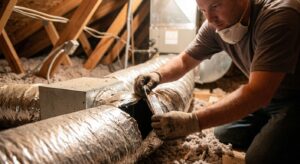
- Starting at the air handler, follow each duct run with your hand held 1 to 2 inches from the surface. Feel for airflow escaping at joints, seams, and connections. Pay special attention to elbows, takeoffs, and any section held together with only tape.
- Visually inspect all duct connections for gaps, disconnected sections, or old duct tape that has dried and pulled away. Standard gray cloth duct tape fails within 2 to 5 years and is not a reliable seal.
- Check where ducts pass through walls, floors, or ceilings for gaps around the penetration. Even small gaps here are significant because they connect conditioned space to unconditioned space.
- Mark every suspected leak with masking tape or a sticky note so you can return with sealant. Photograph each one for reference.
- On a still day, use a stick of incense near return duct seams. Disrupted smoke indicates air being pulled in from outside the duct, confirming a return leak.
- Purchase water-based duct mastic sealant (sold in quarts or gallons at home improvement stores) and UL 181-rated foil-backed tape. Do not use standard gray cloth duct tape as a permanent solution since it dries out and fails.
- Turn the HVAC system off before sealing. Clean all surfaces to be sealed with a dry brush or cloth to remove dust and loose debris so adhesives bond properly.
- Apply mastic sealant to all joints, seams, and connections using a disposable paintbrush or gloved fingers. Apply a generous coat 1/8 inch thick and work it into gaps. For gaps wider than 1/4 inch, embed a layer of fiberglass mesh tape into wet mastic, then apply a second coat over it.
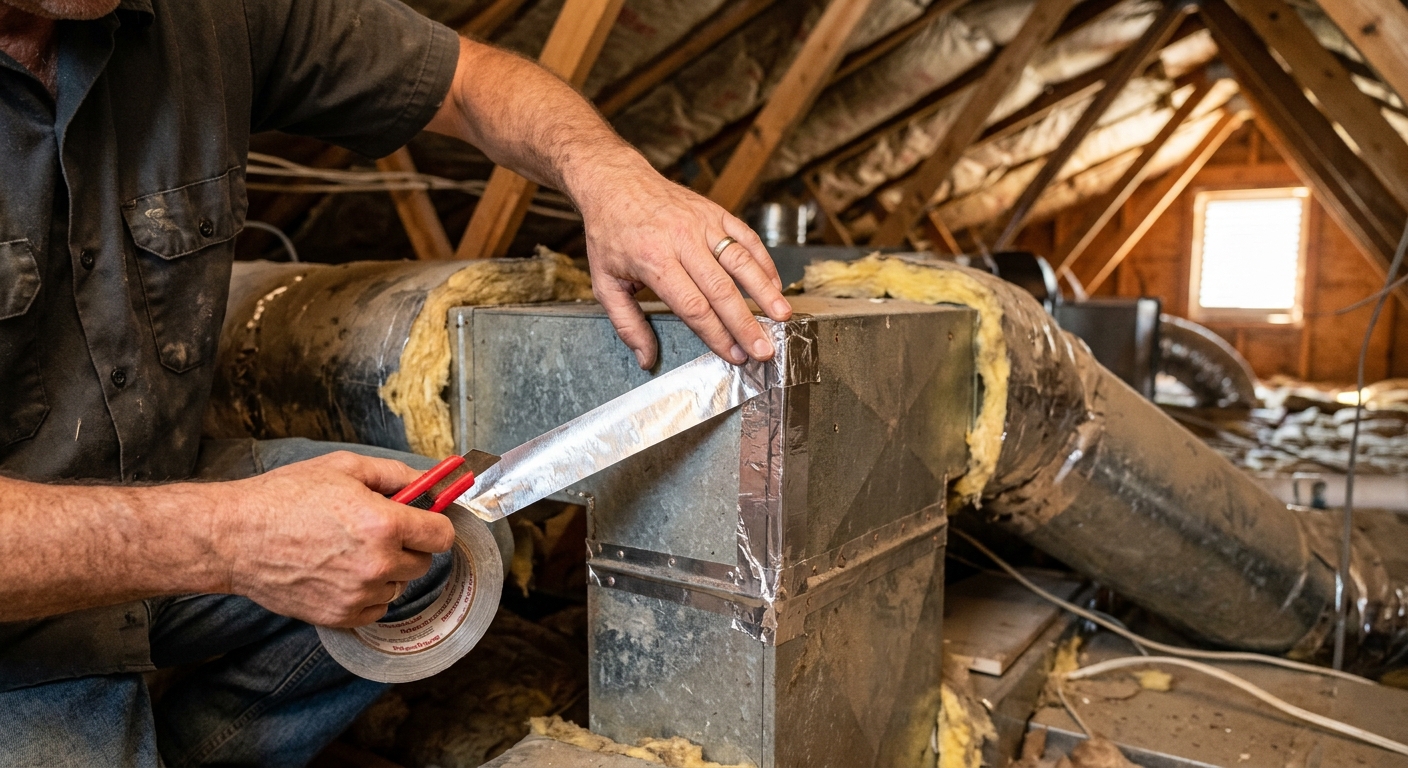
- For rigid metal duct connections that are tight and well-aligned, apply foil-backed tape rated UL 181B-FX. Press firmly and smooth out any bubbles. Use this tape on straight seams and as reinforcement over cured mastic on high-movement joints.
- Seal all duct penetrations through floors, walls, and ceilings using mastic or fire-rated caulk where the duct passes through a framed opening. These bypass leaks are often overlooked but contribute significantly to whole-house air leakage.
- Allow mastic to cure for 24 hours before running the system. After curing, repeat the hand and incense test from the visual audit to confirm all identified leaks are sealed. Note any rooms that now feel more evenly conditioned within the first week.
- Contact a BPI-certified energy auditor or HERS rater through your utility company or the Residential Energy Services Network directory. Many utilities subsidize this test to $100 to $200 after rebates.
- Prepare for the appointment by clearing access to your air handler, all accessible duct runs, and attic or crawl space hatches. The auditor will need to move through these spaces.
- The auditor connects a calibrated fan and pressure gauge to your duct system and seals all registers. The test measures how much air escapes the duct system at a standard pressure, reported as CFM25 (leakage at 25 Pascals). Acceptable leakage is typically below 4 CFM25 per 100 square feet of conditioned floor area.
- Review the written report which will show total leakage, leakage to the outside (the most costly type), and the estimated energy penalty as a percentage of your heating and cooling load.
- Use the report to prioritize sealing work. If leakage to the outside exceeds 10% of system airflow, professional aeroseal duct sealing (which injects adhesive particles into the pressurized duct from inside) may be worth considering at a cost of $1,500 to $3,500 with typical payback of 3 to 7 years.
- Request a post-sealing test after any major remediation to verify results and document improvements for utility rebate applications.
Why It Works: The Benefits
Sealing duct leaks can reduce heating and cooling costs by 15 to 30%, which translates to $200 to $600 per year for an average home spending $2,000 annually on energy.
Leaky supply ducts starve distant rooms of conditioned air. Sealing them restores proper airflow balance, eliminating the hot or cold rooms that no thermostat adjustment can fully fix.
Duct leaks force the blower motor and compressor to run longer cycles under higher strain. Sealing leaks can meaningfully reduce runtime, potentially adding years to your equipment’s lifespan.
Leaky return ducts in attics or crawl spaces can pull in insulation fibers, mold spores, and dust and distribute them throughout your home. Sealing return leaks directly reduces airborne particulates at the source.
In humid climates, leaky return ducts pull in unconditioned outdoor air, making it harder for your AC to dehumidify. A sealed duct system allows the system to maintain relative humidity below the recommended 50% threshold.
💰 Savings Impact by Action
Sealing supply and return duct leaks in unconditioned spaces reduces conditioned air loss by 15 to 30%, with 20% representing a typical whole-house result per DOE research.
Sealing the air handler plenum box alone can reduce total system leakage by up to 12% because it is the highest-pressure point in the duct system.
Reseating and mastic-sealing disconnected or loosely connected flex duct collars eliminates hidden leaks inside insulation wrap that can account for 8% of total airflow loss.
Sealing the gap between duct boots and drywall or subfloor with mastic or caulk reduces unconditioned air infiltration by approximately 5% of total home air leakage.
Wrapping attic ducts from R-4 to R-8 insulation reduces heat gain through duct walls in summer by up to 10% of cooling load independent of leakage sealing.
🏠 Key Concepts Explained
The Science Behind It
Duct systems function as a pressurized distribution network. When your blower turns on, the supply side becomes positively pressurized and the return side becomes negatively pressurized relative to the surrounding space. Any hole or gap in a supply duct allows pressurized conditioned air to escape into whatever space surrounds the duct, whether that is an attic at 140 degrees in July or a crawl space at 20 degrees in January. Any hole in a return duct does the opposite: it pulls unconditioned outside air directly into the air stream headed to your living areas, forcing your system to condition that air from scratch on every cycle.
The energy penalty compounds in two ways. First, there is the direct loss of the conditioned air itself, which represents the electricity or gas already spent heating or cooling it. Second, the pressure loss in the system causes your blower motor to operate outside its designed efficiency curve. Blower motors are sized to move a specific volume of air against a specific resistance. When supply pressure bleeds away through leaks, the blower works harder for less output, pulling more watts per cubic foot of air delivered. This is why leaky ductwork often causes your HVAC system to run more frequently and for longer periods without proportional comfort improvement.
Mastic sealant works better than tape for most applications because it is applied as a semi-liquid that conforms to irregular surfaces and cures into a flexible, airtight membrane. It tolerates the thermal expansion and contraction that ducts experience as temperatures fluctuate between system cycles without cracking or delaminating. UL 181-rated foil tape uses a pressure-sensitive acrylic adhesive specifically formulated for the temperature range inside ductwork (typically 40 to 200 degrees Fahrenheit) and maintains its bond through thousands of heat cycles. Both materials are proven to last the life of the duct system when properly applied, unlike commodity cloth tape which uses rubber-based adhesive that dries and separates within just a few years.
Frequently Asked Questions
▼ How do I know if my ducts are leaking if I can’t access them in the walls?
In-wall ducts are difficult to test without professional equipment. Focus your audit on accessible sections in attics, basements, crawl spaces, and mechanical rooms, which is where the majority of duct leakage occurs in most homes. If you suspect serious in-wall leakage due to very uneven room temperatures or high bills that accessible sealing did not fix, a professional duct blaster test can quantify total system leakage including hidden sections and help determine whether aeroseal injection is warranted.
▼ I sealed the leaks I could find but my energy bills are still high. What am I missing?
Duct leakage is one of several efficiency factors. If sealing accessible leaks did not produce noticeable savings, check attic insulation levels (R-38 to R-60 is current standard for most climates), verify your air filter is not severely restricted, and confirm your thermostat setback schedule is optimized. You may also have significant envelope air leakage at the house shell level rather than the duct level. A whole-house blower door test, often bundled with a duct blaster test by energy auditors, will tell you which system is losing more energy.
▼ Can I use spray foam instead of mastic to seal duct leaks?
Expanding spray foam is not recommended for sealing duct joints that experience thermal movement. As ducts heat and cool through daily cycles, they expand and contract slightly, and rigid cured foam can crack at those joints, reopening the leak. Use water-based duct mastic for joints and seams since it cures flexible and remains airtight through temperature cycling. Spray foam is appropriate for sealing the gap between a duct penetration and the structural framing around it, which is a different application.
▼ My home has older flex duct. Should I replace it or just seal it?
Flex duct that is properly connected, not kinked, and not collapsed can be effectively sealed with mastic at the collar connections and retained for years. If your flex duct is severely kinked, compressed, or has a torn inner liner, sealing alone will not restore proper airflow and replacement is the better investment at $3 to $8 per linear foot installed. Look for sections where flex duct makes sharp turns of more than 90 degrees or sags below its connection points, as these create flow restrictions that no sealant can fix.
▼ Will sealing my ducts cause any problems with my heating or cooling system?
For the vast majority of homes, sealing duct leaks only improves system performance. The one exception is if your home relies on duct leakage as an unintended source of combustion air for a gas furnace or water heater in a confined space. This is an unusual configuration but worth checking if your appliances are in a sealed mechanical closet. Consult an HVAC technician if you are unsure about combustion air requirements before doing extensive sealing in a space that contains gas appliances.
Quick Tips
- Start your audit at the air handler and work outward. The highest-pressure leaks are closest to the blower, so prioritize sealing within the first 10 feet of duct on both supply and return sides.
- Check flex duct connections at both ends. Flexible duct is frequently installed with only a zip tie and no mastic, and the inner liner often separates from the collar over time, creating a large hidden leak inside the insulation wrap.
- Seal during mild weather when your attic is below 90 degrees Fahrenheit. Mastic does not bond well to surfaces above 120 degrees, and working conditions become dangerous in peak summer heat.
- Take before and after photos of every repair. If you later apply for a utility rebate or sell your home, documentation of duct sealing work adds credibility and can support an energy efficiency disclosure.
Variations for Your Situation
- Apartment/Rental: Most apartment HVAC systems use a central air handler with ducts you cannot access or modify. Focus on sealing the gap around supply and return registers where they meet the wall or ceiling using paintable acoustical sealant or removable weatherstrip foam, which is renter-safe and costs under $15. Also check that the register grilles are seated flat against the surface with no air bypassing around the frame. These steps alone can improve airflow distribution without touching any ductwork.
- Tight Budget (under $50): A quart of duct mastic costs $12 to $18 and covers most of the accessible leaks a homeowner will find. Prioritize the air handler plenum, the first 5 feet of supply and return plenums, and any visibly disconnected joints. Skip foil tape entirely on a tight budget and use mastic alone with free fiberglass mesh tape from scraps. This targeted approach addresses the highest-leakage areas first and delivers the majority of potential savings at minimum cost.
- Older Home (pre-1980): Homes built before 1980 frequently have octopus-style duct systems with large round supply ducts and minimal return capacity, often with ducts running through uninsulated crawl spaces or unfinished basements. Before touching any duct wrap or insulation, have it tested for asbestos if it appears gray, white, or fibrous. Once confirmed safe, expect to find joints held with only crimped metal and no sealant at all, which is typical of that era. Budget an additional $30 to $50 for extra mastic and allow for a longer work session since older systems tend to have more joints and longer accessible duct runs.