Most homeowners never think about water quality until something goes wrong: a water heater that fails early, stiff laundry, skin that feels dry after every shower, or a faint chlorine smell from the tap. What connects all of these problems is the water itself. Municipal water is treated to be safe to drink, but that treatment process leaves behind chlorine, chloramines, and disinfection byproducts. Well water brings its own challenges, including iron, sediment, bacteria, and hardness minerals that wreak havoc on plumbing and appliances.
A whole-house water filter, also called a point-of-entry (POE) filter, treats every drop of water before it reaches any faucet, shower, toilet, or appliance. Unlike under-sink or pitcher filters that protect only one tap, a POE system defends your entire home. That means your water heater, washing machine, and dishwasher all receive cleaner water, which translates directly into longer appliance life, lower energy bills, and less money spent on repairs and replacements.
This guide breaks down exactly how whole-house filtration works, what types of systems match different water problems, what realistic costs and payback periods look like, and how to choose and install the right system for your home. Whether you are on city water or a private well, there is a solution that fits your situation and your budget.
What You’ll Need
Click on an item below to shop for the recommended items for this recipe on Amazon.
As an Amazon Associate, we earn from qualifying purchases.
How to Do It
- Order a certified mail-in water test kit from a lab such as Tap Score or National Testing Laboratories ($30 to $80). This identifies your specific contaminants rather than guessing, so you buy the right filter for your actual water.
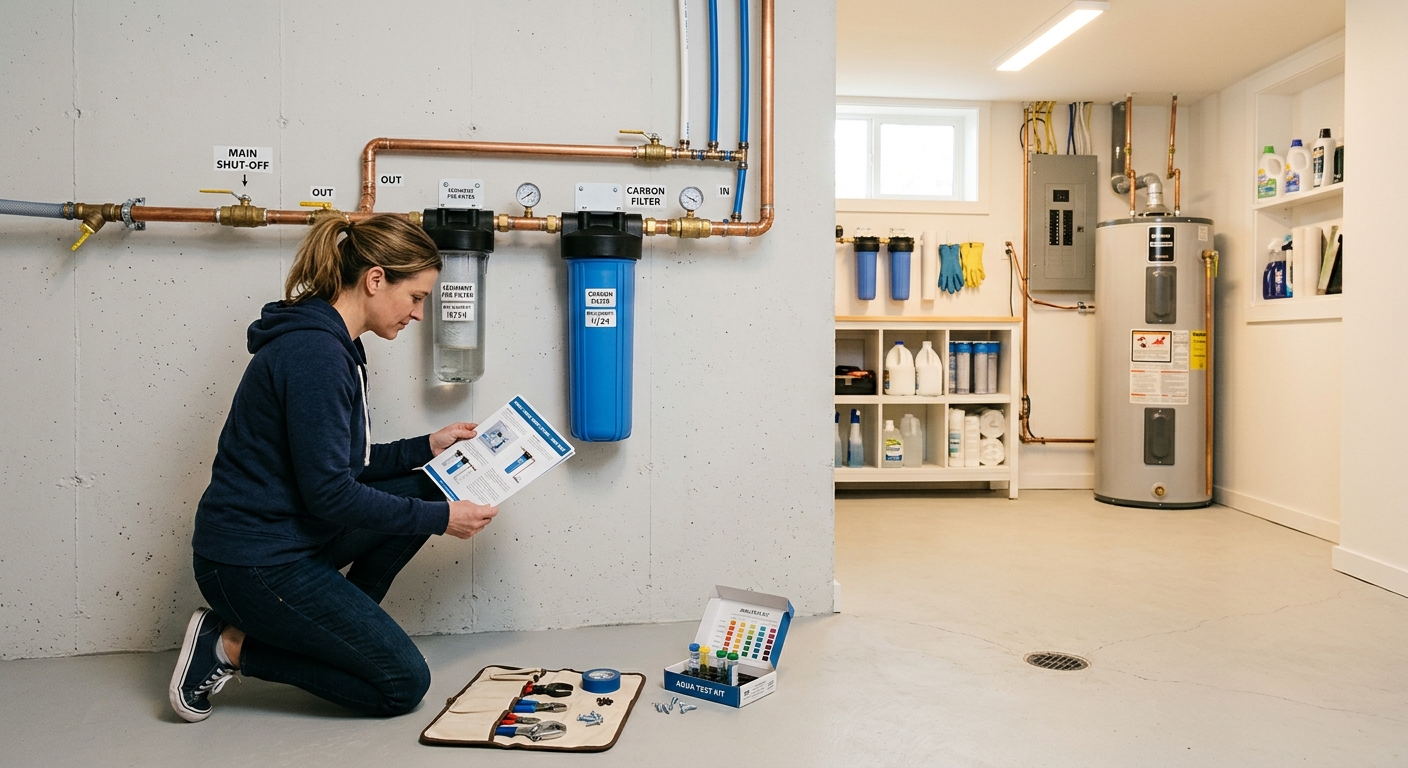
- While waiting for results, install a single-stage 5-micron sediment spin-down filter on your main supply line just after the shut-off valve. These cost $30 to $60, install with two pipe fittings, and immediately protect fixtures and appliances from particulate damage.
- Review your water test results when they arrive. Look for hardness (above 120 mg/L means hard water), chlorine or chloramines (present in virtually all municipal water), iron (above 0.3 mg/L causes staining), and any contaminants flagged as exceeding EPA guidelines.
- Use the test results to shortlist the filter type you actually need: carbon block for chlorine and VOCs, catalytic carbon for chloramines, iron filter for ferrous iron, or a multi-stage system for complex well water.
- Contact your local water utility for their most recent Consumer Confidence Report (CCR), which is free and legally required to be published annually. Cross-reference it with your test results to build a complete picture of your water quality.
- Choose the correct system based on your water test. For municipal water, a two-stage system with a 5-micron sediment filter followed by a 10-inch carbon block filter ($150 to $300) handles most issues. For hard water, add an inline salt-free conditioner or budget for a traditional softener ($400 to $600 for DIY-installed units).
- Locate your main water shut-off valve and the cold water supply line entering your home. The ideal installation point is just after the shut-off valve and pressure regulator, before any branch lines. This ensures every fixture in the home receives filtered water.
- Shut off the main water supply and open a faucet at the lowest point in the house to drain pressure from the lines. Measure the pipe diameter (most residential homes use 3/4-inch or 1-inch supply lines) and purchase the matching compression fittings, union connectors, or SharkBite push-to-connect fittings to avoid soldering.
- Cut the supply line and install the filter housing according to the manufacturer’s instructions. Orient the housing so the filter cartridge is accessible for future replacements. Install a bypass valve (a simple ball valve loop around the housing) so you can swap filters without shutting off water to the whole house.
- Restore water pressure slowly and check all connections for leaks. Use a flashlight and dry paper towel to check each fitting. Tighten any dripping connections with a wrench, but avoid over-tightening plastic housings.
- Label the filter housing with the installation date and the cartridge replacement interval (typically every 3 to 6 months for sediment, every 6 to 12 months for carbon). Set a phone reminder to replace on schedule, as a clogged filter restricts flow and can become a bacterial growth site if neglected.
- Hire a licensed plumber or a water treatment specialist to perform a comprehensive water analysis and system sizing. Professionals can test for bacteria, nitrates, radon, and heavy metals beyond standard home test kits, which is especially important for well water.
- Request quotes for a multi-stage system: a sediment pre-filter, a whole-house carbon filter, an iron removal filter if needed, and a salt-based or salt-free water softener for hardness. Getting two to three quotes is standard; prices vary significantly by region and brand.
- Ask the installer about system flow rate matching. A properly sized system for a 3-bedroom, 2-bathroom home needs a minimum 10 gallons per minute (GPM) flow rate at the filter to prevent pressure drops during peak use (morning showers plus dishwasher running simultaneously).
- Confirm the installer will handle all permit requirements, which some municipalities require for plumbing modifications at the main supply line. Non-permitted work can complicate home sales and insurance claims.
- After installation, request a system overview showing filter replacement schedules, salt replenishment intervals for softeners, and the location of the bypass valve. Schedule a follow-up water test 30 days post-installation to confirm the system is performing to spec.
Why It Works: The Benefits
Scale buildup on water heater elements forces the unit to run longer and draw more energy. Removing hardness minerals can reduce water heater energy consumption by 10 to 30%, saving $40 to $120 per year on a typical household utility bill.
Dishwashers, washing machines, and water heaters last 2 to 5 years longer when operating with filtered water. Replacing a water heater costs $800 to $1,500 installed, so even a modest lifespan extension represents significant real savings.
Sediment and scale are leading causes of faucet drips, valve failures, and clogged shower heads. Homeowners on hard or high-sediment water can spend $200 to $600 per year on preventable plumbing repairs that whole-house filtration largely eliminates.
Chlorine strips natural oils from skin and hair, and hard water leaves mineral deposits in fabric fibers. Filtered soft water noticeably improves skin feel, reduces soap and shampoo usage by 25 to 50%, and keeps clothes looking newer longer.
A whole-house carbon filter removes chlorine, chloramines, and many VOCs from every tap in the home, including the refrigerator ice maker, reducing or eliminating the need to buy bottled water and saving the average family $400 to $700 per year.
💰 Savings Impact by Action
Eliminating scale buildup inside water heater tanks and elements can reduce water heating energy consumption by up to 28% in hard water areas above 150 mg/L.
Filtered water extending appliance life by 2 to 5 years reduces replacement frequency, cutting lifetime appliance costs by an estimated 20 to 30% compared to unfiltered hard water operation.
A household spending $500 to $700 per year on bottled water can eliminate that cost entirely with a whole-house carbon or point-of-entry reverse osmosis system.
Soft, filtered water lathers more efficiently, reducing soap, shampoo, and laundry detergent consumption by 25 to 50% compared to hard water use.
Removing sediment and corrosive chlorine reduces faucet, valve, and seal failures, cutting annual plumbing repair costs by an estimated 15 to 25% in high-sediment or chloraminated water areas.
🏠 Key Concepts Explained
The Science Behind It
Water quality affects home efficiency through two primary mechanisms: heat transfer resistance and mechanical wear. When hard water is heated, calcium and magnesium bicarbonates precipitate out of solution and bond to hot surfaces as calcium carbonate scale. This scale is an excellent thermal insulator, with a conductivity roughly 35 times lower than steel. A 1/4-inch layer on a water heater element means the element must generate significantly more heat to push the same number of BTUs through to the water, directly increasing electricity or gas consumption by 25 to 40% for that appliance alone.
Chlorine and chloramines used in municipal treatment are oxidizing agents. They are effective at killing bacteria in the distribution system, but that same oxidizing chemistry attacks the elastomer compounds in rubber washers, O-rings, and gaskets throughout your plumbing. Over years of exposure, these components harden and crack, leading to dripping faucets and leaking connections. Activated carbon filtration removes chlorine through adsorption, a process where chlorine molecules bond to the vast internal surface area of carbon granules. A standard 10-inch carbon block cartridge has a surface area equivalent to several football fields, giving it enormous capacity to capture dissolved gases and organic compounds before they reach your fixtures.
Sediment filtration works on a purely mechanical basis: water passes through a porous medium rated by micron size, and any particle larger than that rating is physically trapped. Matching the micron rating to your water’s particulate profile matters significantly. A 50-micron filter misses most damaging particles, while a 1-micron filter captures nearly everything but clogs quickly in high-sediment water. A two-stage approach using a coarse 20-micron pre-filter followed by a fine 5-micron polishing filter extends overall filter life and maintains consistent flow rates, which is exactly the strategy professional water treatment installers recommend for maximizing both performance and cartridge economy.
Frequently Asked Questions
▼ My water pressure dropped significantly after installing the filter. What is wrong?
The most common cause is a filter cartridge that is already partially clogged with sediment, especially if you have high-particulate source water. Try replacing the cartridge even if it is new. If pressure is still low, check that all valves in the installation are fully open and that the filter housing O-ring is seated correctly and not causing a bypass restriction. If the pressure was low before installation, the filter is simply making an existing pressure issue noticeable and you may need a booster pump upstream.
▼ How do I know if my whole-house filter is actually working?
The most reliable method is a before-and-after water test using the same certified lab. Test a sample from an outdoor hose bib (which bypasses the filter) and compare it to a sample from an indoor tap. You can also use an inexpensive TDS (total dissolved solids) meter to check for changes in mineral content, though TDS meters do not detect chlorine or bacteria. Many carbon filter manufacturers include test strips for chlorine in the packaging for a quick functional check.
▼ Can I install a whole-house filter in an apartment or rental?
Cutting into the main supply line in a rental is not realistic without landlord permission, since that line serves the whole building, not just your unit. Instead, focus on point-of-use solutions: an under-sink reverse osmosis unit for drinking and cooking water ($150 to $300, typically installs without pipe cutting using a saddle valve), a shower filter for chlorine ($20 to $50), and a refrigerator inline filter if your unit has an ice maker or water dispenser. These address the highest-exposure points without permanent modifications.
▼ My water test showed iron in my well water. Will a standard carbon filter handle it?
Standard carbon block filters do not effectively remove dissolved (ferrous) iron and will clog rapidly with particulate (ferric) iron. Iron above 0.3 mg/L requires a dedicated iron filter, typically using birm, greensand, or air injection oxidation media, installed before your carbon filter. For iron levels above 5 mg/L, consult a water treatment specialist, as you may need a chemical injection system. Untreated iron stains fixtures orange-brown and is especially damaging to washing machines and dishwashers.
▼ How long will a whole-house filter system actually last before needing replacement?
The filter housings themselves are durable and can last 10 to 20 years with proper maintenance. What you replace on schedule are the filter cartridges inside: sediment cartridges every 3 to 6 months ($5 to $20 each) and carbon cartridges every 6 to 12 months ($20 to $60 each). Water softener resin beds last 10 to 15 years. The ongoing cost is low once the system is installed, averaging $60 to $150 per year in replacement cartridges for a standard two-stage municipal water system.
Quick Tips
- Test your water before buying any filter system. A $50 lab test saves you from spending $400 on the wrong type of filter for your specific contaminants.
- Replace filter cartridges on schedule even if the water looks and tastes fine. A carbon cartridge past its rated capacity stops adsorbing contaminants while appearing to work normally.
- If you have a water softener, install it after your sediment and carbon pre-filters, not before. Sediment clogs resin beds and chlorine degrades ion exchange resin, shortening the softener’s life significantly.
- Check your water pressure before installation. Whole-house filters work best between 40 and 80 PSI. Below 40 PSI, flow through the filter housing will feel sluggish. If your home runs low pressure, consider a booster pump.
- For well water users, test annually, not just once. Well water chemistry changes seasonally and after heavy rainfall, and a contaminant level that was safe last year may have shifted.
- Keep a spare filter cartridge on hand so you can swap immediately when the replacement reminder hits, rather than running on an expired cartridge while waiting for shipping.
Variations for Your Situation
- Apartment/Rental: Since cutting the main supply line is off-limits, renters should prioritize point-of-use solutions. An under-sink reverse osmosis system ($150 to $300) handles drinking and cooking water with no permanent modifications. Add a $25 to $50 inline shower filter to reduce chlorine exposure during bathing. Both are portable when you move. Check your lease before installing any under-sink unit, as some landlords consider even minor plumbing connections a modification.
- Tight Budget (under $50): Start with a $30 to $50 certified water test so you understand exactly what you are dealing with. Then install a single whole-house sediment spin-down filter ($30 to $60) on the supply line to protect appliances from particulate damage immediately. This one step extends fixture and appliance life noticeably and costs less than a single plumber service call. Pair it with a $15 to $25 faucet-mounted carbon filter on your kitchen tap for drinking water.
- Older Home (pre-1980): Homes built before 1980 may have galvanized steel supply pipes that are actively corroding and shedding rust and scale into the water regardless of the source quality. A water test will reveal elevated iron and lead in these homes even with clean municipal water. Prioritize a sediment pre-filter and a filter certified to NSF/ANSI Standard 53 for lead reduction. In homes with extensive galvanized pipe, a plumber should assess whether pipe replacement is more cost-effective long-term than continual heavy filtration of corroded plumbing.