If you’ve ever sat near a window in winter and felt a cold chill despite the heat being on, you already know the problem. Drafty windows aren’t just uncomfortable, they’re expensive. The U.S. Department of Energy estimates that heat loss and gain through windows accounts for 25 to 30% of residential heating and cooling energy use. For a typical household spending $2,000 a year on energy, that’s potentially $500 to $600 walking out through your window frames every year.
The instinct many homeowners have is to replace the windows entirely, but new windows can cost $300 to $1,000 per unit installed, with a payback period of 20 to 30 years in energy savings alone. That math rarely pencils out. What does work is addressing the actual source of the draft: gaps in caulking, failed weatherstripping, and poorly sealed frames that let conditioned air escape and outdoor air sneak in.
This guide covers everything you need to stop drafty windows from draining your wallet, starting with free fixes you can do in minutes and building up to a DIY weatherization project that costs under $100 and can cut your window-related energy loss by 40% or more. Whether you rent or own, live in an older home or a newer one, there’s a practical approach here for you.
What You’ll Need
Click on an item below to shop for the recommended items for this recipe on Amazon.
As an Amazon Associate, we earn from qualifying purchases.
How to Do It
- Run a draft check on a windy day or on a cold night with the heat on. Hold a lit stick of incense or a thin piece of tissue paper along the edges of each window frame, sash, and sill. Watch for the smoke or paper to waver, which indicates air movement.
- For immediate relief on windows with large visible gaps along the sill or frame, roll a hand towel or cut a pool noodle to length and press it against the base of the window sill as a temporary draft blocker. This costs nothing and works the same night.
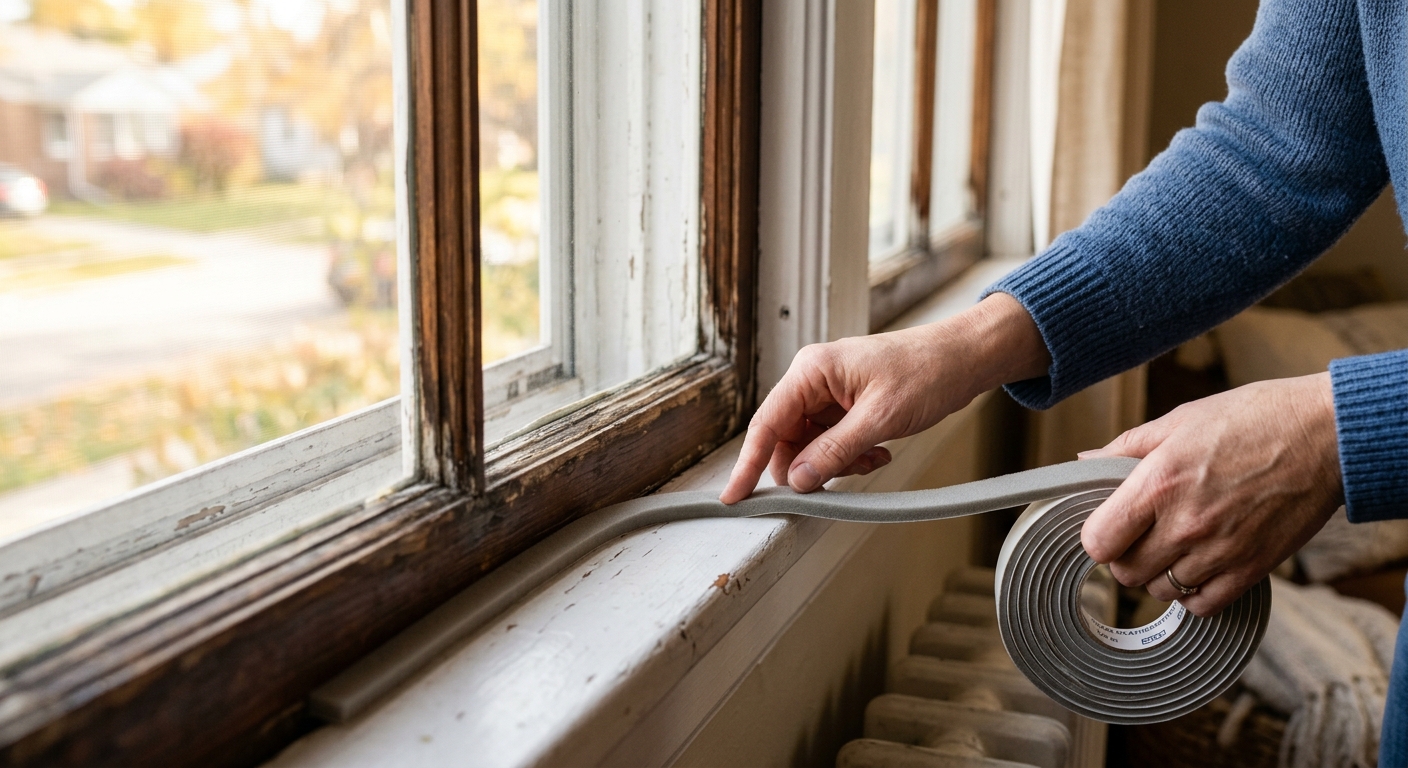
- Pick up a roll of rope caulk (also called removable caulk cord) from any hardware store for about $5 to $8. Press it into the gaps between the window sash and frame like putty. It requires no tools, leaves no residue, and peels off cleanly in spring. This alone can reduce infiltration by 30 to 40% on older single-hung windows.
- Apply 1 to 2-inch strips of foam weatherstripping tape along the bottom rail of the lower sash if the window closes on the tape and creates a seal. Pre-cut adhesive foam tape costs about $4 to $8 per window and takes under 5 minutes to apply.
- Close window blinds or heavy curtains at night in winter. A tightly fitted cellular shade or heavy drape can reduce heat loss through a window by up to 40% on its own by trapping a layer of still air.
- Clean all window frames and sills with a damp cloth and let them dry completely. Caulk and weatherstripping adhesives fail quickly if applied to dusty or oily surfaces, so this step is critical to getting a seal that lasts 5 to 10 years.
- Remove any old cracked caulk using a plastic putty knife or a caulk removal tool. Run your finger along the joint between the window frame and the wall interior. Any gap you can see or feel should be caulked. Apply a continuous bead of paintable acrylic latex caulk and smooth it with a wet finger. A single tube covers 3 to 4 windows at about $5 per tube.
- Replace worn weatherstripping on the sash. For double-hung windows, use V-strip (also called tension seal) weatherstripping cut to length and pressed into the channel where the sash slides. It compresses as the window closes and springs back to seal the gap. V-strip lasts 5 to 10 years and costs about $10 to $15 per window.
- For single-pane windows or windows in rooms that are noticeably cold, apply a low-E window film or a clear insulating shrink film kit. Shrink film kits use double-sided tape and a hair dryer to pull the film taut and nearly invisible. They create a dead air space that effectively bumps a single-pane window from R-1 to R-2, cutting conductive heat loss in half. Kits run $8 to $15 per window.
- Check and seal the exterior side of each window frame with exterior-grade caulk if you have safe access. Water infiltration often enters from outside and follows the frame to the interior. Use a caulk rated for exterior use and rated to handle the temperature range in your climate.
- After completing all windows, repeat the smoke or tissue-paper test to confirm each one is sealed. Mark any that still show movement and revisit the specific gap with an additional layer of rope caulk or foam tape as a targeted patch.
- Measure the interior window opening (inside the window stop molding) precisely, to the nearest 1/8 inch. Measure width at top, middle, and bottom, and use the narrowest measurement. Do the same for height. Most interior storm insert suppliers require these measurements to custom-cut your panel.
- Order interior storm window inserts from a supplier such as Indow, PolarSeal, or a local glass shop. These are acrylic or glass panels with a compression tube edge that press into the window opening without screws or adhesives. They create a 2 to 4-inch dead air space that can bring a single-pane window to R-3 to R-4 performance.
- Install each insert by pressing the compression edge into the window stop on all four sides until it snaps into place. No tools required for most systems. The panel should sit flush with the stop and leave no visible gap around the perimeter.
- Test the seal by checking for light leaks around the perimeter in a dark room with a flashlight on the other side. Press any sections that show light leakage more firmly into the stop.
- Remove and store inserts in summer if desired, or leave them in year-round since they also reduce solar heat gain and UV fading of interior furnishings. Most inserts are stackable and lightweight for easy off-season storage.
Why It Works: The Benefits
Sealing window drafts can reduce heating and cooling costs by 10 to 20% annually. For a home with a $200 monthly energy bill, that’s $240 to $480 back in your pocket each year.
Eliminating drafts removes cold spots near windows and reduces the temperature difference between the window side of a room and the rest of the space, making your thermostat setting actually match how the room feels.
When conditioned air stops escaping through gaps, your furnace or AC cycles less frequently. Shorter, less frequent run cycles extend equipment life and reduce maintenance costs over time.
Weatherstripping and caulk that seal out air also seal out sound. Homeowners near busy roads or urban areas often notice a meaningful drop in outside noise after properly sealing window frames.
Sealing uncontrolled infiltration points means outside pollutants, pollen, and dust enter your home through your filtered HVAC system rather than directly through gaps, giving you better control over what you breathe.
💰 Savings Impact by Action
Sealing sash gaps with removable rope caulk reduces air infiltration through the window by up to 30 to 40%, translating to roughly 10 to 15% savings on heating costs per sealed window.
Replacing worn weatherstripping on all operable windows reduces whole-home air leakage enough to cut heating and cooling costs by 10 to 20% according to DOE estimates.
Insulating window film doubles the effective R-value of a single-pane window, reducing conductive heat loss through the glass by up to 40% per window.
Interior storm inserts can reduce heat loss through single-pane windows by up to 50%, and independent testing shows whole-home heating energy reductions of 20 to 35% in older homes.
Tightly fitted honeycomb cellular shades reduce heat loss through windows by up to 40% at night by trapping a still air buffer between the shade and the glass.
🏠 Key Concepts Explained
The Science Behind It
Windows lose energy through two distinct mechanisms that are easy to confuse but require different fixes. The first is conduction and radiation through the glass itself, which is a function of the window’s R-value and the temperature difference between inside and outside. The second is infiltration, which is air physically moving through gaps and cracks. Infiltration is almost always the bigger culprit in older windows, and it’s the one you can fix without spending thousands on replacements.
When outdoor air at 20 degrees F enters through a gap and mixes with indoor air at 68 degrees F, your furnace has to burn fuel to heat that cold air up to room temperature. Every cubic foot per minute of infiltration is a continuous energy drain. Research from Lawrence Berkeley National Laboratory found that air leakage accounts for 25 to 40% of heating and cooling energy use in typical American homes, and windows and doors are among the primary entry points. Sealing those entry points is one of the most cost-effective energy investments available.
The insulating shrink film and storm insert upgrades work on a different principle: they trap a layer of still air between the film or insert and the original glass. Still air is an excellent insulator (R-1 per inch of thickness). By creating a 1 to 4-inch dead air space, these products can double or triple the effective R-value of the original window. The physics here is the same reason double-pane windows outperform single-pane: it’s not the extra glass that insulates, it’s the trapped gas between the panes.
Frequently Asked Questions
▼ I caulked my windows last year but they still feel drafty. What am I missing?
Check the interior sash gaps, not just the frame-to-wall joint. The most common missed spots are the seam between the upper and lower sash on double-hung windows, and the gap between the sash and the side jamb where the window slides. Apply rope caulk or V-strip weatherstripping in these channels. Also check whether the existing caulk has cracked or pulled away from one side of the joint, which happens when the bead was too thin or the surface was not clean when applied.
▼ Can renters fix drafty windows without violating their lease?
Yes, with the right products. Rope caulk peels off cleanly without damaging the frame. Adhesive foam tape leaves minimal residue if removed within a season. Shrink film kits use double-sided tape that comes up with a heat gun or hair dryer. All three are non-destructive and reversible. Avoid permanent caulk or drilling of any kind without written landlord approval.
▼ How long before I see the savings on my energy bill?
You will see the effect on your very next monthly bill if you weatherize during the heating or cooling season. Because billing cycles average 30 days, the savings show up within 4 to 6 weeks. Expect a 10 to 20% reduction in the portion of your bill driven by heating or cooling. For most homes, that is a $15 to $50 monthly drop during peak season.
▼ My windows have condensation on the inside. Does that mean they are failing?
Interior condensation usually means indoor humidity is too high relative to the glass surface temperature, not necessarily that the window seal has failed. It is most common on single-pane windows in cold weather. Reduce indoor humidity with a bathroom exhaust fan during showers, a kitchen exhaust fan during cooking, or a whole-house dehumidifier if the problem is persistent. If condensation appears between the panes of a double-pane window, the sealed gas unit has failed and that specific unit does need replacement.
▼ Are new windows ever actually worth the cost?
Replacing windows makes financial sense when the frames are rotted or structurally failing, when the existing glass is single-pane in a very cold climate, or when you are already doing a major renovation that includes the surrounding wall. In those cases, Energy Star-certified windows can reduce window-related energy loss by 25 to 30% over old single-pane units. But for windows that are structurally sound, weatherization gives you 70 to 80% of that benefit at 5 to 10% of the cost.
Quick Tips
- Prioritize north-facing and west-facing windows first. They receive the most wind exposure and the least solar heat gain, making them the biggest net energy losers in most climates.
- Buy weatherstripping by the roll rather than pre-cut kits. A 17-foot roll costs about the same as a 2-window kit but covers 4 to 5 windows, cutting your per-window cost in half.
- If a window rattles in its frame when the wind blows, the sash fit is too loose. Foam compression tape on the stop molding (not the sash channel) can take up this slack and stop both the rattle and the draft.
- Check the locking hardware on double-hung and casement windows. A lock that is worn or misaligned leaves the sash slightly open even when you think it is closed. Replacing a $10 sash lock can seal a gap across the entire width of the window.
Variations for Your Situation
- Apartment or Rental: Focus on rope caulk, foam weatherstripping tape, and shrink film kits since all three are fully reversible and require no landlord permission. Budget about $10 to $15 per window and expect to remove everything at move-out. Interior cellular shades add another layer of insulation that is also renter-safe and portable.
- Tight Budget (under $50): Rope caulk and foam tape alone can seal most common window drafts for $5 to $10 per window. Do the smoke test first and only buy materials for the windows that show clear airflow. Prioritize bedroom and living room windows since those rooms are occupied most. Even $20 in rope caulk applied correctly can reduce heating bills by $80 to $150 over a single winter season.
- Older Home (pre-1980): Single-pane wood-frame windows common in older homes have larger gaps and more seasonal wood movement than modern windows, so plan to reapply rope caulk each fall. Test for lead paint before scraping any old caulk. Consider interior storm inserts as a long-term solution since they work with the existing frame rather than against it, and they are reversible if you ever do replace the windows. Budget $100 to $150 per window for custom-fit inserts.