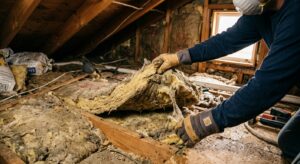
Cathedral ceilings are one of the most visually dramatic features a home can have, but they come with a hidden cost. Because the ceiling surface is directly adjacent to the roof deck with minimal rafter depth, there is far less room for insulation than in a standard attic. Most homes with cathedral ceilings built before 1990 are operating with R-11 to R-19 worth of insulation when building science recommends R-38 to R-60 depending on climate zone. That gap translates directly into higher utility bills and uncomfortable rooms year-round.
The frustrating part is that homeowners often assume fixing this problem requires ripping out drywall or re-roofing the entire structure. That is rarely true. There are several targeted strategies, from injecting blown-in insulation through small access holes to adding continuous rigid foam above or below the existing assembly, that can dramatically improve performance without a full renovation. The right approach depends on your rafter depth, current insulation type, and budget.
This post covers the building science behind why cathedral ceilings underperform, the most cost-effective fixes available to a typical homeowner, and exactly what a professional upgrade looks like when you are ready to go further. Whether you are spending $0 this weekend or planning a $3,000 contractor project, you will leave with a clear action plan.
What You’ll Need
Click on an item below to shop for the recommended items for this recipe on Amazon.
As an Amazon Associate, we earn from qualifying purchases.
How to Do It
- Turn off power to all ceiling fixtures in the cathedral ceiling area. Use a non-contact voltage tester to confirm circuits are dead before touching any electrical boxes.
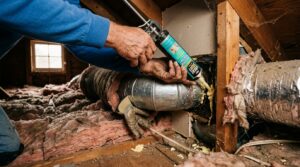
- Remove the trim ring from each recessed light and ceiling fan canopy. Use low-expansion spray foam (not standard window and door foam) to seal the gap where the electrical box meets the drywall and where any wiring enters the box. Standard recessed cans in cathedral ceilings are a primary air leakage path.
- Inspect the perimeter of the ceiling where it meets the wall. Press gently on the drywall tape at this joint. If it feels soft or separates, apply a bead of paintable acrylic latex caulk along the entire ceiling-to-wall joint and smooth it with a damp finger.
- If you have a ridge beam or exposed rafter tails at the eave, go into the attic or crawl space above (if accessible at the edges) and use canned foam or fiberglass batt scraps to block any open rafter bays at the top plate line. These are direct conduit for warm air to escape.
- Replace any old single-pane or leaky skylights in the cathedral ceiling with ENERGY STAR rated double-pane units, or at minimum apply a low-e window film rated for skylights to reduce solar heat gain and radiant heat loss.
- Measure your cathedral ceiling area in square feet. For a typical 200 to 300 square foot vaulted living room ceiling, plan for 20 to 30 panels of 4×8 rigid foam. Choose polyisocyanurate (polyiso) rated at R-6 to R-6.5 per inch for the best performance per inch. Two layers of 1.5-inch polyiso gives you R-18 to R-19 added on top of your existing insulation.
- Before any demo, map all existing electrical boxes with blue painter’s tape on the floor below so you can find them after the foam is applied. Turn off all circuits in the room at the breaker panel.
- Score and snap the rigid foam panels to fit between any exposed beams or to cover the full ceiling field. If the ceiling has exposed decorative beams, run the foam between them and use the beams as the finished border. If the ceiling is flat drywall, you can cover the entire surface continuously.
- Fasten the first layer of foam to the existing drywall using 3-inch construction screws and large-diameter fender washers driven every 16 inches in a grid pattern. Offset joints between layers by at least 6 inches. Tape all foam seams with foil HVAC tape, not standard duct tape, to create a continuous air barrier.
- Apply the second foam layer with seams offset from the first layer. Tape all seams. At this point you have added a continuous thermal break over all the rafters, which eliminates thermal bridging through the wood framing.
- Install new 5/8-inch drywall over the foam using 4 to 5-inch drywall screws long enough to penetrate the existing drywall and reach the rafters behind it. This is the most physically demanding step since the screws must be long enough to catch solid framing. Finish drywall seams, install new trim at the wall-to-ceiling joint, extend electrical boxes to the new ceiling plane using listed box extenders, and paint.
- Hire an insulation contractor certified by BPI (Building Performance Institute) or accredited by a state weatherization program. Ask specifically about dense-pack cellulose or dense-pack fiberglass experience in cathedral ceilings, since the technique differs significantly from blown attic work.
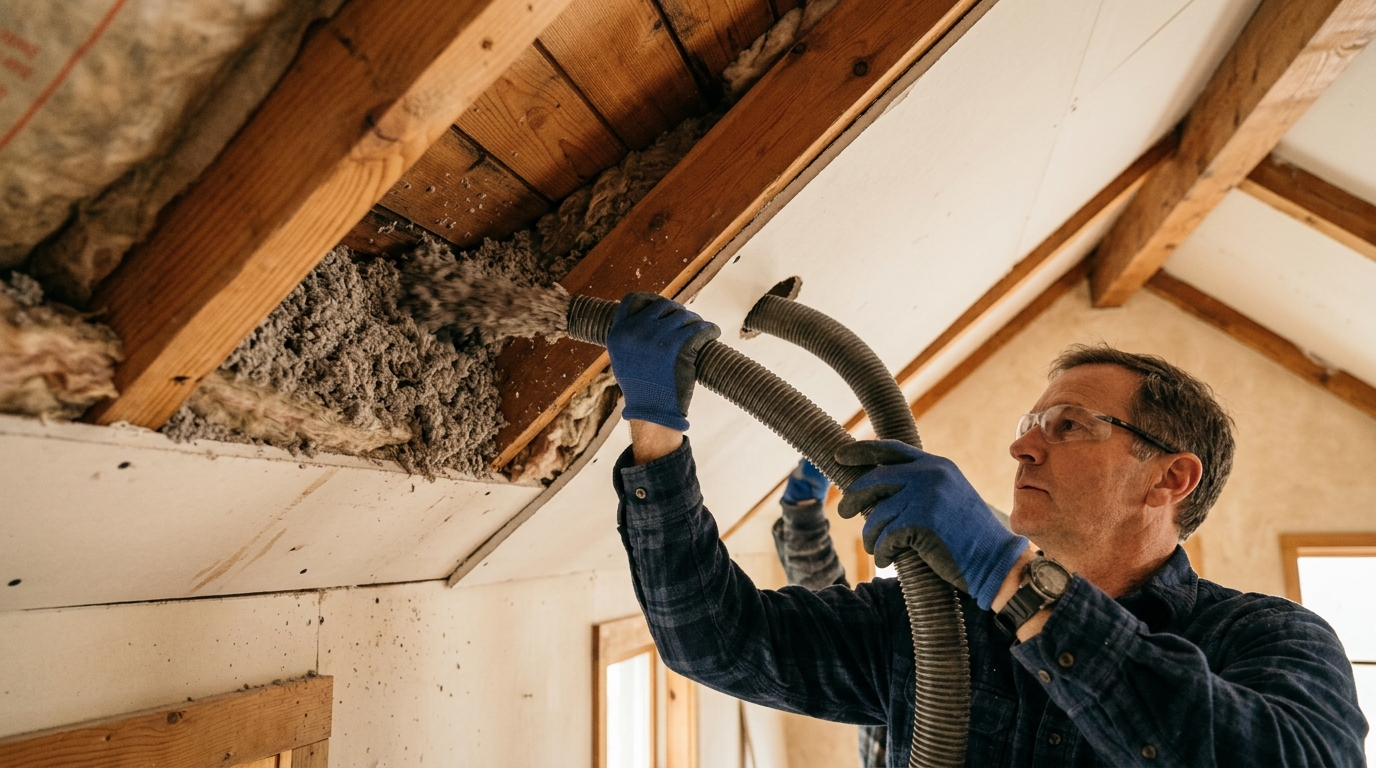
- The contractor will drill 2-inch holes every 18 to 24 inches along each rafter bay, either from inside (patched after) or from outside through the soffit or rake. Inside access is typically less expensive and leaves smaller marks.
- Dense-pack cellulose is blown in at 3.5 pounds per cubic foot minimum density. At this density, the material is self-supporting, will not settle, and provides an effective air barrier in addition to R-3.5 per inch of thermal resistance. A full 5.5-inch rafter bay yields approximately R-19 when dense-packed.
- After filling, the contractor patches all drill holes with setting-type joint compound (not pre-mixed), which hardens chemically and bonds well to the existing drywall surface. With proper feathering and paint, patches are nearly invisible.
- Request a blower door test before and after to verify air leakage reduction. A quality dense-pack job in a cathedral ceiling should reduce total home air leakage by 10 to 20% on its own due to the air-sealing effect of high-density cellulose.
Why It Works: The Benefits
Upgrading a cathedral ceiling from R-19 to R-38 can reduce heat loss through that surface by up to 50%, which typically translates to 15 to 30% total utility savings depending on what fraction of your ceiling area is cathedral versus flat.
A properly insulated and air-sealed cathedral ceiling raises the interior surface temperature in winter, often from 55 to 60 degrees Fahrenheit up to 65 to 68 degrees, eliminating the radiant chill effect that makes rooms feel cold even when the thermostat reads 70.
Most ice dams form because heat escaping through a poorly insulated cathedral ceiling warms the roof deck unevenly, melting snow that refreezes at the cold eaves. Consistent, adequate insulation keeps the deck uniformly cold and dramatically reduces ice dam formation.
Increasing insulation density in rafter bays, especially with dense-pack cellulose or closed-cell spray foam, reduces sound transmission through the roof plane by 5 to 10 STC points, noticeably dampening rain, wind, and aircraft noise.
Homes with documented insulation improvements and lower utility bills consistently appraise higher. Energy upgrades return an average of 60 to 80 cents on the dollar at resale according to Remodeling Magazine’s Cost vs. Value report, with insulation ranking among the top ROI improvements.
💰 Savings Impact by Action
Sealing bypass leakage at recessed lights and ceiling perimeters reduces conditioned air loss through the cathedral ceiling plane by up to 18% with no R-value added.
Filling empty or poorly insulated rafter bays to full depth with dense-pack cellulose at R-19 can cut total heating and cooling loss through the ceiling surface by 25%.
Adding 3 inches of continuous polyiso below existing framing eliminates thermal bridging and raises total assembly R-value, reducing ceiling heat loss by up to 32% compared to batt-only assemblies.
Installing 4 inches of rigid foam above the roof deck during re-roofing achieves R-25 continuous plus existing cavity insulation, reducing total roof heat flow by up to 40%.
🏠 Key Concepts Explained
The Science Behind It
Insulation works by trapping still air in tiny pockets, slowing conductive heat transfer between the warm interior and the cold exterior. The R-value rating measures resistance to that conductive flow, and it is additive: two layers of R-10 give you R-20. However, this only holds true when the insulation is continuous and when air is not moving through it. Moving air carries heat by convection at a rate that can completely overwhelm even well-rated insulation, which is why air sealing and R-value improvement must go together.
Cathedral ceilings face an especially difficult physics problem. The roof surface above them swings between extreme temperatures, from below zero in northern winters to 150 degrees Fahrenheit on a summer afternoon on a dark roof. The delta-T (temperature difference) driving heat flow through the assembly is larger than in any other building surface, which means the same R-value that works adequately in a wall performs poorly at the ceiling plane. Building scientists use the concept of heat flux (BTUs per hour per square foot) to quantify this, and cathedral ceilings consistently show heat flux 2 to 4 times higher than walls with equivalent R-values simply because the driving temperature difference is so much larger.
Thermal bridging through wood rafters compounds the problem. Wood has an R-value of roughly R-1.25 per inch, meaning a 5.5-inch rafter delivers only R-7, compared to R-21 for the fiberglass batt next to it. In a 2×6 rafter assembly with 24-inch on-center spacing, roughly 6 to 8% of the ceiling area is framing, but because that framing is so much more conductive than the insulation, it carries a disproportionate share of the total heat flow. This is why continuous insulation added below or above the framing, which covers the thermal bridges rather than going between them, is so much more effective than simply adding more batt depth where possible.
Frequently Asked Questions
▼ My cathedral ceiling is already insulated, so why is my heating bill still so high?
Older insulation in cathedral ceilings is almost always fiberglass batts installed at the time of construction, which provides only R-11 to R-19 and does nothing to stop air leakage. Over time, batts also sag and lose contact with the roof deck, creating convection loops that further reduce effective performance. Start with the air sealing approach in this guide, then consider adding continuous rigid foam below if bills remain high.
▼ Can I use spray foam in a cathedral ceiling rafter bay myself?
Two-component DIY spray foam kits can work for filling small gaps and around penetrations, but they are not a good choice for filling entire rafter bays. The yield and temperature sensitivity of DIY kits make consistent density very difficult to achieve, and a poorly applied foam job can trap moisture and create the exact condensation problems you are trying to avoid. For filling full rafter bays, hire a professional with a proportioner rig and experience with cathedral ceiling assemblies.
▼ How do I know if I have a vented or unvented cathedral ceiling assembly?
If your rafters have a 1-inch or larger air gap between the insulation and the roof deck that connects to a ridge vent and soffit vents, you have a vented assembly. You can often confirm this by removing a recessed light trim ring and shining a flashlight up into the cavity. If you see solid insulation touching the deck with no gap, it is unvented, likely spray foam. This distinction is critical because the upgrade path differs significantly for each assembly type.
▼ Will adding rigid foam below my cathedral ceiling cause moisture problems?
In most cases, no. Adding interior rigid foam actually improves moisture performance because it keeps the existing drywall and insulation warmer, reducing the chance of condensation within the assembly. However, in very cold climate zones (zone 6 and 7), if your existing rafter bays are poorly sealed and filled with fibrous insulation, adding a vapor-retarding layer inside without addressing the cavity can shift the dew point to a problematic location. Consult a building scientist if you are in Minnesota, Maine, or a similarly cold region before proceeding.
▼ My cathedral ceiling has recessed lights and I want to add insulation. What do I do with the cans?
Check the trim ring of each can for an IC rating stamp. IC-rated cans can be in contact with insulation. Non-IC cans must not be covered with insulation, which creates a problem in cathedral ceilings where every inch matters. The best solution is to replace non-IC cans with airtight IC-rated LED retrofit kits that install from below without attic access, typically $25 to $60 per fixture, then insulate over them.
Quick Tips
- If your cathedral ceiling has exposed decorative beams, use them as the border for rigid foam panels installed between bays. The beams then serve as built-in trim, eliminating most of the finish carpentry work.
- Always use polyisocyanurate (polyiso) rather than EPS or XPS for interior ceiling applications. Polyiso delivers R-6 to R-6.5 per inch versus R-4 for EPS, saving 1 to 1.5 inches of ceiling height per R-value unit added.
- If you are re-roofing anyway, adding 2 to 4 inches of continuous rigid foam above the roof deck before new sheathing and shingles is the highest-performance upgrade available, adding R-12 to R-25 without touching the interior at all.
- Dense-pack cellulose contains boric acid as a fire retardant and is naturally resistant to mold and pests, making it a better long-term choice than fiberglass in humid climates where moisture management is critical.
Variations for Your Situation
- Apartment or Rental with Vaulted Ceilings: Renters cannot modify the ceiling assembly, but can address the interior radiant temperature problem by hanging thermal curtains or insulated fabric panels from a ceiling-mounted track system directly under the lowest point of the vault. This adds R-2 to R-4 of resistance at a cost of $100 to $300 and requires only curtain rod hardware that comes down when you move. Also request that your landlord investigate insulation levels, as this is a habitability and energy cost issue in most states.
- Tight Budget (under $150): Focus entirely on air sealing, which delivers the highest return per dollar spent. Buy two cans of low-expansion spray foam ($10 each), one tube of paintable caulk ($6), and foil tape ($12) and systematically seal every penetration in the ceiling plane including all electrical boxes, ceiling fan mounting brackets, and the perimeter joint where drywall meets the top wall plate. This costs under $50 and can reduce effective heat loss through the ceiling by 15 to 20% with no R-value added at all.
- Older Home (Pre-1980): Homes built before 1980 often have cathedral ceiling rafter bays that were left completely empty, no insulation at all, or filled with deteriorated vermiculite that may contain asbestos. Before drilling any holes or disturbing any ceiling material, have a sample tested by a certified lab ($25 to $50 per sample) if the home was built before 1980 and the insulation has a granular gray appearance. If asbestos is present, dense-pack from outside through the soffit is the preferred approach since it avoids disturbing the interior ceiling surface.