Most homeowners spend hundreds of dollars sealing windows and upgrading thermostats, then completely ignore a gaping hole in their ceiling: the attic hatch. A standard uninsulated attic hatch has an R-value close to R-1 or R-2, while the surrounding ceiling may be insulated to R-38 or higher. That single 22-by-30-inch opening acts like a open window to a freezing or scorching attic every single day of the year.
The problem is not just insulation value. Attic hatches also leak enormous amounts of air. Warm air rises naturally and finds the path of least resistance, and an unsealed hatch is exactly that. Studies from the Department of Energy show that air leakage through attic bypasses, including hatches, can account for 25 to 40% of a home’s total heating and cooling loss. Fixing your attic hatch is one of the highest-return, lowest-cost improvements you can make.
In this post, we cover why attic hatches lose so much energy, how to choose the right fix for your situation, and two approaches ranging from a 30-minute quick fix to a full DIY insulated cover box, with real costs, payback periods, and step-by-step instructions.
What You’ll Need
Click on an item below to shop for the recommended items for this recipe on Amazon.
As an Amazon Associate, we earn from qualifying purchases.
How to Do It
- Measure your attic hatch opening carefully, noting both the hatch door dimensions and the frame lip width where the door rests.
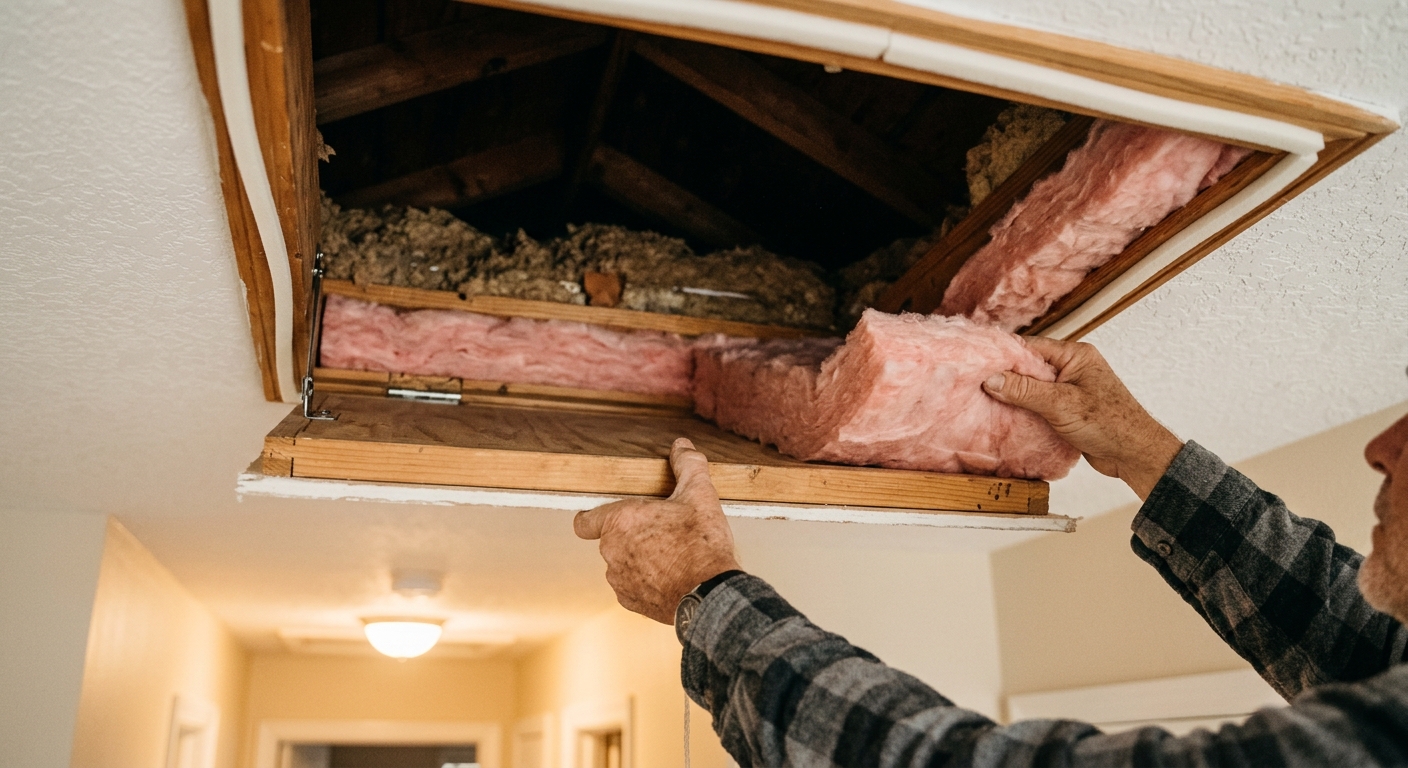
- Purchase a 2-inch-thick sheet of polyisocyanurate (polyiso) rigid foam board, which provides approximately R-13 per 2 inches. Cut it to match the exact size of the hatch door using a utility knife and straightedge.
- Clean the top surface of the hatch door with a dry cloth to remove dust. Apply construction adhesive or spray foam adhesive to bond the rigid foam panel directly on top of the hatch door, on the attic side.
- Cut self-adhesive foam weatherstripping tape (3/8-inch wide by 3/16-inch thick) and press it firmly around the entire perimeter of the hatch frame where the door makes contact. This seals the air gap around the edge.
- Replace the hatch door with the foam panel facing up into the attic. Press down firmly so the weatherstripping compresses and creates an airtight seal.
- Check for daylight gaps around the perimeter from below. If gaps are visible, add a second layer of weatherstripping or use a bead of paintable acoustical sealant around the frame.
- Measure the hatch opening from above in the attic. Your cover box needs to be large enough to extend at least 6 inches beyond the hatch opening on all four sides to overlap the surrounding attic insulation.
- Cut four sides and a top panel from 1.5-inch polyiso rigid foam board using a utility knife. The box should be 12 to 14 inches tall to clear any existing attic insulation depth. Use foil tape rated for rigid foam to seal all seams tightly.
- If your attic has blown-in insulation that may shift, create a simple wooden frame from 1×4 lumber around the hatch opening to hold the cover box in position and keep insulation from migrating under it.
- Apply foam weatherstripping to the bottom edge of the cover box where it will sit on the attic floor or framing, creating an airtight base seal.
- Cut additional rigid foam panels to place inside the top of the cover box, building up to at least R-30. Alternatively, lay two layers of R-19 fiberglass batts on top of the sealed box lid to reach R-38.
- Label the outside of the box clearly with a permanent marker so anyone accessing the attic can find and replace it correctly. Test the fit and alignment from below to confirm the hatch still opens and closes smoothly with the cover removed from above.
Why It Works: The Benefits
Properly insulating and sealing an attic hatch can reduce attic-related energy loss by 15 to 30%, translating to $50 to $150 per year in savings depending on climate, home size, and energy rates.
Rooms with unsealed attic hatches often have cold drafts near the ceiling in winter and radiant heat gain in summer. Sealing the hatch eliminates this localized discomfort noticeably within days.
Stopping conditioned air from leaking into the attic reduces the moisture load on attic framing and insulation, lowering the risk of condensation, rot, and mold growth over time.
When your home retains conditioned air better, your furnace or AC runs fewer cycles to maintain setpoint temperatures, reducing wear on the system and potentially extending equipment life by years.
A DIY insulated attic hatch cover costs $30 to $80 in materials and requires no permits, no contractors, and no specialized tools, with a typical payback period of one to two heating seasons.
💰 Savings Impact by Action
Sealing the air gap around an attic hatch perimeter can reduce attic-related air leakage by up to 25%, since the hatch is often the largest single unsealed opening in the ceiling plane.
Bringing the hatch door from R-1 to R-13 or higher eliminates a concentrated thermal weak point and reduces overall ceiling heat loss by roughly 15% in homes with otherwise adequate attic insulation.
Adding an insulated cover box that brings the hatch assembly to R-38 to match surrounding attic insulation reduces attic-related heat loss through the hatch by up to 30% compared to a bare uninsulated door.
Homes that complete both air sealing and insulation at the hatch together report 15 to 20% reductions in overall heating energy use in the rooms adjacent to the hatch, based on DOE weatherization program data.
🏠 Key Concepts Explained
The Science Behind It
Heat always moves from warm to cold, and it does so through three mechanisms: conduction, convection, and radiation. At an attic hatch, all three are working against you simultaneously. Conduction moves heat directly through the thin hatch door material. Convection carries warm air through gaps around the hatch frame into the cold attic. Radiation transfers heat energy across the air gap between a warm hatch surface and colder attic surfaces. Addressing only one of these mechanisms, such as adding insulation without sealing air gaps, leaves the other two pathways wide open.
The stack effect amplifies the problem significantly. Because warm air is less dense than cool air, it naturally rises to the highest point in a structure and pushes outward through any available gap. In winter, your living space is pressurized at the top relative to the attic, meaning air is constantly being pushed through the hatch perimeter even on calm days. On windy days or in taller homes, this pressure difference increases and the air leakage rate multiplies. An attic hatch that leaks 0.5 cubic feet per minute on a calm day may leak 2 to 3 cubic feet per minute during a winter storm.
R-value is the standard measure of thermal resistance per inch of material. Standard half-inch drywall has an R-value of approximately R-0.45. Adding 2 inches of polyisocyanurate rigid foam brings the assembly to roughly R-13.5, and a full cover box with additional batts on top can reach R-38 to R-50, matching or exceeding the surrounding attic floor insulation. Once the hatch assembly matches the surrounding R-value and all air gaps are sealed, the hatch essentially disappears from a thermal perspective, eliminating its outsized contribution to your home’s daily heat loss.
Frequently Asked Questions
▼ My attic hatch is a pull-down stair unit, not a simple panel. Does this still apply?
Yes, and pull-down attic stairs are actually worse than standard hatches because the folding frame creates multiple air leakage paths and the door is often uninsulated thin plywood. Pre-made insulated cover tents designed specifically for pull-down stairs are available for $30 to $80 and install in under an hour by sitting over the entire stair frame from the attic side. Look for products rated at R-20 or higher.
▼ I added insulation to my hatch but the room below still feels drafty. What am I missing?
Air sealing is likely the missing step. Insulation slows conduction but does not stop air movement through gaps. Go back and inspect the perimeter of the hatch frame with an incense stick or tissue in cold weather to identify airflow. Apply self-adhesive foam tape to the frame contact surface and seal any visible cracks between the frame and the ceiling drywall with acoustical caulk.
▼ Can I use spray foam directly on the hatch door instead of rigid foam board?
Canned spray foam is excellent for sealing gaps and cracks around the frame, but it is not ideal as the primary insulation layer on the door itself because it is difficult to apply in a uniform thickness and can bow or distort a lightweight hatch door as it expands. Use rigid foam board for the insulation layer and reserve spray foam for sealing the perimeter gaps.
▼ How do I know if my existing attic insulation is deep enough to bother with the hatch fix?
If your attic insulation is less than 10 to 11 inches of fiberglass batts or less than 12 inches of blown cellulose, adding more insulation everywhere including the hatch is worth prioritizing. If your attic already has R-38 or more but the hatch is still uninsulated, fixing the hatch gives you a disproportionately large return because it is the single weakest thermal link in an otherwise well-insulated assembly.
▼ Will this fix help in summer as well as winter?
Yes. In summer, attic temperatures regularly reach 130 to 150 degrees Fahrenheit, and an uninsulated hatch radiates that heat directly into your living space. Insulating and sealing the hatch reduces this radiant and conductive heat gain, lowering cooling load and helping your AC maintain setpoint with less effort. Homes in hot climates often see the summer benefit equal to or greater than the winter savings.
Quick Tips
- Use polyisocyanurate (polyiso) foam rather than EPS or XPS when space is tight: polyiso delivers R-6 to R-6.5 per inch versus R-4 to R-5 for EPS, so you get more insulation value in a thinner panel.
- Mark the outline of the cover box on the attic floor with colored tape so anyone entering the attic can quickly locate and replace it correctly without guessing.
- If your attic hatch is in a closet or hallway with a door, weatherstripping that door as well creates a double buffer zone that further reduces air and heat movement into the living space.
- Take before and after photos of your attic hatch during and after the project. If you ever sell your home, documented energy improvements are a selling point and may qualify for home energy credits in some states.
Variations for Your Situation
- Apartment or Condo: If you have attic access through a shared or individual hatch, check with your building manager before modifying it. Many condo owners can add a rigid foam panel to the hatch door without altering the structure, and self-adhesive foam weatherstripping requires no permanent changes. Focus on the weatherstripping and a removable foam panel that can be taken down if a building engineer needs access.
- Tight Budget (Under $30): Skip the cover box and focus entirely on weatherstripping and a single layer of 1-inch polyiso cut to fit the hatch door. A 4×8 sheet of 1-inch polyiso costs about $20 at most home centers and yields R-6, which is still six times better than an uninsulated hatch. Combined with foam tape weatherstripping at $5 to $8, this approach delivers 80% of the benefit for under $30 total.
- Older Home (Pre-1980): Homes built before 1980 are more likely to have knob-and-tube wiring, open wall cavities that connect to the attic, and original hatch frames that are warped or unsealed. Before insulating, inspect the attic for any exposed wiring near the hatch and note the condition of the frame. You may need to re-square or re-nail a warped hatch frame before weatherstripping will seal properly. Consider hiring an energy auditor to do a blower door test, which will confirm whether the hatch is a primary leakage point compared to other bypasses in an older home.