Your electrical panel is the heart of your home’s power system, yet most homeowners never think about it until something goes wrong. If your home was built before 1990, or if you’ve added major appliances, an EV charger, or a home office in recent years, your panel may be struggling to keep up. An undersized or outdated panel doesn’t just cause nuisances like tripped breakers – it can be a genuine fire and safety hazard.
Beyond safety, an aging panel affects your ability to add efficiency upgrades. Heat pump water heaters, EV chargers, induction ranges, and whole-home battery backup systems all require adequate amperage. A 100-amp panel, common in homes built before 1980, simply cannot support a modern electrified home. Upgrading to 200 amps (or even 400 amps for larger homes) unlocks every future efficiency investment you might want to make.
This guide covers the warning signs that your panel needs attention, the difference between a simple breaker fix and a full upgrade, what a licensed electrician will do during the project, and realistic cost ranges based on current contractor data. Whether you’re planning an EV charger installation or just noticed your lights flickering, this is the information you need to make a confident decision.
What You’ll Need
Click on an item below to shop for the recommended items for this recipe on Amazon.
As an Amazon Associate, we earn from qualifying purchases.
How to Do It
- Locate your main electrical panel (usually in a basement, garage, utility room, or hallway closet) and open the cover to inspect the breaker labels and overall condition.
- Look for the brand name on the panel interior or door. If it says Federal Pacific, Stab-Lok, or Zinsco, write this down – these are known defective brands that require replacement.
- Check the main breaker amperage, printed on the large breaker at the top of the panel. A rating of 60 or 100 amps in a home with modern appliances is a strong sign an upgrade is warranted.
- Count the number of available breaker slots. If every slot is full or you see tandem (double) breakers crammed into single slots, your panel is at capacity.
- Write down any existing warning signs: breakers that trip regularly under normal use, a burning smell near the panel, lights that flicker when large appliances start, or breakers that feel warm to the touch.
- Use this information when requesting quotes from electricians. Share the brand, amperage, and symptom list so contractors can give you accurate bids without an in-person visit.
- Obtain at least three written quotes from licensed electricians. Specify whether you want 200-amp or 400-amp service, and ask each contractor to include permit fees, utility coordination, and inspection in their bid.
- Confirm the electrician will pull the required permit. Unpermitted panel work voids homeowners insurance and creates liability issues at resale. This is a non-negotiable requirement.
- Schedule utility company coordination – your power company must disconnect service at the meter before work begins. The electrician typically handles this, but lead times of 3 to 10 business days are common in many areas.
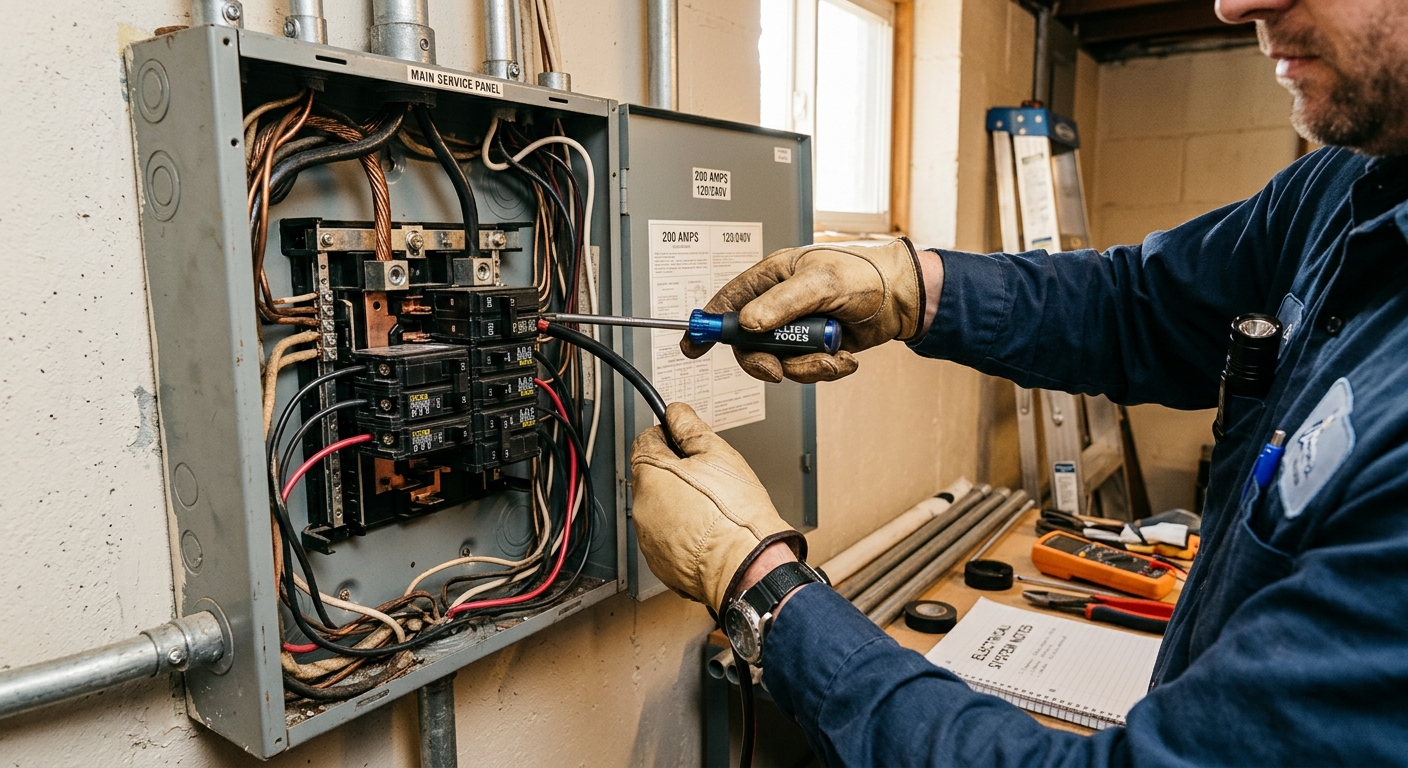
- On installation day, the electrician will remove the old panel, install the new panel box, reconnect all existing circuits, install a new main breaker, and update grounding and bonding to current NEC code.
- Request that the electrician install AFCI breakers on bedroom and living area circuits and GFCI breakers on kitchen, bathroom, garage, and outdoor circuits during the upgrade. This adds $10 to $30 per breaker but brings the home to modern safety standards.
- Schedule the inspection with your local building department. The inspector will verify code compliance and issue a certificate. Keep this document with your home records for insurance and resale purposes.
- Hire an electrician to perform a full NEC Article 220 load calculation before specifying panel size. This calculation accounts for current and planned loads and prevents sizing mistakes.
- Request a 400-amp service with a split meter base, or a 200-amp panel with a subpanel for EV charging and battery systems, depending on your utility’s capabilities and local code.
- Confirm your utility can deliver 400-amp service to your address. In some areas, the utility transformer serving your home may need upgrading, which adds cost ($500 to $2,000) and lead time (2 to 8 weeks).
- Ask the electrician to pre-wire conduit runs for a future EV charger circuit, solar inverter connection, and battery backup connection during the panel project. Adding these stub-outs now costs $100 to $300 and saves $500 to $1,500 later.
- Specify a smart load management panel (brands include Span, Leviton, or Square D EV Ready) if you want app-based circuit monitoring and control. These panels cost $1,500 to $3,000 more but provide granular energy data and automatic load shedding.
- After inspection and utility reconnection, use the panel’s circuit monitoring data (if applicable) to identify phantom loads, high-draw appliances, and optimization opportunities across your home.
Why It Works: The Benefits
Replacing a Federal Pacific or Zinsco panel eliminates one of the top identified causes of electrical fires. Modern breakers with AFCI protection reduce arc-fault fire risk by up to 75% compared to standard breakers, according to CPSC research.
A 200-amp panel is the minimum required to add a Level 2 EV charger (24 to 48 amps), a heat pump system (30 to 60 amps), or a heat pump water heater (30 amps). These upgrades can reduce energy costs by 20 to 50% compared to gas or resistance-electric alternatives.
Many insurers charge 10 to 25% higher premiums for homes with Federal Pacific, Zinsco, or fuse-box panels. After upgrading, you may qualify for a safer-home discount. Some insurers will not renew policies on homes with these panels at all.
A modern 200-amp panel adds an estimated $1,500 to $4,000 in appraised value and removes a common buyer contingency during home inspections, helping deals close faster and smoother.
An adequately sized panel eliminates the cascade of tripped breakers that occurs when you run the microwave, dishwasher, and hair dryer simultaneously – a daily annoyance in homes with 100-amp or smaller service.
💰 Savings Impact by Action
Replacing a flagged panel brand can reduce homeowners insurance premiums by 10 to 25% annually by removing a high-risk classification.
Upgrading to a panel that supports a heat pump system replaces gas or resistance heat with a technology that cuts heating and cooling costs by up to 40%.
Charging an EV at home on off-peak rates instead of using public chargers saves the average driver 50 to 60% on per-mile fuel costs, enabled by a proper 240V circuit.
Corroded connections and undersized conductors waste 2 to 5% of household energy as heat at panel terminations, which proper hardware eliminates.
🏠 Key Concepts Explained
The Science Behind It
Your electrical panel is fundamentally a controlled switching and protection device. It receives high-voltage alternating current (120/240V in North America) from the utility through the service entrance conductors, and distributes it through individual circuits protected by breakers. Each breaker is calibrated to trip at a specific amperage, creating an intentional weak point that protects wiring from overheating. The key principle here is Joule’s Law: heat generated in a conductor equals the square of the current multiplied by resistance. Double the current and you quadruple the heat – which is why an overloaded 15-amp circuit can reach wire-melting temperatures within minutes if the breaker fails to trip.
Modern arc-fault circuit interrupters (AFCIs) add another layer of protection by detecting the specific electrical signature of an arcing fault, which standard thermal-magnetic breakers cannot sense. An arc fault occurs when current jumps a gap in damaged or loose wiring, generating temperatures exceeding 10,000 degrees Fahrenheit locally – enough to ignite wall framing even when current levels are below the breaker’s trip threshold. AFCI breakers sample the current waveform thousands of times per second and interrupt power within milliseconds of detecting an arc pattern. This technology explains why the NEC has expanded AFCI requirements to cover nearly all living spaces since the 2014 code cycle.
From an energy efficiency perspective, a correctly sized panel and service entrance reduces resistive losses at the connection points where most degradation occurs. Corroded lugs, undersized conductors, and loose terminations all add impedance to the circuit. While the losses at any single connection are small, a poorly maintained panel can waste 2 to 5% of total household energy in heat generated at connection points. More importantly, an adequate panel removes the constraint that prevents homeowners from switching to high-efficiency electric alternatives to gas appliances – a transition that, according to DOE analysis, reduces household energy costs by 20 to 40% while cutting carbon emissions significantly.
Frequently Asked Questions
▼ My breakers keep tripping. Does that always mean I need a new panel?
Not always. A single breaker tripping repeatedly usually means that specific circuit is overloaded, not that the panel is failing. Try redistributing loads across different circuits first. If multiple breakers are tripping, the main breaker is weak, or breakers feel hot, those are signs of a panel-level problem that warrants an electrician’s inspection.
▼ How much does a 200-amp panel upgrade cost in 2024?
Nationally, a 200-amp panel replacement by a licensed electrician ranges from $1,500 to $3,500 including parts, labor, permit, and inspection. Costs are higher in California, New York, and other high-labor-cost markets, where $3,000 to $4,500 is more typical. If the service entrance wiring or meter base also needs replacement, add $500 to $1,500.
▼ Can I upgrade my panel myself to save money?
In most states, panel replacement requires a licensed electrician and a permit. Beyond the legal issue, the service entrance wires are energized even with the main breaker off and present a fatal electrocution risk. The money saved on labor is not worth the risk, and unpermitted work creates serious problems with insurance claims and home sales.
▼ Will upgrading my panel actually lower my electric bill?
A panel upgrade alone will not produce dramatic monthly savings – the direct energy waste from an aging panel is typically 2 to 5%. The financial benefit comes from what the upgrade enables: installing a heat pump, EV charger, or induction range that replaces less efficient gas or resistance-electric alternatives. These downstream upgrades are where the 20 to 40% savings appear.
▼ My home inspector flagged a Federal Pacific panel. Is it really that dangerous?
Yes, this is a legitimate concern, not an upsell. Independent testing and CPSC investigations have documented that Federal Pacific Stab-Lok breakers fail to trip at rates far exceeding acceptable limits. Many insurers now refuse to write or renew policies on homes with these panels. Budget for replacement and treat it as a priority safety issue.
Quick Tips
- Always get three quotes and ask specifically what the permit, inspection, and utility coordination process looks like – this filters out contractors who cut corners.
- If your home has a Federal Pacific or Zinsco panel, treat replacement as urgent, not optional. Inform your insurance company of the upgrade once complete to potentially lower your premium.
- Time your panel upgrade to coincide with other planned projects like an EV charger, heat pump, or kitchen remodel to share the cost of permitting and the utility disconnect.
- Ask your electrician to label every circuit clearly on the panel directory during the upgrade. A properly labeled panel saves hours of troubleshooting for every future repair or renovation.
Variations for Your Situation
- Older Home (pre-1980): Homes from this era almost always have 60-amp or 100-amp service, fuse boxes, or one of the problematic panel brands. Start with a licensed electrician inspection ($75 to $150) to document what you have. Expect the full upgrade cost to be at the higher end of the range because service entrance wiring, grounding electrodes, and meter bases often need concurrent replacement under modern code requirements.
- EV or Solar Ready: If you plan to add an EV charger or solar in the next 3 to 5 years, upgrade to 200-amp minimum now and ask the electrician to pre-wire a dedicated 60-amp circuit with conduit to your garage and a solar-ready back-feed breaker slot. Adding these stub-outs during the panel project costs $150 to $400 and avoids a $1,000-plus return visit later.
- Tight Budget: If a full panel upgrade is not immediately affordable, prioritize getting a licensed inspection to confirm whether your situation is a safety emergency or a capacity issue. If the panel brand is safe and symptoms are mild, address the most overloaded circuits by redistributing loads and eliminating high-draw devices on those circuits. Set aside $150 to $200 per month toward the full upgrade and treat it as a 12 to 18 month savings goal rather than an indefinitely deferred project.