Walk into any big-box home improvement store and you will find air conditioners labeled in BTUs next to a simple square footage chart. The problem is that chart is almost always wrong for your specific home. An oversized unit blasts cold air and shuts off before removing enough humidity, leaving your home feeling clammy. An undersized unit runs constantly, never quite reaches your target temperature, and sends your electricity bill through the roof. Either mistake costs you money every single month.
The right size AC is not just about square footage. It depends on your ceiling height, insulation quality, local climate, sun exposure, number of occupants, and even how many heat-generating appliances you run. A 1,500 square foot home in Phoenix, Arizona needs a dramatically different system than the same home in Portland, Oregon. Getting this calculation right can save you 20 to 40% on cooling costs compared to running an improperly sized unit.
This post gives you a practical framework for estimating the right AC size yourself, explains when to invest in a professional load calculation, and helps you avoid the most common sizing mistakes. Whether you are replacing a central system, buying a window unit, or adding a mini-split, the same principles apply.
What You’ll Need
Click on an item below to shop for the recommended items for this recipe on Amazon.
As an Amazon Associate, we earn from qualifying purchases.
How to Do It
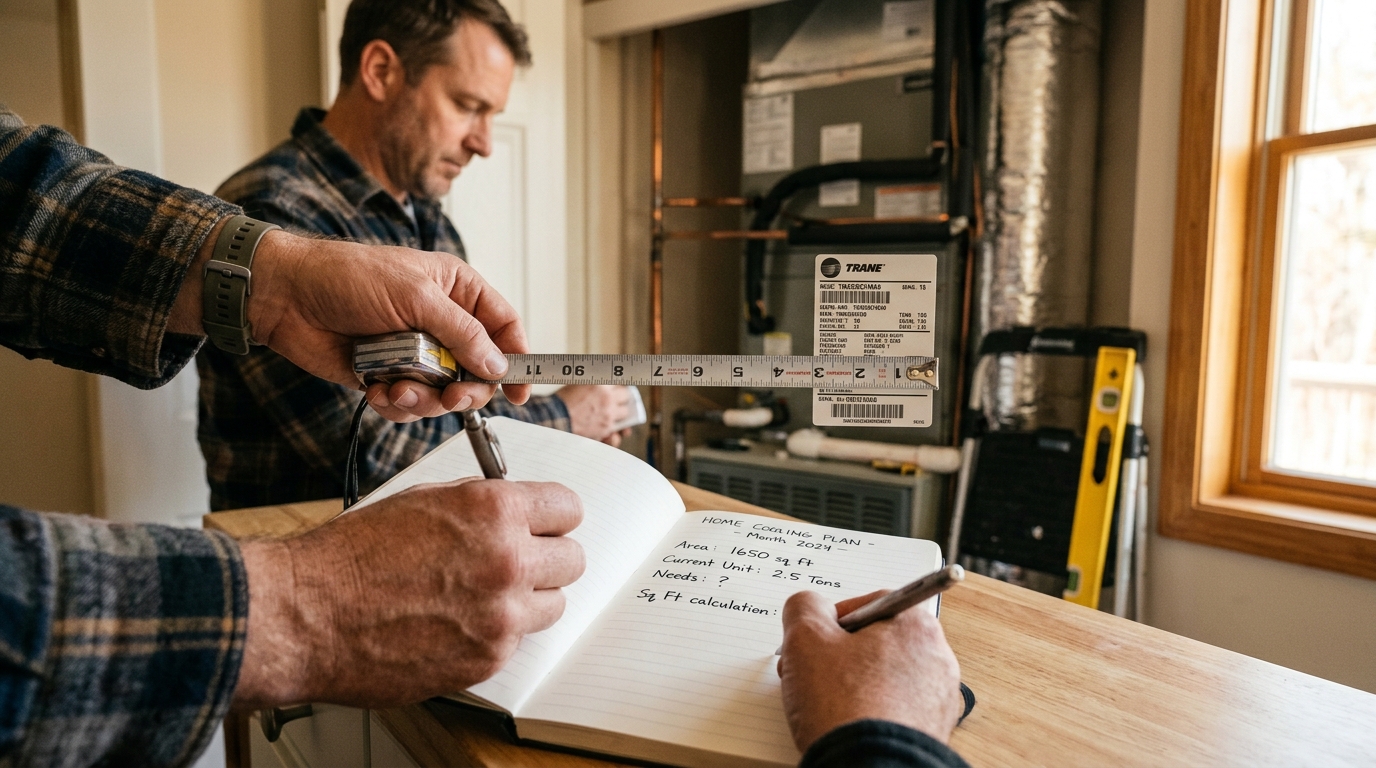
- Measure the square footage of the space you need to cool. For whole-home central AC, use the conditioned square footage only (exclude unconditioned garage, attic, and crawlspace).
- Start with a base BTU estimate: multiply your square footage by 20 BTU per square foot. A 1,500 sq ft home gives you a starting point of 30,000 BTU, which equals 2.5 tons of central AC capacity.
- Adjust for ceiling height. If your ceilings are above 8 feet, multiply your base BTU by 1.10 for 9-foot ceilings or 1.25 for 10- to 12-foot ceilings.
- Adjust for sun exposure. Add 10% if the space has large south- or west-facing windows with no shading. Subtract 10% if the space is heavily shaded by trees or overhangs.
- Adjust for occupancy and climate. Add 600 BTU per person beyond two regular occupants. If you are in a hot-humid climate zone (DOE zones 1 or 2, such as Florida, Texas Gulf Coast, or Louisiana), add an additional 10 to 15% for latent load.
- Convert your final BTU number to tons if shopping for central AC: divide by 12,000. Round to the nearest standard equipment size (1.5, 2, 2.5, 3, 3.5, 4, or 5 tons). If you land between sizes, choose the smaller option for humid climates and the larger for dry desert climates.
- Hire a licensed HVAC contractor or independent energy auditor who explicitly offers a Manual J load calculation. Ask for this in writing before the appointment. Avoid any contractor who sizes equipment only by square footage or by the size of your existing system.
- Before the visit, gather your home’s basic specs: year built, square footage per floor, ceiling heights, window count and approximate sizes, insulation levels in attic and walls if known, and your local utility bills from the last 12 months.
- During the assessment, the technician will measure windows, check insulation, note duct locations and condition, assess attic ventilation, and enter all data into Manual J software (such as Wrightsoft or ACCA-approved tools).
- Review the output report together. The report will show total cooling load in BTU, broken down by sensible and latent load, and recommend a specific equipment size. Ask the contractor to explain any number that seems unusually high.
- Use the Manual J result as a firm anchor when comparing quotes from multiple contractors. If one contractor recommends equipment 50% larger than the Manual J result, ask them to justify it in writing or move on.
- Once you have selected equipment sized to the Manual J result, ask for Manual D duct sizing and Manual S equipment selection reports as well. These three together ensure your ducts and equipment work as a matched system.
Why It Works: The Benefits
A properly sized, high-efficiency AC running in longer cycles uses 20 to 40% less electricity than an oversized unit short-cycling or an undersized unit running non-stop. On a $200 summer cooling bill, that is $40 to $80 saved every month.
A correctly sized unit runs long enough to pull moisture out of the air, keeping indoor humidity between 40 and 50%. This makes 75 degrees F feel as comfortable as 70 degrees F in an oversized system, so you may be able to raise your thermostat setpoint by 2 to 3 degrees and save an additional 6 to 9% on cooling costs.
Proper sizing eliminates short cycling and reduces compressor stress. Central AC compressors sized correctly regularly last 15 to 20 years, while chronically oversized units often fail in 8 to 12 years, costing $1,500 to $4,000 in premature replacement costs.
A right-sized system runs longer, steadier cycles that push conditioned air throughout the whole duct system. This eliminates hot and cold spots that are common when an oversized unit blasts air for 5 minutes then goes silent.
Dropping one equipment size (for example from a 3-ton to a 2.5-ton central system) typically saves $300 to $800 on equipment cost alone, plus lower installation labor. If your home has been oversized for years, fixing the root cause with air sealing and insulation first can unlock these savings.
💰 Savings Impact by Action
Replacing an oversized system with a correctly sized unit reduces cooling energy use by 20 to 40% by eliminating short cycling and improving dehumidification efficiency.
Properly sized equipment keeps humidity at 40 to 50%, allowing thermostat setpoints 2 to 3 degrees F higher without discomfort, saving approximately 6 to 9% per degree raised.
Air sealing and attic insulation before sizing a new AC reduces the peak cooling load by 15 to 25%, potentially allowing a smaller, less expensive unit.
Sealing leaky ducts prevents 20 to 30% of conditioned air from escaping into unconditioned spaces, effectively recovering lost capacity without upsizing equipment.
🏠 Key Concepts Explained
The Science Behind It
Heat always moves from warm areas to cool areas, and your air conditioner is fighting that process constantly. On a 95 degree F summer day, heat pours into your home through the roof, walls, windows, and any air leaks. The rate at which heat enters is called the cooling load, measured in BTUs per hour. Your AC must remove heat at least as fast as it enters to maintain your target temperature. If it removes heat too slowly (undersized), the indoor temperature climbs. If it removes heat far faster than needed (oversized), it shuts off after a few minutes and never runs a full cycle.
The latent load piece is often misunderstood. When humid outdoor air infiltrates your home, it carries water vapor. Removing that moisture requires the AC coil to run cold long enough for condensation to form and drain away. This is only possible during sustained run cycles of 15 minutes or more. An oversized unit that short-cycles in 5 to 8 minutes drops the air temperature but barely touches the humidity, which is why an oversized AC in a humid climate feels clammy even at 70 degrees F. Properly sized equipment balances sensible cooling (temperature drop) and latent cooling (dehumidification) for genuine comfort.
The efficiency loss from oversizing is real and measurable. Every time a compressor starts, it draws 3 to 5 times its running current for a few seconds, called the startup surge. Short-cycling means more startups per hour, more surge events, more energy wasted, and more mechanical stress on the compressor. Studies by Lawrence Berkeley National Laboratory found that oversized residential AC systems use 10 to 25% more energy than right-sized systems doing the same cooling work. Combined with the dehumidification problem, the total comfort and cost penalty of oversizing is significant over a system’s lifetime.
Frequently Asked Questions
▼ My new AC seems to run all day and never fully cools the house. Did I buy too small?
Not necessarily. First check that your air filter is clean, all supply and return vents are open, and the outdoor unit is not blocked by debris or vegetation. If all of those check out, your duct system may be leaking conditioned air into unconditioned spaces, which can account for 20 to 30% of lost cooling capacity. Have an HVAC technician check duct integrity and refrigerant charge before concluding the equipment is undersized.
▼ My AC keeps the temperature fine but the house feels humid and sticky. What is wrong?
This is a classic symptom of an oversized air conditioner. The unit is cooling the air temperature quickly but shutting off before it runs long enough to pull moisture out. Short of replacing the unit, you can raise the thermostat setpoint by 2 degrees to force longer run cycles, or add a whole-home dehumidifier to the system. A dehumidifier sized at 70 to 90 pints per day costs $200 to $400 and can resolve humidity complaints without replacing the AC.
▼ The contractor quoted me a 4-ton unit but my DIY calculation says 2.5 tons. Who is right?
Do not assume the contractor is right. Ask them to provide a written Manual J load calculation justifying the 4-ton recommendation. If they cannot, get a second and third quote from contractors who will perform a Manual J. Oversizing is extremely common because contractors fear callback complaints more than they fear inefficiency, and larger units cost more. Your DIY estimate may actually be closer to correct.
▼ Can I use the same sizing rules for a window unit or mini-split in a single room?
Yes, the same BTU-per-square-foot starting point applies (about 20 BTU per sq ft), with the same adjustments for sun exposure, ceiling height, and occupancy. For a single room, also account for heat from appliances like a TV, desktop computer, or cooking equipment in or near the space, adding 1,000 to 4,000 BTU for a kitchen or home office.
▼ My home is well-insulated and I replaced the windows last year. Should I size down from what I had before?
Possibly, yes. New triple-pane or double-pane low-E windows can reduce solar heat gain by 40 to 70% compared to single-pane glass. Combined with added insulation, your cooling load may have dropped enough to justify a smaller unit. This is exactly the scenario where a Manual J calculation pays for itself since it will give you a defensible number rather than a guess.
Quick Tips
- Always request a Manual J calculation in writing before any central AC quote. If a contractor refuses, that is a red flag.
- In humid climates like the Southeast or Gulf Coast, lean toward the lower end of the BTU range when between two sizes. Better dehumidification beats raw cooling power.
- Shade your west-facing windows with exterior awnings or solar shades before sizing a replacement AC. You may qualify for a smaller, less expensive unit.
- Check your existing system’s nameplate tonnage before calling contractors. It is stamped on the outdoor condenser unit. Knowing your current size helps you spot when contractors are upselling unnecessary capacity.
Variations for Your Situation
- Apartment/Rental: Renters are typically limited to window or portable AC units. Use the 20 BTU per square foot rule adjusted for sun exposure to choose the right window unit size. A south-facing 300 sq ft room may need 8,000 BTU rather than the generic 6,000 BTU recommendation. Avoid portable units if possible since they exhaust some conditioned air and are 15 to 20% less efficient than window units of the same BTU rating.
- Tight Budget (under $50): Use the free DIY sizing method in this post before buying any unit. The most costly mistake is buying the wrong size and having to return it or live with it for years. Spend nothing on calculations and invest your budget in the unit itself. If between two window unit sizes, choose the smaller one for humid regions and the larger for dry climates.
- Older Home (pre-1980): Homes built before 1980 typically have little or no wall insulation, single-pane windows, and high air leakage rates. Your raw cooling load may be 30 to 50% higher than a comparable modern home, but the right answer is usually to improve the envelope first rather than buy a larger AC. A $1,000 to $2,000 investment in attic insulation and basic air sealing can reduce your required equipment size and cut operating costs for decades.