Every winter, millions of homeowners watch helplessly as thick ridges of ice build up along their roof edges, sending meltwater back up under shingles and into ceilings, walls, and insulation. The instinct is to grab a roof rake or call someone to steam off the ice. But that treats the symptom, not the cause. Ice dams form because the upper portion of your roof is warm enough to melt snow while the eaves stay cold – and that uneven temperature is almost always caused by heat escaping through an under-insulated or air-leaky attic floor.
The real culprit hiding behind most ice dams is a combination of insufficient attic insulation and, more critically, unsealed air bypasses – gaps around recessed lights, plumbing chases, attic hatches, and top plates that allow warm interior air to pour directly into your attic. This warm air heats the roof deck from below, melts the snowpack above, and sends water running down to the cold eaves where it refreezes into a dam. No amount of de-icing cables or roof raking will stop the cycle if the heat source is still there.
In this post, you will learn exactly why ice dams form, how to identify whether your attic insulation and air sealing are the problem, and what you can do – from a free DIY inspection this weekend to a professional remediation that pays for itself in energy savings – to stop ice dams at their source and keep your home warmer and drier for decades to come.
What You’ll Need
Click on an item below to shop for the recommended items for this recipe on Amazon.
As an Amazon Associate, we earn from qualifying purchases.
How to Do It
- On a cold day, go into your attic during the morning and look for frost or condensation patterns on the underside of the roof sheathing – bright white patches directly above ceiling penetrations reveal your worst air bypasses.
- Using a headlamp, locate and map all ceiling penetrations: recessed can lights, bathroom exhaust fan housings, plumbing vent pipes, electrical junction boxes, and the tops of interior partition walls.
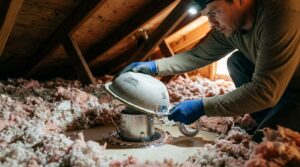
- Seal around recessed light housings with fire-rated caulk or pre-made airtight covers (called IC boxes or intumescent covers) rated for attic use. A single unsealed recessed light can lose as much heat as leaving a window cracked open all winter.
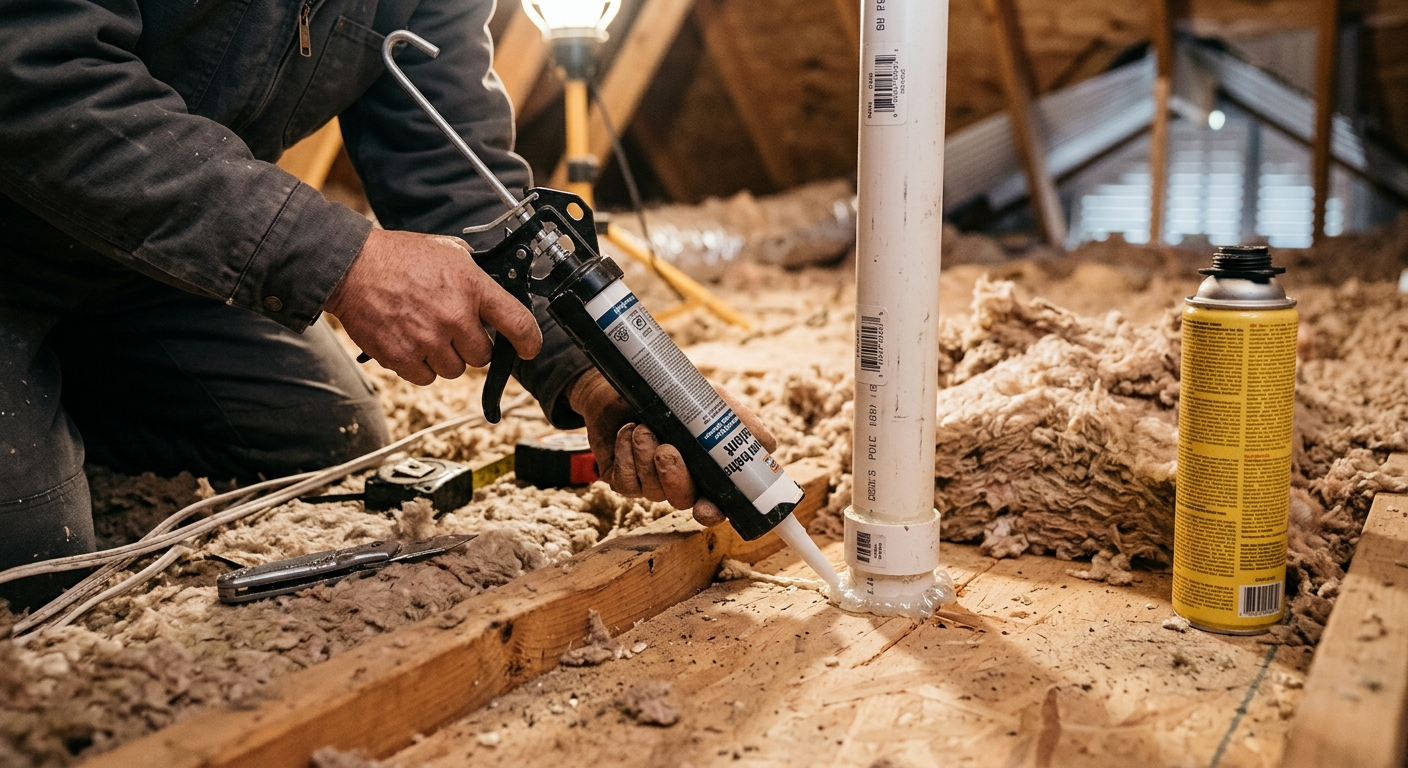
- Use canned spray foam (low-expansion formula) to seal around all plumbing and wiring penetrations through the top plates. Fill gaps less than 1 inch; for larger openings, cut a piece of rigid foam board and foam it in place.
- Cut and fit rigid foam board (2-inch polyiso, R-13) over the attic hatch, then glue weatherstripping to the hatch frame. An unsealed attic hatch can account for 15% of total attic heat loss by itself.
- Check soffit baffles at the eave ends of each rafter bay – they should be open and unblocked by insulation so cold outside air can flow up under the roof deck and keep it uniformly cold. Clear any compressed insulation from the eave edge.
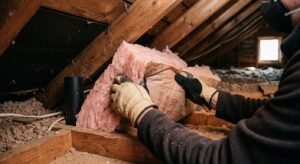
- Measure your attic’s square footage and existing insulation depth. Use the DOE Zone Map to confirm your target R-value (R-49 to R-60 for Climate Zones 5 to 7, which include most northern states). Calculate how many inches of blown cellulose or fiberglass you need to add to reach that target.
- Install or confirm proper soffit baffles in every rafter bay before blowing insulation – these maintain the 1-inch minimum air channel from soffit to ridge that keeps the roof deck cold.
- Lay down temporary walking boards across the attic joists so you can move safely without stepping through the ceiling. Mark the target insulation depth on several vertical stakes positioned across the attic so you can gauge depth while blowing.
- Follow the blower machine setup instructions from the store rental desk. Have a helper feed bags into the hopper while you direct the hose across the attic floor in steady, overlapping passes.
- Blow insulation to your target depth plus about 15% to account for settling. Blown cellulose settles roughly 15 to 20% in the first year, so overshoot slightly.
- After completing the job, verify depth at multiple points with a ruler, re-check that all soffit baffles are still clear, and take photos of the finished attic for your records and any tax credit documentation.
- Schedule a home energy audit through your utility company or a certified BPI (Building Performance Institute) auditor. Blower door testing with a thermal camera will quantify exactly where heat is escaping and give you a prioritized scope of work.
- Review the audit report and request a detailed written quote that separates air sealing labor from insulation materials. A reputable contractor will always air seal before insulating – walk away from any bid that skips this step.
- Ask the contractor to use spray foam for sealing larger cavities and gaps at partition wall top plates, as this provides both an air barrier and moisture barrier. Smaller penetrations should be caulked with fire-rated sealant.
- For rooflines with very low attic clearance (under 18 inches), ask about dense-pack cellulose blown directly into rafter bays – this can achieve R-23 in a 2×6 rafter cavity without requiring attic access.
- After installation, request post-work blower door results to confirm the air leakage has actually been reduced. A good air sealing job on a leaky house typically reduces air changes per hour by 20 to 40%.
- File for your federal tax credit using IRS Form 5695 and save the contractor’s Manufacturer Certification Statement for insulation materials, which is required to claim the credit.
Why It Works: The Benefits
Properly air-sealing and insulating the attic floor removes the heat source that drives snowmelt on the upper roof. Homeowners who bring attic insulation to R-49 and seal bypasses report eliminating ice dams entirely, saving hundreds to thousands of dollars in annual ice removal and water damage repair costs.
The DOE estimates that air sealing and insulation together can reduce heating and cooling costs by 15 to 30% annually. For a home spending $1,800 per year on heating, that is $270 to $540 back in your pocket every year.
A single ice dam leak can cause $4,000 to $10,000 in interior water damage, including ruined drywall, insulation, and mold remediation. Fixing the root cause eliminates this recurring liability, and many insurers offer discounts for documented weatherization improvements.
Sealing attic bypasses reduces cold drafts on upper floors and eliminates the temperature swings that make bedrooms near the roof feel 5 to 8°F colder than the rest of the house in winter.
Under the Inflation Reduction Act, homeowners can claim a 30% federal tax credit (up to $1,200 per year) on insulation and air sealing materials installed through 2032, dramatically shortening the payback period on professional upgrades.
💰 Savings Impact by Action
Sealing attic floor bypasses eliminates convective heat transfer that accounts for 25 to 40% of attic heat loss, delivering up to 20% reduction in heating load in leaky homes.
Bringing attic insulation from R-19 to R-49 reduces conductive heat loss through the ceiling plane by 15 to 25% depending on climate zone and existing conditions.
Insulating and weatherstripping an unsealed attic hatch eliminates an opening that can account for up to 15% of attic heat loss, delivering roughly 8% improvement in overall attic performance.
Restoring blocked soffit-to-ridge airflow keeps the roof deck uniformly cold, reducing ice dam risk by up to 10% and preventing the moisture buildup that degrades insulation R-value over time.
🏠 Key Concepts Explained
The Science Behind It
Ice dams are a thermodynamics problem with a very specific fingerprint. For an ice dam to form, your roof surface must have two distinct temperature zones: an upper section above 32°F that melts accumulated snow, and a lower eave section below 32°F where that meltwater refreezes. The only way this temperature gradient can exist on a single continuous roof surface is if heat is being added unevenly from below. In almost every case, that heat is coming from the conditioned living space through a combination of conductive heat loss through under-insulated attic floors and, more significantly, convective heat transfer through unsealed air bypasses.
The physics of stack effect explains why attic bypasses are so damaging in winter. Warm air is less dense than cold air, so it rises continuously toward the top of the building. Any gap in the ceiling plane – a recessed light, a plumbing chase, a gap at a partition wall top plate – becomes a one-way valve for warm air to escape into the attic. Research from Oak Ridge National Laboratory and the Building Science Corporation has shown that in a typical leaky house, air leakage accounts for 25 to 40% of total heating load. Once that warm air is in the attic, it heats the roof deck directly from below, creating the warm upper roof zone that feeds the ice dam cycle. Meanwhile, the eaves, which extend past the heated building envelope with no warm air input, stay well below freezing.
Proper attic insulation and air sealing break this cycle at the source by maintaining what building scientists call a cold roof in winter. When the attic floor is both airtight and insulated to code (R-49 or higher in cold climates), the attic temperature tracks closely with outdoor temperatures rather than indoor temperatures. The entire roof surface stays uniformly cold, snow melts only during sustained warm weather or direct sunlight, and there is no temperature differential to drive ice dam formation. Equally important, proper soffit-to-ridge ventilation then works as designed, flushing any residual heat and moisture out of the attic before it can affect the roof deck temperature.
Frequently Asked Questions
▼ I added more attic insulation last year but I still got ice dams. What am I missing?
Insulation alone will not stop ice dams if air bypasses are still present. Warm air flowing through unsealed gaps around recessed lights, plumbing, or wall top plates bypasses the insulation entirely and heats the roof deck directly. Go back into the attic and do a thorough air sealing pass before your next heating season, paying close attention to any ceiling penetrations. If you can see daylight or feel a draft near any opening, that is your culprit.
▼ My attic already has R-30 insulation. Is it worth adding more to stop ice dams?
R-30 is below the DOE minimum recommendation of R-49 to R-60 for most northern climates, so adding more insulation will help reduce heating bills and improve comfort. However, the bigger opportunity is almost certainly air sealing, which gives a higher return per dollar in most homes. Air seal first, then evaluate whether topping up to R-49 makes sense based on your heating costs and climate zone.
▼ Can I just install heat cables along my eaves to stop ice dams?
Heat cables will prevent ice dams from forming at the specific spots where they are installed, but they consume electricity continuously and do nothing to address the underlying heat loss causing the problem. You are essentially paying to heat your roof to counteract heat you are already wasting through the attic, which doubles your energy penalty. Treat heat cables as a short-term emergency measure only, not a permanent solution.
▼ How do I know if my soffit vents are blocked and contributing to the problem?
Go into the attic and look at the eave ends of each rafter bay. You should see a clear channel (maintained by a baffle) running from the soffit up to the open attic space. If you see insulation packed right to the roof deck with no air channel, your ventilation is blocked. Install polystyrene or cardboard rafter baffles (also called vent chutes) stapled to the roof deck before adding more insulation – they cost about $1 to $2 each and are available at any hardware store.
▼ We rent our home. Is there anything we can do about ice dams without landlord permission?
Structural fixes like attic air sealing and insulation require landlord involvement, but you can document the ice dam problem with dated photos and formally request repairs in writing, which creates a paper trail. In the short term, a roof rake with a telescoping handle ($30 to $60) used safely from ground level to clear snow before it accumulates can reduce ice dam formation significantly. You can also contact your state’s weatherization assistance program, as some programs work directly with landlords to fund upgrades at no cost to either party.
Quick Tips
- Check your attic insulation depth on the first warm day of fall, before heating season begins – you want to identify gaps and thin spots while conditions are safe and comfortable for attic work.
- Look at your roof after a heavy snowfall before any melting has occurred. A roof where snow melts noticeably faster over the center of the house than at the edges is telling you heat is escaping through the attic floor.
- Prioritize air sealing bathroom exhaust fans – many are installed without any air seal between the fan housing and the ceiling, effectively creating a duct that pumps warm humid air directly into the attic every time the fan runs.
- If you have a pull-down attic stair, install an attic stair cover kit (a rigid foam or reflective insulated tent that fits over the stair from the attic side). These cost $50 to $100 and can eliminate a large, consistently uninsulated opening that loses heat around the clock.
Variations for Your Situation
- Apartment or Condo: If you live in a multi-unit building, ice dams are a building management issue since the attic and roof are common elements. Document the problem with photos, submit a formal written request to your HOA or property manager citing potential water damage liability, and reference local building codes that specify minimum attic insulation requirements. You may also contact your state energy office, as some offer free energy audits for multifamily buildings that can create leverage for required upgrades.
- Tight Budget (under $100): Focus entirely on air sealing with spray foam and caulk, which delivers the highest return for the lowest cost. One two-can pack of low-expansion spray foam ($20) and a tube of fire-rated caulk ($8) can seal the most critical bypasses in an afternoon. Add an attic hatch insulation cover for $50 to $100 and you will have addressed the three biggest heat loss points in most homes for under $130 total, often cutting ice dam severity significantly within the first winter.
- Older Home (pre-1980): Homes built before modern energy codes often have no insulation at partition wall top plates, open balloon framing that connects wall cavities directly to the attic, and knob-and-tube wiring that complicates any insulation work. Have a licensed electrician evaluate the wiring before doing any attic work. Expect to find R-0 to R-11 of original insulation and budget for a complete professional remediation rather than a DIY top-up. The energy savings potential in pre-1980 homes is typically at the high end of the 15 to 30% range, making the investment particularly worthwhile.