If you live in a two-story home, you already know the frustration: the downstairs feels fine while the upstairs bedrooms bake at night. This is not a malfunction. It is basic physics. Warm air is less dense than cool air, so it rises and pools near the ceiling of your upper floor. Without intervention, your AC has to work overtime to overcome this natural stratification, and it often loses the battle entirely during summer heat waves.
Portable fans are one of the most underrated tools in a homeowner’s cooling arsenal. Used correctly, they do not just move air around randomly. They create directed airflow patterns that exhaust hot air out, pull cooler air in, and force your home’s temperature to equalize between floors. The difference between pointing a fan at yourself and using it strategically across two floors is the difference between minor comfort and a genuinely cooler house.
This guide covers the building science behind why two-story homes overheat, then gives you a concrete step-by-step plan for using portable fans to fight back. Whether you spend zero dollars rearranging what you already own or invest $150 in a coordinated fan system, you will find an approach here that fits your situation.
What You’ll Need
Click on an item below to shop for the recommended items for this recipe on Amazon.
As an Amazon Associate, we earn from qualifying purchases.
How to Do It
- Check your existing fans: gather every portable fan in the house and identify which are box fans (most effective for window mounting), tower fans (best for directing airflow in hallways), and desk fans (best for personal cooling at workstations or nightstands).
- Set up the exhaust fan upstairs: place your largest box fan in an upper-floor window facing outward (blades blowing air outside). This creates negative pressure on the upper floor, pulling hot pooled air out of the space.
- Create a supply path downstairs: open a window on the shaded, cooler side of your lower floor, ideally on the north or east side. This is where cooler replacement air enters. If outdoor air is cooler than indoor air, this alone will begin moving heat out.
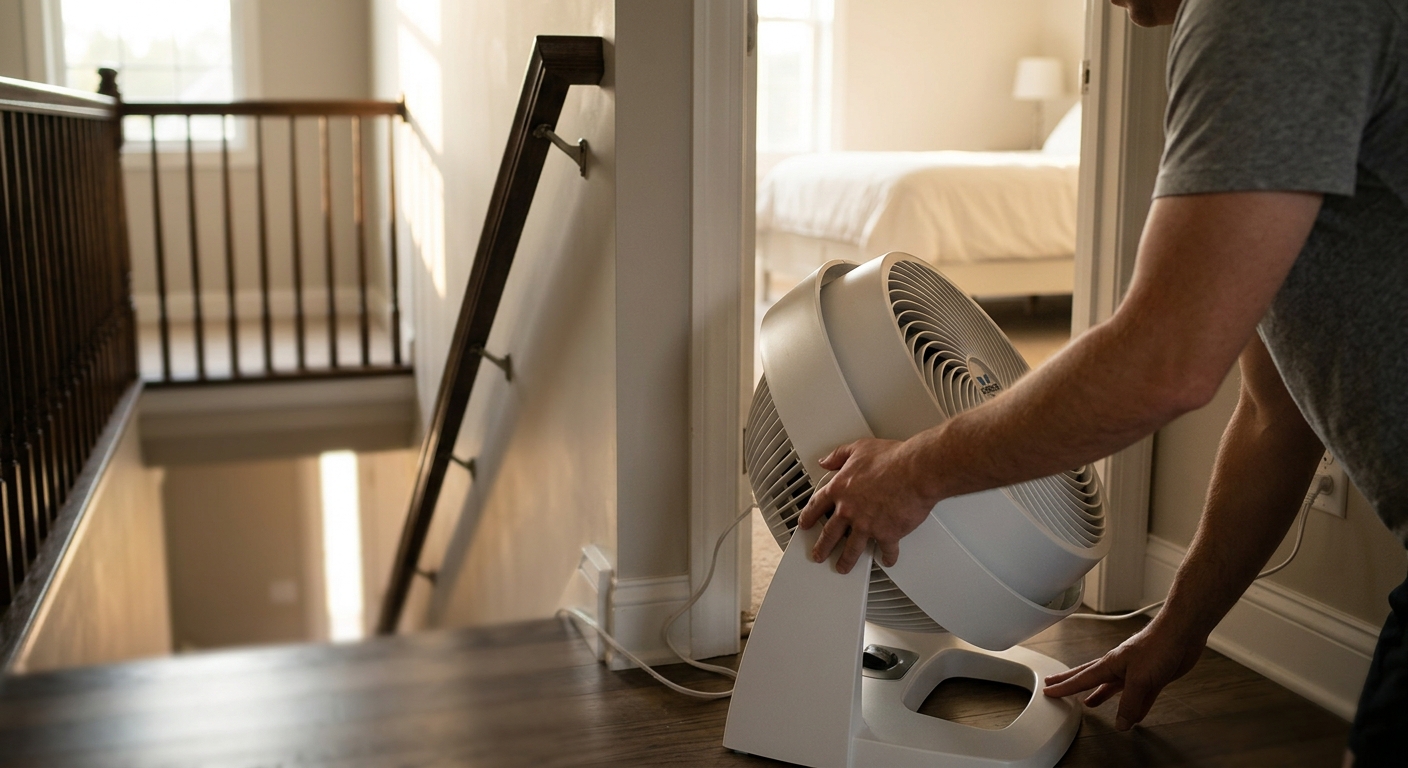
- Position a staircase fan: place a second fan at the base of the stairs pointing upward toward the upper floor. This forces cooler ground-floor air upstairs to replace what the exhaust fan is removing, completing the convective loop.
- Run this setup in the evening only: outdoor air is typically cooler than indoor air after 7 to 9 PM in most climates. Running this configuration for 2 to 3 hours before bed can drop bedroom temperatures by 5 to 8 degrees. During the day, close windows and let the AC work without competing with hot outdoor air.
- Buy the right fans for each role: purchase one 20-inch box fan ($30 to $50) for upper-floor window exhaust, one tower fan with oscillation ($50 to $80) for staircase circulation, and one additional box fan ($30 to $50) for lower-floor intake. Look for fans with at least 1,500 CFM rating on high speed.
- Map your home’s airflow path before placing anything: stand at the top of your stairs and identify where heat collects. In most homes this is the landing area, a south-facing bedroom, or a room above the garage. The exhaust fan goes in the room that gets hottest.
- Install the upper exhaust fan securely in a window: wedge the box fan tightly in the window frame blowing outward. Cover gaps on the sides with foam weatherstripping or a folded towel to prevent hot air from leaking back in around the edges. This dramatically improves the pressure differential.
- Position the tower fan at the staircase top or base: for daytime cooling, place it at the top of the stairs pointing down, pushing warm air toward the lower floor and the AC return. For nighttime purge, flip it to the base pointing upward to push cool ground-floor air toward the bedrooms.
- Program a cooling schedule with outlet timers ($8 to $15 each): set intake and circulation fans to turn on at 8 PM when outdoor temps typically drop, and set the exhaust fan to run until midnight. This automates the night purge without requiring you to remember to open or close windows.
- Test and measure: use an inexpensive indoor thermometer ($10 to $15) placed on the upper floor and check readings before and after a one-week test. Most homes see a 5 to 10 degree improvement in upper-floor temperatures with the full system running.
- Confirm attic ventilation is adequate: a whole-house fan pushes large volumes of air into the attic. You need at least 1 square foot of net free ventilation area for every 750 CFM of fan capacity. Check your soffit and ridge vents before purchasing a unit.
- Choose between belt-drive and direct-drive models: belt-drive units ($400 to $700) are quieter and longer-lasting. Direct-drive units ($200 to $400) are cheaper and easier to install but louder. Insulated shutter models prevent heat loss in winter.
- Cut the ceiling opening and mount the fan housing: follow manufacturer instructions precisely. The fan installs in the hallway ceiling between the upper-floor bedrooms and the attic. This is the most labor-intensive step and where most homeowners choose to hire a handyman ($100 to $200 for labor).
- Wire the fan to a dedicated switch: whole-house fans run on standard 120V circuits but should have a dedicated 15-amp circuit. If your electrical panel requires a new circuit, hire a licensed electrician.
- Use it correctly for maximum savings: open at least two windows on the lower floor before turning it on. Running a whole-house fan for 4 hours at night uses about the same electricity as 15 minutes of central AC operation, at a fraction of the cooling cost.
Why It Works: The Benefits
Raising your thermostat by just 4 degrees while using fans for comfort saves roughly 10 to 15% per degree, translating to $30 to $100 per month depending on your climate and home size.
A properly configured cross-floor fan system can reduce the temperature gap between upper and lower floors from 10 degrees down to 2 to 4 degrees, making bedrooms genuinely comfortable for sleeping.
Strategic fan use can reduce your AC compressor runtime by 20 to 40% on mild days, extending equipment life and reducing wear on the most expensive component in your HVAC system.
Unlike adding ceiling fans or upgrading insulation, portable fan strategies take 30 minutes to implement and require no tools, permits, or contractor appointments.
When outdoor temperatures drop below indoor temperatures at night, a fan-assisted purge can cool your home’s thermal mass by 5 to 10 degrees before morning, reducing the next day’s cooling load significantly.
💰 Savings Impact by Action
Raising the AC setpoint by 3 degrees while using fans for personal comfort saves approximately 8 to 12% on cooling costs without reducing comfort.
Flushing stored heat from walls and floors overnight reduces next-day cooling load by up to 18%, shortening AC runtime during peak afternoon hours.
A coordinated cross-floor fan system can reduce central AC compressor runtime by 20 to 30% on mild days by pre-cooling the space before the hottest part of the day.
Pairing fan strategy with closed blinds on south and west windows blocks up to 40 to 70% of solar heat gain, reducing the total cooling load fans must overcome.
🏠 Key Concepts Explained
The Science Behind It
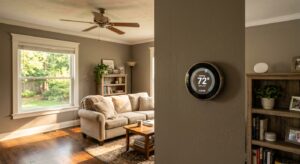
The core problem in a two-story home is density. Warm air is physically lighter than cool air because its molecules are moving faster and spreading farther apart. This causes warm air to float upward continuously, concentrating heat at ceiling level on the upper floor. Your central AC thermostat is almost always located downstairs, so it satisfies the set temperature at that level while the upper floor can remain 8 to 12 degrees warmer. The AC cycles off not because the house is cool, but because the sensor location is satisfied.
Fans attack this problem through two mechanisms. First, they mechanically mix the air layers, breaking up stratification by forcing warm upper air to combine with cooler lower air. Second, when combined with open windows, they create pressure differentials that move large volumes of air directionally. When you exhaust air from the upper floor, you create a low-pressure zone that must be filled. If the replacement air comes from a cooler outdoor source or from the lower floor near the AC, you are essentially running a low-energy heat pump using the natural temperature difference between floors and between indoors and outdoors as your energy source.
The night purge strategy works because most building materials, including drywall, wood framing, and furniture, have significant thermal mass. They absorb heat during the day and store it, which is why a room can feel warm even after the sun goes down. Accelerating airflow over these surfaces at night dramatically speeds up the rate at which they release stored heat to the cooler air. A house that is purged effectively between 9 PM and midnight starts the following day with 5 to 10 degrees less stored heat in its walls, meaning the AC faces a much smaller cooling load during the hottest afternoon hours.
Frequently Asked Questions
▼ Why is my upstairs still hot even with fans running?
The most common cause is running the fans while outdoor air is still hotter than indoor air, which pushes the problem inside rather than solving it. Check that outdoor temperatures are at least 3 degrees cooler than indoors before opening windows. Also verify your exhaust fan is actually blowing outward and that gaps around the fan are sealed with weatherstripping, since air leaking back in around the edges cancels the pressure differential.
▼ Can renters do this without landlord permission?
Yes, the portable fan strategies in the quick fix and DIY approaches require no permanent modifications and are completely renter-safe. The whole-house fan installation approach does require landlord approval since it involves cutting a ceiling opening. For renters, focus on the window box fan exhaust setup, staircase circulation fan, and outlet timers, all of which you can take with you when you move.
▼ How long before I notice savings on my electric bill?
You should feel the comfort improvement within the first night of running the evening purge strategy. Bill savings typically show up within the first full billing cycle, usually 30 days. Because billing cycles include non-summer days, the savings may look smaller than expected. Compare your kilowatt-hour usage on your bill rather than the dollar amount, since rates vary.
▼ What if my house has central air conditioning? Should I still use fans?
Absolutely. The two strategies work together rather than competing. Use fans during evening and night hours when outdoor air is cool to reduce the heat your AC needs to remove the next day. During the hottest part of the day, close windows and let the AC run efficiently. Raising your thermostat setpoint from 72 to 76 degrees while running fans for personal comfort saves approximately 8 to 12% per degree on your cooling bill.
▼ My upstairs has no windows that open safely. What can I do?
If upper-floor windows are not accessible or safe to open, focus on staircase circulation using a tower fan to push cool air from the AC-conditioned lower floor upward. You will not get the full benefit of the exhaust strategy, but improving vertical air mixing can still reduce the floor-to-floor temperature gap by 3 to 5 degrees. Consider adding a ceiling fan in the hottest upper-floor room to keep air moving at the ceiling level where heat pools.
Quick Tips
- Always check the outdoor temperature before opening windows. The night purge strategy only works when outdoor air is cooler than indoor air, typically a difference of at least 3 degrees.
- Close blinds and curtains on south and west-facing upper floor windows during the day. Window coverings can block 40 to 70% of solar heat gain, doing some of the work before your fans even turn on.
- Place a bowl of ice in front of a fan for short-term relief during extreme heat events. While not a substitute for proper airflow strategy, it can drop the perceived temperature by 3 to 5 degrees in a small room for about 45 minutes.
- Clean fan blades every 4 to 6 weeks during cooling season. Dusty blades can reduce airflow efficiency by 15 to 20%, undermining the pressure differential your setup depends on.
Variations for Your Situation
- Apartment or Condo: Renters in apartments should focus on single-room cross-ventilation by placing one box fan in the window blowing out and opening a second window on the opposite side of the room as an intake. For upper-floor apartments with no cross-ventilation, a tower fan on high aimed at the ceiling can disrupt heat stratification in the room by 3 to 5 degrees. Bladeless tower fans in the $80 to $130 range move more air more quietly than budget desk fans and are worth the investment for a space you cannot modify.
- Tight Budget Under $50: Start with a single 20-inch box fan ($25 to $35) placed in the hottest upper-floor room blowing outward in the evening. Open the front door or a lower-floor window simultaneously to create the supply path. This one-fan setup costs almost nothing to run (about $0.02 per hour) and can drop bedroom temperature by 4 to 6 degrees before bedtime. Add outlet timers ($8 each) so the fan starts automatically at 8 PM without requiring you to remember.
- Older Home Pre-1980: Homes built before 1980 typically have more air leakage, which actually helps the stack effect but hurts AC efficiency. In an older two-story home, check that attic hatch covers are insulated and sealed before optimizing fan flow, since uncovered attic hatches in upper-floor ceilings act as direct heat radiators. The fan strategies described here still work well, but pair them with basic weatherstripping on upper-floor doors and attic hatch insulation covers ($20 to $40) to prevent the fans from pulling hot attic air back down into living spaces.