Every summer, millions of homeowners wrestle with doors that swell shut, scrape against frames, or refuse to latch properly. What feels like a minor nuisance is actually a symptom of wood expansion caused by heat and humidity, and if left unaddressed, it can lead to warped frames, damaged weatherstripping, and gaps that bleed conditioned air out of your home around the clock. A single poorly sealing exterior door can account for 7 to 11% of your total air leakage according to Department of Energy estimates.
The good news is that sticky doors are almost always fixable without calling a contractor. The culprit is usually one of three things: wood swelling from moisture absorption, hinge screws that have worked loose over time, or a door that was never perfectly plumb to begin with. Each of these has a clear, low-cost solution that most homeowners can handle in under two hours with basic tools.
This guide walks you through diagnosing exactly why your door is sticking, then gives you two practical repair approaches, from a zero-cost quick fix to a proper DIY correction that will last for years. You will also find real numbers on energy savings, common mistakes to avoid, and answers to the questions homeowners ask most often.
What You’ll Need
Click on an item below to shop for the recommended items for this recipe on Amazon.
As an Amazon Associate, we earn from qualifying purchases.
How to Do It
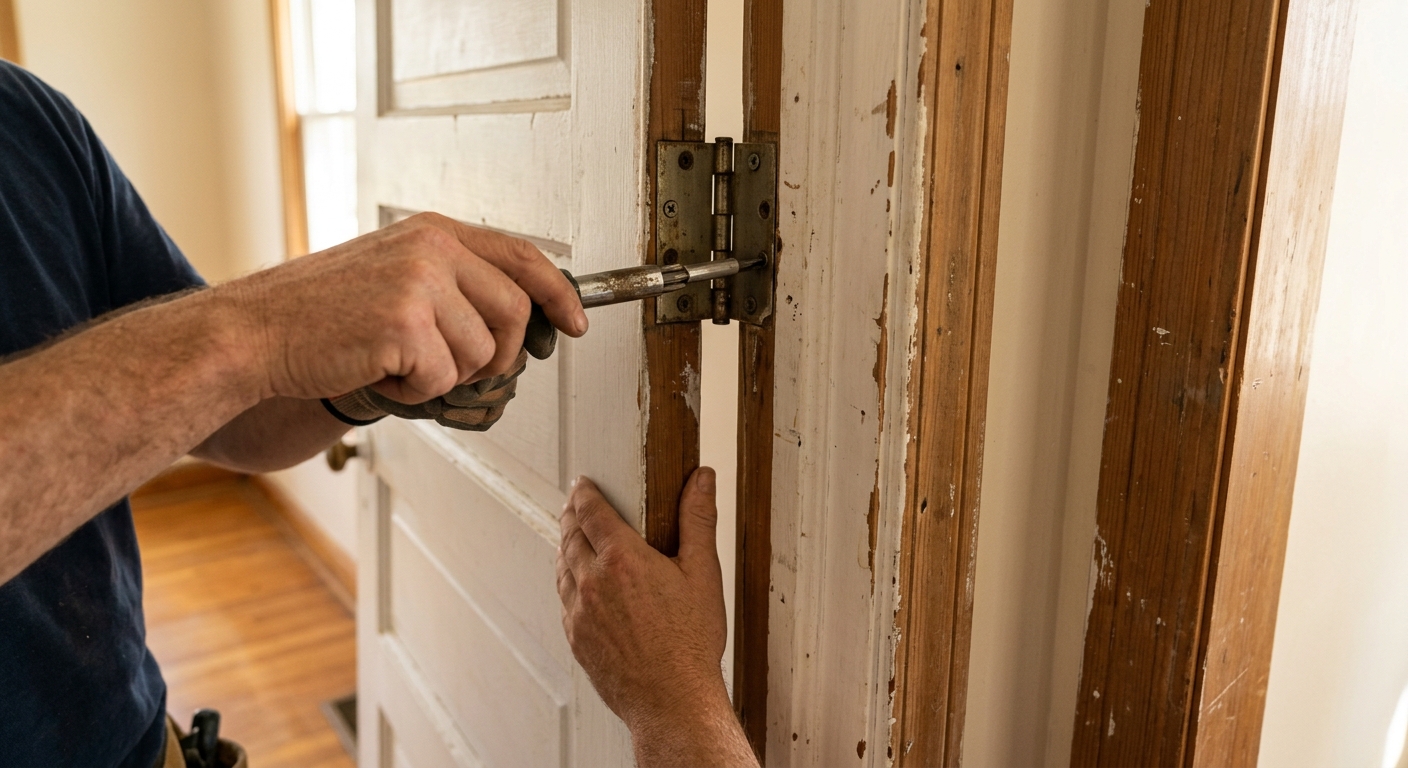
- Open the door fully and examine all three hinges. Wiggle each leaf gently to check for looseness. Tighten every screw with a screwdriver, turning until snug. If a screw spins freely, the hole is stripped – push a wooden toothpick coated in wood glue into the hole, snap it flush, let it dry for 30 minutes, then re-drive the screw.
- Identify exactly where the door is sticking by sliding a thin piece of paper around the closed door frame. Where the paper catches or tears is your contact point. Common spots are the top corner on the latch side or the bottom edge.
- For light sticking along the door edge, rub a bar of dry soap, a wax candle, or a block of paraffin directly on the sticking edge. This reduces friction immediately and is safe on painted wood.
- Check the weatherstripping around the full door perimeter. If it is compressed, torn, or missing, replace it with self-adhesive foam or V-strip weatherstripping, available for $8 to $15 at any hardware store. Poor weatherstripping causes sticking as well as air leakage.
- Close the door slowly and confirm it latches without force. If the latch bolt is slightly misaligned with the strike plate, use a metal file to enlarge the strike plate opening by 1/16 inch rather than forcing the door.
- Remove the door from its hinges by tapping out the hinge pins with a flathead screwdriver and hammer, starting from the bottom hinge. Have a helper support the door as you remove the last pin.
- Use the paper test again to mark the sticking area with a pencil along the full length of the contact zone. You are aiming to remove just enough material to create a 1/16-inch gap, roughly the thickness of a nickel, between door edge and frame.
- Clamp the door on its edge using sawhorses or prop it against a stable surface. Use a hand plane, belt sander, or orbital sander with 60-grit paper to remove material gradually from the marked area. Work in long, even strokes and check frequently by holding a straightedge against the edge.
- Once you have the right clearance, finish with 120-grit sandpaper to smooth the surface. Wipe away all dust with a tack cloth.
- Immediately seal the planed or sanded edge with two coats of exterior primer or wood sealer. This step is critical – bare wood absorbs humidity rapidly and will swell again within one season if left unsealed. Allow the first coat to dry per label instructions before applying the second.
- Re-hang the door, check swing and latch operation, and replace any weatherstripping that was damaged during removal. Apply a fresh coat of matching exterior paint over the sealed edge once primer is fully cured.
- Use a 4-foot level to check both side jambs and the header of the door frame. A frame that is out of plumb by more than 1/4 inch requires shimming or reframing, which is beyond most DIY skill levels and warrants a carpenter.
- Probe the bottom corners of the frame and sill with a screwdriver. Soft, spongy wood indicates rot. Rotted framing must be replaced before any door fix will hold, and depending on extent, this may involve a general contractor.
- If the door itself is warped, lay it on a flat surface and check with a straightedge diagonally corner to corner. A warp of more than 1/4 inch means the door should be replaced rather than repaired.
- Get two to three quotes from licensed carpenters or door installation specialists. Specify whether you want the existing frame repaired or a full pre-hung door unit installed. Pre-hung units include a new frame and are the better long-term choice when the existing frame has settled significantly.
- Ask your contractor about ENERGY STAR certified exterior doors, which meet air infiltration standards of 0.3 cubic feet per minute per square foot or less, versus the 0.5 cfm or higher common in older units. An ENERGY STAR door upgrade may qualify for a 30% federal tax credit up to $250 under the Energy Efficient Home Improvement Credit.
Why It Works: The Benefits
A properly fitting exterior door with intact weatherstripping can reduce door-area air infiltration by up to 40%, meaningfully cutting the cooling load your AC has to handle each day.
Fixing door gaps and weatherstripping as part of overall air sealing can save 10 to 20% on annual cooling costs according to ENERGY STAR, with exterior doors being one of the top five leakage points in most homes.
A door that does not latch fully is a security liability. Correcting the alignment ensures the deadbolt and latch engage fully with the strike plate every time.
Forcing a swollen or misaligned door repeatedly damages the frame, hinges, and door edge. Fixing the root cause now prevents $300 to $800 in door replacement costs down the road.
Eliminating gaps around exterior doors removes hot spots near entryways, reduces the load on rooms closest to the door, and helps your HVAC maintain more consistent temperatures throughout the home.
💰 Savings Impact by Action
Correcting door fit and replacing weatherstripping reduces door-area air infiltration by up to 40%, contributing roughly 15% to overall air sealing savings per DOE estimates.
Eliminating a 1/8-inch gap around an exterior door reduces the steady-state heat gain through that opening by approximately 10%, lowering the demand on your cooling system.
Sealing bare wood edges and correcting alignment can extend a wood door’s functional lifespan by 30% or more by preventing moisture-driven deterioration.
Replacing failed door weatherstripping alone reduces whole-home air leakage by 5 to 12% according to ENERGY STAR air sealing data.
🏠 Key Concepts Explained
The Science Behind It
Wood is a hygroscopic material, meaning it constantly exchanges moisture with the surrounding air. In summer, when outdoor relative humidity climbs above 60%, wood absorbs water vapor and the cell walls swell in diameter. This swelling is greatest perpendicular to the wood grain, which for a standard door means the width increases more than the height. A 36-inch wide solid wood door can expand by 3/16 to 1/4 inch in high humidity conditions, easily enough to close off the 1/8-inch clearance that a properly hung door should have on all sides.
The rate of moisture absorption depends heavily on whether bare wood is exposed. Sealed and painted surfaces resist moisture exchange significantly compared to raw wood. This is why the unsealed top and bottom edges of a door are so often the entry point for moisture. Once water penetrates the end grain at the bottom edge, it wicks upward through the wood fibers, accelerating swelling throughout the door panel. This is also why doors tend to get progressively worse each summer if the root cause is never addressed: each wet season adds a little more moisture-driven deformation to the wood structure.
Hinge mechanics play an equally important role. A standard residential door hinge is rated for doors up to 200 pounds and is designed to hold alignment within tight tolerances. But hinge screws driven into softwood framing gradually pull out over years of use, allowing the hinge leaf to tilt slightly. As little as 1/16-inch of hinge sag at the top hinge translates to the latch-side top corner dropping enough to drag on the strike jamb. Combined with summer wood expansion, even a door that is only marginally misaligned in spring can become completely inoperable by August. Addressing both the wood swelling and the hinge integrity together is the most reliable path to a door that closes smoothly year-round.
Frequently Asked Questions
▼ I tightened the hinges but my door still sticks. What else should I check?
Tightening hinges addresses sag but not wood swelling. Use the paper test to find the exact contact point, then try the soap or wax method on that edge for a temporary fix. If sticking is significant, more than just catching, you need to plane or sand down the contact area and seal the bare wood to prevent it from returning next summer.
▼ Can I fix a sticky door without taking it off the hinges?
Yes, for minor sticking. Soap or wax on the edge, tightening hinge screws, and filing the strike plate can all be done with the door in place. However, if you need to sand or plane more than 1/16 inch of material, removing the door gives you much better control and a flatter, more even result. Sanding an in-place door risks removing too much in some areas and too little in others.
▼ My door sticks at the bottom and drags on the floor. Is that a different problem?
Usually yes. Dragging at the bottom is almost always caused by hinge sag rather than wood swelling, since wood expands most in width, not height. Tighten all hinge screws first, and replace any stripped screws using the toothpick and wood glue method. If the door still drags after hinge work, check whether the floor has heaved, which can happen with tile or hardwood over a concrete slab, and you may need to trim the door bottom with a circular saw.
▼ Will a dehumidifier inside the house stop my door from sticking?
It can help if your indoor humidity is consistently above 55%, but exterior doors are also exposed to outdoor humidity on the other face, so indoor dehumidification alone rarely solves the problem completely. The more reliable fix is sealing the door edges so wood does not absorb moisture in the first place. A dehumidifier is a good complement but not a substitute for the physical repair.
▼ How do I know if my sticking door is caused by foundation settling instead of just swelling wood?
Look for these signs of foundation movement: diagonal cracks in drywall at the corners of the door or nearby windows, other doors or windows in the same area of the house that have also become hard to operate, and a door frame that is visibly leaning when you hold a level against it. If two or more of these are present, stop the DIY repair and consult a structural engineer or foundation specialist before investing in any door work.
Quick Tips
- Check all exterior doors in early May before humidity peaks. A door that is slightly snug in spring will be impossible to close by July.
- Rub the hinge pivot points with a thin coat of petroleum jelly or 3-in-1 oil once a year to prevent squeaking and reduce wear on the barrel.
- If your door sticks at the exact same spot every summer, that area was never sealed properly. Sand it lightly, prime it, and repaint as part of your annual exterior maintenance.
- A door that sticks only on rainy days but is fine otherwise is almost certainly a sealing problem on the door edges, not a structural issue. Sealing the bare wood edges will usually resolve it within one dry season.
Variations for Your Situation
- Apartment or Rental: Renters should start by notifying the landlord in writing, since sticky exterior doors are a maintenance issue the landlord is typically obligated to fix. If the landlord is slow to respond, renters can safely apply the zero-cost fixes: tighten visible hinge screws, apply soap or wax to the sticking edge, and request replacement weatherstripping. Do not plane or sand the door without written landlord permission, as this modifies the unit and could affect your security deposit.
- Tight Budget (under $20): Focus on the hinge screw tightening and toothpick repair first, since stripped screws are free to fix with items you likely have at home. Then apply paraffin wax or a dry bar of soap to the sticking edge, which costs nothing if you have a candle stub on hand. Replace weatherstripping only where visibly damaged, using self-adhesive foam tape at $6 to $10 per roll. These steps alone resolve about 60% of seasonal sticking problems without spending more than $10.
- Older Home (pre-1980): Homes built before 1980 often have solid wood doors with many layers of oil-based paint, which adds significant thickness to door edges over decades. Start by scraping and sanding the edge down to bare wood before evaluating true clearance. Also check for lead paint using an inexpensive test swab kit ($10 to $15) before sanding, since pre-1978 paint may contain lead. If lead is present, use wet sanding techniques and wear an N100 respirator, or hire an EPA-certified renovation contractor to do the work.