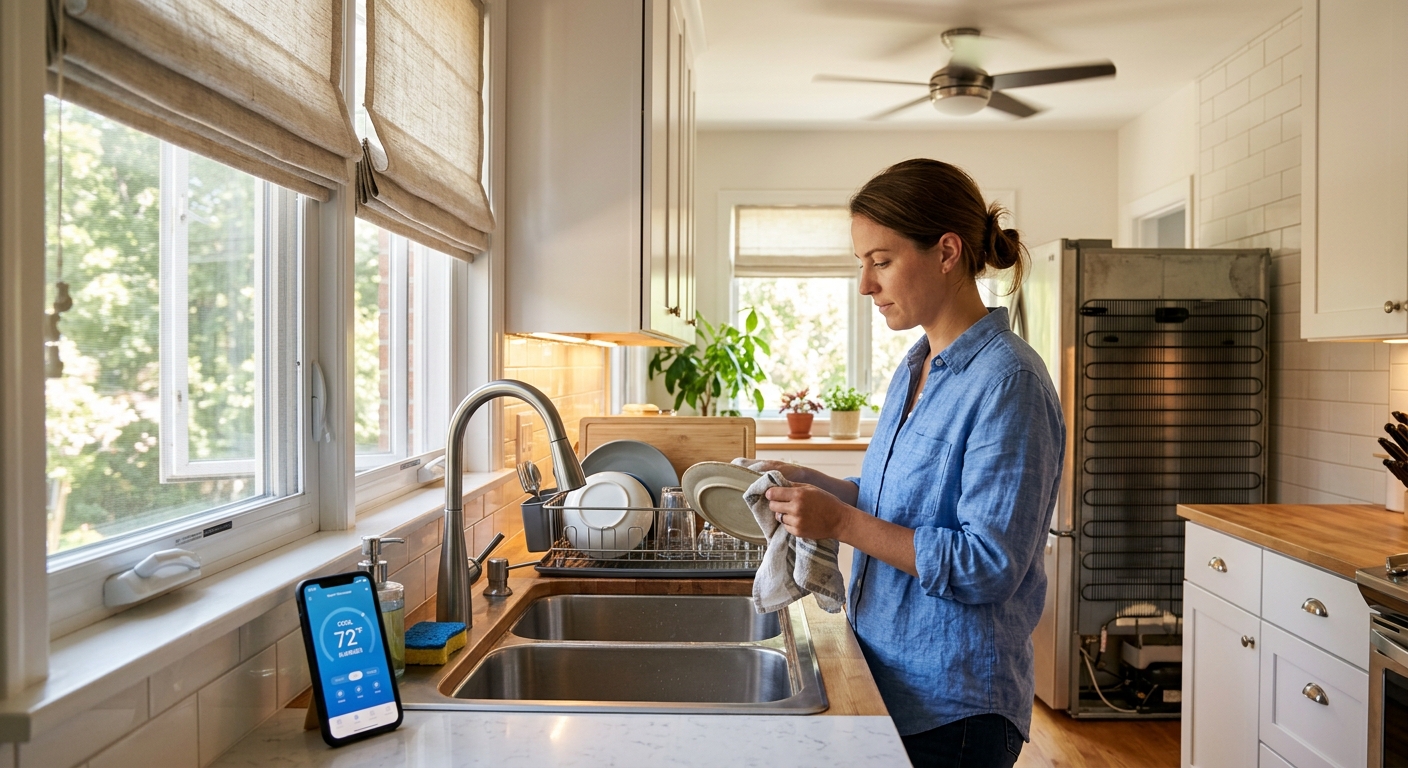
Every summer, millions of homeowners crank up their AC and wonder why their energy bills keep climbing. The usual suspects get the blame: the brutal sun, poor insulation, or an aging HVAC system. But some of the biggest culprits are already inside your home, quietly generating heat around the clock and forcing your air conditioner to work twice as hard to compensate.
Internal heat gains, as building scientists call them, account for a surprisingly large portion of your total cooling load. Lighting, appliances, cooking, and even your own body heat can collectively add 3,000 to 6,000 BTUs per hour or more to your home’s interior, depending on your habits and equipment. That’s the equivalent of running one to two small space heaters indoors while your AC fights to cool things down.
In this post, we’ll identify the five most impactful indoor heat sources, show you exactly how much each one contributes to your cooling load, and give you practical steps to reduce or eliminate them. Whether you want a quick free fix or a weekend upgrade project, you’ll leave with a clear action plan that can trim 15 to 30% off your summer cooling bills.
What You’ll Need
Click on an item below to shop for the recommended items for this recipe on Amazon.
As an Amazon Associate, we earn from qualifying purchases.
How to Do It
- Shift your oven and stovetop cooking to early morning or evening when outdoor temperatures are lower, or switch to a microwave or outdoor grill for dinner preparation during heat waves.
- Run your dishwasher on the ‘air dry’ setting instead of heated dry, or open the door and let dishes air dry after the wash cycle completes.
- Turn off incandescent or halogen lights in rooms you are not actively using. Each 60-watt incandescent bulb releases about 90% of its energy as heat.
- Move floor or table lamps away from your thermostat if any are within 3 to 4 feet. A nearby lamp can fool the thermostat into running the AC an extra 10 to 15 minutes per hour.
- Unplug televisions, gaming consoles, and phone chargers when not in use. Many electronics draw 5 to 20 watts in standby mode and release that energy as heat continuously.
- Use exhaust fans in the kitchen and bathrooms during and for 15 minutes after cooking or showering to actively expel heat and moisture before it spreads through the house.
- Replace all incandescent and halogen bulbs with LED equivalents. A 60-watt incandescent puts out roughly 2,400 BTUs per day when used 8 hours. An equivalent 9-watt LED puts out only 360 BTUs. Budget $25 to $60 for a whole-home swap.
- Install a smart power strip in your home theater or office area. These strips cut power to peripherals when the primary device (TV or computer) is turned off, eliminating phantom load heat from 4 to 8 devices at once.
- Add a programmable or smart thermostat if you do not already have one, and set it to raise the target temperature by 7 to 10 degrees during the 8 to 9 hours you are away. This alone saves about 10% annually on cooling costs according to DOE data.
- Check your refrigerator’s condenser coils. Dusty coils force the compressor to run hotter and longer, releasing more heat into your kitchen. Vacuum the coils from the back or bottom grille using a coil brush. A fridge with clean coils runs 15% more efficiently.
- If your clothes dryer is inside the conditioned space, inspect the exhaust duct for kinks or partial blockages. A restricted dryer vent can dump heat and humidity into the laundry area even when the duct appears to be connected.
- Install a bathroom exhaust fan timer switch (replacing the standard toggle, about $15 to $25) so the fan runs automatically for 20 minutes after a shower without relying on occupants to remember.
- Replace an electric resistance oven or range with an induction cooktop. Induction transfers about 84% of its energy directly to the cookware versus 40% for electric coil, meaning far less waste heat escapes into the kitchen.
- Upgrade to an ENERGY STAR certified refrigerator if yours is more than 10 to 12 years old. Older refrigerators can consume 800 to 1,200 kWh per year and release substantial heat. A modern ENERGY STAR model uses 300 to 450 kWh per year.
- Replace an older electric water heater inside conditioned space with a heat pump water heater. Heat pump water heaters actually extract heat from the surrounding air, cooling and dehumidifying the space where they are installed while heating your water.
- Have an HVAC technician assess your duct system for leaks. Leaky ducts inside unconditioned attics or crawl spaces can cause your air handler to pull warm air into the system, raising supply air temperature and increasing indoor heat gain indirectly.
- If you have recessed can lights with incandescent or halogen bulbs on the floor below an attic, replace them with IC-rated LED trim kits. Old recessed lights are both heat sources and major air leakage points between conditioned and unconditioned space.
Why It Works: The Benefits
Eliminating or reducing the top five indoor heat sources can cut your AC’s cooling load by 15 to 30%, translating directly to lower monthly electricity bills throughout the summer.
Every degree you reduce indoor heat gain means fewer compressor run cycles. Reducing runtime by even 15 to 20% can extend your AC system’s useful life by several years and delay costly replacement.
Homes with lower internal heat gain maintain more even temperatures without hot spots near appliances or kitchens, making every room feel noticeably cooler even at the same thermostat setting.
Cutting moisture-producing heat sources like unvented cooking and frequent dishwashing can lower indoor relative humidity by 5 to 10 percentage points, which makes 76°F feel as comfortable as 72°F.
Switching to LED lighting alone reduces lighting energy use by up to 75% and eliminates the associated heat output, giving you a double benefit: less electricity consumed and less heat for your AC to remove.
💰 Savings Impact by Action
Replacing all incandescent bulbs with LEDs reduces lighting heat output by up to 85%, cutting associated AC cooling load by 10 to 15% in homes with heavy lighting use.
Shifting oven use to cooler times of day and using exhaust fans during cooking can reduce kitchen-related heat gain by 40 to 60%, reducing overall home cooling load by roughly 10 to 12%.
Using smart power strips to eliminate standby power draw from electronics can cut continuous low-level heat output by 50 to 100 watts, reducing cooling load by 5 to 8% in tech-heavy homes.
Cleaning condenser coils on a refrigerator running more than 5 years improves its efficiency by 10 to 15%, directly reducing the heat it dumps into the kitchen by that same margin.
Setting thermostat setbacks of 7 to 10 degrees during away hours saves approximately 10% annually on cooling costs according to DOE energy data.
🏠 Key Concepts Explained
The Science Behind It
Your air conditioner does not create coldness; it removes heat. Every BTU of heat generated inside your home by lighting, appliances, cooking, or people is a BTU your AC must collect and pump back outside. This is why internal heat gain has a one-to-one relationship with cooling energy use. Reduce the heat sources inside by 20%, and your AC has to do roughly 20% less work to maintain the same setpoint temperature.
The thermodynamics get more interesting when you consider efficiency. An incandescent bulb rated at 60 watts consumes 60 watts of electricity but converts only about 5 to 10% of that into visible light. The remaining 54 to 57 watts become infrared radiation and convective heat released directly into your room. Your AC then has to use additional electricity to remove that heat. So a single incandescent bulb running 8 hours a day actually triggers roughly 1.3 to 1.5 times its rated wattage in total energy cost when you factor in the AC penalty. An LED producing the same light uses 9 watts, with a much smaller heat penalty.
Moisture adds another layer of complexity through latent heat. When your AC cools and dehumidifies air, it must first condense water vapor out of the air before it can lower the air temperature further. Every pound of water vapor removed requires about 1,060 BTUs of energy. This is why high-moisture activities like boiling water, running the dishwasher on heated dry, or taking long hot showers can dramatically increase your AC’s runtime even if they do not feel like major heat events. Exhausting humid air directly outdoors with a properly functioning range or bathroom fan prevents your AC from having to do that dehumidification work at all.
Frequently Asked Questions
▼ I switched to all LEDs but my AC still runs constantly. What am I missing?
LEDs are a great start, but lighting is usually just one piece of the puzzle. Check whether your kitchen appliances, particularly the refrigerator and oven, are running inefficiently and adding significant heat. Also check for air leaks around windows, doors, and recessed lights that may be letting hot outdoor air infiltrate faster than your AC can remove it.
▼ Does leaving the oven on for a short time really affect my AC that much?
Yes, more than most homeowners expect. A standard electric oven at 350°F can release 2,000 to 4,000 BTUs of heat into your kitchen during a one-hour baking session, on top of any moisture from whatever you are cooking. In a small kitchen, that can raise the ambient temperature 5 to 10 degrees, which your AC then has to pull back down over the next 30 to 60 minutes.
▼ Can I do anything about my old fridge without replacing it?
Absolutely. Cleaning the condenser coils (usually at the back or on the bottom grille) is the single highest-impact free maintenance task for an older refrigerator and can improve its efficiency by 10 to 15%. Also check that the door gaskets seal tightly by placing a piece of paper in the door seal and pulling. If it slides out easily, the gasket needs replacing, which costs $20 to $50 and reduces the fridge’s heat output noticeably.
▼ My home office gets really hot in the afternoon. How do I fix it?
A home office is often a hotspot because it combines multiple heat sources: a computer, monitor, printer, networking equipment, and task lighting in a small space. Start by switching to a laptop or using power management settings to put your desktop into sleep mode during breaks, which can drop idle power draw from 80 to 150 watts down to 5 to 10 watts. A small USB-powered desk fan and closing blinds on west-facing windows during afternoon hours can also make a noticeable difference without touching the thermostat.
▼ Is it worth buying a heat pump water heater just to help my AC?
If your current water heater is inside conditioned living space (basement, utility closet, or garage attached to the house), yes, the math is compelling. A heat pump water heater uses 60 to 70% less electricity than a standard electric resistance model and actively removes heat from the surrounding air as it operates, effectively giving you a small cooling boost in that space. Federal tax credits through the Inflation Reduction Act currently cover 30% of the purchase and installation cost, improving the payback period significantly.
Quick Tips
- Cook large meals on weekends when temperatures are cooler and reheat smaller portions in the microwave during peak heat days. Microwaves produce about 80% less waste heat than a conventional oven.
- Set your refrigerator temperature to 37°F and your freezer to 0°F. Colder settings make the compressor run longer and release more heat. The recommended settings are the most efficient that still keep food safe.
- Use ceiling fans to help your AC distribute cool air more evenly, allowing you to raise the thermostat 2 to 4 degrees without losing comfort. Set fans to spin counterclockwise in summer for a direct cooling effect.
- If you work from home, consolidate your computer equipment. Running one efficient laptop instead of a desktop tower with dual monitors can reduce office heat output by 60 to 80 watts continuously throughout the workday.
Variations for Your Situation
- Apartment/Rental: Renters cannot modify HVAC systems or swap out major appliances, but you can still make a meaningful dent. Focus on LED bulb swaps (ask your landlord or simply replace and save the originals), smart power strips for your entertainment setup ($25 to $40), and a plug-in smart thermostat if your unit has a standard thermostat hookup. Avoid using the oven on hot days and use your microwave or an electric pressure cooker instead. A portable induction burner ($40 to $80) is a renter-friendly alternative to using the range and produces dramatically less waste heat.
- Tight Budget (under $50): Start with the zero-cost behavioral changes: shift cooking times, air-dry dishes, unplug idle electronics, and use exhaust fans consistently. Then spend $15 to $25 on a pack of LED bulbs for your highest-use fixtures. Cleaning your refrigerator’s condenser coils costs nothing but a few minutes and a vacuum. These steps combined can reduce your internal heat load by 20 to 30% with no major investment.
- Older Home (pre-1980): Older homes often have a mix of incandescent lighting, aging refrigerators, and electric resistance appliances that all run less efficiently than modern equivalents, meaning the heat gain problem is compounded. Prioritize the refrigerator first if it is more than 15 years old, as it may be consuming 3 to 4 times more electricity than a modern model. Also inspect old recessed lighting fixtures, which were often not air-sealed and leak both heat and conditioned air into the attic. IC-rated LED retrofit trim kits ($8 to $20 each) address both issues simultaneously.