Switching to an electric vehicle is one of the biggest financial decisions a homeowner can make, and yet most people have only a vague sense of what it actually costs to power their car at home. The honest answer is: it depends. Your electricity rate, your vehicle’s efficiency, your battery size, and even the time of day you plug in all affect your monthly charging bill. The good news is that home charging is almost always cheaper than public charging stations and dramatically cheaper than gasoline, often by 50 to 70 percent per mile.
The average American drives about 1,100 miles per month. At a typical EV efficiency of 3 to 4 miles per kWh and a national average electricity rate of around $0.16 per kWh, that works out to roughly $44 to $59 per month to charge at home. Compare that to a 30 MPG gas car paying $3.50 per gallon, which runs about $128 per month for the same mileage. That is a real, measurable difference that shows up on your utility bill every single month.
This post walks you through exactly how to calculate your personal charging cost, how to reduce that cost using time-of-use rates and smart charging schedules, and whether installing a Level 2 home charger makes financial sense for your situation. Whether you just brought home your first EV or you have been plugging into a standard outlet for a year, there are concrete steps here that can save you money starting tonight.
What You’ll Need
Click on an item below to shop for the recommended items for this recipe on Amazon.
As an Amazon Associate, we earn from qualifying purchases.
How to Do It
- Find your electricity rate on your utility bill. Look for ‘rate per kWh’ or ‘energy charge.’ The national average is around $0.16 per kWh but yours may be higher or lower.
- Calculate your monthly charging cost using this formula: (Monthly miles driven / EV efficiency in miles per kWh) x rate per kWh. Example: 1,000 miles / 3.5 miles per kWh x $0.16 = $45.71 per month.
- Call your utility or visit their website and ask about time-of-use (TOU) rate plans. Specifically ask what the off-peak rate is and what hours qualify. Most off-peak windows are 9 PM to 6 AM.
- Set your vehicle’s built-in charge scheduler to begin charging at your off-peak start time. Most EVs (Tesla, Chevy, Ford, Hyundai) have this in the vehicle’s charging settings or companion app.
- Set a charge limit of 80 percent in your vehicle settings for daily use. Keeping the battery between 20 and 80 percent is better for long-term battery health and is the recommendation of most automakers.
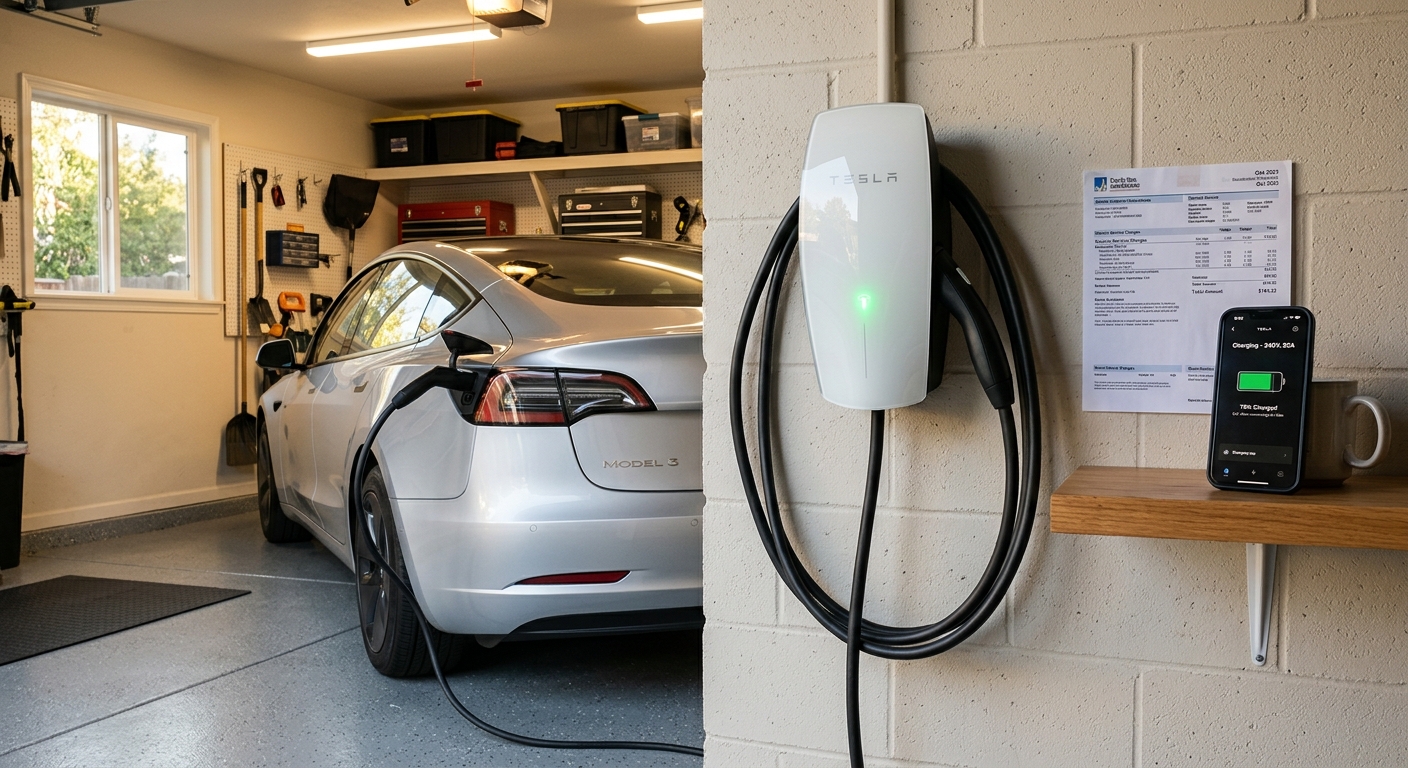
- Choose a Level 2 charger (EVSE) rated for your vehicle. A 32-amp charger delivers about 25 miles of range per hour and works for most households. Popular options include the ChargePoint Home Flex, Enel X JuiceBox, and Emporia Smart Home Charger, typically priced from $199 to $399.
- Hire a licensed electrician to install a dedicated 240V, 40-amp circuit from your electrical panel to the garage or parking area. Get at least two quotes. Labor typically runs $200 to $600 depending on panel distance and local rates.
- Apply for any available rebates before or immediately after installation. Federal tax credits do not currently cover home charger equipment, but many utilities and states offer $100 to $500 rebates. Check your utility’s website and the DSIRE database at dsireusa.org.
- Mount the EVSE unit on the wall following the manufacturer’s instructions. Most units mount with four to six screws and plug into or hardwire to the 240V outlet your electrician installed.
- Connect the charger to your home Wi-Fi network and download the companion app. Enable charge scheduling in the app to restrict charging to off-peak hours automatically, even if you forget to set it in the car.
- Track your charging sessions in the app for 30 days and compare your utility bill to the prior month. This gives you a real baseline for your cost per mile and confirms your off-peak scheduling is working.
- Calculate your total annual EV energy consumption first: (Annual miles / miles per kWh) = annual kWh needed for your car. A driver doing 15,000 miles per year in a 3.5 miles per kWh vehicle needs about 4,286 kWh annually just for the car.
- Get solar quotes sized to cover both your home electricity load and your EV charging needs. Request quotes from at least three installers through the EnergySage marketplace to benchmark pricing.
- Confirm eligibility for the federal Residential Clean Energy Credit, which covers 30 percent of system cost through 2032. A $15,000 system yields a $4,500 federal tax credit applied directly against your tax liability.
- Ask each solar installer about pairing with a battery storage system if you want to charge your EV from stored solar energy during evening hours, especially useful in states where net metering rates have been reduced.
- After installation, update your EV charging schedule to align with peak solar production hours (typically 10 AM to 3 PM) if your utility offers net metering at a favorable rate, or stores excess in a home battery.
Why It Works: The Benefits
Home charging at the national average rate of $0.16 per kWh costs roughly $0.04 to $0.05 per mile. Gasoline at $3.50 per gallon in a 30 MPG car costs about $0.12 per mile. For a typical driver, that is a savings of $60 to $100 per month, or $720 to $1,200 per year.
Home charging means your car is ready every morning without a detour to a gas station. Over a year, the average driver saves roughly 25 to 30 hours of time previously spent at gas stations.
DC fast chargers degrade lithium-ion batteries faster than slower home charging. Regular Level 1 or Level 2 home charging can extend battery longevity and reduce potential out-of-warranty repair costs over the life of the vehicle.
Electricity prices are far more stable than gasoline prices. Home charging allows you to forecast your monthly transportation energy cost within a few dollars, making household budgeting much easier.
Homeowners who enroll in a time-of-use rate plan and schedule overnight charging can reduce their effective per-kWh rate by 30 to 50 percent, saving an additional $15 to $40 per month on top of already-lower fuel costs.
💰 Savings Impact by Action
Home charging at $0.16 per kWh costs roughly 60 percent less per mile than gasoline at $3.50 per gallon in a 30 MPG vehicle.
Shifting all EV charging to off-peak hours on a TOU rate plan reduces the per-kWh charging cost by 30 to 50 percent compared to peak daytime rates.
Home charging at average residential rates costs roughly 50 percent less per kWh than DC fast chargers priced at $0.30 to $0.45 per kWh.
Capping daily charging at 80 percent reduces energy consumption per session by roughly 20 percent while extending battery cycle life over the vehicle’s lifespan.
A properly sized solar array can offset 80 to 90 percent of annual EV charging costs, reducing fuel expense to near zero for the system’s 25-year lifespan.
🏠 Key Concepts Explained
The Science Behind It
Electric vehicles store energy in large lithium-ion battery packs rated in kilowatt-hours (kWh), the same unit your utility uses to measure electricity consumption. When you charge your EV, you are essentially refilling this battery from the grid. The charger hardware outside the car (the EVSE, or Electric Vehicle Supply Equipment) does not actually do the converting. It simply delivers AC power safely to the car’s onboard charger, which converts it to DC and manages the flow into the battery cells. This is why charging speed is limited by whichever is smaller: the EVSE’s output rating or the car’s onboard charger capacity.
The 10 to 15 percent efficiency loss during charging is a result of resistance heating in the wiring and conversion losses in the onboard charger’s power electronics. This is the same principle that makes your phone charger warm to the touch. It means that if you need to add 40 kWh of usable energy to your battery, you will actually draw about 44 to 47 kWh from the wall. At $0.16 per kWh, that extra inefficiency costs about $0.64 to $1.12 per full charge, a minor but real factor over thousands of charging sessions.
Time-of-use pricing works because electricity demand follows predictable daily patterns. Grid operators must maintain enough generation capacity to meet peak demand, typically late afternoon and early evening when homes and businesses overlap in consumption. By charging at night, EV owners use generation capacity that would otherwise sit idle, which is why utilities incentivize it with lower rates. In regions with high solar penetration, some utilities have shifted their cheapest rates to midday when solar production peaks, a pattern called the ‘duck curve.’ Always check your specific utility’s TOU schedule rather than assuming overnight is always cheapest.
Frequently Asked Questions
▼ My electric bill went up way more than expected after getting my EV. What is happening?
First, calculate your expected kWh addition: monthly miles divided by your car’s miles-per-kWh efficiency. If your bill increase does not match, check whether your charge scheduling is actually working or if the car is charging during peak rate hours. Also confirm you are on the correct rate plan. If your utility has a tiered rate structure (where higher usage triggers a higher rate), adding EV charging may have pushed your total consumption into a higher tier, making all your electricity cost more, not just the EV portion. Switching to a TOU plan often solves this.
▼ Can I charge my EV with a standard 120V outlet permanently or do I really need Level 2?
Level 1 charging is perfectly fine for drivers who cover fewer than 30 to 40 miles per day, since a standard outlet delivers about 40 to 50 miles of range overnight. If you regularly drive more than that, or you come home with a battery under 30 percent, Level 1 may not fully restore range before your next departure. Level 2 adds 140 to 200 miles overnight, which covers virtually all daily driving scenarios. The decision is about your daily mileage pattern, not a technical requirement.
▼ Does charging my EV at home actually void any warranties or cause electrical problems?
Charging on a properly installed circuit does not void any manufacturer warranty. The risk is using an improperly wired outlet or an extension cord, especially with Level 2 equipment. Never use a standard extension cord for EV charging as the sustained current draw can overheat the cord and create a fire hazard. If you are using a 120V outlet, confirm it is on a dedicated 15-amp or 20-amp circuit and that the outlet is in good condition with no loose connections.
▼ How do I know if my electrical panel can handle a Level 2 charger?
A 240V Level 2 charger on a 40-amp circuit requires your panel to have at least 40 amps of available capacity (two open slots in a standard breaker panel). Have a licensed electrician evaluate your panel load before proceeding. Panels smaller than 100-amp service or those already at near-full capacity may need an upgrade before a Level 2 charger can be safely added. The evaluation typically costs $75 to $150 for a service call and gives you a clear answer.
▼ Are there any tax credits for installing a home EV charger?
The federal Alternative Fuel Vehicle Refueling Property Credit (IRS Form 8911) offers a 30 percent tax credit up to $1,000 for residential EVSE installations through 2032, but it is only available in designated low-income or non-urban census tracts as of the Inflation Reduction Act changes. Check your census tract eligibility at the IRS website or through a tax professional. Separately, many state and utility rebates are available regardless of location and can be worth $100 to $500 applied at point of purchase or as a bill credit.
Quick Tips
- Use your car’s built-in charge limit setting to cap daily charging at 80 percent. Reserve full 100 percent charges for long trips only, as this reduces battery degradation over time.
- Compare your electricity cost per mile to gasoline cost per mile monthly using this shorthand: divide your rate per kWh by your miles-per-kWh rating to get cost per mile. At $0.12 per kWh and 3.5 miles per kWh, that is $0.034 per mile.
- If you have a smart meter, ask your utility for hourly interval data. This lets you see exactly how many kWh your EV charging sessions consume and verify your off-peak scheduling is working.
- Plug in every night even for short trips. Topping off regularly is better for lithium-ion chemistry than letting the battery drop below 20 percent frequently before recharging.
- Check the federal Alternative Fuels Station Locator and your state’s energy office website for any active rebates on EVSE equipment before purchasing a Level 2 charger. Rebates change seasonally and can reduce equipment cost by $100 to $500.
Variations for Your Situation
- Apartment/Renter: If you cannot install a home charger, focus on workplace charging (often free or subsidized) and low-cost public charging networks like Blink or EVgo during off-peak hours. Ask your property manager about installing a shared Level 2 charger in the parking garage. Many states now have right-to-charge laws that require landlords to accommodate reasonable EVSE installation requests. A Level 1 outdoor outlet from a shared utility room is often a viable compromise that costs the building under $200 to add.
- Tight Budget (under $50): Enroll in your utility’s TOU rate plan (usually free to do online or by phone) and set your car’s charge timer to start at 9 PM or your utility’s off-peak start time. This single step costs nothing and can reduce your monthly charging cost by $15 to $30. If your utility offers a free smart meter, request one, as it enables TOU billing and gives you access to hourly usage data to verify your savings.
- High-Mileage Driver (over 1,500 miles per month): At this level, a Level 2 charger pays back in under two years through time savings alone, and the math on a dedicated EV rate plan becomes very compelling. At 1,500 miles per month and a 3.5 miles per kWh efficiency rate, you are consuming roughly 429 kWh per month for your car. At an off-peak rate of $0.08 versus a standard rate of $0.16, you save $34 per month, or $408 per year, just from rate optimization. Combine that with the Level 2 charger installation cost of $600 to $1,000 and payback is 18 to 30 months.