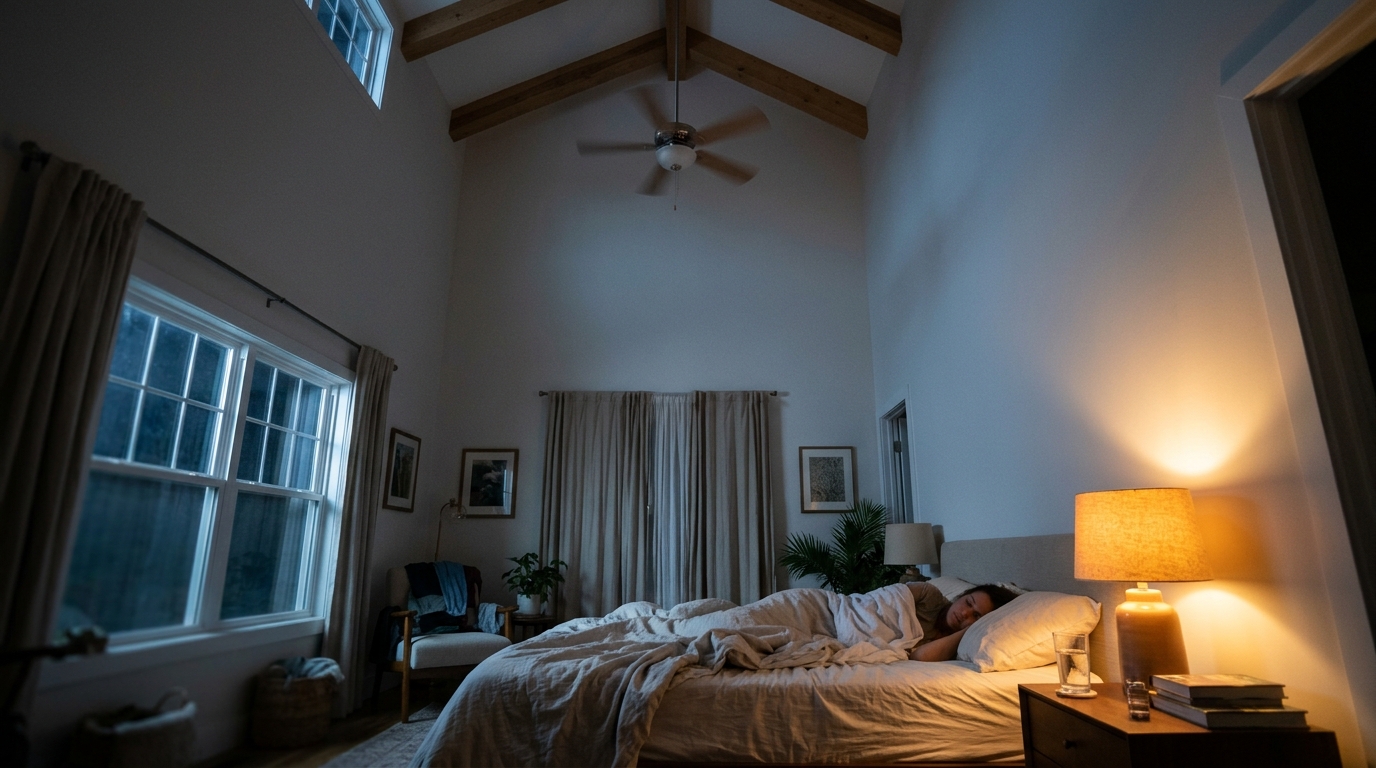
You go to bed in a room that felt fine at 9 PM, and by 2 AM you are kicking off the covers and staring at the ceiling. The thermostat says 74 degrees, yet your bedroom feels like a sauna. If your room has a vaulted ceiling, a loft-style layout, or sits directly under a roof, ceiling height is often part of the story.
Warm air is lighter than cool air, so it rises and pools near the ceiling. In a standard 8-foot bedroom, that warm layer is only a few feet above your head. In a 10 to 12 foot or vaulted room, there is more volume, a bigger pool of hot air, and a longer path between your thermostat and your pillow. Sleep research suggests the ideal bedroom temperature is roughly 65 to 68 degrees, and even a 3 to 4 degree overshoot can fragment your sleep.
This post explains how ceiling height shapes nighttime bedroom temperature, then walks through a quick no-cost fix and a more thorough DIY upgrade. You will also find savings estimates, payback periods, and answers to the questions homeowners ask most often.
What You’ll Need
Click on an item below to shop for the recommended items for this recipe on Amazon.
As an Amazon Associate, we earn from qualifying purchases.
How to Do It
- Run your ceiling fan counterclockwise (as seen from below) on medium to push air down and create a cooling breeze. If you have no ceiling fan, place a pedestal or box fan low in the room aimed across the bed.
- Pre-cool the room: lower the thermostat 2 to 3 degrees for 30 to 60 minutes before bedtime, then set it to 66 to 68 degrees for sleep.
- Close blinds and curtains on sun-facing windows all afternoon, and close the bedroom door during the day so the room does not absorb hot hallway air.
- Open the bedroom window and a window on the opposite side of the home after sunset when outdoor temperatures drop below indoor temperatures, and run a box fan facing outward to exhaust warm air.
- Make sure the supply vent is fully open and not blocked by furniture or bedding, and point the louvers upward so cool air mixes through the room.
- Inspect the attic above the bedroom. Look for thin or compressed insulation, bare drywall, and gaps around light fixtures, wiring, plumbing stacks, and the attic hatch.
- Seal air leaks first with caulk for small cracks and expanding foam for larger gaps. Use fire-rated caulk around chimneys and flues, and cover recessed lights with IC-rated, airtight boxes.
- Install weatherstripping around the attic hatch and add a rigid foam board or insulated cover on top of it.
- Add blown-in cellulose or fiberglass, or lay unfaced fiberglass batts perpendicular to the joists, until you reach R-38 to R-49 depending on your climate zone. Keep insulation 3 inches away from recessed light housings that are not IC-rated.
- Install baffles at the eaves so insulation does not block soffit vents, then confirm that ridge or gable vents are clear to keep attic airflow moving.
- Optional: add a ceiling fan with a reversible motor and a 52 inch blade span for bedrooms larger than 144 square feet to boost nighttime comfort.
- Hire an energy auditor or insulation contractor to do a blower door test and infrared scan, which pinpoints the ceiling and roof sections losing the most energy.
- Have the contractor add dense-pack cellulose or spray foam to the rafter bays to reach R-30 to R-49 where possible, while preserving required ventilation.
- Ask an HVAC professional to rebalance or add a return vent or transfer grille in the bedroom so air circulates when the door is closed.
- Consider a ductless mini-split or zoned damper for the bedroom if it is on the far end of the duct run and consistently runs 4 or more degrees warmer than the rest of the house.
Why It Works: The Benefits
Keeping the bedroom near 65 to 68 degrees supports deeper sleep. Even a 3 degree drop at night can reduce tossing, turning, and middle-of-the-night waking.
Moving heat out of the sleeping zone with fans and sealing the ceiling plane can trim cooling costs by 5 to 15%, because your AC no longer fights stored heat all night.
Reducing stratification narrows the floor-to-ceiling temperature gap from as much as 8 to 10 degrees down to 2 to 3 degrees.
When the room sheds heat faster, the system cycles less often. That reduces wear and can extend the life of your equipment.
Feeling cooler lets you raise the thermostat by 2 to 3 degrees, which saves roughly 3% per degree on cooling energy.
💰 Savings Impact by Action
Raising attic insulation from R-19 to R-38 or higher reduces ceiling heat gain by 15 to 25% and shortens AC runtime.
Sealing ceiling penetrations and the attic hatch can cut cooling loss from air leaks by 10 to 20%.
Using a fan allows a 2 to 4 degree higher thermostat setting, saving about 3% per degree on cooling.
Blackout curtains, shades, or film on sun-facing windows can reduce solar heat gain by up to 60 to 70%.
Running a cooler set point only at bedtime and a higher one during the day saves about 7% annually.
🏠 Key Concepts Explained
The Science Behind It
Ceiling height matters because of buoyancy. Air expands when heated, becomes less dense, and floats upward. Heat sources in a bedroom, including sunlight through windows, warm attic ceilings, electronics, and your own body (about 80 to 100 watts at rest), all feed the warm layer near the ceiling. The taller the room, the thicker that layer becomes and the more energy it holds after the sun goes down.
At night the roof continues to release the heat it absorbed all day. This is called thermal lag. Shingles and roof sheathing can stay hot for several hours after sunset, and the attic air can remain above 100 degrees until midnight or later. If your ceiling insulation is thin, that heat conducts and radiates down into the room. Insulation raises the R-value, slowing the rate of heat flow in proportion to the temperature difference.
Finally, air movement affects how warm you feel even when the thermostat reading does not change. Moving air breaks up the thin layer of warm air around your skin and speeds evaporation of moisture, which is why a fan can make a 76 degree room feel closer to 72. Combined with lower stratification, this explains why tall bedrooms often feel hotter than their thermostat setting suggests.
Frequently Asked Questions
▼ Why is my bedroom hotter than the rest of the house even with the AC on?
Common causes are a long or poorly sealed duct run, thin attic insulation above the room, or a west-facing window. Check that the supply vent is fully open, feel for airflow strength compared to other rooms, and inspect the attic above. If airflow is weak, have an HVAC technician test duct leakage, which often wastes 20 to 30% of system output.
▼ Which way should my ceiling fan spin in summer?
Counterclockwise, when viewed from below, which pushes air down and creates a cooling breeze. Most fans have a small switch on the motor housing to reverse direction. In winter, run it clockwise on low to gently pull warm air off the ceiling.
▼ Can renters do this without landlord permission?
Yes, the quick fix is fully renter friendly. Use tower or box fans, blackout curtains, window film, and a plug-in thermometer. You can also request that the landlord check attic insulation, since many rentals are under-insulated, but do not modify ducts or the ceiling yourself.
▼ How long before I notice savings on my bill?
Comfort improves the same night you make changes with the quick fix. Bill savings usually show up within one to two billing cycles, and the insulation and air sealing upgrade typically pays for itself in 2 to 4 years through a 5 to 15% reduction in cooling energy.
▼ What if my home is older than 30 years?
Older homes often have R-11 to R-19 attic insulation or less, plus many ceiling air leaks. Start with air sealing and add insulation up to current recommendations (R-38 to R-60 depending on climate zone). Have a pro check for knob-and-tube wiring or vermiculite before you disturb any insulation.
Quick Tips
- Place a small thermometer at bed height and another near the ceiling for one night to see how large your temperature gap really is.
- Use blackout curtains or cellular shades on west-facing windows to block up to 60 to 70% of afternoon solar heat gain.
- Keep the bedroom door open during the day if the supply vent is in the hallway, or add a door undercut or transfer grille to prevent pressure imbalances.
- Choose lightweight breathable bedding such as cotton or linen and a mattress topper that does not trap heat to improve comfort without touching the thermostat.
Variations for Your Situation
- Apartment/Rental: Focus on portable solutions. A $30 to $60 box fan in the window exhausting warm air after sunset, a plug-in oscillating tower fan aimed at the bed, thermal blackout curtains ($25 to $60), and removable reflective window film ($15 to $30) can reduce nighttime bedroom temperature by 3 to 5 degrees. If you are on the top floor, ask your landlord about attic or roof insulation.
- Tight Budget (under $50): Pre-cool the room before bed, close blinds on sun-facing windows all day, run a ceiling or box fan, and open windows after sunset to flush out hot air. Add a $10 tube of caulk and a roll of weatherstripping for the attic hatch or bedroom door. These steps cost almost nothing but can cut nighttime temperature by 2 to 4 degrees.
- Older Home (pre-1980): Prioritize air sealing and insulation over any equipment purchase. Expect leaky ceiling penetrations, thin R-11 to R-19 insulation, and possibly an uninsulated attic hatch. A $300 to $700 weekend project adding R-30 or more can lower bedroom temperatures 4 to 8 degrees and pay back in 2 to 4 years, but have a pro check for vermiculite or old wiring first.
- Vaulted or Cathedral Ceiling: Install a high-efficiency ceiling fan with a downrod sized to hang 8 to 9 feet above the floor, and consider a small low-wattage fan on a bedside table. Because there is no attic above, ask a contractor about adding rigid foam or spray foam to the roof assembly from the exterior during re-roofing for the best long-term results.