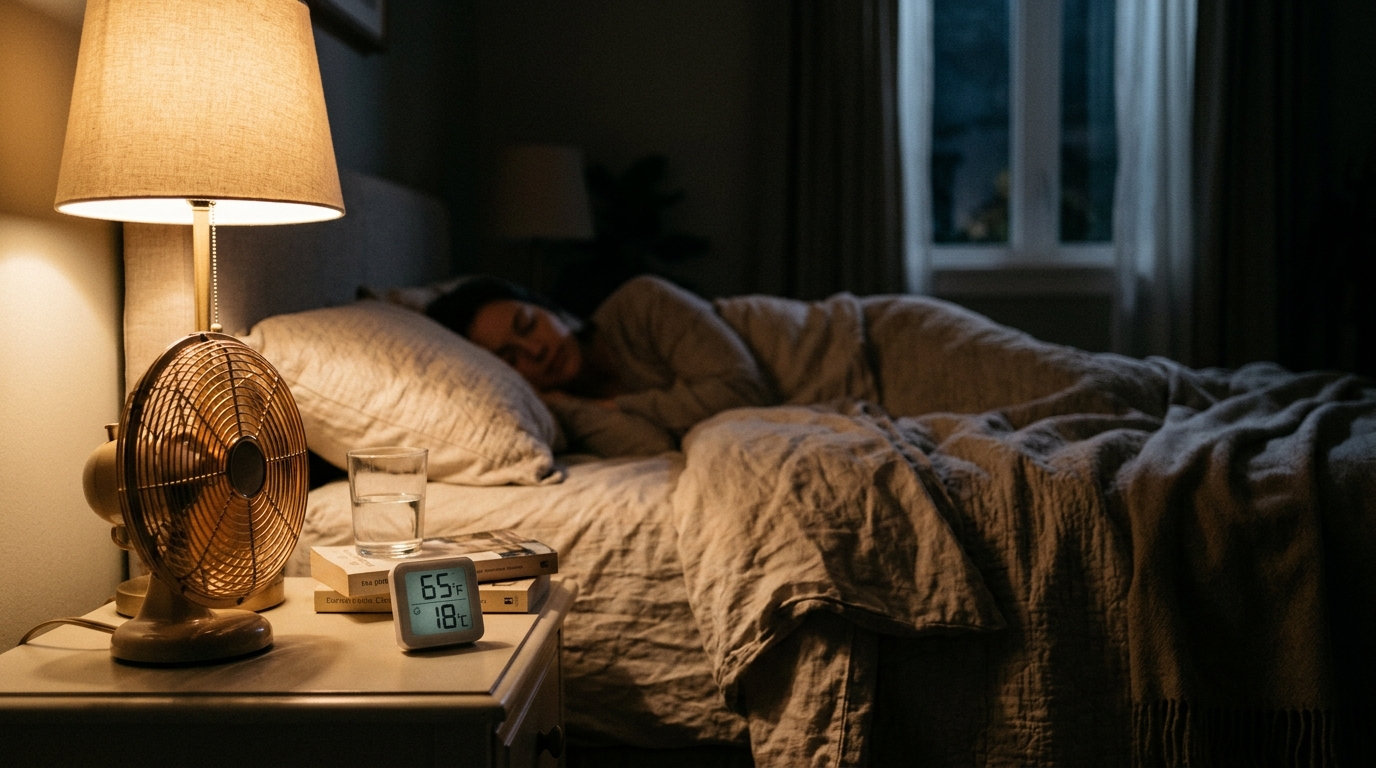
If you toss and turn at 2 a.m. kicking off the covers, your thermostat may be the culprit. Your body temperature naturally drops about 1 to 2 degrees Fahrenheit as you fall asleep, and a bedroom that is too warm works against that process. Sleep scientists, including researchers cited by the Sleep Foundation and the National Institutes of Health, generally find that a cool room, roughly 65 to 68°F for most adults, supports faster sleep onset and deeper rest.
Here is the good news for your wallet: the temperature that helps you sleep best is also cheaper to maintain in winter. The Department of Energy estimates you can save about 1% on heating costs for every degree you lower the thermostat for 8 hours a day, and a nighttime setback fits that window perfectly. Summer is trickier, since cooling a bedroom to 66°F costs money, so the strategy there is to get cool air where it matters instead of chilling the whole house.
In this post, we cover what the research says about ideal sleep temperatures by age, a zero-cost quick fix you can start tonight, a more robust DIY upgrade for stubborn hot rooms, and the building science behind why some bedrooms never seem to cool down. We also include troubleshooting answers and variations for renters, tight budgets, and older homes.
What You’ll Need
Click on an item below to shop for the recommended items for this recipe on Amazon.
As an Amazon Associate, we earn from qualifying purchases.
How to Do It
- Set your thermostat to 66 to 68°F for sleeping hours. If that feels too cold at first, start at 70°F and drop 1 degree every few nights.
- In summer, start cooling the bedroom about 30 to 60 minutes before bed so the room reaches temperature while you are still awake.
- Close the bedroom curtains or blinds during the day on sun-facing windows to stop solar heat from building up.
- Swap heavy bedding for breathable cotton, linen, or bamboo sheets in warm months and add a blanket instead of raising the heat in winter.
- Turn off or unplug heat-producing electronics like TVs and chargers in the bedroom. Standby devices add small but real heat.
- Install a programmable or smart thermostat and program a sleep schedule that drops to 65 to 68°F at bedtime and rises 30 minutes before you wake.
- Add weatherstripping and a door sweep to the bedroom door and seal any gaps around windows with removable caulk or foam tape to stop drafts and heat leaks.
- Install blackout or cellular shades on hot-facing windows. Cellular shades can cut window heat gain by up to 60% according to DOE estimates.
- Place a box fan or ceiling fan on a timer to move air across the bed, which makes the room feel about 4°F cooler at no extra cooling cost. In summer, run the ceiling fan counterclockwise.
- Use a hygrometer to check humidity. If it is above 55%, run a dehumidifier or the AC in dry mode to improve comfort at the same temperature.
- Hire an HVAC technician to measure airflow at each register and check whether the bedroom duct run is undersized, kinked, or leaking in the attic or crawlspace.
- Ask for duct sealing with mastic and insulation upgrades. Leaky ducts can waste 20 to 30% of conditioned air, per ENERGY STAR.
- Consider adding a dedicated return vent or jump duct so the bedroom does not become pressurized when the door is closed.
- For rooms that never cool properly, discuss a ductless mini-split zone, which gives independent control to the bedroom.
Why It Works: The Benefits
Cooler rooms in the 65 to 68°F range help your core temperature fall on schedule, which research links to falling asleep sooner and waking less often.
Setting the thermostat back from 72°F to 65°F overnight saves roughly 5 to 10% on annual heating costs, about $50 to $150 per year for a typical household.
Keeping the room out of the heat-stress zone, above roughly 75°F, helps protect restorative sleep stages that heat tends to cut short.
Targeting only the bedroom with a fan or small window unit can cost a fraction of lowering whole-house central air, often saving 10 to 20% on nighttime cooling energy.
A properly cooled room and breathable bedding reduce the overheating that causes mid-night wakeups, a common complaint in warm months.
💰 Savings Impact by Action
Lowering the thermostat 7 to 10°F for 8 hours per night can cut annual heating costs by about 10%.
Cellular shades and blackout curtains can reduce summer window heat gain by up to 60%, trimming bedroom cooling needs by 10 to 20%.
Sealing leaky ducts can recover up to 20% of lost conditioned air, helping hard-to-cool bedrooms reach target temperature.
Using a fan lets you raise the AC setpoint about 4°F with the same comfort, saving roughly 8% on cooling.
Weatherstripping and sealing drafts around the bedroom door and windows reduces temperature swings and cuts heating and cooling loss by 10 to 15%.
🏠 Key Concepts Explained
The Science Behind It
Sleep and temperature are tightly linked through your circadian rhythm. In the evening, blood vessels in your hands and feet dilate, shedding heat from your core and lowering your internal temperature. This drop is one of the biological triggers for sleepiness. A bedroom that is too warm limits how well your body can offload that heat, which is why researchers often find that rooms above roughly 75°F are associated with more wakefulness and less slow-wave sleep.
The 65 to 68°F recommendation is a general range, not a rule. Studies and sleep organizations suggest it fits most healthy adults, while babies and older adults often prefer slightly warmer rooms, and individual factors like body size, bedding, and sleepwear shift the ideal by a few degrees. The key insight is that bedding creates its own microclimate, so a cool room with a warm duvet can feel perfect while a warm room with no covers can feel stifling.
From a building science angle, heat flows from hot to cold through conduction, convection, and radiation. A sun-baked roof radiates heat into the upstairs ceiling, and window glass transmits solar radiation straight into the room. That is why shading windows and insulating the attic often matter more for bedroom comfort than simply lowering the thermostat. Moving air with a fan also helps because it accelerates evaporative cooling on your skin, making the same temperature feel noticeably cooler.
Frequently Asked Questions
▼ Why is my bedroom still hot even when the thermostat says 68°F?
Your thermostat measures the temperature where it is mounted, often a hallway on the main floor, not your bedroom. Place a standalone thermometer in the bedroom to see the real reading. If the room is consistently 5°F or more warmer, check for sun-exposed windows, leaky ducts, or an undersized supply vent, and consider a fan, window shades, or an HVAC duct inspection.
▼ Can renters do this without landlord permission?
Yes. Adjusting the thermostat, using a box fan, switching to breathable bedding, and adding removable window film or temporary blackout curtains require no permanent changes. A portable window AC or a small oscillating fan on a timer can also cool just the bedroom, and plug-in smart plugs let you automate them without touching the building’s systems.
▼ How long before I actually notice savings on my bill?
You will see the effect on your next bill, since thermostat setbacks begin saving energy immediately. In winter, expect roughly 5 to 10% off heating costs. For a smart thermostat purchase of $100 to $250, the payback is typically 6 to 18 months depending on your climate and energy prices.
▼ What if my home is older than 30 years?
Older homes often have leakier windows, less attic insulation, and drafty doors, so the bedroom may swing in temperature more than newer builds. Start with weatherstripping, window film, and sealing attic hatch gaps, then check your attic insulation depth. Adding insulation to R-38 or higher in an attic often delivers some of the biggest comfort and savings gains.
▼ Is 65°F too cold for sleeping?
For many adults 65°F works well with the right bedding, but comfort is personal. If you wake up shivering or have trouble getting warm, move up to 67 or 68°F. People with circulation issues, older adults, and infants should generally err on the warmer side of the range.
Quick Tips
- Pair a 65 to 68°F bedroom with breathable bedding so you stay comfortable without cranking the thermostat lower.
- Program your thermostat to warm the house 30 minutes before you wake so mornings are comfortable without running heat all night.
- Keep bedroom doors open during the day to let conditioned air circulate, then close them at night if your home has a return vent in the room.
- Check the temperature at bed height with a cheap indoor thermometer, since your thermostat may be in a different part of the house and read differently.
Variations for Your Situation
- Apartment/Rental: You usually cannot change the central HVAC, so focus on a $25 to $60 oscillating or tower fan on a timer, $20 to $40 blackout curtains with a thermal liner, and a $15 plug-in thermometer. A $150 to $350 portable or window AC cools just the bedroom if your lease allows it.
- Tight Budget (under $50): Pre-cool the room with the thermostat or a fan 60 minutes before bed, close sun-facing blinds all day, swap to lightweight cotton sheets, and use a $10 door draft stopper. These steps cost little and often deliver the biggest sleep improvement.
- Older Home (pre-1980): Expect more air leakage and less insulation, so start with weatherstripping ($15 to $40), window insulation film ($10 to $25 per window), and check attic insulation depth. Upgrading to R-38 or higher can cut heating and cooling costs by 10 to 20% and stabilize bedroom temperatures year-round.