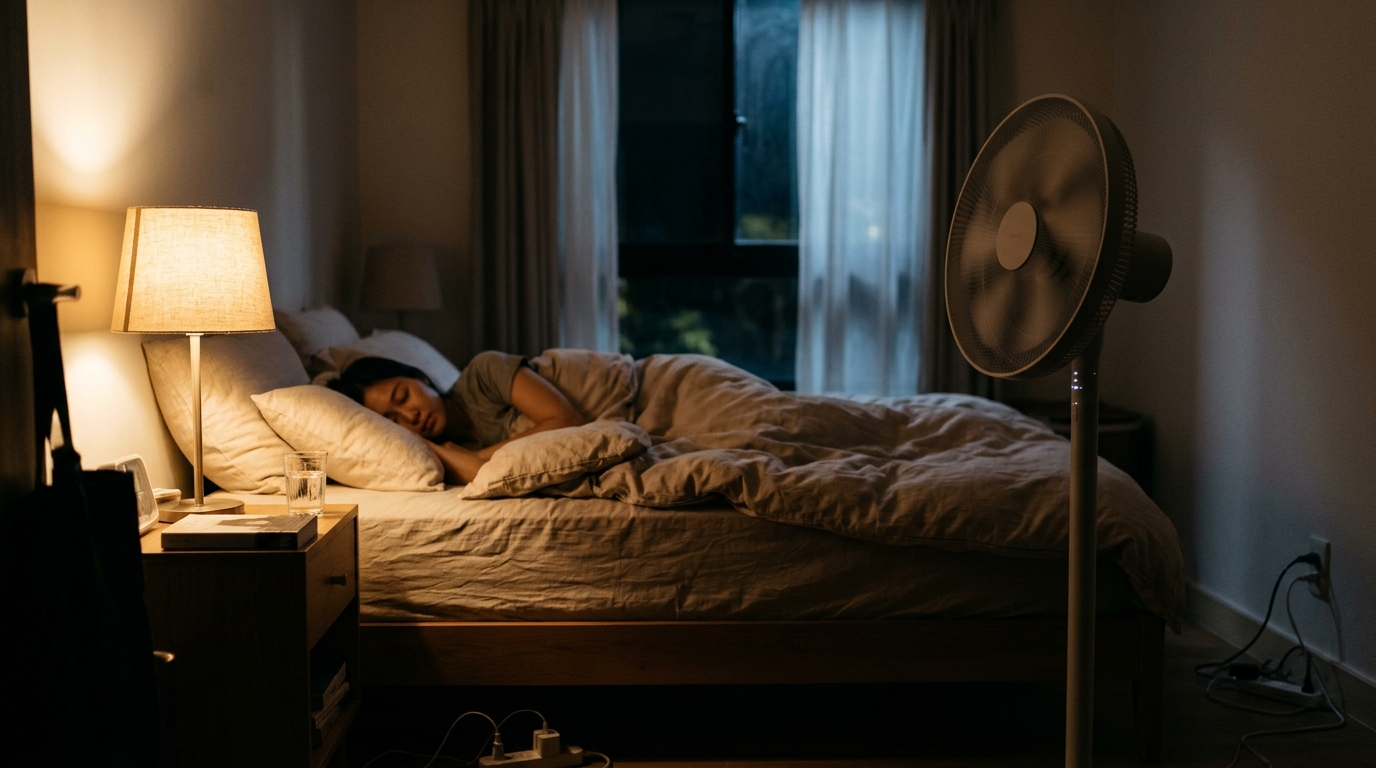
If you have ever lain awake on a warm night with a fan blasting directly at you, you know the trade-off. You get a burst of relief, then dry eyes, a scratchy throat, and a noisy room that makes it hard to drift off. Meanwhile your air conditioner is still cycling because the thermostat says the room is too warm, even though you feel fine under the breeze.
The truth is that a fan does not cool the air at all. It cools you by speeding up evaporation from your skin and by breaking up the thin warm layer of air that clings to your body. That means the right speed, angle, and placement matter far more than raw airflow. A fan set too high wastes electricity and disrupts sleep. A fan aimed poorly leaves hot spots and moves air that never reaches you.
This post breaks down the speed and angle combination that works best for most bedrooms, how to set it up in under 15 minutes, and how to take it further with a ceiling fan or a window fan arrangement. Used well, a fan can let you raise your thermostat setpoint by about 4 degrees Fahrenheit with no loss in comfort, which the U.S. Department of Energy notes can trim cooling costs meaningfully over a season.
What You’ll Need
Click on an item below to shop for the recommended items for this recipe on Amazon.
As an Amazon Associate, we earn from qualifying purchases.
How to Do It
- Set the fan to low or medium rather than high. Start on low, and only step up if you still feel warm after 10 minutes.
- Place the fan 6 to 10 feet from the bed instead of right beside it. Distance lets the airflow widen and soften before it reaches you.
- Tilt the fan so it points at the foot or torso area of the bed, not your face. Aim slightly upward so the air arcs and settles over the whole bed.
- Turn on the oscillation setting if your fan has one, or manually angle it toward a wall so the air bounces back as a gentler, diffused breeze.
- Raise your thermostat 3 to 4 degrees from your usual nighttime setting (for example, from 72 to 76 degrees Fahrenheit) and give yourself a few nights to adjust.
- If the fan has a timer, set it for 3 to 4 hours so it runs during the early sleep period when you need the most cooling, then shuts off.
- Check your ceiling fan direction. Stand under it while it runs. You should feel a breeze, which means it is spinning counterclockwise. If not, flip the small switch on the motor housing.
- Install a smart plug or a basic outlet timer ($10 to $25) on your floor or tower fan so it can ramp down automatically, such as medium for the first two hours and low for the rest.
- On nights when outdoor temperatures drop below your indoor temperature, open a window on the cooler side of the house and place a window fan blowing outward in a window on the opposite side. This pulls cooler air through the room.
- Keep bedroom and interior doors open or cracked so air can travel through the house. A closed door chokes off the cross-breeze.
- Add a small bedside fan aimed at your feet or legs on low speed. Lower-body airflow cools you effectively without disturbing your face or sleep.
- Track your thermostat setpoint for two weeks. Once you are comfortable at 76 to 78 degrees Fahrenheit with the fan running, lock that schedule into your programmable or smart thermostat.
Why It Works: The Benefits
Each degree you raise the thermostat in cooling season saves roughly 3 to 5% on cooling costs. A fan lets you gain 3 to 4 degrees of perceived comfort, which can add up to 10 to 15% on the cooling portion of your bill.
A gentle, steady breeze helps keep skin temperature in the range where people fall asleep faster and wake less often. Lower speeds also mean less noise, which matters as much as temperature for staying asleep.
Direct high-speed airflow dries out nasal passages and eyes. Indirect, lower-speed airflow gives most of the cooling benefit without waking you with a scratchy throat.
A box fan on low or medium costs roughly 0.3 to 0.8 cents per hour at average U.S. electricity rates. A ceiling fan on low costs even less, often under half a cent per hour.
Fan noise rises quickly with speed. Dropping from high to low can cut perceived noise substantially, which helps light sleepers and partners with different temperature preferences.
💰 Savings Impact by Action
Raising the setpoint 3 to 4 degrees while using a fan can cut cooling costs by roughly 10 to 15%.
Dropping a fan from high to low can cut its electricity use by half or more because power draw climbs steeply with speed.
Running the fan only during the first three to four hours of sleep instead of all night trims its electricity use by about a third.
Using outdoor air on cool nights in place of AC can reduce nighttime cooling runtime by 15% or more.
🏠 Key Concepts Explained
The Science Behind It
A fan lowers your skin temperature through two mechanisms. First, it speeds up evaporation of the thin layer of moisture on your skin, and evaporation is a powerful cooling process because water absorbs a lot of heat as it turns to vapor. Second, it disrupts the stagnant boundary layer of warm air that forms around your body, replacing it with room-temperature air that can carry heat away more easily. Neither effect changes the actual air temperature, which is why the room thermometer does not move even as you feel noticeably cooler.
Airflow speed and comfort do not rise in a straight line. Moving from still air to a gentle breeze of around 100 to 150 feet per minute delivers most of the perceived cooling benefit. Pushing the fan far beyond that gives diminishing returns while noise, dryness, and power use all climb. That is why low or medium speed, at a comfortable distance, often beats high speed pointed straight at your face.
Fan power also rises faster than airflow. Fan affinity laws show that power draw increases roughly with the cube of speed, so a modest drop in speed saves a surprising amount of electricity. Combine that with a higher thermostat setpoint, and your air conditioner runs less often during the hours when you are asleep and least aware of the difference.
Frequently Asked Questions
▼ Why is my AC still running all day even after I tried these fixes?
A fan lowers how warm you feel, but it does not remove heat from the house, so your AC still has to handle the actual indoor temperature. Check that you really did raise the thermostat setpoint, since the savings come from the setpoint change and not the fan itself. If the AC runs constantly even at 76 to 78 degrees, look into air leaks, attic insulation, a dirty filter, or an undersized system.
▼ Can renters do this without landlord permission?
Yes. Everything in the quick fix uses a portable fan and your thermostat settings, and a window fan or smart plug is removable with no permanent changes. The only step to skip is swapping or rewiring a ceiling fan, which should go through your landlord.
▼ How long before I actually notice savings on my bill?
You will see the effect on your next full billing cycle, though it is easiest to confirm after two to four weeks of consistent use. Compare your kilowatt-hour usage to the same period last year, adjusting for weather if you can. The savings come from the higher thermostat setpoint, so expect roughly 3 to 5% per degree raised.
▼ What if my home is older than 30 years?
Older homes often have more air leakage and thinner attic insulation, so bedrooms can stay warm well after sunset. A fan still helps, but pairing it with a window cross-breeze on cooler nights and sealing obvious gaps will make a bigger difference. If upstairs rooms stay hot, adding attic insulation to R-38 or higher is usually the highest-value next step.
▼ Is it bad to sleep with a fan blowing on me all night?
For most healthy people it is fine, but direct high-speed airflow can dry out your eyes and nasal passages and sometimes causes muscle stiffness. Use a lower speed, aim it at your feet or toward a wall, and run it on a timer. If you have allergies or asthma, keep the fan clean and avoid blowing dust directly toward your face.
Quick Tips
- Set the fan one speed lower than feels necessary when you first lie down. Your body cools as you fall asleep, so what feels right at 10 PM is usually too much by midnight.
- Use a fan with multiple speeds or a timer rather than a single-speed unit so you can taper airflow through the night.
- Keep fan blades and grilles clean. Dust buildup reduces airflow and can make a fan louder and less effective.
- Close blinds and curtains on sun-facing windows during the day so your bedroom starts the evening cooler, which lets the fan do less work at night.
- Pair your fan with lightweight, breathable bedding such as cotton or linen so moving air can actually reach your skin.
Variations for Your Situation
- Apartment/Rental: Use a portable tower or box fan ($25 to $60) and a plug-in smart plug ($10 to $20) so nothing is permanent. A tension-mounted or sill-sitting window fan ($30 to $70) lets you pull in cooler night air without modifying the window.
- Tight Budget (under $50): Skip new purchases. Move the fan 6 to 10 feet back, aim it at your feet, run it on low, and raise your thermostat 3 degrees. If you want one upgrade, a $10 outlet timer gives you automatic shutoff.
- Older Home (pre-1980): Expect warmer bedrooms due to leaky ducts and thinner insulation. Use a window fan to exhaust hot air on cooler nights, keep interior doors open for airflow, and prioritize sealing attic bypasses and adding insulation before spending on more fans.