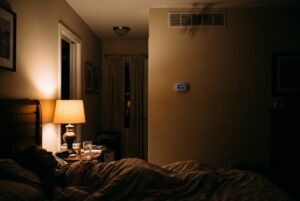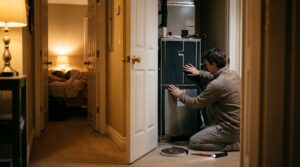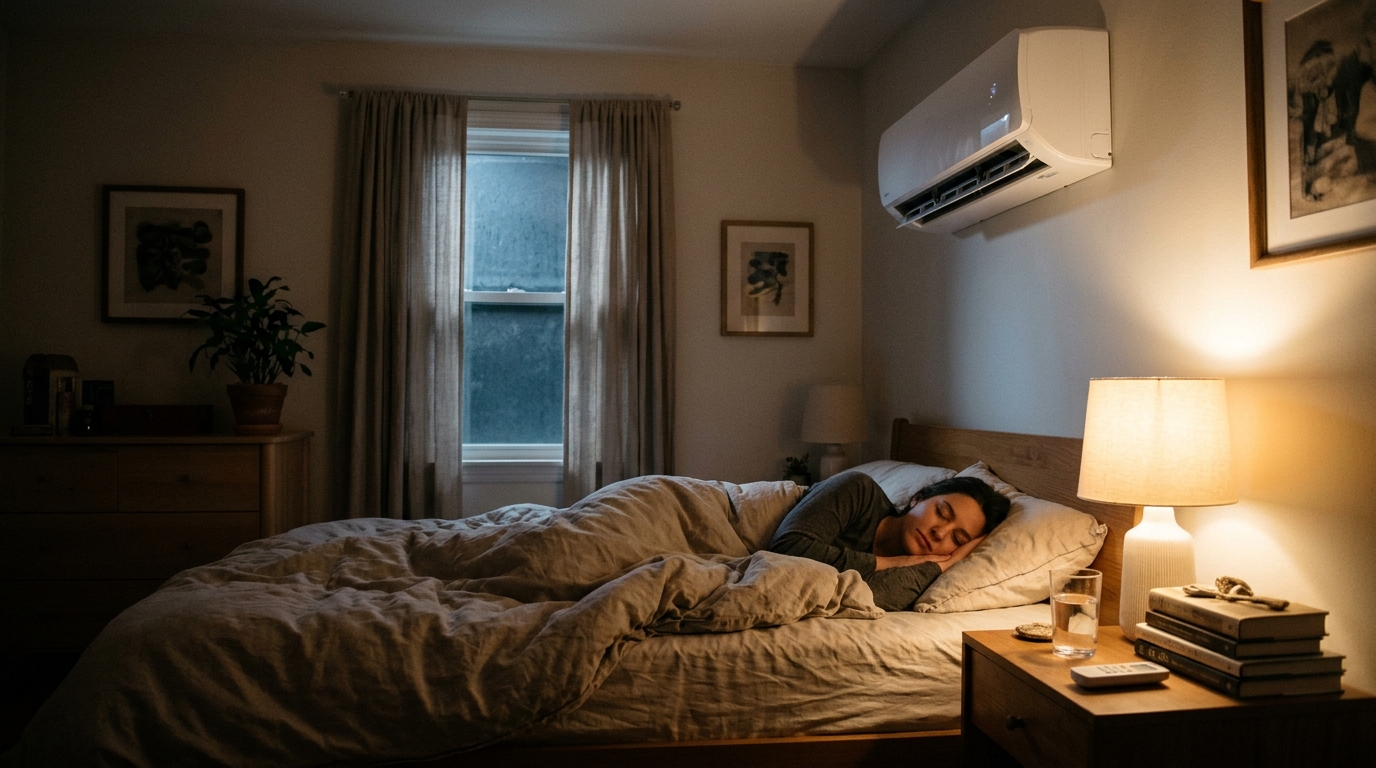
If you have ever lain awake in a bedroom that is too warm while the thermostat downstairs reads a perfect 72 degrees, you already understand the problem with central HVAC. A single thermostat controls the whole house, but you only occupy one or two rooms at night. Meanwhile, the system is conditioning a kitchen, a living room, and a guest room that nobody is using for eight hours straight.
Ductless mini-split heat pumps solve this by letting you condition only the space you are using. Because they skip the ductwork entirely, they avoid the 20 to 30% energy loss that the DOE estimates occurs in typical leaky duct systems. They are also among the most efficient heating and cooling equipment available, with many models rated SEER2 20 or higher and HSPF2 9 or higher.
This post covers how to use a mini-split as a nighttime bedroom zone, whether you already own one or are considering adding one. We will walk through the best sleep settings, how to pair the mini-split with a thermostat setback on your central system, and what a professional installation looks like if you want to add a head to an existing home.
What You’ll Need
Click on an item below to shop for the recommended items for this recipe on Amazon.
As an Amazon Associate, we earn from qualifying purchases.
How to Do It
- Set the central thermostat back 4 to 6 degrees overnight (for example, 78 degrees in summer or 62 degrees in winter) so the main system rarely runs while you sleep.
- Set the mini-split to Sleep mode if available. This gradually raises the cooling setpoint (or lowers the heating setpoint) by 1 to 2 degrees over the first few hours, matching your body’s natural temperature drop.
- Choose a setpoint between 66 and 70 degrees F for cooling, or 62 to 66 degrees F for heating, and leave it there. Avoid big swings, since inverter units are most efficient when holding a steady temperature.
- Set the fan to Auto or Low and point the louvers away from the bed. Use the swing function if you want gentle air movement without a direct draft on you.
- Close the bedroom door so the unit only has to condition that room. If the door must stay open, expect savings closer to the low end of the range.
- In humid weather, try Dry mode for the first hour before bed to pull moisture out of the room before switching to Cool.
- Connect the mini-split to its Wi-Fi app (or add the manufacturer’s Wi-Fi adapter, typically $30 to $90) so you can schedule the unit and adjust it without getting out of bed.
- Build a schedule: start pre-cooling or pre-heating the bedroom 30 to 45 minutes before bedtime, then switch to Sleep mode, then raise or lower the setpoint 30 minutes before you wake so the room is comfortable but not wasting energy.
- Add a small plug-in temperature and humidity monitor ($15 to $30) on the nightstand. Check the real room reading for a few nights, since the unit’s internal sensor sits high on the wall and can read differently than the air at bed height.
- Seal the bedroom door gaps with a door sweep ($10 to $20) and adhesive foam weatherstripping ($8 to $15) to keep conditioned air in the room and reduce noise leakage.
- Clean the mini-split’s washable filters every 2 to 4 weeks. Rinse them in lukewarm water, dry completely, and reinstall. Dirty filters reduce airflow and efficiency noticeably.
- After one week of tracking, adjust the setpoint by 1 degree at a time until you find the warmest (summer) or coolest (winter) temperature that still lets you sleep well. Each degree of adjustment saves roughly 3 to 5% on that unit’s energy use.
- Have an HVAC contractor perform a Manual J load calculation for the bedroom. A typical 12,000 BTU (1-ton) unit suits 400 to 600 square feet, but a 9,000 BTU unit is often right for a single bedroom. Oversized units short-cycle and dehumidify poorly.
- Choose a high-efficiency inverter model rated SEER2 20 or higher with a low-ambient heating rating if you live in a cold climate. Look for models that operate down to minus 13 degrees F or lower.
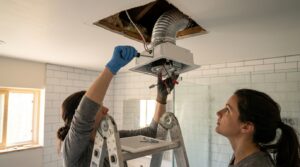
- Pick the indoor head location with the installer. Mount it high on an exterior wall where airflow will circulate the room without blowing directly on the bed. The line set (refrigerant lines) should run to the outdoor unit with a short, clean path.
- Make sure the installer pulls a vacuum on the lines, weighs the refrigerant charge correctly, and provides a condensate drain with proper slope. Skipping the vacuum step is one of the most common causes of early failure.
- Ask the installer to program Sleep mode and walk you through the filter cleaning and remote or app controls before they leave.
- Apply for any utility rebates and the federal tax credit, and keep your invoice and the equipment’s efficiency certification for paperwork.
Why It Works: The Benefits
Conditioning one bedroom instead of the whole house typically cuts nighttime HVAC energy by 30 to 50%, depending on home size and climate.
Direct, stable temperature control in the bedroom eliminates the hot or cold spots common in rooms at the end of a duct run, and inverter units keep noise as low as 19 to 25 dB on the lowest fan setting.
Indoor mini-split heads are far quieter than a central blower kicking on, and there are no duct rattles or whooshing registers to wake light sleepers.
A dedicated bedroom zone solves the classic argument over the thermostat, and it can hold a cool 66 degrees at night without making the rest of the house uncomfortable in the morning.
With the central system set back overnight, it runs fewer hours, which can extend the life of a furnace or air handler over time.
💰 Savings Impact by Action
Conditioning only the bedroom instead of the whole house cuts nighttime load by roughly 30 to 40% in a typical single-family home.
Ductless delivery eliminates the 20 to 30% of energy that leaky central ductwork can waste.
Setting the central system back 4 to 6 degrees overnight saves about 10% annually on that system’s energy use.
Gradual setpoint drift over the first hours of the night reduces the mini-split’s own runtime by 5 to 10%.
A modern inverter heat pump uses 30 to 50% less electricity than electric resistance heating for the same output.
🏠 Key Concepts Explained
The Science Behind It
A ductless mini-split is a heat pump, which moves heat rather than generating it. In cooling mode it pulls heat out of the bedroom air and releases it outdoors, and in heating mode it reverses the process. Because it moves heat instead of burning fuel or running electric resistance coils, a modern unit can deliver 2 to 4 units of heating or cooling energy for every 1 unit of electricity it consumes. That ratio, called the coefficient of performance, is why heat pumps beat electric baseboard heaters by 60 to 70% in many climates.
The inverter compressor is the other major reason mini-splits shine at night. Traditional compressors are either fully on or fully off, so they cycle repeatedly and consume a large surge of power each time they start. An inverter compressor modulates its speed continuously, sometimes running at just 20 to 30% capacity to hold a steady bedroom temperature. Running slowly and steadily keeps the evaporator coil colder for longer, which improves dehumidification, and keeps noise to a minimum.
Zoning amplifies the savings. Heat transfer through walls, windows, and ceilings is driven by the temperature difference between inside and outside. By conditioning only the bedroom and letting the rest of the house drift toward a more relaxed setpoint, you shrink the total envelope area working against you. You are also avoiding the duct losses that plague central systems, where the DOE notes that leaky ducts in unconditioned attics can waste a quarter or more of the energy they carry.
Frequently Asked Questions
▼ Why is my mini-split blowing warm air in cooling mode or not cooling the bedroom enough?
First check that the filters are clean and the mode is set to Cool rather than Fan or Dry. Make sure the outdoor unit is running and not blocked by debris. If the unit is running but the room never reaches setpoint, the system may be undersized or low on refrigerant, so book a technician to test the charge and run a load calculation.
▼ Can renters use this strategy without modifying the home?
Permanent mini-splits require landlord approval and professional installation, but renters have good alternatives. A window-mounted inverter air conditioner or a portable heat pump unit ($400 to $900) can serve a single bedroom without altering the building. Pair it with a door sweep and a smart plug for scheduling to capture most of the benefit.
▼ How long before I actually notice savings on my bill?
If you are changing settings on an existing unit, you should see a difference on your very next bill, typically within 30 days. Savings of 10 to 20% on your total cooling or heating cost are common if the central system was previously running all night. A new installation shows savings gradually, with payback depending on your local rates and how much runtime you shift.
▼ Is it okay to leave a mini-split running all night?
Yes, they are designed for continuous operation. Inverter units run most efficiently when they hold a steady temperature rather than being switched on and off repeatedly. The key is choosing a reasonable setpoint and using Sleep mode so it is not working harder than needed.
▼ What if my home is older than 30 years?
Older homes often have more air leakage and less insulation, so the bedroom load may be higher than you expect. Seal obvious gaps around windows, outlets, and attic hatches first, since this can reduce the unit’s workload by 10 to 20%. A mini-split is still a great fit because it avoids the aging, leaky ductwork common in older houses.
Quick Tips
- Use Sleep mode if your unit has it. It nudges the setpoint 1 to 2 degrees over the first hours of the night, which matches your body’s natural cooling and saves 5 to 10% on its own.
- Keep the outdoor unit shaded and at least 12 to 24 inches clear of walls and shrubs. A unit in direct afternoon sun works harder and loses a few percent of efficiency.
- Pair the mini-split with a ceiling fan on low. The moving air lets you raise the setpoint by about 4 degrees in summer with no loss in comfort.
- Have a technician check refrigerant charge and clean the coils every 1 to 2 years. A system low on refrigerant can lose 10 to 20% of its efficiency without any obvious symptoms.
Variations for Your Situation
- Apartment/Rental: Skip the permanent install and use a window-mounted inverter AC or a portable heat pump ($400 to $900) in the bedroom only. Add a door sweep ($10 to $20) and a smart plug ($10 to $15) to schedule it, and ask your landlord about a mini-split if you plan to stay several years.
- Tight Budget (under $50): Set the central thermostat back 4 to 6 degrees overnight, close the bedroom door, and add foam weatherstripping and a door sweep. If you have any existing window unit or fan, use it in the bedroom and leave the rest of the house at a relaxed setpoint.
- Older Home (pre-1980): Prioritize air sealing and attic insulation to R-38 before or alongside the mini-split, since leaky older rooms can waste 25% or more of conditioned air. Choose a slightly larger head only if a Manual J calculation supports it, and avoid mounting it where drafty windows blow against it.
- Cold Climate: Choose a cold-climate rated heat pump that maintains rated capacity at 5 degrees F or below, and keep the outdoor unit elevated on a stand above snow level. Set heating to 62 to 66 degrees overnight and use a heated mattress pad ($60 to $120) for extra comfort at very low energy cost.