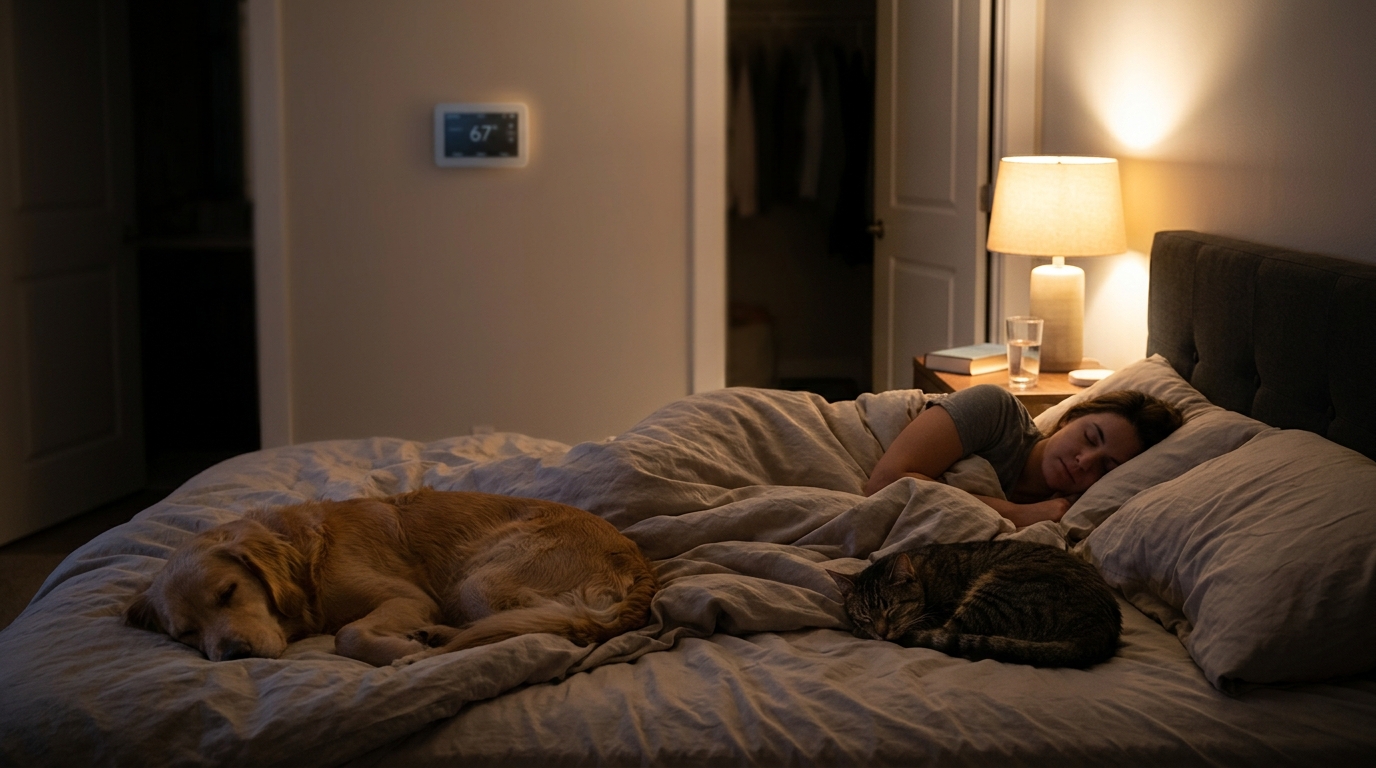
If you share your bed with a dog, cat, or both, you already know the feeling: you wake up at 2 a.m. sweating, with a furry heater pressed against your legs. Most pets run warmer than we do. A dog’s normal body temperature is 101 to 102.5°F and a cat’s is about 100.5 to 102.5°F, compared with roughly 98.6°F for people. A 60-pound dog sleeping next to you can add the heat equivalent of a small space heater to your side of the mattress, and that changes what thermostat setting makes sense overnight.
Many pet owners respond by dropping the thermostat to 65°F or lower in summer, which makes the AC work harder for hours and drives up the bill. Others do the opposite in winter, setting the thermostat too low and leaving the pet (and themselves) chilled. Neither extreme is efficient, and neither is necessarily more comfortable.
This post breaks down how much heat your pet really adds to the bed, what nighttime temperature range works best for a shared sleeping setup, and how to get comfortable without wasting energy. You will find a no-cost quick fix, a DIY upgrade, and a few strategies for renters, tight budgets, and older homes.
What You’ll Need
Click on an item below to shop for the recommended items for this recipe on Amazon.
As an Amazon Associate, we earn from qualifying purchases.
How to Do It
- In summer, set your nighttime thermostat to 68 to 70°F instead of dropping it to the mid-60s. Your pet’s body heat will make the bed feel several degrees cooler to you than it would otherwise be.
- In winter, try 63 to 66°F overnight. If your pet sleeps under the covers with you, you can often go toward the lower end of that range.
- Switch to layered bedding: a lightweight sheet plus a blanket you can kick off, rather than one heavy comforter that traps your pet’s heat against you.
- Run a ceiling fan on low, set to spin counterclockwise in summer, to create gentle airflow across the bed. Moving air helps sweat evaporate and makes the room feel about 4°F cooler.
- Give your pet a nearby alternative, such as a cooling mat in summer or a cozy blanket on top of the bed in winter, so they can regulate their own temperature without piling onto you.
- Install a programmable or smart thermostat (typically $25 to $130). Program a bedtime setpoint of 68°F in summer or 64°F in winter, with a gentle ramp toward your wake-up temperature 30 minutes before you rise.
- Add a small bedside or floor fan ($20 to $40) aimed across the bed, not directly at your pet’s face. This lets you hold a higher thermostat setting without feeling hot.
- Use a breathable mattress pad or cooling topper ($40 to $120) to reduce heat build-up on your side of the bed, which helps when a pet is lying against you.
- Seal drafts around bedroom windows and doors with weatherstripping ($10 to $20) so the room holds your chosen setpoint without the system cycling constantly.
- Track how you and your pet sleep for a week. If either of you seems restless, adjust the setpoint 1 degree at a time rather than making big jumps.
- Have an HVAC pro assess whether your bedroom is a hot or cold spot caused by duct size, insulation, or sun exposure.
- Consider a ductless mini-split head for the bedroom ($1,000 to $1,500 installed in many markets), which lets you condition just that room at night while setting the rest of the house back more aggressively.
- Alternatively, add a smart room sensor to your thermostat ($30 to $60) so it regulates based on bedroom temperature instead of the hallway.
- Add a smart vent or manual damper adjustment to send more or less air to the bedroom during sleeping hours.
Why It Works: The Benefits
Raising your summer nighttime setpoint from 65°F to 68°F can cut overnight cooling use by roughly 6 to 9%, since each degree adds about 3% to cooling costs.
Overheating is a leading cause of nighttime waking. Matching the room temperature to your combined body heat helps you stay in deeper sleep stages longer.
A bedroom that is too cold can leave short-haired, small, senior, or arthritic pets stiff and shivering, while one that is too warm risks overheating in thick-coated breeds. A steady 66 to 70°F suits most pets.
Since your pet adds free heat, you can often set the winter nighttime thermostat 2 to 3°F lower, around 62 to 65°F, saving about 3 to 6% on heating.
With the right setpoint and bedding layers, you stop kicking covers on and off, which keeps your body temperature steadier through the night.
💰 Savings Impact by Action
Moving the summer nighttime setting from 65°F to 68°F cuts overnight cooling energy by roughly 9%, since each degree adds about 3%.
Dropping the winter nighttime setting 2 to 3°F lets your pet’s body heat do some of the work and trims heating use by about 3 to 6%.
A fan makes you feel about 4°F cooler, letting you hold a higher setpoint and shaving roughly 8% off cooling runtime.
The DOE estimates up to 10% annual savings from setting back your thermostat 7 to 10°F for 8 hours a day.
Sealing bedroom gaps reduces air leakage so your chosen setpoint holds with less equipment runtime, saving around 5%.
🏠 Key Concepts Explained
The Science Behind It
Most of the extra warmth you feel comes from conduction, the direct transfer of heat between objects in contact. When a 50-pound dog lies against your legs, heat flows from their roughly 101.5°F body into your lower-temperature skin and bedding. Because the blanket traps that heat close to your body, the micro-climate under the covers can be 5 to 8°F warmer than the room air. That is why your thermostat reading and your actual comfort can be so far apart.
Heat also leaves your body through convection and evaporation. Moving air from a fan speeds up both, which is why a fan can let you raise your thermostat setting by 3 to 4°F without losing comfort. Every degree you raise the cooling setpoint typically cuts energy use by about 3%, so a fan that costs only a few cents a night can deliver savings well beyond its operating cost.
In winter the story reverses. Your pet becomes a free heat source, a bit like a small radiant panel in the bed. Because your body senses warmth locally, you can usually tolerate a cooler room, which reduces how often your furnace runs overnight. Balancing these effects against your pet’s own needs is the key: aim for a room temperature in the mid-60s that suits both of you rather than one that suits only the thermostat.
Frequently Asked Questions
▼ Why do I still wake up hot even with the AC set to 65°F and my dog in bed?
Conductive heat from your dog is warming the bedding directly, so a colder room does not fully fix it. Try a lighter blanket, a fan across the bed, and a cooling mat for your dog, then raise the thermostat to 68°F to save energy.
▼ Can renters do this without landlord permission?
Yes. Changing your thermostat setting, using a plug-in fan, swapping bedding, and adding a cooling mat require no modifications. Many renters can also use a smart plug or a portable room sensor without touching the HVAC system.
▼ How long before I notice savings on my bill?
Most households see a difference on the very next billing cycle. A 3 to 4 degree nighttime adjustment in summer or winter commonly trims 5 to 10% off heating and cooling costs, depending on climate and how long your system runs overnight.
▼ What if my home is older than 30 years?
Older homes tend to leak more air and have weaker insulation, so the bedroom may swing in temperature overnight. Seal drafts with weatherstripping and caulk first, then fine-tune your setpoint, since an uncomfortable room can undo the savings from a smarter schedule.
▼ What temperature is too cold for my pet at night?
Most healthy adult pets are fine at 62 to 68°F, especially with a blanket or bed to burrow into. Small, short-haired, very young, or older pets may need it a few degrees warmer, so watch for shivering or curling up tightly.
Quick Tips
- Start with a 2 to 3 degree change and give it a full week before adjusting again, since your body and your pet’s both need time to adapt.
- Place a room thermometer at bed level, not just on the wall, to see the real temperature where you and your pet sleep.
- Wash pet bedding and your sheets regularly. Dander and moisture trap heat and humidity and can make a bed feel warmer.
- If your pet pants or moves off the bed during the night, that is a clear sign the room or bed is too warm for them.
Variations for Your Situation
- Apartment/Rental: You cannot modify central HVAC, so focus on a plug-in fan ($20 to $40), breathable bedding, and a cooling mat for your pet ($25 to $50). Use a smart plug or a portable room sensor to monitor and nudge the temperature without altering the system.
- Tight Budget (under $50): Raise your summer setpoint to 68 to 70°F, switch to a lightweight blanket you can kick off, and run a ceiling or box fan you already own. Add a $10 roll of weatherstripping on the bedroom door to hold temperature, and skip any new gadgets.
- Older Home (pre-1980): Expect more drafts and uneven temperatures, so seal bedroom windows and the door gap first with caulk and weatherstripping ($15 to $30). Add a bedroom-level thermometer and consider a small oscillating fan to even out hot and cold spots before changing your thermostat schedule.
- Large or Thick-Coated Dog: Prioritize airflow and a cooler sleep surface for your dog, such as a cooling pad at the foot of the bed, and keep the room around 66 to 68°F so the dog does not overheat.