If you wake up with a scratchy throat, static shocks on the stair rail, and a nose that feels like sandpaper, your indoor air is probably too dry. When outdoor air drops below freezing, it holds almost no moisture. Your furnace then heats that air up, and the relative humidity inside can plummet to 10 to 20 percent, drier than the Sahara. Dry air also pulls moisture off your skin faster, which makes you feel colder at the same temperature, so many homeowners compensate by raising the thermostat and burning more fuel.
A whole-house humidifier, the kind installed on your furnace or air handler, can fix this, but only if the humidistat is set correctly. Set it too low and you get no benefit. Set it too high and you get condensation on windows, mold risk inside wall cavities, and peeling paint. The right setting is not a single number. It changes with the outdoor temperature, and that is where most homeowners go wrong by setting it once in November and forgetting it.
In this post, you will learn the recommended humidity setting for each outdoor temperature range, how to dial it in with a quick fix or a more precise DIY upgrade, and how to use comfortable humidity to lower your thermostat at night. You will also get troubleshooting answers for foggy windows, humidifiers that never seem to run, and older homes with leaky windows.
What You’ll Need
Click on an item below to shop for the recommended items for this recipe on Amazon.
As an Amazon Associate, we earn from qualifying purchases.
How to Do It
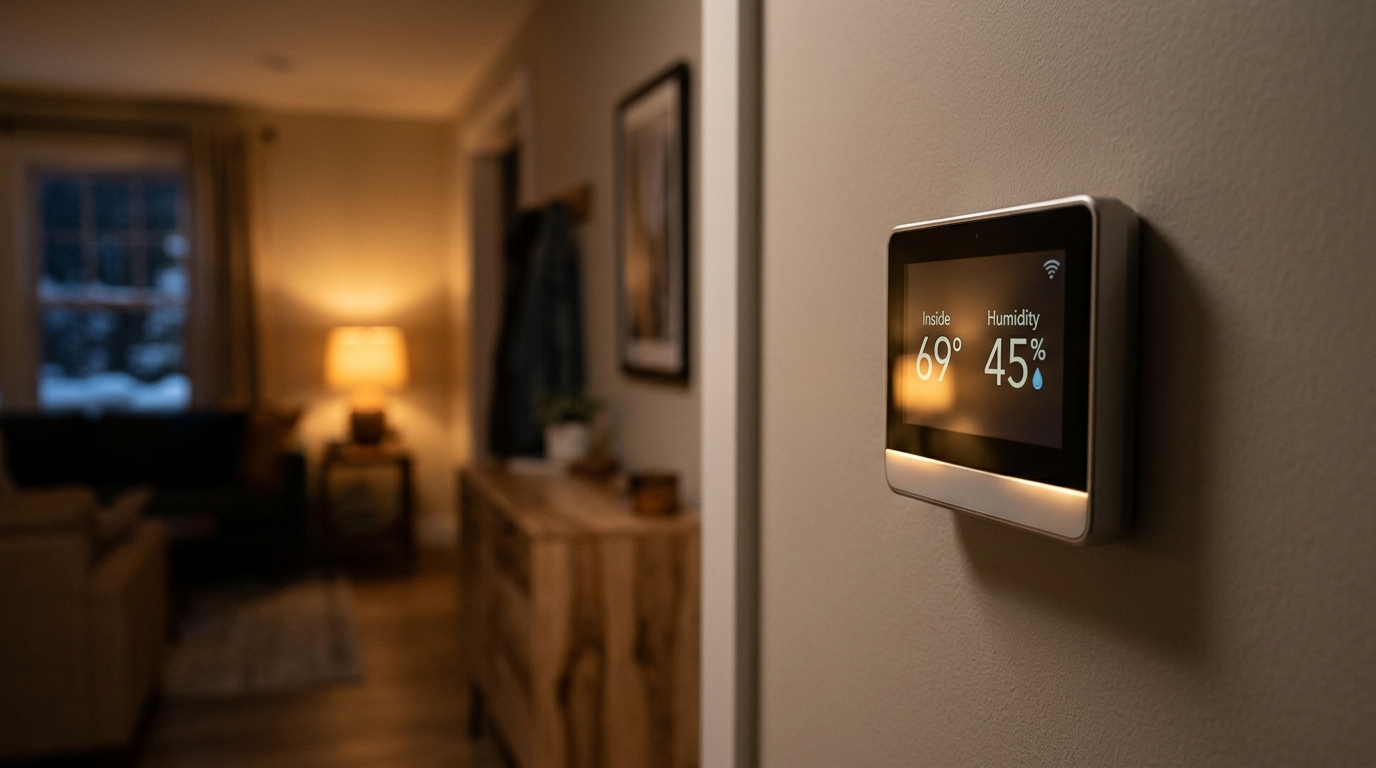
- Buy a basic digital hygrometer for $10 to $15 and place it in your bedroom or main living area, away from vents, windows, and exterior walls.
- Check the outdoor temperature forecast, then set the humidifier dial using this guide: 40 degrees F and above, 40 to 45 percent; 20 to 40 degrees, 35 to 40 percent; 10 to 20 degrees, 30 to 35 percent; 0 to 10 degrees, 25 to 30 percent; below 0 degrees, 20 to 25 percent.
- Wait 24 hours, then read the hygrometer. If it is off from your target by more than 3 points, nudge the dial up or down by one notch and recheck the next day.
- Inspect the bottoms of your windows each morning for the first week. If you see fog or beads of water, drop the setting by 5 percent immediately.
- Re-adjust the dial every time the forecast shifts into a new temperature range, or at minimum, check it weekly during cold snaps.
- Lower your nighttime thermostat by 2 degrees for a few nights and see whether you still feel comfortable. If so, try another degree.
- Turn off power to your furnace and humidifier at the breaker, and shut off the water supply to the humidifier using the saddle valve or inline shutoff.
- Identify your humidifier brand and model number, usually on a label on the unit, and look up the compatible digital humidistat or automatic control with an outdoor sensor.
- Mount the outdoor sensor on a shaded north-facing exterior wall, at least 3 feet from vents and dryer exhaust, and run the low-voltage wire through a small hole sealed with caulk.
- Replace the old indoor control with the new digital humidistat, matching the wiring labels from the old unit, usually two or three low-voltage wires. Take a photo before disconnecting anything.
- Restore power and water, then program the control to its automatic or outdoor-reset mode so it lowers the target humidity as the temperature drops.
- Verify with your separate hygrometer after 48 hours and fine-tune the offset setting if the control reads high or low.
- Schedule an HVAC technician in early fall, before the heating season, when appointments are easier to get and cheaper.
- Ask the technician to replace the water panel or evaporator pad, clean the water distribution tray, and check the drain line for scale and blockage.
- Have them verify the bypass damper or fan-powered operation is working so the unit actually moves moist air into your ductwork.
- Request installation of a digital humidistat with an outdoor temperature sensor if your model does not already have one.
- Ask for a measured humidity reading at several rooms so you know the system is distributing moisture evenly.
Why It Works: The Benefits
Because moist air feels warmer, many households can lower the thermostat 2 to 4 degrees and feel the same. The Department of Energy estimates roughly 1 percent savings per degree of setback over 8 hours, so this alone can trim heating bills by 3 to 8 percent.
Humidity in the 30 to 40 percent range keeps nasal passages and throat tissue from drying out overnight. Many people notice less snoring, fewer nosebleeds, and fewer morning sore throats within a week.
Keeping humidity above 30 percent prevents hardwood from shrinking and gapping, which can cost thousands to repair. It also reduces cracking in trim, musical instruments, and wood furniture.
Static shocks become noticeable below about 25 percent humidity. Holding the air at 30 to 40 percent virtually eliminates them and protects sensitive electronics from static discharge.
Dust, pet dander, and some viruses stay airborne longer in very dry air. Moderate humidity helps particles settle and may reduce the survival of certain flu viruses, though it is not a substitute for ventilation and filtration.
💰 Savings Impact by Action
Lowering the thermostat 2 to 4 degrees because properly humidified air feels warmer saves about 1 percent per degree over the heating season.
Pairing humidity control with basic air sealing keeps moist, warm air inside and cuts infiltration losses by 2 to 4 percent.
Stable humidity above 30 percent cuts the risk of hardwood gapping and cracked trim, avoiding repairs that can run into the thousands.
A clean water panel and correct setting prevent overworking the humidifier and furnace blower, saving 3 to 5 percent on fan and humidifier energy.
🏠 Key Concepts Explained
The Science Behind It
Air at 70 degrees F can hold roughly four times as much water vapor as air at 20 degrees F. When cold outdoor air leaks in or enters through ventilation and gets heated, its actual moisture content stays the same, but its relative humidity collapses. Outdoor air at 20 degrees and 70 percent humidity becomes indoor air at 70 degrees and about 10 percent humidity without any added moisture. That is why homes feel so dry in January even when it is snowing outside.
The reason humidity affects how warm you feel comes down to evaporation. Your skin is constantly losing moisture, and each gram that evaporates carries away heat. In dry air, that evaporation rate speeds up, which makes you feel chilly even when the thermometer reads a comfortable temperature. Raising humidity from 15 percent to 35 percent slows that evaporative heat loss, and many people report feeling about 2 to 3 degrees warmer at the same air temperature.
The upper limit on humidity is set by your windows and walls. Condensation forms when air touches a surface at or below its dew point. At 70 degrees and 40 percent humidity, the dew point is about 45 degrees. A window pane at 40 degrees will sweat, which is why the safe humidity setting drops as outdoor temperatures fall and glass surfaces get colder. Upgrading to double-pane or low-e windows raises the interior glass temperature and gives you more room to run higher humidity safely.
Frequently Asked Questions
▼ Why are my windows foggy or dripping even though my humidifier setting seems low?
Your windows are colder than the setting assumes, or your home is tighter than average and holds moisture well. Drop the humidistat 5 percent, run bathroom and kitchen fans, and check again the next morning. If it persists, your windows may be single-pane or failing, and you may need to hold humidity closer to 25 percent in the coldest weather.
▼ My humidifier runs all the time but my hygrometer still shows 15 percent. What is wrong?
The most common causes are a clogged or scaled water panel, a closed water supply valve, or a home that leaks air heavily. Replace the water panel, confirm the supply valve is open, and have the unit’s bypass damper checked. If your home is very leaky, air sealing around windows, doors, and attic penetrations will help the humidifier keep up.
▼ Will a whole-house humidifier really let me lower my thermostat?
Yes, for most people. Moist air reduces evaporative heat loss from your skin, so 66 to 68 degrees at 35 percent humidity often feels as comfortable as 70 degrees at 15 percent. Try lowering the thermostat one degree at a time every few days, and expect a savings of roughly 1 percent per degree over the heating season.
▼ How long before I notice savings on my bill?
You should feel comfort improvements within a day or two, and you can start lowering the thermostat right away. The savings show up on your next one or two utility bills, though weather swings can mask them. Compare your heating degree day adjusted usage, or simply track therm or kWh usage against the same month last year.
▼ What humidity should I use if my home was built before 1980?
Start 5 to 10 percent lower than the guide suggests, since older homes typically have leakier windows and less insulation in wall cavities. Watch your windows daily and use a hygrometer in the coldest room. Many older homes do best at 25 to 30 percent in deep winter.
Quick Tips
- Replace the humidifier water panel at the start of every heating season, and mid-season if you have hard water, because scale reduces output and hurts efficiency.
- Set a phone reminder to check the dial whenever a major cold front is forecast, since the safe humidity limit can drop 10 points overnight.
- Close the humidifier water supply valve and turn the humidistat to off during spring and summer to prevent stagnant water and unnecessary operation.
- Run bathroom and kitchen exhaust fans for the normal recommended time, since they remove excess moisture even when your humidifier is set correctly.
Variations for Your Situation
- Apartment/Rental: If you cannot install a whole-house unit, use one or two evaporative console humidifiers in the bedroom and living room, costing $40 to $120 each. Set a $10 hygrometer as your guide, aim for 30 to 40 percent, and clean the tank every 3 days to prevent bacterial growth.
- Tight Budget (under $50): Buy a $10 hygrometer, then use the quick fix temperature chart and adjust your existing humidifier dial. Add free moisture by air-drying laundry indoors, leaving the bathroom door open after showers, and placing a bowl of water near a heat register.
- Older Home (pre-1980): Run lower targets, typically 25 to 30 percent in cold weather, because leaky single-pane windows will sweat at higher levels. Prioritize caulking and weatherstripping first, and consider window insulation film at about $15 per window to raise the glass surface temperature.
- Newer Tight Home: Modern airtight construction holds moisture well, so you may need less humidification than you expect and more ventilation. Use your ERV or HRV if you have one, and keep the setting at 30 to 35 percent to avoid moisture buildup.