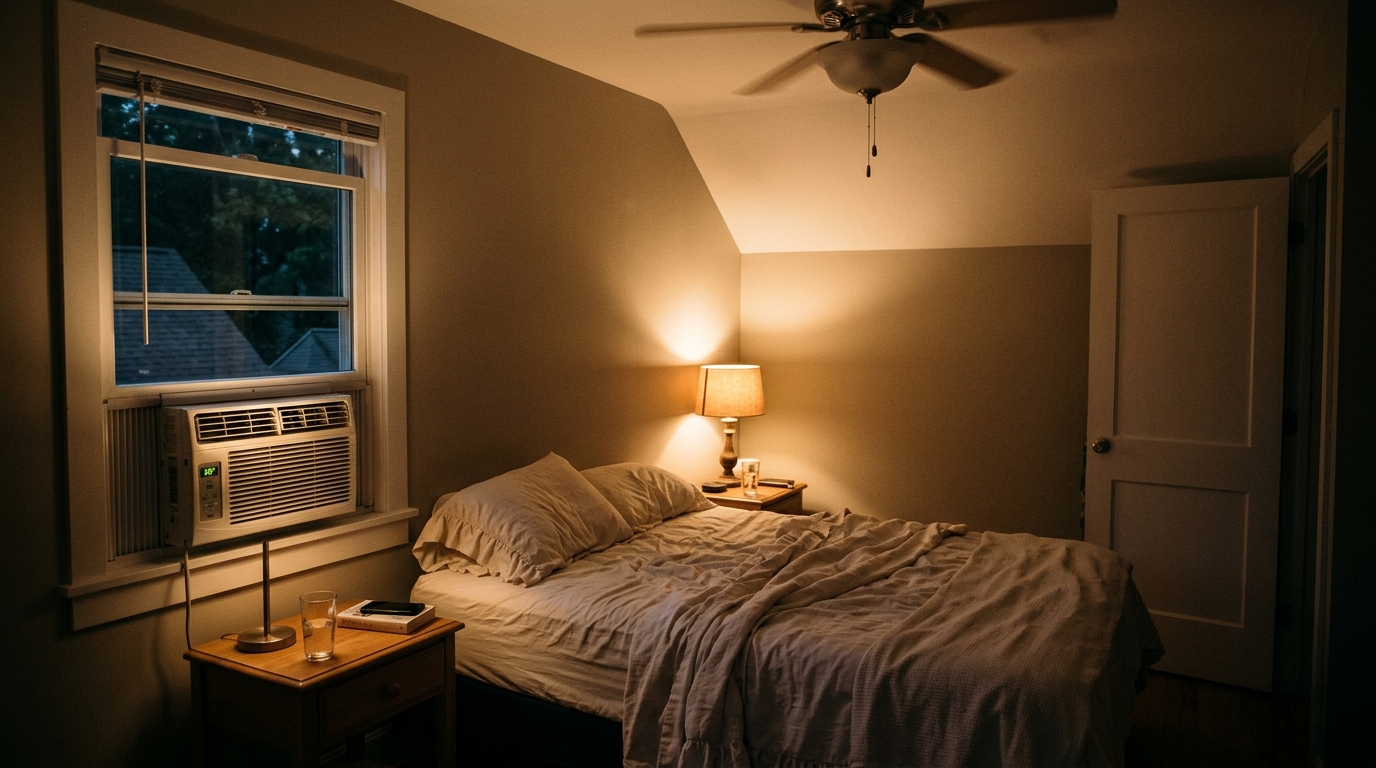
If you have ever lain awake at 2 a.m. in a stuffy upstairs bedroom while your living room feels like a meat locker, you are not imagining things. Warm air naturally rises, and the second floor also sits directly under a roof that can reach 140 degrees or more on a summer afternoon. That heat soaks into the attic, radiates down through the ceiling, and lingers in the bedroom long after sunset. Meanwhile, the thermostat is usually on the first floor, so it shuts the AC off once the main level hits its target.
Cranking the thermostat down is the instinct, but it is the expensive and uncomfortable answer. It overcools the downstairs, wastes energy, and often still fails to fix the bedroom. Every degree you lower the setpoint adds roughly 3 to 5 percent to your cooling costs, according to the U.S. Department of Energy.
This post walks through two approaches: a no-cost quick fix you can do tonight, and a DIY upgrade that tackles the root causes (solar gain, attic heat, and airflow imbalance). You will also get the building science behind why second floors run hot, plus troubleshooting for the situations that trip people up.
What You’ll Need
Click on an item below to shop for the recommended items for this recipe on Amazon.
As an Amazon Associate, we earn from qualifying purchases.
How to Do It
- Close blinds, curtains, or shades on sun-facing windows by mid-morning, before the room heats up. Blocking sun before it enters the glass is far more effective than closing coverings in the afternoon.
- Partially close (about half, not fully) the supply registers in the downstairs rooms to push more cool air upstairs. Never close more than about 20 percent of your registers total, since that can raise duct pressure and hurt efficiency.
- Fully open the supply vent and the return vent (if present) in the bedroom, and make sure nothing blocks them. Keep the bedroom door open during the day so conditioned air can circulate.
- Set a ceiling fan to run counterclockwise (when viewed from below) at medium speed to create a cooling breeze. Remember fans cool people, not rooms, so turn them off when you leave.
- At night, place a box fan in a window facing outward on the side of the house away from the wind, with a second window cracked open on the opposite side, once outdoor air drops below indoor temperature. This pulls cooler night air through the room and exhausts hot air out.
- Run the main thermostat’s fan setting to ON or circulate for 15 to 20 minutes per hour overnight (if your system allows) to even out floor-to-floor temperatures.
- Install cellular (honeycomb) shades or blackout curtains with a reflective backing on the hottest windows. Quality cellular shades run $40 to $120 per window and can cut heat gain through glass by up to 40 to 60 percent according to DOE estimates.
- Apply removable solar window film to west- and south-facing windows. Film costs about $20 to $60 per window and can reject 50 to 80 percent of solar heat, making it a solid option if curtains are not enough.
- Inspect the attic above the bedroom. Add blown-in or batt insulation to reach R-38 to R-49 (about 12 to 16 inches). Cost runs roughly $1 to $2 per square foot for DIY blown-in, and bedroom-sized sections can often be done in an afternoon.
- Seal air leaks around the ceiling before adding insulation: recessed lights, attic hatches, wire penetrations, and top plates. Use caulk and expanding foam rated for the application, and weatherstrip the attic hatch. Air sealing can cut upstairs heat leakage noticeably on its own.
- Add a low-cost smart temperature sensor or a second thermostat sensor in the bedroom, if your thermostat supports remote sensors (many Ecobee and some Nest models do). This lets the system cool based on the temperature where you actually sleep.
- Have the supply registers in the bedroom opened fully and check the damper on the main trunk line for the upstairs branch. Adjust slightly to send more air upstairs and test over two to three days, making small changes each time.
Why It Works: The Benefits
Research suggests the ideal sleeping temperature is roughly 65 to 68 degrees. Bringing a 78-degree bedroom into that range improves sleep quality without touching the rest of the house.
Reducing solar gain and attic heat transfer can cut cooling energy use by 5 to 15 percent, since your AC no longer fights heat that should never have entered the room.
Fixing the bedroom directly means you can raise the main thermostat 2 to 3 degrees. That alone saves about 6 to 15 percent on cooling costs.
Shorter, more balanced cooling cycles reduce strain on the compressor and blower, helping extend the life of a system that costs $5,000 to $12,000 to replace.
Balanced airflow eliminates the hot-and-cold swings that cause people to constantly fiddle with the thermostat.
💰 Savings Impact by Action
Cellular shades, solar screens, or window film can reduce solar heat gain through windows by 25 percent or more, lowering bedroom cooling load.
Upgrading attic insulation to R-38 or higher can cut heat gain through the ceiling by 15 to 25 percent, noticeably lowering upstairs temperatures.
Sealing ceiling penetrations and attic bypasses reduces uncontrolled air exchange and can trim cooling costs by 10 to 15 percent.
Raising the main thermostat 2 to 3 degrees after fixing the bedroom saves roughly 6 to 10 percent on cooling energy.
Properly balancing and sealing ducts improves delivery to upstairs rooms and can recover up to 10 percent of lost cooling capacity.
🏠 Key Concepts Explained
The Science Behind It
Second floors run hot because of a combination of heat transfer mechanisms working together. Convection moves warm air upward through the house (the stack effect), so the upper floor collects the warmest air while cooler air settles near the lower levels. Meanwhile, radiation and conduction deliver heat from the roof deck down through the attic and ceiling. A dark roof surface in direct sun can reach 150 degrees, and the attic air heats to near that temperature, driving heat through the ceiling into the bedroom.
Windows add another load through solar radiation. Standard glass lets through roughly 70 to 85 percent of incoming solar energy, which then becomes heat once it strikes floors, furniture, and walls. This is called solar heat gain, and it is why shading is so effective: stopping the energy before it converts to heat in the room prevents the load entirely instead of asking your AC to remove it.
Finally, your cooling system sees only the temperature at the thermostat. Because the first floor is cooler, the AC satisfies its setpoint and cycles off while the upstairs is still warm. Balancing airflow, adding insulation, and measuring temperature where you sleep align the system’s behavior with where cooling is actually needed.
Frequently Asked Questions
▼ Why is my AC still running all day even after I tried these fixes?
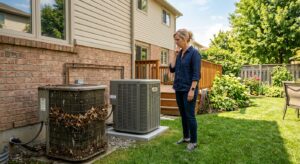
If the system runs constantly and the upstairs is still warm, you may have a duct leak, an undersized system, or low refrigerant. Check that your air filter is clean and the outdoor unit is free of debris, then call an HVAC technician to test airflow and refrigerant. Duct leakage in the attic is especially common and can waste 20 to 30 percent of your cooled air.
▼ Can renters do this without landlord permission?
Yes, most of the quick fix works without modifications. Use removable window film, tension-rod blackout curtains, a box fan, and adjustable vent covers, and rearrange fans and furniture as needed. Avoid anything involving the attic, ductwork, or permanent changes without written approval.
▼ How long before I actually notice savings on my bill?
Comfort improvements are immediate, often within the first night. Bill savings usually show up within one to two billing cycles, especially if you also raise the main thermostat by 2 to 3 degrees. Compare the same month year over year to account for weather differences.
▼ What if my home is older than 30 years?
Older homes commonly have less attic insulation (often R-11 to R-19), leakier ducts, and single-pane or early double-pane windows. Prioritize attic air sealing and insulation first, since that typically delivers the biggest payoff. A professional energy audit, often $200 to $500 and sometimes subsidized by your utility, can pinpoint the biggest leaks.
▼ Would a portable AC or window unit be a better choice?
A window or portable AC can cool a single bedroom for $150 to $500 upfront, but it uses more electricity per BTU than central air and adds noise. It makes sense if your ductwork cannot be improved or you only need cooling in one room. Look for an ENERGY STAR model with an appropriate BTU rating, typically 5,000 to 8,000 BTU for a standard bedroom.
Quick Tips
- Close shades and blinds before the sun hits the window, not after the room is already hot.
- Use a ceiling fan in counterclockwise rotation in summer and turn it off when the room is empty.
- Check your attic insulation depth: if you can see the tops of the joists, you likely have under R-30 and would benefit from adding more.
- Change your HVAC filter every 1 to 3 months, since a clogged filter reduces airflow and hurts upstairs rooms the most.
- Run laundry, dishwasher, and oven use in the early morning or evening so you are not adding heat to the house during peak hours.
- Keep the bedroom door open during the day to let conditioned air circulate, and consider a door undercut or transfer grille if you prefer it closed at night.
Variations for Your Situation
- Apartment/Rental: Focus on removable window film ($20 to $40 per window), tension-rod blackout curtains ($15 to $40), and a window-mounted fan or an ENERGY STAR window AC ($150 to $400). Use draft stoppers and adjustable vent covers, and leave the bedroom door open during the day for airflow. None of this requires touching ductwork or insulation.
- Tight Budget (under $50): Close blinds early, run a ceiling fan counterclockwise, use a box fan for night-air cooling, and partially close first-floor vents to push air upstairs. Hang a light-colored bedsheet or reflective car windshield shade over the hottest window for a few dollars. These steps alone can drop bedroom temperature by 3 to 5 degrees.
- Older Home (pre-1980): Start with attic air sealing and insulation, since older homes often leak heavily around chimney chases, recessed lights, and top plates. Add insulation up to R-38 or higher and have a pro test your ducts for leakage. Consider storm windows or low-E window film for single-pane glass, which can cut solar gain and drafts significantly.