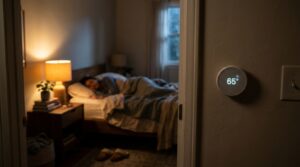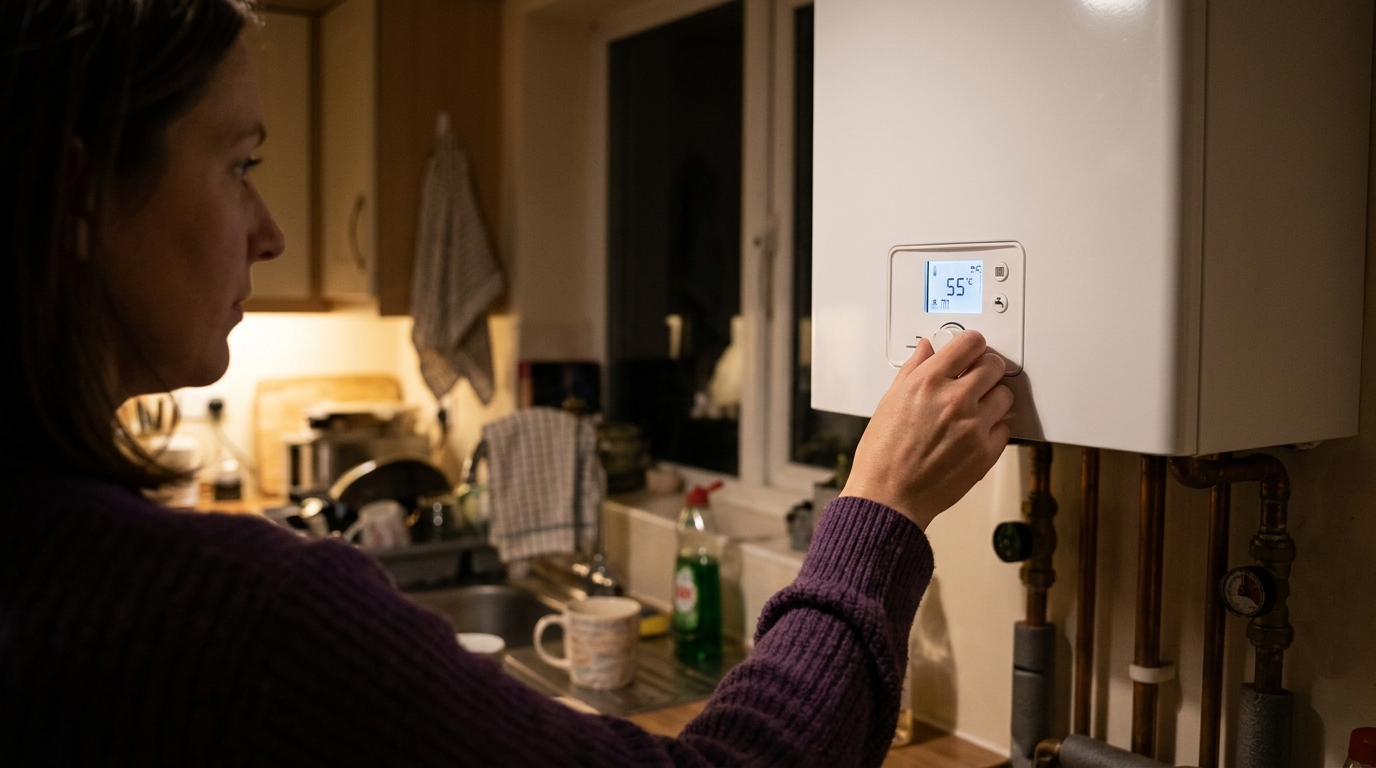
Waking up to a cold bedroom, then listening to the boiler blast at full power for an hour, is one of the most common complaints about combi boiler homes. The usual instinct is to turn the thermostat up or start the heating earlier. That tends to make things worse, because the real culprit is often the boiler’s flow temperature setting and a schedule that lets the house cool too far overnight.
A combi boiler heats water on demand and fires at high output whenever the thermostat calls for heat. If the flow temperature is set high (often 75 to 80 C out of the box), the boiler overshoots, shuts off, cools, and cycles again. This is called short cycling, and it creates the hot-and-cold rhythm you feel in the house while burning more gas than necessary.
This post covers the one setting that matters most, lowering your central heating flow temperature, plus how to pair it with a smarter overnight schedule. You can start with a no-cost five-minute change or go further with weather compensation and a modulating thermostat. Both approaches are explained step by step below.
What You’ll Need
Click on an item below to shop for the recommended items for this recipe on Amazon.
As an Amazon Associate, we earn from qualifying purchases.
How to Do It
- Find the central heating flow temperature control on the boiler front panel. It is usually a dial or digital menu marked with a radiator symbol, separate from the hot water (tap) temperature control.
- Note the current setting, then lower it from 75 to 80 C to about 60 to 65 C. If your boiler uses a numbered dial instead of degrees, turn it to roughly two-thirds of the way up rather than maximum.
- Leave the domestic hot water setting alone so showers and taps are unaffected.
- Change your overnight setback so the house only drops 2 to 3 degrees, for example from 20 C day to 17 or 18 C at night, rather than 14 or 15 C.
- Move your morning start time about 30 minutes earlier, since lower flow temperature heats the house more gradually.
- Watch the house for one week. If rooms are not reaching target by the time you wake, raise flow temperature in 3 to 5 degree steps until they do. If it is comfortable, try dropping another 5 degrees to 55 C.
- Confirm your boiler supports OpenTherm (also called modulating control) by checking the manual or the wiring terminals labeled OT or OpenTherm.
- Choose a compatible smart thermostat that offers load compensation or weather compensation, so it automatically adjusts flow temperature based on how hard the boiler needs to work.
- Turn off power to the boiler at the isolator or fused spur, then swap the old thermostat wiring onto the new unit, matching terminal labels exactly. Photograph the old wiring first.
- Restore power and run the setup wizard. Enter your home size, insulation level, and radiator type if prompted.
- Set a shallow setback (2 to 3 degrees) and let the thermostat learn for 5 to 7 days before judging results.
- Review the thermostat’s flow temperature graph after a week. On mild days you should see flow temperatures sitting around 40 to 55 C, rising only when it is cold outside.
Why It Works: The Benefits
Dropping flow temperature from 75 C to about 60 C typically cuts gas use by 6 to 10%, and combining it with a gentler setback can push total savings to 8 to 15%.
Long, low-output burns hold rooms within about 1 to 2 degrees of target, instead of the 4 to 5 degree swings common with high flow temperature and short cycling.
Lower flow temperatures reduce pipe expansion noise, kettling, and the loud fire-up you hear at 5 a.m.
Fewer ignition cycles per day means less stress on the heat exchanger, fan, and gas valve, which can add years to the boiler’s service life.
Keeping return temperatures under 55 C lets a modern condensing combi actually deliver its 90 to 94% rated efficiency, rather than the 80 to 84% seen when it runs hot.
💰 Savings Impact by Action
Dropping flow temperature from 75 C to about 60 C lets the boiler condense more often and can cut gas use by 6 to 10%.
A 2 to 3 degree overnight setback avoids the energy-hungry morning recovery that comes with deep temperature drops.
Longer, steadier burns reduce wasted gas from repeated ignition and purge cycles by roughly 3 to 5%.
Evenly balanced radiators let the whole system run at lower temperatures without cold-room complaints.
🏠 Key Concepts Explained
The Science Behind It
A combi boiler’s burner has a minimum output below which it cannot modulate. When your flow temperature is set to 80 C and your house only needs a little heat, the boiler reaches that temperature within minutes, shuts off, and waits for the water to cool before firing again. Each cycle uses extra gas for ignition and purge, and the radiators swing between hot and lukewarm, which is exactly what you feel as temperature swings in the room.
Lowering the flow temperature changes the physics in your favor. The temperature difference between the water and the room (delta T) is smaller, so radiators release heat more slowly, but they do so continuously. The boiler stays lit longer at lower modulation, which smooths the heat delivery. Meanwhile, return water coming back to the boiler is cooler, which pulls the flue gases below their dew point of about 55 C. That condensation recovers latent heat from water vapor in the exhaust, pushing real-world efficiency from around 80 to 84% up toward 90% or higher.
The overnight setback matters because of thermal mass. When the house cools deeply, the walls, floors, and furniture all lose stored heat, and the boiler has to reheat all of that mass in the morning, not just the air. A shallow setback keeps that stored energy in place, so the recovery is gentle and the house feels more stable at 3 a.m. than it does with a deep setback.
Frequently Asked Questions
▼ Why is my house still cold in the morning after lowering the flow temperature?
Your heating probably needs to start earlier because lower flow temperature heats more gradually. Move the start time 30 to 45 minutes earlier, and make sure your setback is only 2 to 3 degrees. If it is still cold, raise flow temperature in 5 degree steps until it works.
▼ Can renters change the flow temperature on a combi boiler?
In most cases yes, since the flow temperature dial is a user-level control, not a modification. Check your tenancy agreement and tell your landlord what you plan to do. Avoid opening the boiler casing or touching any internal settings, which should only be done by a qualified engineer.
▼ How long before I notice savings on my gas bill?
You should see a difference within one full billing cycle, typically 4 to 6 weeks, especially during heating season. Compare the same period year over year or use kWh per heating degree day to account for weather differences.
▼ What if my home is older than 30 years or has single-glazed windows?
Older, leakier homes lose heat faster, so you may need to settle on a slightly higher flow temperature of 60 to 70 C. The shallow setback matters even more here, because a deep overnight drop is very hard to recover from. Pairing this with draught-proofing around doors and windows can recover most of the lost savings.
▼ My boiler keeps switching on and off every few minutes. Is that normal?
Frequent short cycling is a sign flow temperature is too high or the boiler is oversized for your home. Try lowering flow temperature by 10 degrees first. If cycling continues, have an engineer check radiator balancing, system pressure, and the boiler’s built-in anti-cycling delay.
Quick Tips
- Aim for a flow temperature of 55 to 60 C as a starting target, then fine-tune by 3 to 5 degrees based on how rooms feel on the coldest days.
- Use a shallow overnight setback of 2 to 3 degrees instead of switching heating fully off, especially in homes with solid brick walls or poor insulation.
- Bleed any radiator that has cold spots at the top, since trapped air reduces output and forces the boiler to compensate with higher flow temperatures.
- Check boiler pressure monthly. Most combis want 1.0 to 1.5 bar when cold, and low pressure can trigger lockouts that mimic temperature problems.
Variations for Your Situation
- Apartment/Rental: Stick to the quick fix. The flow temperature dial and your thermostat schedule are both user-accessible, cost $0, and need no landlord permission in most leases. If you want a smart upgrade, look for a plug-in or wireless smart thermostat with an easy-to-reverse install, typically $100 to $180.
- Tight Budget (under $50): Lower flow temperature to 60 C, shrink your overnight setback to 2 to 3 degrees, bleed your radiators, and balance them using the lockshield valves. A $10 radiator key and a $15 digital thermometer are all you may need to verify results.
- Older Home (pre-1980): Expect higher heat loss, so start at 65 to 70 C flow temperature and tune down slowly. Prioritize draught-proofing, loft insulation to at least 270 mm (about R-38), and radiator reflector foil behind external-wall radiators, which together can add another 10 to 15% savings on top of the boiler adjustment.