Think about what your water heater does at 3 a.m. Nobody is showering, running the dishwasher, or doing laundry, yet the burner or heating elements still kick on every few hours to keep a tank full of water at 120 to 140 degrees. That is called standby heat loss, and it happens because heat naturally flows from the hot tank into the cooler air around it. The warmer the tank and the colder the room, the faster the heat escapes.
For a typical 40 to 50 gallon tank, standby loss can account for 10 to 20 percent of your total water heating cost. Water heating is the second largest energy use in most homes, typically around 14 to 18 percent of the utility bill, so those losses add up to real money over a year. Older tanks with thin factory insulation lose the most, and tanks sitting in unheated garages, basements, or crawl spaces lose even more in winter.
The good news is that this is one of the cheapest and fastest efficiency upgrades you can make. In this post, we will cover how to tell whether your tank needs extra insulation, how to install a blanket safely on both electric and gas models, how to insulate the first few feet of hot water piping, and when to skip the project entirely.
What You’ll Need
Click on an item below to shop for the recommended items for this recipe on Amazon.
As an Amazon Associate, we earn from qualifying purchases.
How to Do It
- Check the tank’s label for its R-value. If it is R-24 or higher, or if the tank feels cool to the touch, skip the blanket and do this pipe step only.
- Measure the first 3 to 6 feet of hot water pipe leaving the tank, plus the cold inlet pipe if it is accessible, and buy pre-slit foam pipe sleeves in the matching diameter, typically 3/4 inch.
- Slide each sleeve over the pipe and press the seam closed. Keep foam at least 6 inches away from a gas flue or vent connector.
- Lower the thermostat to 120 degrees. Use a kitchen thermometer to check the temperature at the tap after a few hours.
- If the water heater sits on a concrete floor in a cold space, place a rigid foam board or a manufacturer-approved insulating pad under the tank. Electric tanks are the safest candidates for this step.
- Turn the thermostat down to the lowest setting or switch the breaker off for electric models. For gas models, set the dial to pilot while you work.
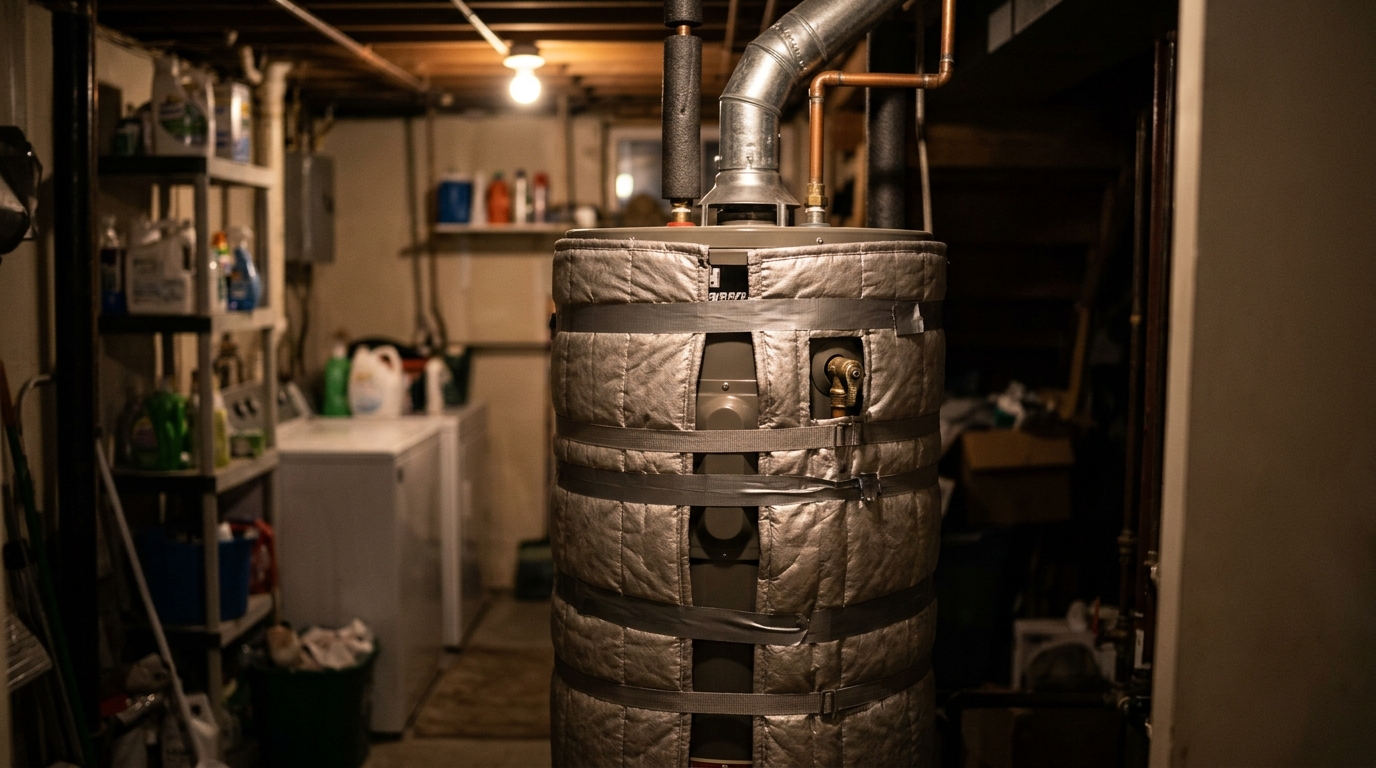
- Measure the tank’s height and circumference, then buy a blanket rated R-8 or higher that fits. Fiberglass blankets with a vinyl cover are the most common choice.
- Wrap the blanket around the tank starting at the top, keeping the top of the tank clear on gas models so the draft hood and flue are never covered.
- Cut out openings for the temperature and pressure relief valve and its discharge pipe, the access panels on electric models, and the gas control valve on gas models. Leave at least 2 inches clear around the burner compartment door and keep the bottom 2 to 4 inches of a gas tank uncovered.
- Tape the seams with the foil tape provided, making sure the blanket fits snugly without compressing the insulation. Do not cover the thermostat or the tank label.
- Restore power or gas, set the thermostat to 120 degrees, and check that the burner flame stays blue and the flue draws normally on gas models.
- Have a licensed plumber or HVAC contractor inspect the tank for corrosion, rust at the base, and sediment buildup. Ask whether a flush or anode rod replacement could extend its life.
- Compare the Energy Factor or UEF of your current tank to new models. A heat pump water heater with a UEF of 3.0 or higher can cut water heating energy use by 60 to 70 percent compared to a standard electric tank.
- Ask about federal tax credits and utility rebates, which can offset $500 to $2,000 or more on qualifying heat pump models.
- Have the installer verify clearances, venting, and condensate drainage, and ask that all nearby hot water piping be insulated at installation.
Why It Works: The Benefits
The DOE estimates a properly installed blanket on an older tank reduces standby losses by 25 to 45 percent, saving about 4 to 9 percent on water heating bills. For a household spending $400 a year on water heating, that is roughly $16 to $36.
Blankets cost about $20 to $45 and pipe insulation runs $5 to $15, so most homeowners recoup the investment within 6 to 12 months. Few home upgrades pay back this quickly.
With less heat escaping, the tank holds temperature through the night and between uses. You get fewer burner or element cycles and a more consistent supply of hot water during morning rush hours.
Fewer heating cycles mean less stress on elements, thermostats, and gas controls. That can modestly extend the working life of a tank that is already in decent shape.
Less heat leaking into a small utility closet or furnace room keeps that space cooler in summer, which can slightly reduce the cooling load on adjacent living areas.
💰 Savings Impact by Action
Adding an R-8 blanket to an older tank reduces standby heat loss by 25 to 45 percent, which translates to up to 9 percent off water heating costs.
Insulating the first 6 feet of hot and cold pipes cuts heat loss and can save 3 to 4 percent on water heating while delivering hot water faster.
Dropping the thermostat from 140 to 120 degrees reduces standby losses and total water heating energy by roughly 6 to 10 percent.
Replacing a standard electric tank with a heat pump water heater cuts water heating energy use by 60 to 70 percent when the tank is in a conditioned or semi-conditioned space.
🏠 Key Concepts Explained
The Science Behind It
Heat always moves from warmer areas to cooler ones through three mechanisms: conduction, convection, and radiation. Inside a water heater tank, the hot water conducts heat through the steel wall and foam insulation, then the outer jacket transfers it to the surrounding air by convection and radiation. The rate of loss depends on the temperature difference, the surface area, and the thermal resistance of the layers in between, which is what R-value measures.
Standby loss is the energy required to replace that lost heat so the tank stays at its setpoint. A tank with R-8 insulation loses heat roughly twice as fast as one with R-16, assuming the same conditions. Adding a blanket with R-8 on top of existing R-8 foam effectively doubles resistance, cutting the heat flow in half in the best case, though real-world gains are lower because of gaps at seams, the top, the bottom, and penetrations.
Overnight is when standby loss is most visible because there is no draw to mask it. A heater that cycles on every two to three hours with nobody home or awake is simply compensating for conduction through the tank walls. Reducing that conduction means longer intervals between cycles, less fuel or electricity burned, and a smaller impact on your utility bill without any change in how you use hot water.
Frequently Asked Questions
▼ How do I know if my water heater needs a blanket?
Check the tank’s label for its R-value, and put your hand on the outer jacket. If the R-value is under R-12 or the tank feels warm to the touch, a blanket will help. If the R-value is R-16 or higher, or the tank feels cool, skip it and focus on pipe insulation and the thermostat.
▼ Is it safe to put a blanket on a gas water heater?
Yes, if it is installed correctly. Never cover the top of the tank, the flue, the draft hood, the burner access door, or the gas control, and keep the bottom 2 to 4 inches clear. If you are not comfortable making the cutouts, have a plumber install it.
▼ Why is my water heater still running constantly after I added insulation?
Check for a stuck relief valve, a leaking hot water fixture, a failing heating element, or heavy sediment buildup. A water heater that cycles even when nothing is being used usually has a mechanical issue rather than an insulation issue, so call a plumber if the problem continues.
▼ How long before I notice the savings on my bill?
You may see a small drop in your next billing cycle, but the savings are modest, usually $2 to $4 a month. Compare gas or electric use over a full year to account for seasonal changes, or use a plug-in energy monitor on electric tanks to see the difference in daily kWh.
▼ Can I use a blanket on a tankless water heater?
No. Tankless units do not store hot water, so they have almost no standby loss and do not need a blanket. Insulating the hot water pipes is still worthwhile if they run through unheated spaces.
Quick Tips
- Lower the thermostat to 120 degrees. It is safe, reduces scalding risk, and cuts standby loss by 4 to 22 percent depending on the starting temperature.
- Use a vacation or away setting if you will be gone for 3 or more days. Reheating a cooled tank uses less energy than maintaining temperature for the entire trip.
- Flush the tank once a year to remove sediment, which acts as an insulating layer on the bottom of gas tanks and forces the burner to run longer.
- Insulate hot water pipes in unheated spaces like basements and crawl spaces for the full run if you can, not just the first few feet.
Variations for Your Situation
- Apartment/Rental: You usually cannot change the water heater, but you can ask your landlord about adding a blanket since it saves them money too. If you control a shared closet or have a tank in your unit, pipe sleeves ($5 to $10) and a thermostat adjustment to 120 degrees are low-risk and removable.
- Tight Budget (under $50): Skip the blanket if your tank is new and lower the thermostat to 120 degrees for free. Add foam pipe sleeves for $5 to $15 on the first 6 feet of hot pipe, which often delivers more benefit per dollar than the blanket.
- Older Home (pre-1980): Older homes often have tanks in uninsulated basements or crawl spaces, where the temperature difference is greatest. A blanket and full pipe insulation can have a faster payback here, and also check for rusted fittings, outdated venting, and missing drain pans before investing in upgrades.