A sunroom sounds like a dream: morning coffee in warm natural light, plants thriving year-round, a seamless indoor-outdoor connection. What the contractor’s brochure rarely mentions is that a poorly designed sunroom can increase your heating and cooling costs by 15 to 40%, depending on climate, orientation, and construction quality. Because sunrooms are dominated by glass, they behave almost nothing like the rest of your house, and your existing HVAC system almost certainly was not sized to handle them.
The problem isn’t sunrooms themselves; it’s that most homeowners treat them as a straightforward room addition when they’re actually a radically different building type. Glass transmits heat 10 to 15 times faster than an insulated wall. A 200-square-foot sunroom with three glazed walls and a glass roof can generate more heat gain on a summer afternoon than your entire main living area. In winter, that same room can lose heat so quickly that any attempt to keep it at 68°F becomes a money furnace running nonstop.
This post walks you through the real energy math before you sign a contract, the design and construction choices that separate efficient sunrooms from expensive mistakes, and what you can do if you’ve already built one and are feeling the pain on your utility bills. Whether you’re planning a new addition or trying to fix an existing one, you’ll leave with specific, actionable steps and realistic numbers for what they cost and what they save.
What You’ll Need
Click on an item below to shop for the recommended items for this recipe on Amazon.
As an Amazon Associate, we earn from qualifying purchases.
How to Do It
- Install solar control window film on all glazed surfaces. Choose a film with SHGC of 0.25 to 0.40 and visible light transmission above 50%. This alone can cut summer cooling load in the sunroom by 30 to 50% and costs $3 to $8 per square foot installed.
- Add weatherstripping and a door sweep to every door connecting the sunroom to your main living space. If the sunroom is not actively conditioned, treating it as a thermal buffer zone and sealing it from the house interior prevents heat and cold from migrating inward.
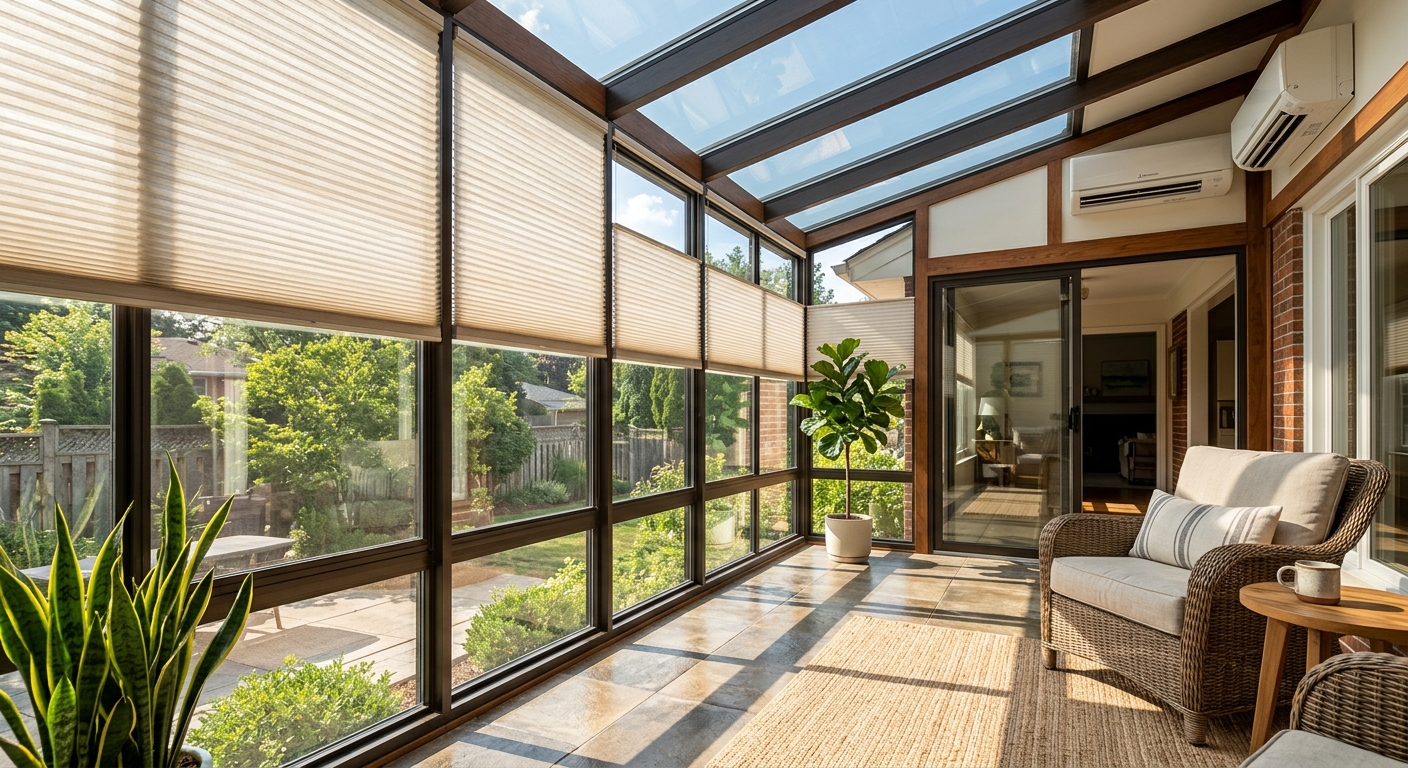
- Install cellular shades or insulating Roman shades on roof glazing and west-facing panels. Honeycomb cellular shades add R-3 to R-6 of insulating value when closed and are one of the highest-return window treatments available at $20 to $60 per shade.
- Place a portable thermal mass element such as a dark-colored stone or ceramic tile tray, water-filled containers, or a small masonry planter near the floor on the south or west side. Even modest thermal mass delays peak temperature spikes by 1 to 2 hours.
- Audit the existing duct connections if your central HVAC feeds the sunroom. If the supply register delivers cold air in summer but the room never cools, close or damper that register and use a dedicated portable or window unit sized correctly for the space instead.
- Specify low-SHGC insulated glazing units (IGUs) in your construction documents before any contract is signed. For south-facing glass in cooling-dominated climates, target SHGC below 0.30. For north-facing or heating-dominated climates, SHGC of 0.40 to 0.55 captures useful solar gain in winter without overheating.
- Require thermally broken aluminum framing or wood and fiberglass framing. Thermally broken frames interrupt the conductive path through the metal, improving effective frame U-values from roughly 1.0 down to 0.3 to 0.4, which meaningfully reduces winter heat loss along every linear foot of framing.
- Install a dedicated ductless mini-split system sized specifically for the sunroom’s Manual J heat load calculation, not a rule-of-thumb estimate. A 200-square-foot sunroom in a sunny climate may require a 12,000 to 18,000 BTU unit. A qualified HVAC contractor can run this calculation in about an hour.
- Incorporate operable windows or a ridge vent in the roof design to enable natural ventilation and flush out hot air without mechanical cooling during mild weather. This passive strategy alone can eliminate the need for mechanical cooling on 30 to 40% of warm days in moderate climates.
- Pour or specify a concrete slab or install ceramic or porcelain tile over a concrete board subfloor to provide thermal mass at the floor level. A 4-inch concrete slab can absorb enough solar energy during the day to delay peak room temperature by 2 to 4 hours and reduce HVAC runtime by 15 to 25%.
- Apply an exterior solar shade or automated retractable awning on south and west exposures. Exterior shading blocks solar radiation before it enters the glass, which is far more effective than interior shades. Retractable motorized awnings run $1,500 to $4,000 installed and can reduce solar heat gain through glazing by 65 to 77%.
Why It Works: The Benefits
A properly designed or retrofitted sunroom with low-SHGC glazing, thermal breaks in framing, and dedicated climate control can hold energy penalty to 5 to 10% above your pre-addition baseline rather than the 20 to 40% spike typical of poorly planned additions.
Homes with a poorly performing sunroom report using the space only 3 to 4 months per year because it is either too hot or too cold. Good design or targeted retrofits extend comfortable use to 10 to 12 months, making the per-hour cost of the addition dramatically lower.
Installing a dedicated mini-split for the sunroom instead of tapping existing ductwork removes the mismatch load from your central system. This alone can reduce compressor run-time by 15 to 20% and extend system life by several years.
A well-insulated, properly conditioned sunroom adds roughly 50 to 70 cents in resale value for every dollar of construction cost, versus a drafty, expensive-to-heat addition which appraisers routinely discount or flag as a liability.
Low-SHGC and spectrally selective glazing blocks 95 to 99% of UV radiation, protecting flooring, furniture, and plants from fading while reducing peak solar heat gain by up to 70% compared to clear single-pane glass.
💰 Savings Impact by Action
Solar control window film with SHGC of 0.30 reduces summer heat gain through glass by up to 35%, directly cutting cooling runtime.
Sealing the door between the sunroom and main living space prevents thermal bleed and reduces whole-house conditioning load by 10 to 15%.
Replacing central duct extension with a properly sized dedicated mini-split reduces sunroom energy use by 20 to 30% versus resistance heating and reduces wear on the main system.
Honeycomb cellular shades on roof glazing add R-3 to R-6 and can reduce overnight heat loss through glass by up to 20% in winter.
Motorized retractable awnings on south and west exposures block solar radiation before it enters the glass, cutting peak solar heat gain by 40 to 77%.
🏠 Key Concepts Explained
The Science Behind It
Glass is a thermally terrible building material by almost every metric. Its R-value even in high-performance triple-pane configurations tops out around R-9, compared to R-20 to R-60 for insulated walls and ceilings. This means a sunroom wall made of glass loses or gains heat 3 to 7 times faster per square foot than an adjacent insulated frame wall. The physics do not care how expensive the glass is; they only care about the temperature difference between inside and outside, which is why even a premium sunroom experiences dramatic temperature swings.
Solar heat gain operates on a different mechanism from conductive heat transfer. Sunlight enters as short-wave radiation, passes through glass easily, and then strikes interior surfaces, converting to long-wave infrared heat that cannot escape back through the glass as readily. This is the greenhouse effect at a room scale. On a clear day, south-facing glass in the continental US receives 200 to 300 BTUs of solar energy per square foot per hour at peak. A 300-square-foot glazed sunroom can therefore receive 60,000 to 90,000 BTUs of solar input in a single afternoon, roughly equivalent to running 18 to 27 one-kilowatt space heaters simultaneously. This is why air conditioning a poorly designed sunroom in summer can feel financially ruinous.
In winter, the same glass walls become radiative cooling surfaces at night. The interior glass surface temperature on a single-pane window can drop to within 5 to 10 degrees of outdoor air temperature even when the room is being heated. Anyone sitting near that glass surface loses body heat to the cold surface through radiation, feeling cold even when the air temperature reads 68°F on the thermostat. This is why thermal comfort in sunrooms requires understanding radiant temperature, not just air temperature, and why high-performance glazing with a lower U-factor creates a physically warmer feeling environment even at the same thermostat setting.
Frequently Asked Questions
▼ My new sunroom is unbearably hot in summer even with the AC running. What’s wrong?
This almost always means the sunroom’s cooling load far exceeds what is being delivered, either because the existing system was never sized for the added space or because solar heat gain through the glass is overwhelming any mechanical cooling. Start by measuring the square footage and checking whether the supply duct to the room delivers adequate airflow using a simple airflow meter or by having an HVAC tech test static pressure. If the duct is adequate but the room still overheats, solar heat gain is the culprit and solar control window film is the fastest fix, followed by exterior shading.
▼ Can I just extend my existing furnace ducts into the sunroom?
Technically yes, but it is almost always the wrong move without a load calculation first. Sunrooms have extreme heating and cooling loads relative to their floor area, and adding them to an existing duct system typically robs other rooms of conditioned air, causes the main system to run longer and harder, and still leaves the sunroom uncomfortable. A dedicated mini-split is the correct solution in most cases and will typically pay back through energy savings and equipment longevity within 4 to 6 years.
▼ How do I know if my sunroom is actually costing me money on my utility bill?
Compare your utility bills from the 12 months before the sunroom was added to the 12 months after, adjusting for any unusually hot or cold weather using degree-day data from your local weather service. A sunroom that adds 15% or more to your annual energy spend is underperforming. You can also install a plug-in energy monitor on any portable heating or cooling equipment in the sunroom to directly measure its electricity consumption in kilowatt-hours and multiply by your utility rate.
▼ Will adding window film void my glass warranty?
It depends on the glazing manufacturer and the film product. Many glass warranties explicitly exclude damage caused by aftermarket film, particularly if the film causes heat buildup that stresses the edge seal of insulated glass units. Always check your glass warranty documentation first and use only films that are certified compatible with your specific glazing type. Many reputable film manufacturers like 3M and Llumar provide a compatibility checker on their websites.
▼ What’s the cheapest thing I can do right now if my sunroom is already built and drafty?
Seal the connection between the sunroom and your main house first. Add weatherstripping to the door between them, install a door sweep, and caulk any gaps in the framing around that door opening. This prevents your main HVAC system from trying to condition the sunroom at all and can reduce your overall energy loss by 10 to 15% almost immediately at a cost of $20 to $60 in materials.
Quick Tips
- Request a solar path analysis from your architect or use a free tool like SunCalc.org to map exactly how sun enters your proposed sunroom at different times of year before finalizing window placement.
- If your sunroom is already built and you cannot afford a mini-split right away, use a programmable plug-in space heater with a built-in thermostat in winter and a portable evaporative cooler in dry climates during summer as a lower-cost bridge solution.
- Specify low-emissivity (low-e) coating on the interior surface of outer glass panes for winter-dominant climates and on the interior surface of the inner pane for cooling-dominant climates. The coating placement changes whether the glass reflects summer heat out or winter heat in.
- Check with your utility company before starting construction. Many utilities offer rebates of $50 to $500 for high-performance glazing or mini-split installations, and some will provide a free energy consultation to review your sunroom plans.
Variations for Your Situation
- Apartment or Condo with an Enclosed Balcony: Residents in condos with glass-enclosed balconies face the same thermal dynamics at smaller scale. Focus on interior solar shades or cellular blinds rated for high-solar-gain exposures, which cost $30 to $80 per panel and require no structural modification. Seal the gap between the balcony enclosure and interior living space with a removable rope caulk in winter and remove it in spring. Avoid portable electric resistance heaters in these spaces, as they are extremely costly to run. A small plug-in infrared panel heater at 600 watts is a more efficient choice for spot heating.
- Tight Budget Under $500: Prioritize the door seal between the sunroom and the main house above everything else, spending $20 to $60. Next, invest in cellular shades for the largest glass surfaces, starting with the west-facing wall or roof, at $25 to $60 per shade. Apply reflective window film yourself on south and west windows using a DIY kit costing $30 to $80 for a typical sunroom. These three steps together can reduce the energy impact of a poorly designed sunroom by 20 to 30% for under $200 in materials.
- Older Home with a Legacy Sunroom Addition: Sunrooms added to homes in the 1970s and 1980s commonly used single-pane glass, aluminum frames with no thermal break, and no roof insulation whatsoever. Before investing in HVAC upgrades, address the building envelope first. Replace single-pane glass panels with insulated glass retrofit kits where frame condition allows, costing $15 to $40 per square foot. Check whether the knee walls or any opaque sections have insulation by removing a small section of interior trim. Adding insulation to opaque walls in an older sunroom typically costs $200 to $600 and can cut heat loss from those sections by 70 to 80%.