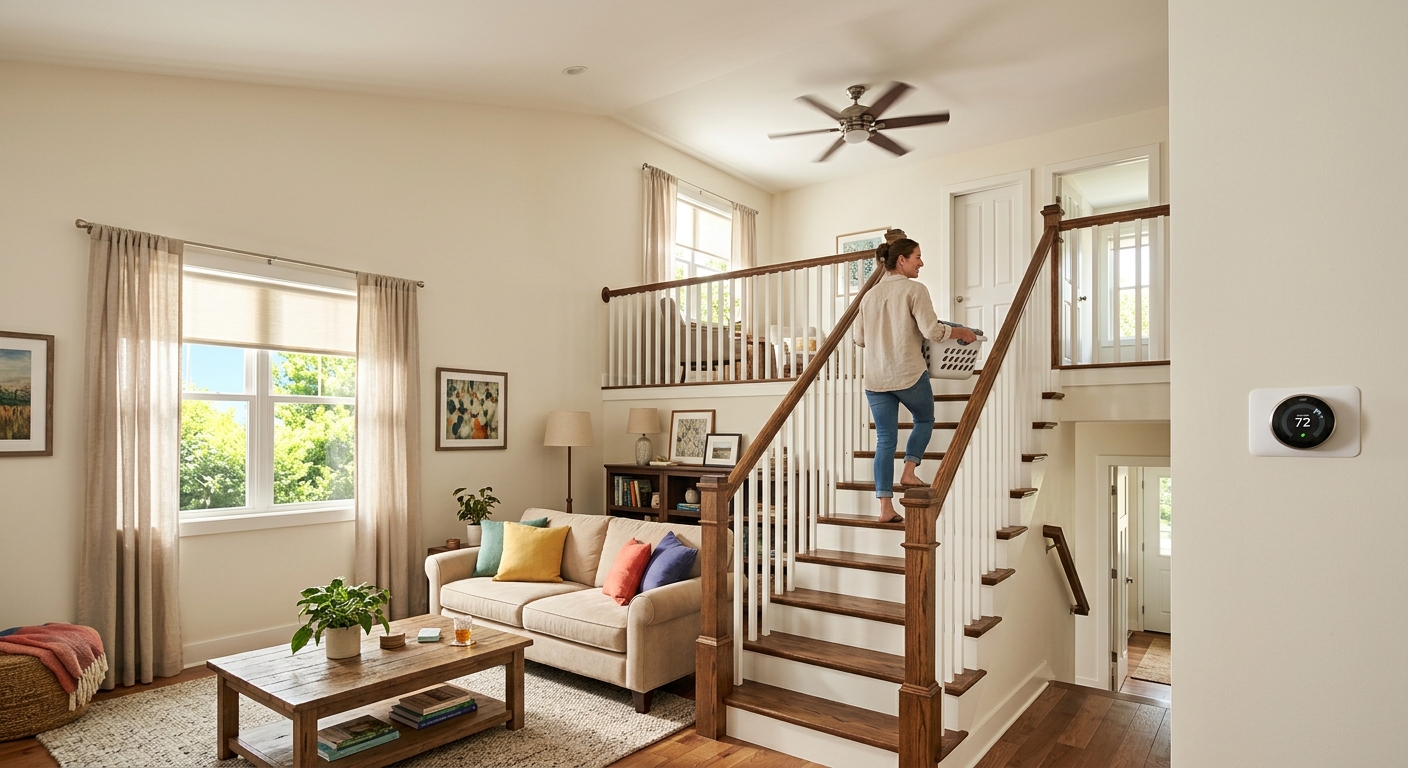
If you live in a two-story home, you already know the frustration: crank the thermostat down to cool the upstairs bedrooms, and the first floor becomes uncomfortably cold. Leave it set for the main living area, and everyone sleeping upstairs sweats through the night. This is one of the most common comfort complaints among homeowners, and it has nothing to do with a broken air conditioner.
The root cause is basic physics. Heat rises, so your upper floor naturally accumulates more heat throughout the day, especially if the attic above it is poorly insulated or ventilated. At the same time, your HVAC system was likely designed as a single-zone system that treats the whole house as one space, even though the thermal conditions on each floor are dramatically different. The result is a system that can never truly satisfy both floors simultaneously.
This post walks you through the real reasons two-story homes suffer from uneven cooling, and gives you a clear set of actions you can take right now, whether you want a free fix you can do in ten minutes or a longer-term upgrade that solves the problem for good. You will find real numbers, practical steps, and honest guidance on when a professional can help most.
What You’ll Need
Click on an item below to shop for the recommended items for this recipe on Amazon.
As an Amazon Associate, we earn from qualifying purchases.
How to Do It
- Walk through every room on the first floor and partially close the supply register dampers to about 50 to 60% open. This redirects more conditioned air toward the upper floor without blocking it entirely.
- If your thermostat is on the first floor, raise the set-point by 2 to 3 degrees (for example, from 72 to 74 or 75 degrees). The upper floor will still cool effectively while the first floor avoids over-conditioning.
- Switch your HVAC fan from ‘Auto’ to ‘On’ during peak afternoon hours (typically 2 PM to 7 PM). Continuous fan operation circulates air between floors and reduces stratification by 4 to 6 degrees without extra cooling cycles.
- Close blinds or curtains on all south- and west-facing upper-floor windows before 1 PM. This single step can cut solar heat gain through glass by 40 to 70% depending on shading depth.
- Check that upper-floor supply vents are fully open and unobstructed by furniture or rugs. A blocked vent on the second floor is one of the most common causes of inadequate upstairs cooling.
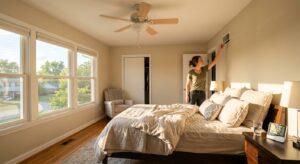
- Install ceiling fans in any upper-floor bedrooms that lack them. A quality 52-inch fan with a summer counterclockwise setting costs $60 to $150 and allows occupants to raise the thermostat set-point by 4 degrees while maintaining the same perceived comfort.
- Verify that all existing ceiling fans are set to counterclockwise rotation for summer. Look for the small direction switch on the motor housing and flip it if needed, then run the fan on medium or high.
- Install light-filtering or blackout cellular shades on upper-floor south- and west-facing windows. Cellular shades with a double-cell honeycomb design provide an R-value of 3 to 4.5, reducing heat transfer through glass by 30 to 40% compared to uncovered windows.
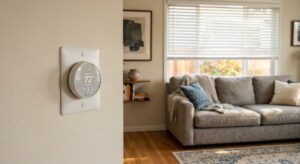
- Add a smart or programmable thermostat if you do not have one. Set the temperature to rise 2 degrees at night (when the first floor empties) and drop 2 degrees in the early morning to pre-cool the upper floor before the attic heats up. This scheduling can save 10% annually on cooling costs.
- Apply window insulating film to upper-floor windows that receive direct afternoon sun. Low-E window film blocks 50 to 70% of solar heat gain and costs $1 to $3 per square foot as a DIY install.
- Get an HVAC contractor to perform a Manual J load calculation for each floor separately. This identifies exactly how much cooling capacity each level needs and is the foundation for any proper zoning solution.
- Ask about adding motorized zone dampers to your existing ductwork. A two-zone system with a zone control board, two thermostats, and motorized dampers costs $1,500 to $3,000 installed and lets each floor maintain its own set-point independently.
- Alternatively, consider a single ductless mini-split head unit (9,000 to 18,000 BTU) installed in the upstairs hallway or main bedroom area. This supplements your central system by handling just the upper-floor load and costs $1,500 to $3,000 installed.
- If the home is older and the attic is under-insulated (below R-30), have blown-in insulation added to bring it to R-38 to R-60 before installing any new equipment. Proper attic insulation reduces the upper-floor cooling load by 15 to 25% and makes any zoning solution work significantly better.
- After installation, have the contractor commission and balance the system, verifying airflow at each register with a flow hood or anemometer to confirm that each zone is receiving its design volume of conditioned air.
Why It Works: The Benefits
Balancing airflow and controlling heat gain can reduce the floor-to-floor temperature gap from 10 to 15 degrees down to 3 to 5 degrees, making both levels genuinely comfortable at the same thermostat setting.
Homes that address stratification and duct balance typically see 10 to 30% reductions in cooling costs because the system runs shorter, more efficient cycles instead of struggling against an unbalanced load all day.
When a system cannot satisfy the thermostat due to heat imbalance, it runs longer hours. Correcting the balance reduces runtime, extending equipment life and lowering maintenance frequency.
The ideal sleeping temperature is 65 to 68 degrees Fahrenheit. When upstairs bedrooms hover 10 degrees above the downstairs set-point, sleep quality suffers. Balancing the system brings bedroom temperatures into the optimal range.
A 15 to 20% reduction in cooling energy use in an average home translates to roughly 300 to 600 fewer pounds of CO2 per summer, depending on your regional power grid mix.
💰 Savings Impact by Action
Partially closing first-floor vents and redirecting airflow upstairs reduces system runtime by shifting cooling to where it is most needed, saving up to 10% on cooling costs with no equipment changes.
Cellular shades or window film on upper-floor south- and west-facing windows block 40 to 70% of solar heat gain, reducing the upper-floor cooling load by up to 15%.
Upgrading attic insulation to R-38 or higher cuts radiant heat transfer into the upper floor by 15 to 25%, directly reducing the cooling load that drives floor-to-floor temperature imbalance.
A two-zone HVAC system allows each floor to be cooled independently, eliminating over-conditioning of the first floor and reducing total cooling energy use by 20 to 30% in typical two-story homes.
Programming the thermostat to raise the set-point by 2 to 4 degrees during unoccupied hours and pre-cool before peak heat saves approximately 10% annually according to DOE estimates.
🏠 Key Concepts Explained
The Science Behind It
The core physics at work in a two-story home is buoyancy-driven heat stratification. Warm air is less dense than cool air because its molecules move faster and spread farther apart. That lower-density air rises naturally toward the ceiling and upper floors, a process that continues passively regardless of how your HVAC system runs. In a sealed two-story home on a 90-degree day, this buoyancy effect alone can create a 10 to 15 degree temperature gradient between the floor and ceiling of a single room, and a similar gradient between the first and second story.
Compounding this is the radiant heat load from the attic. An unventilated or under-insulated attic routinely reaches 130 to 150 degrees Fahrenheit in summer. That extreme heat conducts through the attic floor (your ceiling) and radiates downward into the living space below. This is a completely separate heat source from the outdoor air temperature, and it is why upper-floor rooms can feel hot even when the air conditioner is running well. Addressing attic insulation directly cuts this radiant load and reduces the upper-floor cooling demand by 15 to 25%.
Single-zone thermostats create a feedback problem by sensing conditions at only one point, typically a first-floor hallway. When the system cools the first floor to the set-point, it shuts off, even if the second floor is still 8 to 12 degrees warmer. This cycle repeats all day, leaving the upstairs perpetually under-served. Zoning systems solve this by placing independent sensors and dampers on each floor, allowing the system to continue cooling the upper zone after the lower zone has satisfied. Ceiling fans address the stratification mechanism directly by mechanically mixing the air column, flattening the temperature gradient without adding any cooling capacity.
Frequently Asked Questions
▼ Why is my upstairs still hot even when the AC is running constantly?
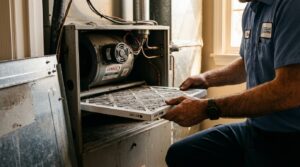
Constant runtime with inadequate cooling usually points to one of three causes: insufficient airflow to the upper floor (check that registers are open and filters are clean), an oversized system that short-cycles before removing humidity effectively, or an attic with inadequate insulation that is overwhelming the system with radiant heat. Start by replacing the air filter if it has been more than 60 days, then check attic insulation depth. If it is below 10 inches of fiberglass, adding insulation is likely the highest-impact fix.
▼ Will closing downstairs vents damage my HVAC system?
Partially closing a few first-floor vents (to 50 to 60% open) is generally safe and is a standard balancing technique. The risk comes from closing too many vents fully, which raises duct static pressure and forces the blower to work harder against resistance. Keep at least 70% of all supply registers open at all times, and if you hear the system straining or notice reduced airflow, reopen the vents immediately.
▼ Can I fix uneven cooling without spending money on an HVAC contractor?
Yes, and the free steps can make a meaningful difference. Switching the fan from Auto to On, partially closing first-floor registers, raising the thermostat set-point by 2 to 3 degrees, and closing afternoon window coverings on the upper floor are all zero-cost actions that collectively can reduce the floor-to-floor temperature gap by 4 to 8 degrees. Start there before investing in equipment.
▼ What if my two-story home only has one thermostat and I cannot add another?
A wireless smart thermostat with remote room sensors is your best option without modifying ductwork. Devices like the Ecobee or Honeywell T6 Pro allow you to place a secondary sensor upstairs and have the thermostat average both readings or prioritize the hotter location during specific times of day. These thermostats cost $100 to $200 and install in under an hour.
▼ How long before I see savings on my electricity bill after making these changes?
The free adjustments (register balancing, fan mode, thermostat set-point) will show up on your very next billing cycle, typically as a 5 to 15% reduction depending on your climate and home size. Window treatment upgrades show savings within the same month. A full zoning system or mini-split typically pays back its installation cost within 2 to 4 years through reduced runtime and improved efficiency.
Quick Tips
- Set the upstairs thermostat (or a smart sensor) 2 to 4 degrees warmer than your downstairs target to let the system serve both floors without over-cooling the ground level.
- Install a wireless remote temperature sensor paired to your smart thermostat and place it in the hottest upstairs room. Many smart thermostats can average readings from multiple sensors to make better decisions.
- Cook with the oven in the evening rather than the afternoon to avoid adding heat load during the hottest part of the day, which hits the upper floor hardest.
- Seal attic hatch covers with weatherstripping and rigid foam board insulation. An unsealed attic hatch is equivalent to leaving a window partially open and allows hot attic air to spill directly into the upper-floor living space.
Variations for Your Situation
- Apartment or Condo with Two Levels: Renters in townhouse-style units cannot modify ductwork or install zoning, but can still make a big impact. Focus on portable or window-mounted air conditioners (5,000 to 8,000 BTU) placed in the upper-level bedroom, cellular shades on sun-facing windows ($20 to $60 per window), and ceiling fan direction adjustment. A smart plug paired with a portable AC unit lets you schedule it to pre-cool the upper level before bedtime for under $150 total.
- Tight Budget Under $50: Prioritize the zero-cost register and thermostat adjustments first, then spend $10 to $20 on a box fan placed at the top of the stairs facing downward. This forces warmer upper air back down through the stairwell and disrupts stratification without any HVAC modification. Add a $15 to $25 window insulating film kit to the worst sun-facing upper-floor window. These steps together can reduce the temperature gap by 5 to 7 degrees for under $30.
- Older Home Pre-1980: Homes built before 1980 typically have undersized duct systems, minimal attic insulation (R-11 or less), and single-pane windows that dramatically worsen the two-story cooling problem. In these homes, attic air sealing and insulation upgrades to R-38 or R-49 should come before any HVAC balancing, because the radiant heat load from the attic is so large that no amount of airflow adjustment will compensate. Budget $1,500 to $3,000 for professional blown-in insulation and expect a 2 to 4 year payback. Many utilities offer rebates of $200 to $600 for insulation upgrades in this age of home.