That slow drip from your bathroom faucet might sound harmless, but water adds up fast. The EPA estimates that household leaks waste nearly 1 trillion gallons of water nationwide each year, and a faucet dripping just once per second wastes more than 3,000 gallons annually. For most homeowners, that translates to a real, measurable charge on every water bill.
What makes leaky faucets especially costly is that many people underestimate both the volume lost and the energy tied to it. If the dripping faucet is on the hot water side, your water heater is working to heat water that goes straight down the drain. Between water costs, sewer fees (often charged as a percentage of water use), and water heating energy, a single drip can cost anywhere from $20 to over $200 per year depending on your utility rates and drip speed.
This post breaks down exactly how much a leaky faucet costs with real numbers, shows you how to fix the most common types yourself in under an hour, and helps you decide when it makes sense to call a plumber. Whether you are renting or own your home, there are actionable steps here that can stop the waste starting today.
What You’ll Need
Click on an item below to shop for the recommended items for this recipe on Amazon.
As an Amazon Associate, we earn from qualifying purchases.
How to Do It
- Turn off the water supply by closing the shutoff valves under the sink clockwise until they stop. Turn on the faucet to release remaining pressure and confirm the water is off.
- Remove the decorative cap on the handle using a flathead screwdriver, then unscrew the handle screw and pull off the handle.
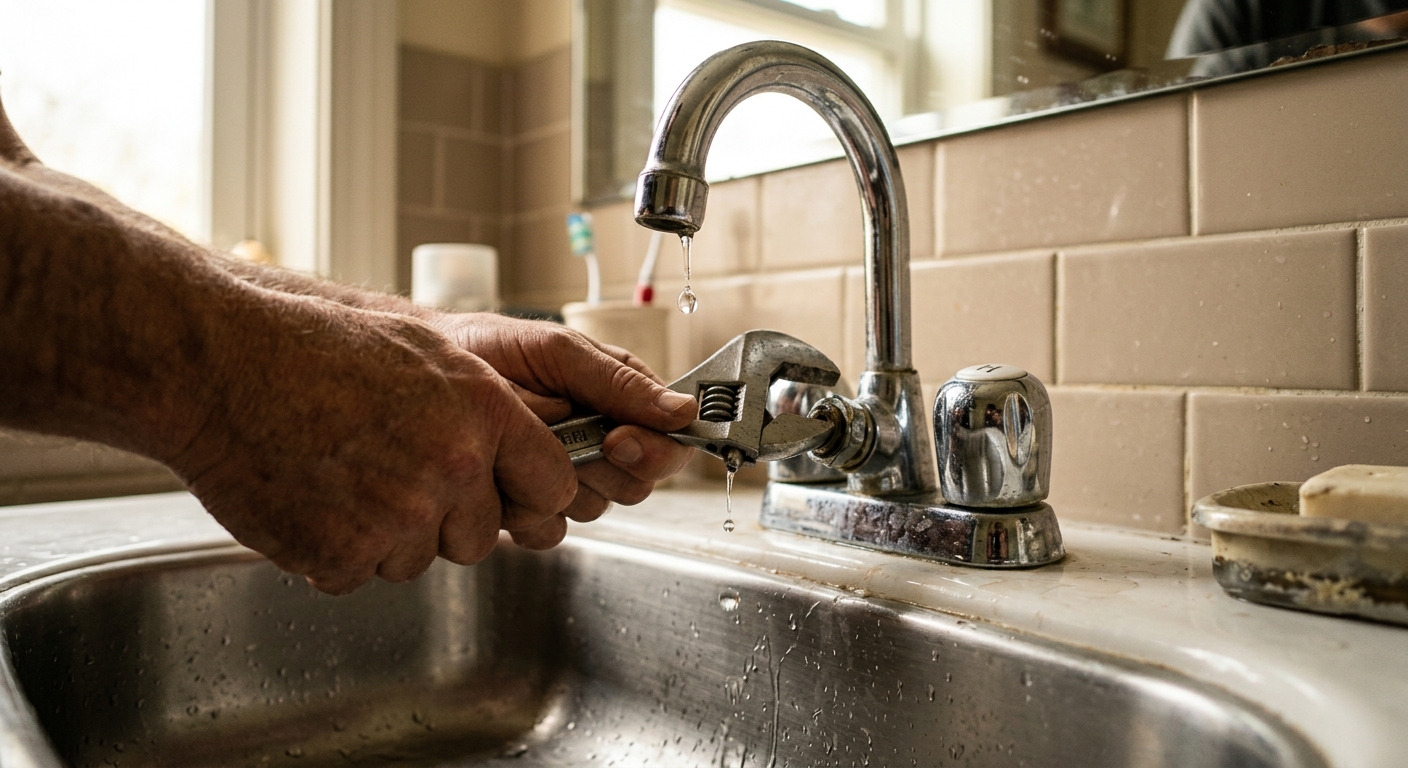
- Use an adjustable wrench to unscrew the packing nut, then pull out the stem by turning it counterclockwise as if opening the faucet.
- Inspect the rubber washer at the bottom of the stem. If it is cracked, flattened, or has a visible groove, that is your culprit. Remove the screw holding it and replace it with an exact-size washer from a hardware store ($1 to $3 per washer).
- Reassemble the faucet in reverse order: stem, packing nut, handle, screw, and cap. Turn the supply valves back on slowly and test for drips.
- Photograph the faucet brand and model number before disassembly. Cartridges are brand-specific, so you need the exact replacement. Common brands include Moen, Delta, Kohler, and Price Pfister, and replacement cartridges cost $10 to $40.
- Shut off the supply valves under the sink and open the faucet to drain pressure. Place a towel or small bucket in the cabinet below in case of residual water.
- Remove the handle by prying off the decorative cap and unscrewing the handle screw. Some single-handle faucets have a set screw on the side requiring an Allen wrench.
- Note the orientation of the cartridge before pulling it out, since installing it backwards will cause hot and cold to reverse. Use cartridge puller pliers if it is stuck. Do not force it with standard pliers, which can damage the faucet body.
- Insert the new cartridge in the same orientation, pressing it firmly into place. Reassemble the handle and turn the water back on slowly.
- Test both hot and cold operation and check under the sink for any drips at the supply connections. If the cartridge was installed correctly and dripping continues, the faucet seat may be damaged and a plumber should inspect it.
- Call a licensed plumber if you have stripped supply valve stems, a corroded faucet body, or if a DIY repair did not stop the drip after two attempts.
- Request an itemized estimate that separates labor from parts. A standard faucet replacement typically runs $150 to $250 in labor, plus the cost of the new faucet ($40 to $200 depending on quality).
- Choose a WaterSense-certified replacement faucet, which uses no more than 1.5 gallons per minute versus the older standard of 2.2 gallons per minute. This reduces water use by 30% and qualifies for rebates in many utility districts.
- Ask the plumber to inspect supply valves and drain assembly at the same time. If supply valves are stiff or have not been closed in years, they may need replacement to avoid future leak risk.
- After the repair, monitor your next water bill against the previous period to quantify your actual savings.
Why It Works: The Benefits
Fixing a faucet dripping once per second saves roughly 3,153 gallons per year. At the U.S. average water rate of $0.004 per gallon, that is about $12 to $15 in water charges alone, and more in high-cost areas like California or the Northeast where rates can reach $0.01 per gallon.
A hot-water faucet dripping once per second can waste enough hot water to add $50 to $100 per year to your water heating bill, depending on your fuel type and rate. Stopping the drip eliminates this entirely.
Because sewer fees track water consumption, every gallon saved through fixing a drip also reduces your sewer bill. Combined, water plus sewer savings from one medium drip can reach $30 to $60 per year.
A dripping faucet left unaddressed can escalate. Constant moisture around the sink base can cause cabinet rot, mold growth, and caulk failure, turning a $10 washer fix into a $500 to $2,000 repair.
Replacement washers, cartridges, and O-rings typically cost $5 to $25. In most cases, the parts pay for themselves within the first month of water bill savings, making this one of the highest-return home repairs available.
💰 Savings Impact by Action
Replacing a worn washer or cartridge eliminates the drip entirely, stopping 100% of the water waste from that faucet immediately.
Fixing all household faucet leaks can reduce a typical water bill by up to 10% according to EPA WaterSense data.
Stopping hot water drips eliminates the reheating load, cutting water heating energy use by up to 8% in households with multiple leaking hot-side fixtures.
Replacing an old 2.2 gpm faucet with a WaterSense-certified 1.5 gpm model reduces flow-related water and energy use by approximately 30%.
🏠 Key Concepts Explained
The Science Behind It
A faucet drips when the internal seal no longer creates enough surface contact to overcome water pressure. In compression faucets, a rubber washer is pressed against a metal seat by the handle. Over thousands of cycles, the washer hardens and the seat develops a small groove, allowing pressurized water to push past even when the handle is fully closed. Water pressure in most homes runs between 40 and 80 psi, which is enough force to push a measurable stream through even a tiny gap.
The volume lost per drip is roughly 0.25 milliliters, which sounds trivial until you account for frequency. At one drip per second, that is 15 milliliters per minute, 21.6 liters per day, and about 7,884 liters per year. That converts to approximately 2,082 gallons annually from a single faucet. At two drips per second, you are at over 4,000 gallons per year. The relationship is linear: drip rate times volume per drip times time equals total waste.
The energy penalty on hot water drips comes from how storage water heaters work. Every gallon of hot water lost down the drain is replaced by cold water entering the tank, which the heater must then bring back up to setpoint, typically 120 degrees Fahrenheit. Each gallon requires roughly 0.5 BTUs per degree of temperature rise, and heating one gallon of water from 55 to 120 degrees uses about 0.036 kWh. At national average electricity rates, that is fractions of a cent per gallon, but multiplied across thousands of gallons per year it becomes a meaningful line item on your energy bill.
Frequently Asked Questions
▼ I replaced the washer but the faucet is still dripping. What did I miss?
The most likely cause is a damaged faucet seat, which is the metal ring the washer presses against. If the seat has a groove or rough edge worn into it, no washer will seal properly. You can resurface it using a seat wrench and seat grinder tool (about $15 at hardware stores), or replace the seat entirely if it is a removable type. If the seat is not removable or the damage is severe, replacing the entire faucet is the most cost-effective next step.
▼ Can a leaky faucet increase my sewer bill too?
Yes, and this is one of the most overlooked costs. Most water utilities bill sewer charges based on total water consumption, typically at 50 to 100 percent of the water rate. This means every gallon you waste through a drip is billed at roughly double the water-only rate. Check your utility bill for a separate sewer or wastewater line item and factor that into your true cost per gallon.
▼ How do I know if my dripping faucet is on the hot or cold side?
Turn off one supply valve at a time under the sink and see whether the drip stops. If closing the hot supply stops the drip, the hot-side seal is the problem. This matters because a hot-side drip carries an additional energy cost from your water heater, making the repair even more financially urgent than a cold-side leak.
▼ I am a renter. Can I fix this myself or should I tell my landlord?
In most states, landlords are legally required to maintain plumbing in working order, so you should notify your landlord in writing and give them a reasonable window to fix it, typically 14 to 30 days depending on state law. If they do not act, document the drip with a video showing the date and contact your local housing authority. Attempting your own plumbing repair as a renter can void lease terms, so check your lease before touching any fixtures.
▼ How much can I actually save per year by fixing one dripping faucet?
The savings depend on drip rate and local utility rates, but a realistic range for a faucet dripping once per second is $30 to $120 per year when you account for water, sewer, and water heating costs combined. In high-rate areas like San Francisco or New York where combined water and sewer rates exceed $0.015 per gallon, savings from a fast drip can exceed $150 per year. Use the EPA Drip Calculator at epa.gov/watersense/fix-leak-week for a personalized estimate.
Quick Tips
- Check all faucets in the house at once, including outdoor hose bibs and rarely used bathroom faucets, since leaks in less-used fixtures often go unnoticed for months.
- Use your water meter to detect hidden leaks: record the meter reading, avoid using any water for two hours, then check again. Any movement indicates a leak somewhere in the system.
- Keep one universal washer assortment kit on hand ($8 to $12 at any hardware store) so you can fix a compression faucet drip the same day you discover it without a hardware store trip.
- Apply plumber’s grease to new washers and O-rings before installation to extend their lifespan and prevent squeaking when the handle is turned.
Variations for Your Situation
- Apartment or Rental: Renters cannot legally modify plumbing without landlord approval in most jurisdictions, but you can and should report the leak in writing to create a paper trail. While waiting for repair, place a bowl under the drip and pour the collected water into houseplants to avoid waste. If your landlord is unresponsive, many cities allow tenants to deduct minor repair costs from rent after proper notice. Check local tenant rights resources for your state’s specific rules.
- Tight Budget Under $15: The compression faucet washer replacement is the best option, since parts cost $2 to $5 and the repair requires only a screwdriver and wrench most homeowners already own. A universal washer kit from a dollar store or hardware store bargain bin covers most repair sizes. Skip the professional option entirely unless the faucet body is damaged, and focus on the one faucet dripping the fastest first to maximize savings per dollar spent.
- Older Home Pre-1980: Older homes often have compression faucets with non-removable seats and washers sized in non-standard dimensions. Bring the old washer with you to the hardware store rather than guessing the size. Also check whether shutoff valves under the sink actually close fully since older gate valves often fail to seal completely, requiring you to shut off water at the main to do the repair. If galvanized pipes are present, a plumber should assess overall pipe condition while they have access.