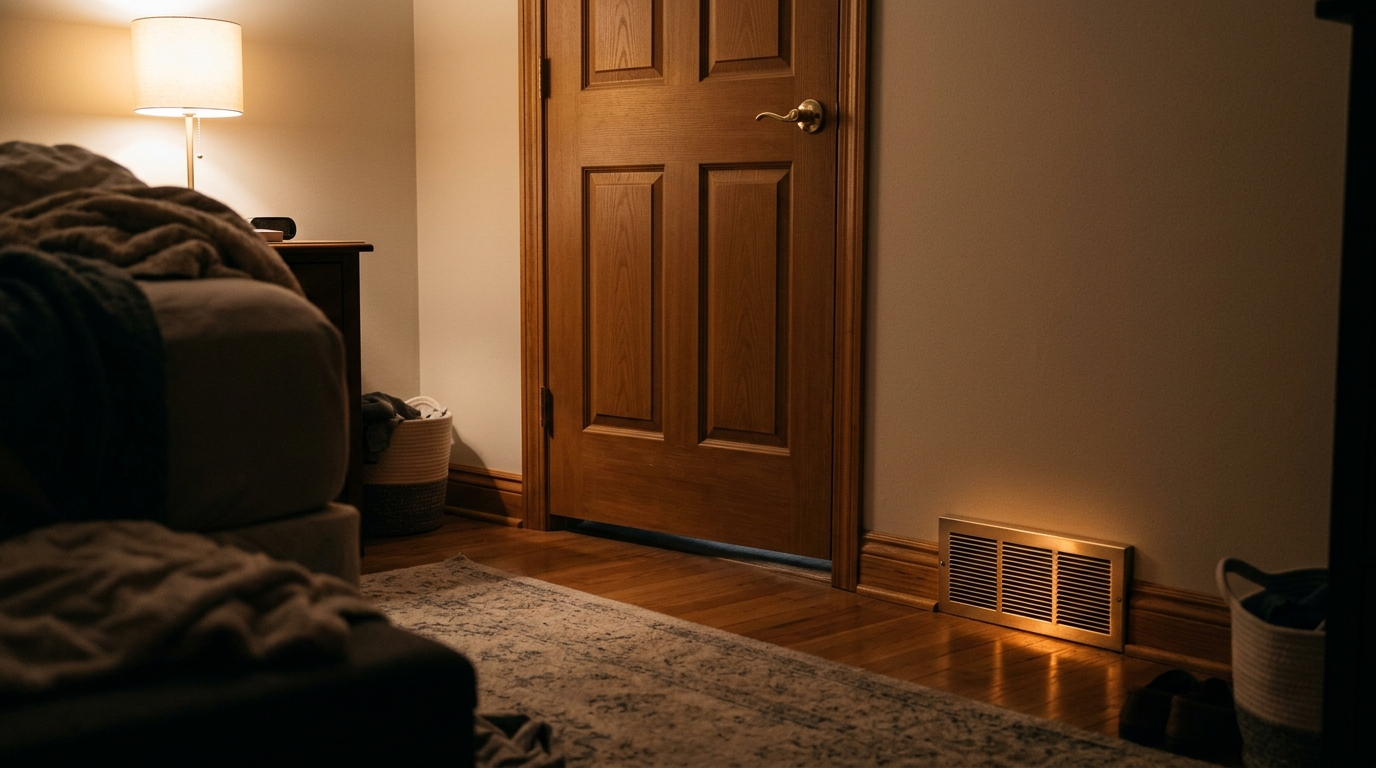
Most of us close the bedroom door before sleep without a second thought. It feels cozier, quieter, and more private. But in a home with a central forced-air system, that closed door can create a hidden airflow problem. Your supply vent keeps pushing conditioned air into a sealed room, but there is no easy path for that air to return to the system. The room pressurizes, the rest of the house gets starved, and your equipment works harder to do the same job.
The effects show up in ways you might not connect to the door. Bedrooms that feel stuffy or warmer than the hallway, a furnace or AC that short-cycles, whistling at door gaps, and utility bills that creep up without any change in your habits are all common signs. Studies from Florida Solar Energy Center and Lawrence Berkeley National Laboratory have found that closed doors in homes without return air pathways can raise bedroom pressure by several pascals, enough to force air to leak out through walls, attic penetrations, and recessed lights while pulling unconditioned outdoor air in elsewhere.
This post explains why it happens, how to tell if your home is affected, and two practical ways to fix it. One takes five minutes and costs nothing. The other is a modest weekend upgrade that solves the problem permanently without giving up your sleeping privacy.
What You’ll Need
Click on an item below to shop for the recommended items for this recipe on Amazon.
As an Amazon Associate, we earn from qualifying purchases.
How to Do It
- Close a bedroom door at night, then feel for air at the gap under the door and around the frame. Strong air movement or whistling is a clear sign of pressurization.
- Crack the door open about 1 inch using a rubber door stop or a small wedge. This alone often relieves most of the pressure imbalance.
- Check for a return air grille in the hallway or common area and make sure it is not blocked by furniture, rugs, or drapes.
- Open any interior doors you do not need closed, such as home offices or guest rooms, so air can circulate freely.
- Compare room temperatures with an inexpensive thermometer after one night. A drop in the difference between the bedroom and hallway confirms the fix is working.
- Measure the gap under the bedroom door. The industry rule of thumb is about 1 square inch of free area per 1 cubic foot per minute (CFM) of supply air, so a typical 100 CFM bedroom vent needs roughly 100 square inches of return pathway.
- Option A, door undercut: Trim the bottom of the door so there is a 3/4 to 1 inch gap above the finished floor. Use a circular saw with a guide, then seal the cut edge with paint or primer to prevent moisture damage.
- Option B, transfer grille: Install a matched pair of grilles, one high on the bedroom wall and one on the hallway side, connected by a short duct or wall cavity. Look for sound-lined or baffled versions to reduce noise.
- Option C, jump duct: Run a short flexible insulated duct through the ceiling from the bedroom to the hallway, with a grille on each end. This is the quietest and most private option and is popular in master bedrooms.
- After installation, close the door and use a small piece of tissue or a smoke pencil near the door edge to confirm air is moving freely rather than whistling through cracks.
- Retest bedroom and hallway temperatures after a full night to verify the difference has dropped to 2 degrees or less.
- Hire an HVAC contractor or home performance specialist who can measure room-to-room pressure with a manometer.
- Have them test total external static pressure and compare it against your equipment’s rated limits, typically 0.5 inches of water column.
- Ask for a recommendation on adding dedicated return ducts to bedrooms, which is the gold-standard solution for homes with large closed-door pressure problems.
- Request a post-work pressure test to confirm every closed-door room stays within 3 pascals of the rest of the house.
Why It Works: The Benefits
Restoring balanced airflow can cut HVAC energy use by 5 to 15% in homes with significant pressure problems, which is roughly $75 to $200 per year for a typical household.
Bedrooms that were previously 3 to 6 degrees off from the thermostat setting often come within 1 to 2 degrees once air can circulate freely.
Lower static pressure reduces blower motor load and cycling stress, which can extend equipment life and reduce repair calls.
Reducing negative pressure in the main living area cuts the amount of dusty attic, garage, and crawlspace air pulled into the home through leaks.
Transfer grilles and jump ducts let air move while still blocking most sound and all line of sight, so you keep the benefits of a closed door.
💰 Savings Impact by Action
Restoring return pathways reduces static pressure and lets your system run at design airflow, cutting HVAC energy use by 5 to 15% in affected homes.
Eliminating pressure imbalances can cut unwanted outdoor air leakage by 10 to 20%, lowering the load on heating and cooling equipment.
Even room temperatures help the thermostat hold setpoint longer between cycles, saving roughly 5 to 10% on runtime and wear.
Lower duct pressure means less air escaping from leaky joints, improving effective delivery by up to 10%.
🏠 Key Concepts Explained
The Science Behind It
Forced-air HVAC systems work by moving a fixed volume of air in a loop. The blower pulls air from the return grilles, pushes it across the heat exchanger or evaporator coil, and delivers it to rooms through supply registers. In a balanced system, the same volume of air that leaves a room through the return must be replaced by the supply air entering it. When a bedroom door is closed and no dedicated return exists, the supply air has nowhere to go except through whatever gaps and cracks it can find.
This creates a positive pressure bubble in the bedroom and a corresponding negative pressure zone in the rest of the home, where the main return is pulling air that is no longer being replaced. Pressure differences as small as 2 to 3 pascals are enough to measurably change air leakage rates. Conditioned air is forced out through recessed lights, wall cavities, and attic bypasses, while outdoor air is drawn in through the building envelope on the negative side. Research from the Florida Solar Energy Center has shown infiltration rates can rise by 10 to 30% in homes with severe closed-door imbalances.
The energy penalty comes from three places: lost conditioned air, increased infiltration of hot or cold outdoor air, and higher blower energy due to elevated static pressure. Fixing the imbalance by restoring a return pathway lets the system run at its design airflow, deliver the heating and cooling you are already paying for, and shut off sooner because the thermostat reaches setpoint faster.
Frequently Asked Questions
▼ Why is my AC still running all day even after I tried cracking the doors?
Door pressure is just one possible cause of long run times. Check your air filter first, then look for leaky ducts in the attic or crawlspace, closed or blocked vents, and low refrigerant. If the system still cannot keep up on moderate days, have a technician measure static pressure and airflow before assuming you need a bigger unit.
▼ Can renters do this without landlord permission?
Yes. Propping the door open an inch with a removable door stop is completely reversible and often solves most of the problem. You can also use a freestanding door-mounted air transfer vent or a plug-in fan to move air under the door, though you should avoid cutting doors or walls without written landlord approval.
▼ How long before I actually notice savings on my bill?
Comfort improvements usually show up the first night. Bill savings appear within one or two billing cycles, although seasonal weather swings can mask them. Compare your kilowatt-hours or therms to the same month last year, adjusted for weather, to see the real change.
▼ What if my home is older than 30 years?
Older homes often have fewer return ducts, leakier duct systems, and less insulation, so closed doors can have an even bigger impact. Start with the quick fix, then prioritize duct sealing with mastic and adding returns in the largest bedrooms, since those upgrades usually deliver the best payback in older construction.
▼ Will cutting a gap under my bedroom door make my room too loud or too bright?
A 3/4 inch undercut lets in some hallway light and noise, but it is usually tolerable. If privacy is a concern, use a transfer grille with sound baffles or a jump duct, which keeps light and sound down while still equalizing pressure.
Quick Tips
- Test your home on a hot or cold night by closing a bedroom door and comparing that room’s temperature to the hallway after two hours. A difference of more than 3 degrees means you likely have a pressure problem.
- If you have a ceiling fan in the bedroom, run it on low at night to improve mixing and reduce temperature stratification, but still provide a return pathway for the supply air.
- Keep supply vents and return grilles clear of furniture, curtains, and rugs, since blocked vents make pressure imbalances worse.
- Replace your HVAC filter every 1 to 3 months. A clogged filter raises static pressure and makes any closed-door problem more noticeable.
Variations for Your Situation
- Apartment/Rental: Use a removable rubber door stop to crack doors open about 1 inch at night, and place a small oscillating fan in the hallway to push air toward the return. A $12 door-mounted air transfer vent that clips onto the bottom of the door is another renter-friendly option that needs no tools or modifications.
- Tight Budget (under $50): Start by opening interior doors you do not need closed and clearing every return grille of obstructions, which costs nothing. Add a $5 door wedge for bedrooms and a $10 thermometer to find the worst rooms, then undercut one or two doors yourself with a handsaw if the problem persists.
- Older Home (pre-1980): Expect fewer return ducts and leakier existing ductwork, so combine the airflow fix with mastic sealing on accessible duct joints, which costs about $20 to $60 in materials. Be cautious about cutting old doors that may contain lead paint, and use proper dust control or hire a certified contractor if the paint is original.