If you have noticed your toilet taking forever to refill after a flush, or heard it trickling and hissing long after you have walked away, you are not dealing with a minor annoyance. A healthy toilet tank should refill fully in 60 to 90 seconds. Anything longer than 3 minutes points to a real problem, and leaving it unaddressed often means a complete fill valve failure, a running toilet, or a surprise spike in your water bill.
The good news is that slow-filling toilets have a short list of causes, all of them diagnosable without special skills. The three most common culprits are a partially closed shut-off valve, a clogged or failing fill valve, and a waterlogged float. Each one has a straightforward fix, and replacement parts cost between $10 and $25 at any hardware store. Catching the problem now means you avoid the scenario where the valve fails completely and the toilet either runs nonstop or stops filling altogether.
This guide walks you through diagnosing which issue you have, two levels of fix (a no-cost quick check and a full DIY repair), and what to watch for if the problem points to something more serious in your supply line. By the end, you will know exactly what is causing the slow fill and how to resolve it permanently.
What You’ll Need
Click on an item below to shop for the recommended items for this recipe on Amazon.
As an Amazon Associate, we earn from qualifying purchases.
How to Do It
- Locate the shut-off valve on the wall behind or beside the base of the toilet. Turn it fully counterclockwise until it stops. Even a quarter turn of restriction significantly reduces flow, and many valves get left partially closed after past repairs.
- Flush the toilet and time how long the tank takes to refill completely. A normal fill is 60 to 90 seconds. If it is now within that range, the shut-off valve was your only problem.
- If still slow, remove the tank lid and watch the fill cycle. Check where the water level stops relative to the fill line marked inside the tank. The water level should stop about half an inch below the top of the overflow tube.
- If the float is a ball float, bend the float arm slightly downward to lower the shutoff point. If it is a cup float on a vertical fill valve, pinch the adjustment clip and slide it down about one inch, then flush and recheck.
- Inspect the float for waterlogging by gently shaking it. A ball float that has water inside will feel heavy and should be replaced. This is a $5 part and takes 5 minutes to swap out.
- Flush three times and confirm the tank reaches full level within 90 seconds each time. If it does, the fix is complete.
- Turn off the shut-off valve by rotating it clockwise until it stops. Flush the toilet to empty the tank, then hold the handle down for a few extra seconds to drain as much water as possible.
- Place a towel on the floor and put a small bucket under the tank. Disconnect the supply line from the bottom of the tank by hand or with an adjustable wrench. Expect a small amount of residual water to drain out.
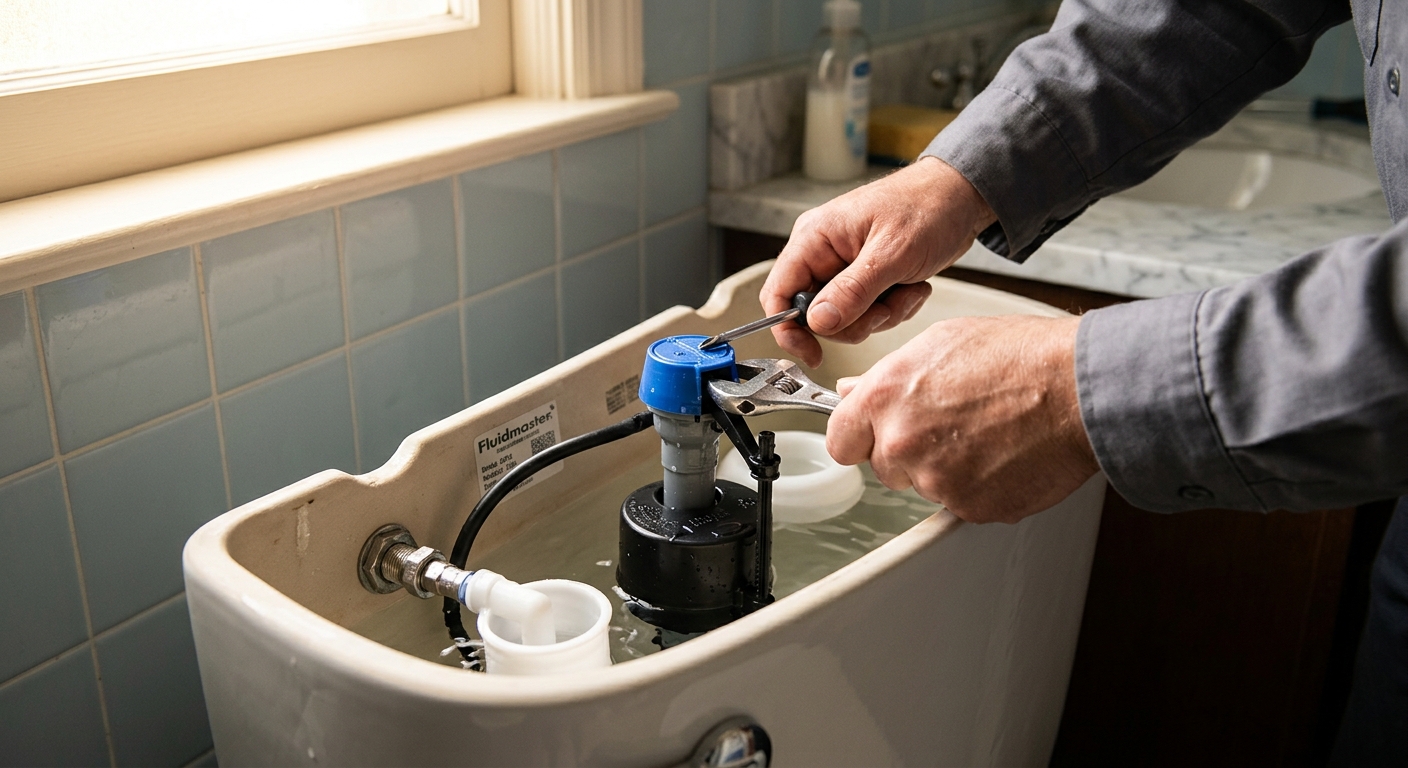
- Inside the tank, hold the fill valve body steady with one hand and unscrew the plastic locknut on the underside of the tank counterclockwise with your other hand or with pliers. Lift the old fill valve straight out.
- Before installing the new valve, flush the supply line briefly into a bucket with the shut-off valve open for 2 to 3 seconds to clear any debris that was sitting in the line.
- Insert the new fill valve into the tank opening. Adjust the valve height according to the manufacturer’s instructions so the critical level mark sits at least one inch above the top of the overflow tube. Hand-tighten the locknut firmly from below, then add a quarter turn with pliers. Do not overtighten or you will crack the tank.
- Reconnect the supply line, open the shut-off valve fully, and let the tank fill. Flush twice and confirm the tank refills in under 90 seconds and that there is no dripping at the supply line connection. Adjust the float clip if the water level needs fine-tuning.
- Before calling, test water pressure at a nearby sink by observing flow rate. If multiple fixtures throughout the house seem slow or low-pressure, the issue is upstream of the toilet and a plumber needs to assess the PRV or main supply.
- Check whether the shut-off valve behind the toilet turns freely. If it is stuck, corroded, or leaks when you try to open it, do not force it. A licensed plumber should replace the angle stop valve, which requires shutting off water to the home.
- Describe the symptoms clearly when calling: how long the tank takes to fill, whether other fixtures are affected, the age of the home, and whether you have hard water. This helps the plumber bring the right parts and estimate time accurately.
- Ask the plumber to also inspect the supply line age and condition. Rubber-core supply lines older than 10 years should be replaced with braided stainless steel lines rated to 500 PSI as a precaution against blowout, which can cause significant water damage.
Why It Works: The Benefits
A running or slow-filling toilet that does not shut off properly can waste 20 to 200 gallons per day. Fixing a faulty fill valve alone can save a household 3,000 to 6,000 gallons per month, which translates to $15 to $50 in water savings depending on local rates.
A fill valve showing slow-fill symptoms is nearing the end of its life. Replacing it now for about $12 to $20 avoids the scenario where it fails completely and requires an emergency plumber visit, which typically costs $150 to $300 for a straightforward valve replacement.
The hissing, trickling, and gurgling sounds associated with a slow-filling toilet are caused by restricted water flow and a valve struggling to close properly. Fixing the root cause eliminates the noise entirely rather than masking it.
A slow fill often means the tank is not reaching its full water level before the next flush, resulting in weak flushes that require double-flushing. A properly functioning fill valve restores the full flush volume, typically 1.28 to 1.6 gallons per flush on modern toilets.
💰 Savings Impact by Action
Replacing a worn fill valve eliminates the continuous trickle that wastes 20 to 100 gallons per day, reducing toilet water use by up to 15 percent of total household water consumption.
A leaking flapper is the most common silent water waster in homes, and replacing it for $5 stops losses of up to 200 gallons per day, cutting household water bills by roughly 10 percent.
Fully opening a partially closed shut-off valve costs nothing and restores normal fill speed, eliminating valve strain that shortens component life and wastes energy from the water heater on heated-water loops.
Replacing a kinked or internally corroded supply line with a new braided stainless steel line restores full flow and eliminates a failure risk that can cause 50 to 100 gallons per hour of uncontrolled water loss.
🏠 Key Concepts Explained
The Science Behind It
A toilet fill valve works on a simple pressure differential principle. Municipal water supply pressure (typically 40 to 80 PSI) pushes water through the fill valve at a controlled rate, and a buoyant float rising with the water level gradually reduces flow until it triggers a complete shutoff at the target water level. The entire cycle depends on adequate supply pressure reaching the valve with minimal restriction. When any point in that path is narrowed, whether by a partially closed valve, a scaled orifice, or a worn diaphragm seal, the flow rate drops and refill time increases proportionally.
Mineral buildup is particularly problematic because it worsens progressively. Hard water deposits calcium carbonate (scale) inside fill valve seats at a rate that accelerates as the existing layer grows thicker and rougher, trapping more minerals. A fill valve in an area with 15 grains per gallon hardness can accumulate enough scale to reduce flow by 30 to 40 percent within 5 years. This is why homeowners in hard water regions often see fill valves fail faster than the 5 to 10 year average lifespan.
Float calibration matters because the fill valve is designed to approach shutoff gradually, reducing flow rate as the float nears the shutoff point to prevent water hammer. A waterlogged float that sits too low never properly signals the valve to enter that gradual shutoff phase, keeping the valve partially open and creating the characteristic hissing sound of a running toilet. This is not just an annoyance: a valve held partially open continuously experiences more wear than one that cycles normally, dramatically shortening its remaining useful life.
Frequently Asked Questions
▼ I replaced the fill valve but the tank is still filling slowly. What did I miss?
The most likely culprit after a valve replacement is the shut-off valve not being fully open, or debris that was dislodged during the repair and is now partially blocking the new valve’s inlet screen. Remove the fill valve cap (twist counterclockwise), check for the small screen filter at the base, and rinse it under running water. Also confirm the shut-off valve behind the toilet is turned fully counterclockwise.
▼ My toilet fills slowly only sometimes, not every flush. What causes that?
Intermittent slow fills usually point to a partially waterlogged float that works fine when the water is cold but sits slightly low as it warms, or to a fill valve diaphragm that is worn and sticks unpredictably. It can also indicate fluctuating water pressure in your home, which is more noticeable when other fixtures are running simultaneously. If the pattern lines up with peak household water use times, pressure fluctuation is the likely cause.
▼ Can a slow-filling toilet actually raise my water bill?
Yes, significantly. A toilet fill valve that does not fully seat and allows a continuous trickle, even one that is invisible to the eye, can waste 20 to 100 gallons per day. At average U.S. water rates of about $0.01 per gallon, that is $6 to $30 per month in wasted water from a single toilet. Use the food coloring test described in the pro tip section to confirm whether your flapper is also contributing to waste.
▼ The shut-off valve behind my toilet is leaking a little since I touched it. What should I do?
A small drip from the packing nut on a compression-style shut-off valve can sometimes be stopped by tightening the packing nut (the nut just behind the handle) clockwise by a quarter turn with a wrench. Do this with the water on and watch whether the drip stops. If it continues or gets worse, turn off the main water supply and call a plumber to replace the angle stop valve, as forcing it further risks a full failure.
▼ How do I know if low water pressure is a whole-house problem rather than just the toilet?
Turn on the cold water at a nearby bathroom or kitchen sink and observe the flow while the toilet is filling. If the sink flow is also weak or drops noticeably when the toilet is filling, the issue is upstream and likely involves the pressure reducing valve (PRV) on your main supply line or a partially closed main shut-off. A plumber can test your static pressure with a gauge at an outdoor hose bib, with normal readings between 40 and 70 PSI.
Quick Tips
- Replace the supply line at the same time you replace the fill valve if the line is older than 10 years. The additional $8 to $12 cost is worth it compared to the risk of a supply line failure.
- Keep a spare Fluidmaster 400A fill valve and a spare flapper in a bathroom cabinet. Both parts are under $20 total and cover the two most common toilet failures instantly.
- If you have hard water (above 7 grains per gallon), pour one cup of white vinegar into the overflow tube once every 6 months. It dissolves early-stage mineral deposits inside the fill valve before they restrict flow.
- After any toilet repair, check the supply line connection for drips after the first 24 hours. Connections can seep slowly at first and only reveal a small drip once fully pressurized for a day.
Variations for Your Situation
- Apartment/Rental: Renters should report a slow-filling toilet in writing to their landlord or property manager, since toilet repairs are typically the landlord’s legal responsibility. Before submitting the request, check and fully open the shut-off valve yourself, which requires no tools and no landlord permission. If the landlord is slow to respond, document the issue with a video showing the fill time and reference your lease’s habitability or maintenance clause.
- Tight Budget (under $50): The shut-off valve check and float adjustment cost nothing and resolve the problem in a significant share of cases. If parts are needed, a universal fill valve costs $10 to $15 and a flapper costs $5 at any hardware store. Prioritize these two parts over any other toilet component since they cover more than 80 percent of slow-fill and running toilet scenarios. Skip branded or specialty parts and buy the standard Fluidmaster 400A, which is the industry standard and available at every major hardware retailer.
- Older Home (pre-1980): Homes built before 1980 often have original compression shut-off valves that have never been exercised and may crack if forced. Before touching the shut-off valve, locate your main water shut-off so you can act quickly if needed. Also expect original fill valves to be the ballcock style (a ball float on a horizontal arm) rather than modern cup floats. These are noisier and less reliable, and replacing a ballcock with a modern fill valve for $12 to $15 is one of the highest-value toilet upgrades you can make in an older home.