If your cabinet doors swing open on their own, refuse to latch, or hang at an awkward angle, you are not alone. Over time, the hinges that hold cabinet doors in place loosen from daily use, humidity cycles, and the natural settling of your home. What starts as a minor annoyance quickly becomes a daily frustration, and in kitchens and bathrooms, an open cabinet door can also mean wasted energy if it allows warm or cool air to escape around an exterior wall cavity.
The fix is almost always simpler than homeowners expect. In the majority of cases, the culprit is a loose hinge screw, a misadjusted European-style hinge, or a worn magnetic catch, not a structural problem with the cabinet itself. Each of these can be corrected in minutes without replacing the door or calling a carpenter. This post walks you through diagnosing the problem and applying the right fix, from a zero-cost tightening trick to a proper hinge replacement for chronic repeat offenders.
We will cover the two most common cabinet hinge types found in American homes, the tools and materials you actually need, and step-by-step approaches for every skill level. Whether you have frameless IKEA-style cabinets with clip-on Euro hinges or older face-frame cabinets with butt hinges, there is a clear path to doors that close and stay closed.
What You’ll Need
Click on an item below to shop for the recommended items for this recipe on Amazon.
As an Amazon Associate, we earn from qualifying purchases.
How to Do It
- Open the cabinet door fully and wiggle it gently side to side. If it wobbles at the hinge, the screw hole is stripped or the screws are simply loose.
- Use a Phillips screwdriver to tighten every screw on every hinge, both on the door side and the cabinet box side. Turn until snug, not so tight that you crack the wood.
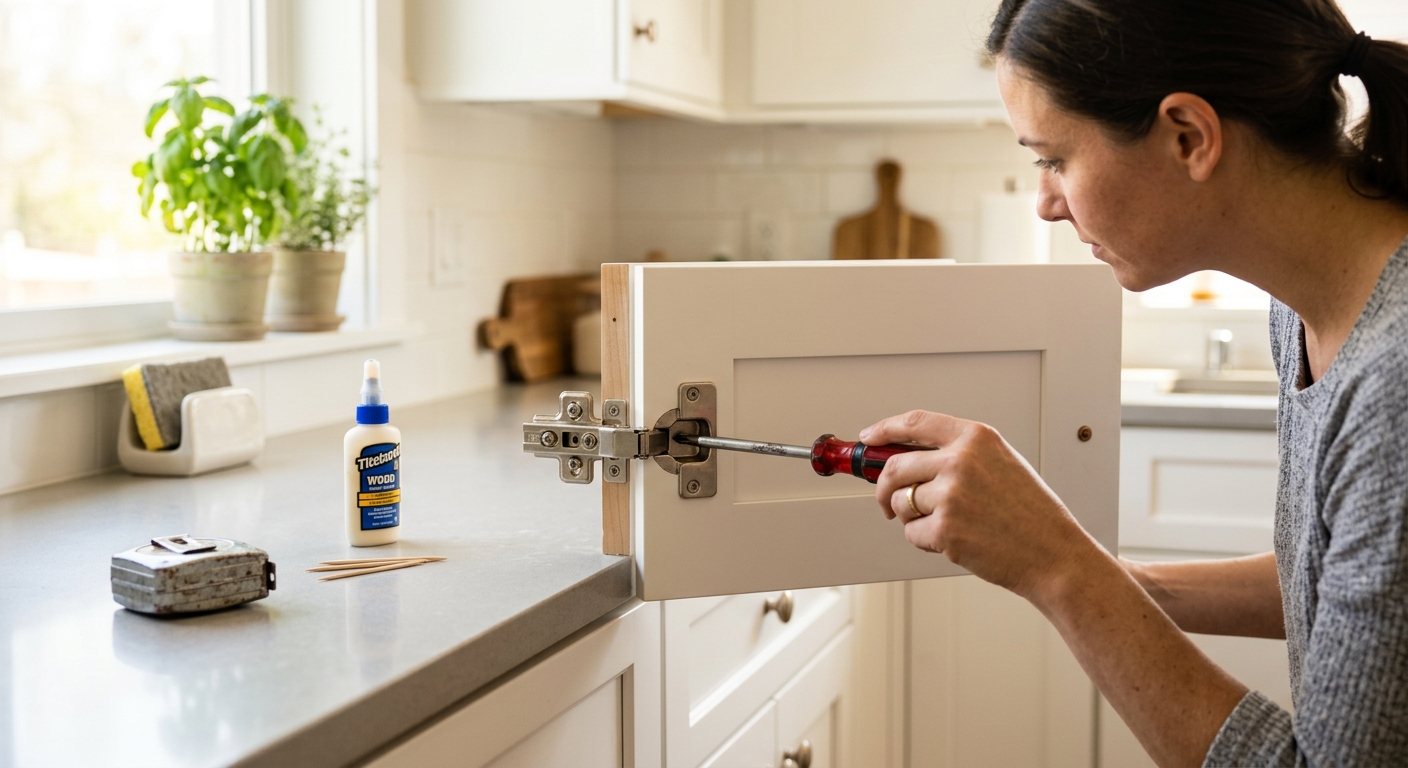
- If screws spin without gripping, the hole is stripped. Remove the screw, dip 3 to 4 wooden toothpicks in wood glue, pack them into the hole, let dry for 30 minutes, then trim flush and reinstall the screw.
- For European-style hinges with visible adjustment screws, use a Phillips screwdriver to turn the side-to-side screw until the door gap is even on all sides (roughly 2mm), then tighten the depth screw until the door face sits flush with adjacent doors.
- Close the door and check if the magnetic or roller catch engages. If the door bounces back open, press the catch with your finger to locate it, then loosen its mounting screws and slide it forward by 1 to 2mm until the door clicks shut reliably.
- Test the door 10 times. If it stays closed consistently, you are done.
- Measure your existing Euro hinge cup diameter (almost always 35mm) and the overlay dimension, which is how much the door overlaps the cabinet face frame. Common overlays are 1/2 inch and full overlay. Note these before ordering replacement hinges.
- Purchase soft-close Euro hinges matching your measurements. Blum and Grass are reliable brands available at home centers for $5 to $12 per hinge. Each door typically uses 2 hinges.
- Remove the old hinge by pressing the clip release lever or unscrewing the mounting plate. Set the door aside on a padded surface to avoid scratching it.
- Attach the new hinge mounting plates to the cabinet box using the existing screw holes. If holes are stripped, fill with toothpicks and wood glue as described in the quick fix approach before proceeding.
- Clip the new hinges onto the mounting plates, then close the door and make all three adjustments: height (up/down screw), side-to-side (lateral screw), and depth (door-face screw) until gaps are even and the door face sits flush.
- If the door still will not latch after hinge replacement, install a new magnetic catch on the cabinet interior. Position it so the steel strike plate on the door contacts the magnet squarely, then tighten. Test 10 times and fine-tune position as needed.
- Check for water damage first: run your hand along the inside bottom of the cabinet under the sink. Soft, spongy, or discolored particleboard means moisture intrusion that must be resolved before any hinge work will hold.
- Place a framing square in the cabinet opening. If the gap between the square and the corner exceeds 3/8 inch, the box has racked and needs a carpenter to re-square and brace it.
- If hinges have pulled entirely out of the cabinet box and taken chunks of the face frame with them, the face frame needs to be repaired or replaced before new hinges can be installed.
- Contact a local cabinet installer or handyman for an in-person estimate. Ask specifically whether they can repair in place or whether the cabinet needs to be pulled and rebuilt.
- Get at least two quotes. A reputable pro should be able to repair a single warped or racked cabinet box for $150 to $300, and full hinge and hardware replacement across an entire kitchen typically runs $400 to $800 for labor.
Why It Works: The Benefits
A stripped screw hole fixed with toothpicks and wood glue costs under $1 and takes 15 minutes, compared to $75 to $200 per door for a professional cabinet repair visit.
Doors that stay closed keep pests out, protect stored items from grease and steam, and eliminate the daily irritation of a door swinging into your path while cooking.
A door that repeatedly swings open and contacts an adjacent door or the counter can chip paint, crack face frames, and damage the door itself. Fixing the latch early prevents $300 to $800 in cabinet door replacement costs.
Crooked or gaping cabinet doors are one of the first things buyers and guests notice in a kitchen. Properly aligned doors instantly make a kitchen look better maintained without a renovation.
Working through a hinge fix forces you to inspect the cabinet box, which can reveal early signs of water damage or sagging shelves before they become a $1,000 or more cabinet replacement project.
💰 Savings Impact by Action
Fixing a cabinet door yourself for $5 to $15 saves 85% compared to a handyman call-out starting at $75 to $100 per visit.
Fixing a loose hinge early prevents door and face-frame damage that can cost $300 to $800 to replace, saving roughly 70% of potential future repair costs.
Replacing a worn standard hinge with a soft-close model reduces door-slam impact by roughly 60%, slowing future screw loosening and extending cabinet life.
Buying Euro hinges in a 10-pack online versus individually at a hardware store reduces per-hinge cost by up to 55%, making a full kitchen refresh affordable.
🏠 Key Concepts Explained
The Science Behind It
Cabinet hinges fail for a simple mechanical reason: the holding force of a screw is directly proportional to the surface area of wood fiber gripping the screw threads. Particleboard, which is used in roughly 80% of stock and semi-custom cabinets sold today, has much lower screw-holding strength than solid wood or plywood. A standard 35mm European hinge mounted in particleboard with 1.25-inch screws holds reliably for years under normal loads, but the repeated torque of opening and closing a door loaded with dishes or pots gradually enlarges the screw hole. Once the hole diameter exceeds the screw thread diameter, the hinge is essentially floating.
The toothpick-and-glue method works because wood glue bonds cellulose fibers together, and the compressed toothpicks fill the void while adding new fiber material for the screw threads to bite into. When the glue cures, the screw effectively finds fresh, undisturbed material again. This repair can hold for 5 to 10 more years in a low-traffic cabinet, though high-traffic doors may need a longer screw or a threaded insert for a permanent fix.
Humidity’s role is often underestimated. Wood products absorb moisture from the air and swell measurably, sometimes by 1 to 3 millimeters across a cabinet width, during humid months. This is enough to shift a hinge out of alignment or compress a door into its frame so tightly that it binds. Conversely, in dry winter conditions, the wood shrinks and a previously tight door may suddenly gap. If your cabinet door problem is seasonal, the hinge itself may be fine and a simple re-adjustment each spring and fall may be all that is needed. Installing a bathroom or kitchen exhaust fan to reduce humidity spikes can minimize this cycle significantly.
Frequently Asked Questions
▼ I tightened all the screws but the door still swings open on its own. What am I missing?
A door that drifts open on its own usually means the hinge is slightly out of plumb, causing gravity to pull the door open, or the magnetic catch is too weak or misaligned. Check that the cabinet box is level using a bubble level, then reposition the magnetic catch so it contacts the strike plate squarely and fully. If both are fine, the soft-close damper in the hinge may have failed and the hinge needs to be replaced.
▼ My cabinet door is crooked and hits the adjacent door. How do I fix that without buying anything?
This is almost always an adjustment issue on a Euro hinge. Look at the hinge and find the screw closest to the door edge. Turning it clockwise moves the door away from the adjacent door, and counterclockwise brings it closer. Make small quarter-turn adjustments and check the gap after each one. Most misalignment can be corrected in under 5 minutes without any new hardware.
▼ The screw holes are completely stripped and toothpicks are not holding. What do I do next?
Step up to a longer screw, typically a 2-inch coarse-thread screw, which reaches past the damaged layer into solid material below. Alternatively, install a threaded insert, also called a barrel nut or hinge repair insert, which creates a metal thread in the cabinet wall that grips far more reliably than wood screws in particleboard. Both fixes cost under $5 and are available at any hardware store.
▼ Can renters fix cabinet doors without landlord permission?
Tightening existing screws and adjusting Euro hinges are maintenance tasks that require no modification and are safe for renters in virtually any lease. Replacing a worn magnetic catch with an identical unit is also generally acceptable. Before installing new hinges that require drilling new holes, check your lease or send a quick text to your landlord. Documenting the repair with before-and-after photos protects you from any security deposit dispute.
▼ How do I know if my cabinets have face-frame hinges or Euro hinges?
Open a cabinet door and look at the hinge. European or concealed hinges have a round cup pressed into the back of the door and are almost invisible from the outside when the door is closed. Face-frame or butt hinges are flat rectangular metal plates visible on both the door edge and the cabinet frame when the door is open. The adjustment and repair process differs for each type, so identifying yours first saves time.
Quick Tips
- Take a photo of your existing hinge before removing it so you can match the model number or dimensions exactly at the hardware store.
- If you have many identical cabinets, buy replacement hinges in a 10-pack online. The per-unit cost drops from about $10 each to $3 to $5 each.
- Self-adhesive foam bumpers applied to the inside corners of the cabinet frame cushion door closing and reduce the impact that loosens hinge screws over time.
- A magnetic catch rated at 6 pounds or more of pull force will outlast a budget 2-pound catch by years in a frequently used kitchen cabinet.
Variations for Your Situation
- Apartment or Rental: Renters should start with screw tightening and Euro hinge adjustment since both are reversible and require no new holes. A replacement magnetic catch is an inexpensive swap that landlords rarely object to. Avoid any approach requiring drilling new mounting holes without written permission, and photograph all work before and after.
- Tight Budget (under $10): The toothpick-and-glue repair costs almost nothing and resolves the majority of stripped-screw problems. A 4-pack of replacement magnetic catches costs $6 to $8 at a hardware store and can fix multiple doors. Skip the hinge replacement entirely until you have confirmed these cheaper steps do not solve the problem.
- Older Home (pre-1980): Cabinets from this era are more likely to use butt hinges or surface-mount hinges rather than Euro cups. Replacement butt hinges are widely available but require precise alignment since they offer little adjustment range. If the door or face frame wood is soft or crumbly, test it with a screwdriver tip before attempting any repair, as soft wood may indicate rot and a carpenter should assess the cabinet before you invest in new hardware.