If you have ever read a forum thread about lowering summer energy bills, you have probably seen someone swear that a tiny overnight thermostat tweak changed everything. The claim usually goes like this: nudge the temperature up a couple of degrees while you sleep, and your bill drops without anyone noticing. It sounds almost too simple, which is exactly why many people skip it.
The truth is more nuanced and more interesting. The U.S. Department of Energy estimates that you can save about 1% on cooling costs for each degree you raise the thermostat for an 8-hour stretch. So a two-degree setback is worth roughly 2%, and a four-degree setback closer to 4%. That is real money, but it is not magic. The savings depend on your climate, your insulation, your equipment, and how you manage the recovery in the morning.
In this post we will cover how the setback actually works, why the common fear of the AC working overtime to catch up is mostly a myth, and two ways to put it into practice: a no-cost manual approach you can start tonight, and a programmable or smart thermostat setup that does it for you. We will also cover when a setback backfires, especially with heat pumps and high-humidity homes.
What You’ll Need
Click on an item below to shop for the recommended items for this recipe on Amazon.
As an Amazon Associate, we earn from qualifying purchases.
How to Do It
- Note your current nighttime setpoint. If it is 72 degrees, plan to raise it to 74 degrees at bedtime.
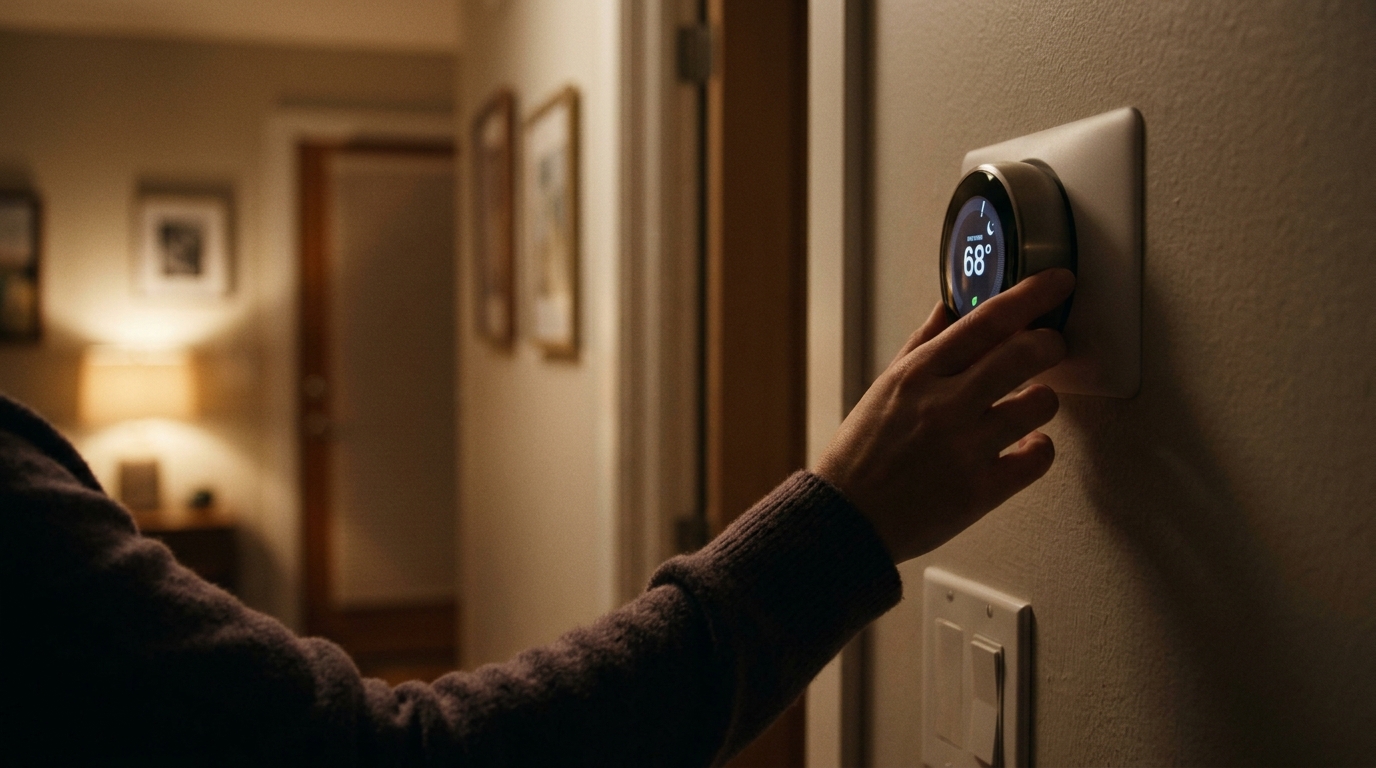
- Adjust the thermostat when you go to bed, and set a phone reminder for the first few nights so it becomes routine.
- Run a ceiling fan on low in the bedroom (counterclockwise in summer) so the room feels about 4 degrees cooler than the thermostat reads.
- Lower the setpoint back to your daytime temperature when you wake up, or better, set it back down about 30 minutes before you get out of bed.
- Track comfort and your next two utility bills. If sleep quality holds up, try a three-degree setback the following week.
- Confirm compatibility. Check whether your system is a standard single-stage AC, a multi-stage system, or a heat pump, and verify whether your wiring includes a common (C) wire for a smart thermostat.
- Turn off power to the HVAC system at the breaker, photograph your existing wiring, label each wire, then remove the old thermostat and install the new one following the manufacturer instructions.
- Program a schedule: daytime comfort setpoint, an overnight setback of two to four degrees starting around bedtime, and a morning recovery that begins 30 to 60 minutes before you wake.
- Enable features like adaptive recovery or early-start, which learn how long your home takes to cool down and begin recovery at the right moment.
- Review the energy report after two weeks and fine-tune the setback depth and recovery timing until you find the sweet spot for comfort and savings.
Why It Works: The Benefits
The DOE rule of thumb is about 1% savings per degree for each 8-hour period, so a two to four degree overnight setback saves roughly 2 to 4% on cooling. On a $150 summer cooling bill, that is $3 to $6 per month.
A shorter nightly run time reduces wear on the compressor and fan. Over many summers that can modestly extend equipment life and cut repair risk.
A system that cycles less overnight means fewer startup thumps and less fan noise while you sleep, which many light sleepers notice right away.
You can begin with the thermostat you already own and a single adjustment at bedtime. The only investment is optional, such as a programmable thermostat at $25 to $60 or a smart model at $100 to $250.
Once you are comfortable with a two-degree shift, you can stretch to three or four degrees and add daytime setbacks while you are away, which can push total savings toward 5 to 10% in the right home.
💰 Savings Impact by Action
A two to four degree setback for about 8 hours saves roughly 2 to 4% on annual cooling costs, based on the DOE rule of thumb.
A fan lets you feel about 4 degrees cooler, which makes a higher setpoint comfortable and supports additional savings.
A programmable or smart thermostat that sets back both overnight and while you are away can reach about 8% total savings.
Sealing leaks and adding insulation can cut heating and cooling costs by about 15%, which makes any setback more effective.
🏠 Key Concepts Explained
The Science Behind It
Heat moves from warm to cool, and the speed of that movement depends on the temperature difference between the two sides of your walls, roof, and windows. When you raise your indoor setpoint overnight, you shrink the difference between inside and outside, so heat flows in more slowly. Your air conditioner has less heat to remove, which means it runs for shorter periods. That reduction in runtime is where the savings come from.
The big myth is that the system has to work so hard to catch up in the morning that it cancels out the savings. In practice, a modest setback of two to four degrees does not create a large recovery penalty because the house never drifts far from your target and the morning pull-down happens while outdoor temperatures are still relatively mild. The energy saved during the long setback period is larger than the extra energy used during the short recovery. This holds true as long as the setback is not extreme and your system is sized reasonably.
The savings are smaller in cooling than in heating for one reason: cooling systems have to fight both temperature and humidity. Raising the setpoint reduces sensible cooling load, but it can also slow dehumidification, which is why humid regions need a lighter touch. Combined with airflow from a ceiling fan, which increases evaporative cooling on your skin and makes a room feel about 4 degrees cooler, a two-degree setback becomes nearly unnoticeable while still trimming your bill.
Frequently Asked Questions
▼ Why is my AC still running all day even after I tried a setback?
A setback only trims overnight runtime, so it will not stop a system that struggles during the day. Check for a dirty filter, blocked vents, and a dirty outdoor coil, and make sure your attic insulation and window shading are doing their job. If the system still runs constantly on a normal day, have an HVAC tech check refrigerant charge and airflow.
▼ Can renters do this without landlord permission?
Yes, in most cases. A manual setback uses the thermostat you already have, so no permission is needed. If you want a programmable or smart thermostat, check your lease first, though many renters use a renter-friendly option and swap the original back when they move out.
▼ How long before I actually notice savings on my bill?
You will see the effect on your next full billing cycle, but weather swings can mask a 2 to 4% change. Compare your usage to the same month last year, or use a smart thermostat energy report, to isolate the effect. Expect a few dollars per month in a typical home.
▼ Will a setback damage my heat pump or make it use backup heat?
In cooling mode, a modest setback is generally fine for a heat pump. The issue appears in heating mode, where a large setback can trigger expensive auxiliary heat during recovery. Since this post is about cooling, you are safe with two to four degrees, but check your manufacturer manual if you use the same schedule year-round.
▼ What if my home is older than 30 years?
Older homes often leak more air and have thinner insulation, so they warm up faster overnight. Stick to a smaller setback of two degrees, seal obvious air leaks around windows, doors, and attic hatches first, and add attic insulation toward R-38 for the best results.
Quick Tips
- Pair the setback with a ceiling fan on low. Fans cool people, not rooms, so turn the fan off when nobody is in the space.
- Close blinds and curtains on sun-facing windows before bed so the house holds its temperature better through the night.
- Start with two degrees and add one degree per week until you find your comfort limit rather than jumping straight to four.
- Check your filter before the cooling season starts. A clogged filter forces longer runtimes and can erase your setback savings.
Variations for Your Situation
- Apartment/Rental: Start with a manual two-degree setback and a plug-in oscillating fan at about $25 to $40, since you cannot change central HVAC. If you rent a unit with a window AC, use its built-in timer to shut off or raise the setpoint for part of the night, and add blackout curtains for roughly $20 to $50.
- Tight Budget (under $50): Use your existing thermostat for a two-degree manual setback, run a ceiling or box fan, close blinds before bed, and swap a dirty filter for about $10 to $20. These zero and low-cost steps deliver most of the benefit without buying new equipment.
- Older Home (pre-1980): Keep the setback to two degrees because leaky walls and thin attic insulation let heat creep in quickly. Spend $30 to $75 on caulk, weatherstripping, and an attic hatch cover first, then layer on a programmable thermostat to maximize the payoff.
- Hot-Humid Climate: Limit the setback to two degrees and monitor indoor humidity with a $15 hygrometer. If humidity rises above 55 to 60%, reduce the setback or run a dehumidifier, because comfort and mold risk matter more than a few extra dollars saved.