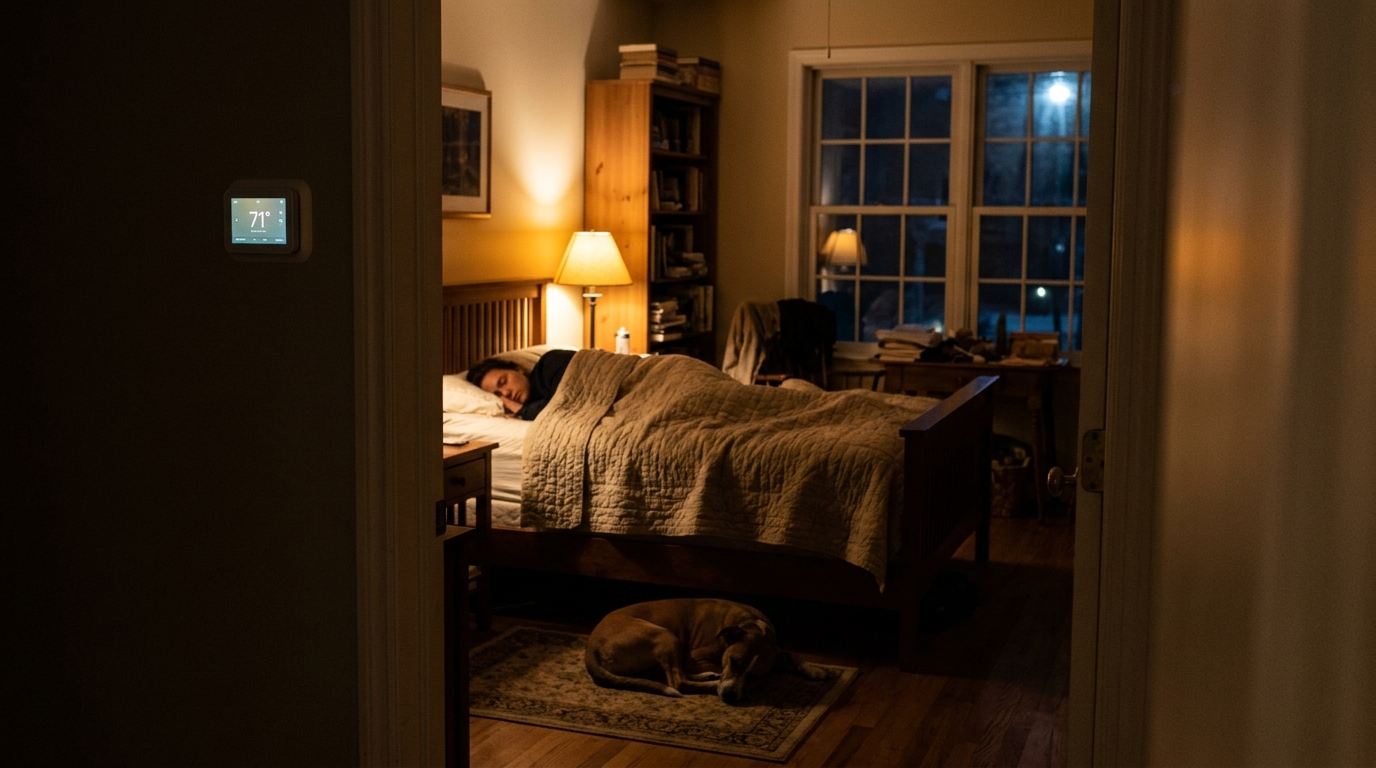
Around 3 a.m., your home’s heating system is working at its hardest and its least efficient. Outdoor air is at its coldest, which means an air-source heat pump is struggling to pull heat from freezing air, a furnace is cycling to fight the deepest heat loss of the day, and an electric resistance backup strip may be kicking in to cover the gap. This is exactly when a geothermal heat pump shines, because the ground three to six feet down does not care that it is 15 degrees outside.
A geothermal (ground-source) heat pump moves heat between your home and the earth through a buried loop of fluid-filled pipe. Below the frost line, soil temperature stays remarkably constant, typically between 45 and 75 degrees F depending on your region. Since the system is always working with a stable, moderate source or sink, its efficiency does not swing with the weather. The DOE and ENERGY STAR report that geothermal systems can deliver 3 to 5 units of heat for every unit of electricity consumed, which is a coefficient of performance (COP) of 3.0 to 5.0, compared to roughly 1.5 to 2.5 for an air-source heat pump on a very cold night.
This post explains why that overnight advantage exists, how to make sure your system is actually capturing it, and what to do whether you already own a ground-source unit or are weighing the investment. We will cover quick settings changes, a hands-on DIY maintenance routine, and when it makes sense to call a certified geothermal installer.
What You’ll Need
Click on an item below to shop for the recommended items for this recipe on Amazon.
As an Amazon Associate, we earn from qualifying purchases.
How to Do It
- Set your thermostat to hold a steady overnight temperature, ideally a setback of only 2 to 3 degrees F. Unlike furnaces, geothermal units gain little from deep setbacks, and large swings can trigger auxiliary heat.
- Disable or raise the lockout threshold for auxiliary electric heat in your thermostat settings, if your installer says it is safe. Auxiliary strips are the single biggest overnight efficiency killer.
- Call your utility and ask about a geothermal or time-of-use rate plan. Many offer overnight rates 30 to 60 percent lower than daytime, and some have dedicated heat pump discounts.
- Check that your thermostat is in heat pump mode (not conventional furnace mode) so the staging logic runs correctly.
- Close doors to unused rooms and keep supply registers unblocked so the system can move air freely at low overnight speeds.
- Replace the air filter every 1 to 3 months with a MERV 8 to 11 filter. A clogged filter forces the blower to work harder and drops airflow, which hurts efficiency most during long overnight run cycles.
- Clean the evaporator coil area and condensate drain line with a mild cleaner and flush the drain with a cup of vinegar to prevent clogs and mold.
- Check your thermostat or monitoring app for the system’s entering and leaving water temperature if available. In winter, entering loop temperature should stay above roughly 30 degrees F; a steady decline over several seasons can signal an undersized or struggling loop field.
- Inspect visible ductwork and seal leaks with mastic or foil tape. Leaky ducts can waste 20 to 30 percent of conditioned air and undercut your system’s strengths.
- Install a smart thermostat compatible with heat pumps and schedule a gentle overnight profile with a minimal setback and a gradual morning ramp-up.
- Get a Manual J heat load calculation from a certified installer (look for IGSHPA accreditation). Oversizing or undersizing is the most common cause of disappointing performance.
- Request quotes for both horizontal loops (cheaper, need more land) and vertical loops (more expensive, smaller footprint) and compare projected COP and annual operating cost.
- Ask for a two-stage or variable-speed unit, which delivers the best overnight comfort and efficiency at part-load conditions.
- Have ducts tested and sealed before installation. A new system cannot overcome a leaky or undersized duct system.
- Confirm warranty terms, loop field guarantees, and what the installer will do to commission and balance the system after startup.
Why It Works: The Benefits
Geothermal heating typically costs 30 to 60 percent less than electric resistance, oil, or propane heat, and 25 to 40 percent less than a standard air-source heat pump during cold-snap nights.
Air-source units can lose 30 to 50 percent of their heating capacity at 5 degrees F and lean on 100-percent-efficient backup strips. Geothermal capacity stays essentially flat, so backup heat rarely engages.
With no outdoor fan or defrost cycles, geothermal units run quietly and avoid the temperature swings and noise of air-source defrost modes that often happen in the middle of the night.
A desuperheater add-on captures waste heat and can supply 25 to 50 percent of your annual hot water needs, with some overnight running using nearly no extra energy.
Indoor components often last 20 to 25 years and ground loops 50 or more, because nothing sits outside battling snow, ice, and temperature extremes.
💰 Savings Impact by Action
Geothermal avoids cold-night capacity loss and resistance backup heat, cutting heating costs roughly 30 percent compared to a standard air-source heat pump.
With COP of 3.0 to 5.0 versus 1.0 for baseboard or furnace strips, geothermal can cut heating costs by 60 percent or more.
Shifting more run time to overnight time-of-use rates can lower the cost per kilowatt-hour by 30 to 60 percent for the hours you run most.
Raising the auxiliary lockout and shrinking setbacks can trim 10 to 20 percent from winter bills by keeping resistance strips off.
Sealing leaky ducts recovers up to 20 percent of lost conditioned air, per DOE estimates, boosting delivered efficiency.
🏠 Key Concepts Explained
The Science Behind It
A heat pump does not create heat; it moves it. The work required depends on how far the heat has to be lifted, a concept engineers call temperature lift. When an air-source heat pump pulls heat from 10-degree air and delivers it into a 70-degree home, the compressor must work against a 60-degree gap. When a geothermal unit pulls heat from 50-degree ground to reach the same indoor target, the gap shrinks to about 20 degrees. According to the Carnot relationship that sets the theoretical ceiling for any heat pump, a smaller lift means dramatically higher efficiency per unit of electricity.
The ground is an exceptional thermal reservoir because soil has high thermal mass and low conductivity. Daily and even seasonal air temperature swings barely penetrate beyond a few feet, and by around 10 feet the soil temperature stays roughly equal to the average annual air temperature of your region. This is why a buried loop sees a nearly constant supply temperature at 3 a.m. in January, while the air above it plunges. The ground is also warmer than winter air and cooler than summer air, so the same loop provides efficient heating and cooling.
Overnight, the advantage compounds. Air-source systems face their lowest capacity and highest demand simultaneously, which triggers defrost cycles (which temporarily reverse the system and pull heat from your home) and auxiliary resistance heat at COP 1.0. Geothermal avoids both. Pair that with lower overnight electric rates and a steady, low-speed run profile, and you get the combination of the lowest cost per BTU delivered and the most even comfort of any residential heating system available.
Frequently Asked Questions
▼ Why does my geothermal system still run all night and my bill is high?
Long run times are normal and actually a sign of efficient low-speed operation, but a high bill often points to auxiliary electric heat kicking in. Check your thermostat for an emergency or auxiliary heat indicator, reduce the setback depth, and ask your installer to raise the auxiliary lockout setting.
▼ Can I add geothermal if I rent or live in an apartment?
Not directly, since the ground loop and indoor unit need to be installed by the property owner. Renters can still benefit by asking the landlord about a time-of-use rate if the building is already served by a ground-source system, and by reporting any airflow or comfort issues so maintenance stays on schedule.
▼ How long before I actually see savings on my bill?
If you are changing settings or switching rate plans on an existing system, you will see savings on your very next bill. For a new installation, most homeowners recoup the premium over conventional equipment in 5 to 10 years after the 30 percent federal credit, depending on local energy prices and what fuel you are replacing.
▼ What if my home is older than 30 years?
Older homes can absolutely use geothermal, but air sealing, attic insulation, and duct repair should come first because a tighter house needs a smaller, cheaper system. Many installers recommend an energy audit before sizing, and the combination of envelope upgrades plus geothermal often produces the best payback.
▼ Is my system losing efficiency if the loop water temperature drops in winter?
Some seasonal drop is normal, with entering water temperatures commonly falling into the 30s or 40s F by late winter. If it dips below about 25 to 30 degrees F or declines further each year, the loop field may be undersized or the ground is not recovering, so have a certified technician evaluate it.
Quick Tips
- Keep overnight thermostat setbacks to 2 to 3 degrees F to avoid triggering auxiliary electric heat during morning recovery.
- Check your utility’s website for geothermal or time-of-use rates, since some offer discounts of 30 to 60 percent on overnight kilowatt-hours.
- Change the air filter on a regular schedule and mark the date on the filter frame so you do not guess.
- Have a technician check loop pressure, antifreeze concentration, and flow rate every 3 to 5 years to confirm the ground loop is healthy.
Variations for Your Situation
- Apartment/Rental: You cannot install or modify a ground loop, but you can ask your landlord whether the building uses a shared geothermal system, request a programmable heat pump thermostat, and enroll in any utility time-of-use plan, which typically costs nothing and can trim overnight electric costs by 30 to 60 percent.
- Tight Budget (under $50): Replace the air filter ($10 to $25), seal visible duct leaks with foil tape ($8 to $15), and switch your thermostat to a gentle 2 to 3 degree overnight setback. Call your utility to ask about heat pump or time-of-use rates, which are free to switch to and often the biggest single savings.
- Older Home (pre-1980): Prioritize air sealing and attic insulation to at least R-38 before sizing any geothermal system, since a tighter envelope can reduce your required system size by 20 to 40 percent and lower installation cost. Have ducts tested, since older duct systems often leak 25 to 40 percent of airflow and can erase much of the efficiency advantage.