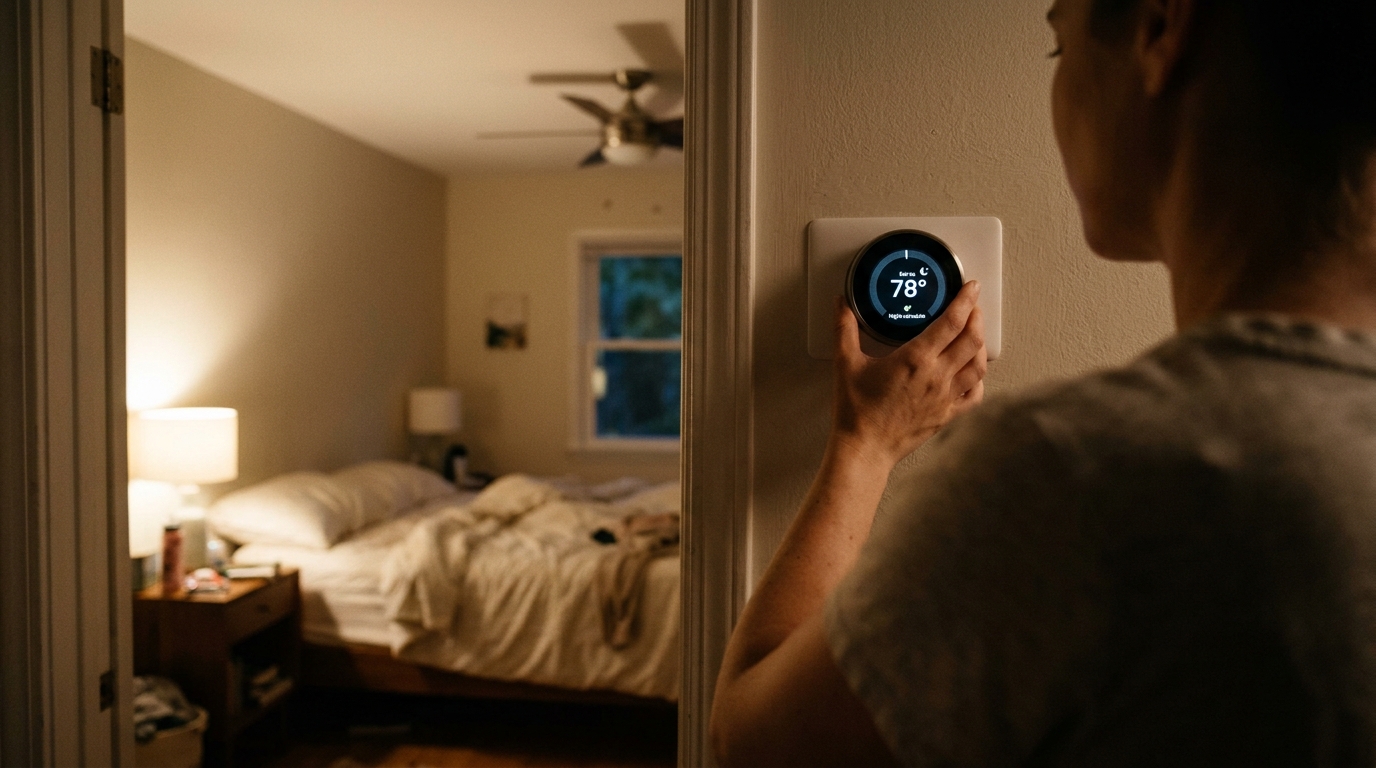
Here is a question worth asking: why does your air conditioner work just as hard at 3 a.m. as it does at 3 p.m.? For most homes with a manual thermostat, it does exactly that. You pick 72 degrees and the system defends that number around the clock, even while everyone is asleep under a blanket and perfectly comfortable at a warmer temperature.
Night setback is the practice of letting your home drift to a slightly warmer temperature for a set period, then bringing it back to your comfort setting before you need it. The Department of Energy estimates you can save roughly 1% on cooling costs for every degree you raise the thermostat setting for eight hours a day. Set it back 7 to 10 degrees for eight hours and the savings add up quickly, often 5 to 10% on a typical summer bill.
In this post, we will cover how night setback works, why summer setback needs a different strategy than winter setback, and two ways to put it in place: a free quick fix you can do tonight and a programmable or smart thermostat upgrade that automates everything. We will also cover the mistakes that cause people to give up on setbacks too early.
What You’ll Need
Click on an item below to shop for the recommended items for this recipe on Amazon.
As an Amazon Associate, we earn from qualifying purchases.
How to Do It
- Pick your daytime comfort setting, such as 74 or 75 degrees, and keep it as your baseline.
- At bedtime, raise the thermostat 3 to 5 degrees (for example, from 75 to 79). Start with a smaller bump if you are nervous about sleeping warm.
- Turn on a ceiling fan or place a small box fan near your bed, since moving air makes a warmer room feel noticeably cooler.
- Use lighter bedding, such as a cotton sheet instead of a comforter, so you are comfortable at the higher temperature.
- In the morning, lower the thermostat back to your daytime setting when you wake, and note how comfortable you were so you can adjust the next night.
- Turn off power to your HVAC system at the breaker, then remove the old thermostat cover and photograph the wire connections before touching anything.
- Label each wire with the terminal letter it connects to (R, C, Y, G, W) using the stickers that come with the new unit, then disconnect them and remove the old backplate.
- Mount the new backplate, connect the labeled wires to the matching terminals, and attach the thermostat. If you have no C wire, check whether your model includes a power adapter kit.
- Restore power and program a summer schedule: 75 degrees from 6 a.m. to 10 p.m. when you are home, 78 to 79 degrees from 10 p.m. to 5:30 a.m., and 80 degrees during work hours if no one is home.
- Set the recovery start so cooling begins 30 to 60 minutes before you wake or arrive home, rather than letting the system scramble at the last minute.
- Review energy reports or your bill after two to three weeks and tweak the setback depth by 1 to 2 degrees if you notice any discomfort.
- Have an HVAC technician confirm your system type, wiring, and whether a compatible smart thermostat or zoning control is the best fit.
- Ask about adding a separate sleeping-zone setpoint so bedrooms stay slightly cooler while unused rooms are set back further.
- Have the tech program staging and recovery settings for variable-speed or two-stage equipment so setback does not trigger inefficient emergency or auxiliary modes.
- Request a short walkthrough on the schedule and ask for a follow-up check after the first month of cooling season.
Why It Works: The Benefits
Raising the setpoint 7 to 10 degrees for 8 hours can reduce cooling costs by roughly 5 to 10%, which is $8 to $20 per month on a typical $150 summer bill.
Fewer run hours means fewer cycles on your compressor and blower motor, which can extend equipment life over a 10 to 15 year span.
Shifting some cooling away from late evening helps if your utility uses time-of-use rates, where evening electricity can cost 2 to 3 times more than overnight rates.
A ceiling fan on low adds a wind-chill effect that makes the room feel about 4 degrees cooler, so a 76 degree bedroom can feel like 72.
Once programmed, the savings happen every night without you thinking about it, which is where most of the long-term value comes from.
💰 Savings Impact by Action
Raising the setpoint 5 to 7 degrees for 8 overnight hours trims cooling use by roughly 5 to 10%
Letting the house reach 80 degrees while no one is home saves an additional 5 to 8% on weekdays
A ceiling fan lets you raise the setpoint about 4 degrees with no comfort loss, adding 3 to 5% in savings
Replacing a clogged filter can lower AC energy use by 5 to 15% and helps recovery time
Gradual pre-cooling before wake time avoids high-load catch-up runs and saves roughly 2 to 4%
🏠 Key Concepts Explained
The Science Behind It
Heat flows from warm to cool at a rate proportional to the temperature difference. On a 95 degree afternoon, a 75 degree house has a 20 degree gap driving heat through the walls, attic, and windows. Raise the indoor setpoint to 79 and that gap shrinks to 16 degrees, a 20% drop in the driving force behind heat gain. Your AC does not have to remove as much heat, so it runs less.
Night setback is especially effective because outdoor temperatures fall after sunset. When the outdoor air is 72 degrees at midnight and your house is allowed to sit at 78, the gap is only 6 degrees. Your AC may barely need to run at all for several hours, while a house held at 72 would be fighting a much larger gap earlier in the evening as stored heat releases from walls and attic.
The common objection is that the AC has to work harder to catch up in the morning. In practice, this does not erase the savings. Total heat gain over the period is lower because the house spent hours at a smaller temperature difference, and the energy needed to pull temperature back down is less than the energy you would have spent holding it low all night. The savings shrink only if recovery is rushed, which is why a gradual, timed recovery works best.
Frequently Asked Questions
▼ Why is my AC still running all day even after I set up a night setback?
Night setback only affects the hours it is active, so long daytime run times usually point to other issues such as a dirty filter, leaky ducts, poor attic insulation, or an undersized system. Replace the filter, check that supply vents are not blocked, and make sure your daytime setpoint is not set too low. If the AC runs continuously on a 90 degree day without ever cycling off, have a technician check refrigerant and airflow.
▼ Can renters do this without landlord permission?
Yes, the manual quick fix needs no permission at all, since you are just changing the temperature on the existing thermostat. A basic programmable thermostat swap is often allowed but check your lease, and if you do replace one, save the original and reinstall it when you move out. Window units and portable ACs can use a plug-in smart plug or timer to achieve a similar effect.
▼ How long before I actually notice savings on my bill?
You will see the effect on your next full billing cycle, typically 30 days. Compare your kilowatt-hour usage rather than the dollar amount, since rates and weather vary. Expect a 5 to 10% drop in cooling-related usage if the weather is similar to the prior month.
▼ What if my home is older than 30 years?
Older homes often have leakier ducts and less insulation, which means the house heats up faster when the AC is off, so keep the setback shallower at first, around 3 to 4 degrees. Air sealing and attic insulation will improve how well the house holds its temperature and make deeper setbacks comfortable. Even with some leakage, setback still saves money because the smaller temperature difference reduces heat gain.
▼ Will a setback damage my air conditioner?
No. Modern compressors are designed for normal on and off cycling, and raising the setpoint actually reduces run hours. The one thing to avoid is repeatedly switching the system on and off within a few minutes, which smart thermostats prevent automatically with built-in minimum off timers.
Quick Tips
- Start with a modest 3 to 4 degree setback for the first week, then add a degree every few nights until you find your limit.
- Pair your setback with a ceiling fan set to counterclockwise in summer, which pushes air down and boosts the cooling effect on skin.
- Close blinds and curtains on sun-facing windows during the day so the house starts the evening with less stored heat.
- If you have time-of-use electricity rates, ask your utility whether a pre-cooling strategy (cooling slightly more in the afternoon before peak rates) makes sense for you.
Variations for Your Situation
- Apartment/Rental: Use the manual quick fix with a 3 to 4 degree bump at bedtime, plus a $25 to $40 box fan or tower fan for airflow. If you have a window unit, a $10 to $15 smart plug or mechanical timer can shut it off or cycle it overnight, and a $15 plug-in thermostat controller can hold a specific temperature without touching the unit itself.
- Tight Budget (under $50): Skip new hardware. Raise your thermostat 4 degrees at bedtime, run a fan you already own, close blinds during the day, and swap in a clean $5 to $15 air filter. These steps alone can deliver most of the savings. If you want automation, a basic programmable thermostat runs $30 to $50 and often pays for itself within one summer.
- Older Home (pre-1980): Expect faster warm-up overnight because of higher air leakage and thinner insulation, so start with a 3 degree setback and add a bedroom fan. Sealing attic bypasses with a $10 can of spray foam and adding insulation toward R-38 will help the house hold temperature, which makes deeper setbacks more comfortable and increases total savings.
- Hot and Humid Climate: Limit setbacks to 2 to 4 degrees and keep the fan running to avoid humidity buildup. If your indoor relative humidity climbs above 55 to 60%, reduce the setback or add a dehumidifier.