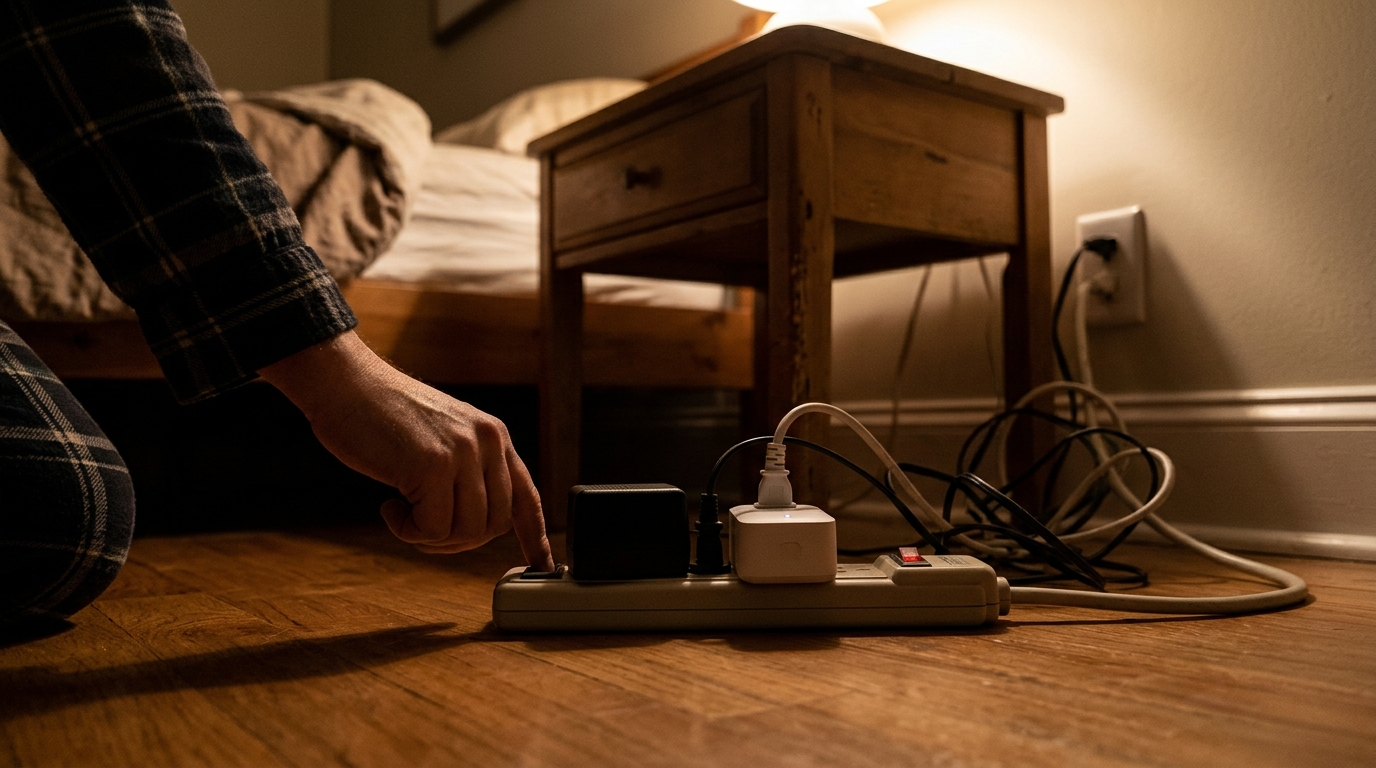
You are lying in a quiet bedroom and you hear it: a thin, steady buzz coming from somewhere near the wall. Nine times out of ten the source is a small power adapter, a smart plug, a phone charger, or a plug-in transformer for a doorbell, landscape light, or LED strip. These devices convert 120-volt household power into a lower voltage, and the parts inside can physically vibrate at 60 Hz (twice that, 120 Hz, in many cases) when they are loaded wrong, cheaply built, or starting to fail.
A hum is more than an annoyance. Cheap switching power supplies and older iron-core transformers can draw 1 to 5 watts continuously even when the device they feed is off. Across a handful of devices, that adds up to roughly 10 to 45 kWh per year, which is a small but real cost. More importantly, a loud buzz or a warm, vibrating housing can be an early warning sign of a failing component, and a failing power supply is worth replacing before it becomes a heat or fire concern.
This post walks through why these devices hum, a no-cost quick fix you can do tonight, and a more permanent DIY upgrade. You will also get troubleshooting answers, options for renters and tight budgets, and clear guidance on when to stop and call an electrician.
What You’ll Need
Click on an item below to shop for the recommended items for this recipe on Amazon.
As an Amazon Associate, we earn from qualifying purchases.
How to Do It
- Find the source by unplugging suspect devices one at a time at night. Hold your hand near each adapter (do not grip hot ones) and listen closely. Warm to the touch is normal; too hot to hold for a few seconds is not.
- Move the device to a different outlet, ideally one on a different circuit. If the hum changes or vanishes, the original outlet or its wiring may be the cause.
- Stop surface amplification: lift the adapter off hard surfaces, unplug it from a loose wall plate, or place a small piece of felt or rubber pad under a power strip so it is not buzzing against wood or tile.
- Check the load. If a plug-in transformer feeds just one tiny LED, add the load it was designed for, or if it feeds many lights, remove a few to bring it under about 80 percent of its rated wattage.
- If the hum only appears when the connected device is off, unplug the adapter entirely when not in use or put it on a switched outlet or timer so it is powered only when needed.
- Read the label on the old adapter and note output voltage, whether it is AC or DC, and the maximum amperage or wattage. Take a photo so you can match it exactly.
- Buy a certified replacement with the same voltage and equal or slightly higher amperage. Look for DOE Level VI efficiency marking, which means lower no-load power draw (typically under 0.5 watts).
- For a smart plug that hums, replace it with a different model. Cheap units with mechanical relays can buzz or click, while solid-state or higher-quality relays are typically quieter.
- For a buzzing dimmer, swap it for an LED-rated dimmer sized to your total bulb wattage, and confirm your bulbs are labeled dimmable. Turn off the breaker before touching any wall wiring.
- For doorbell or low-voltage landscape transformers, replace an older iron-core unit with a modern one rated for your total load, and mount it firmly so it cannot vibrate against a wall or panel.
- Test at night, then recheck after a day of use. A properly matched, healthy adapter should be silent or nearly silent and only slightly warm.
- Describe where the noise is loudest and when it occurs (all the time, only with certain lights on, only when the AC runs) so the electrician can narrow it down quickly.
- Have the electrician test outlets and the circuit for loose connections, overloaded circuits, or a failing breaker, which can all buzz.
- Ask them to inspect hard-wired transformers (such as low-voltage lighting or doorbell transformers in the wall or attic) and replace or re-secure any that are loose or failing.
- Consider upgrading to quiet, properly rated dimmers or drivers throughout a problem lighting circuit rather than fixing them one at a time.
Why It Works: The Benefits
Even low-level steady noise around 30 to 40 decibels can disturb light sleepers. Eliminating a constant buzz in the bedroom removes a common, easily avoidable sleep disruptor.
Replacing a hot, humming 2 to 5 watt adapter with an efficient modern one that draws under 0.5 watts can save roughly 15 to 40 kWh per device per year, about $2 to $7 at typical U.S. rates.
A louder hum, a hot housing, or a crackling sound often shows up before a power supply fails. Catching it early lets you replace a $10 adapter before it causes a device failure or a safety issue.
Right-sizing the load keeps adapters and drivers from running hot, and heat is the main killer of small power electronics. Cooler operation can noticeably extend service life.
Consolidating or removing unneeded always-on adapters reduces clutter and the number of constant-draw devices running in the background.
💰 Savings Impact by Action
Replacing a high-draw adapter with a DOE Level VI unit trims that device’s no-load power by 80 to 90 percent, which lowers total household standby use by roughly 5 to 10 percent.
Right-sizing the load can cut an adapter’s wasted heat by up to 25 percent, which also extends its service life.
Powering a seldom-used adapter only when needed with a switched strip or timer can eliminate up to 30 percent or more of its yearly draw.
Isolating or replacing the vibrating source typically removes about 90 percent of the audible buzz in a quiet bedroom.
🏠 Key Concepts Explained
The Science Behind It
Most hums come from simple mechanical physics. A transformer works by passing alternating current through a coil wrapped around an iron core. As the current reverses direction 60 times each second, the core’s magnetic field flips with it, and the iron physically changes shape by a microscopic amount. That repeated flexing, called magnetostriction, produces sound at 120 Hz (twice the line frequency) and its harmonics. In a well-built transformer the core is clamped tight and the sound is barely audible. In a cheap or aging unit, loose laminations vibrate freely and the hum gets louder.
Modern plug-in adapters and smart plugs mostly use switching power supplies, which chop the incoming power at tens of thousands of cycles per second. That is above human hearing, but under light loads the circuit can drop into a burst or skip mode that creates lower-frequency pulses you can hear as a buzz or whine. This is why adding a small steady load, or choosing a unit with better regulation, can quiet it. Smart plugs add another noise source: the mechanical relay that switches power can buzz or chatter if the coil is weak or the load is inductive.
Energy use ties directly to noise. Efficient, well-matched supplies waste very little as heat or sound, and DOE Level VI standards cap no-load draw at roughly 0.1 to 0.5 watts depending on size. Older or cheap units can waste several watts as heat and vibration around the clock. At 3 watts continuous, one adapter uses about 26 kWh per year, so quieting and upgrading it recovers both your sleep and a small amount of money.
Frequently Asked Questions
▼ Why does my smart plug buzz even when nothing is plugged into it?
The internal relay and the always-on Wi-Fi radio power supply can both produce a faint hum, especially in cheaper models. Try a different outlet, and if it persists, replace it with a model from a reputable brand that uses a quieter relay. If it is also warm or smells odd, unplug it immediately.
▼ Is a humming transformer dangerous?
A faint, steady hum from a cool adapter is usually normal and harmless. It becomes a concern if the unit is hot to the touch, the hum is getting louder over time, you smell burning, or you see discoloration or melting. In those cases, unplug it and replace it with a certified unit.
▼ Why does my dimmer hum only when the lights are partly dimmed?
The dimmer chops the AC waveform when lowered, and that can make the dimmer, the bulb filaments, or the LED drivers vibrate at audible frequencies. Switch to an LED-rated dimmer matched to your total wattage and confirm every bulb on the circuit is labeled dimmable. If it still hums, an electrician can check for a loose connection.
▼ Will fixing the hum actually lower my electric bill?
If the hum came from an inefficient or overloaded adapter, replacing it can save roughly 15 to 40 kWh per year per device, or about $2 to $7 at average rates. The savings are modest per device, but they add up across a home with many adapters, and the real payoff is quieter nights and safer equipment.
▼ The hum seems to come from inside the wall. What should I do?
Do not open the wall or the panel yourself. Noise from inside a wall, a breaker panel, or a hard-wired fixture can point to loose connections or an overloaded circuit. Turn off power to the affected circuit if you can do so safely, and call a licensed electrician to inspect it.
Quick Tips
- Do the ‘one at a time’ unplug test at night when the house is quiet, so you can pinpoint the exact source in minutes instead of guessing.
- Match adapter capacity to the load: aim to run at roughly 50 to 80 percent of rated wattage, neither maxed out nor nearly empty.
- Look for DOE Level VI or ENERGY STAR labeling on replacement adapters to get the lowest standby draw.
- Mount low-voltage transformers firmly on a solid surface and use felt or rubber pads under power strips to stop vibration from turning into audible noise.
Variations for Your Situation
- Apartment/Rental: You cannot touch the wiring, so focus on plug-in fixes. Move devices to different outlets, put a switched power strip ($8 to $15) on the bedside circuit, and swap any noisy plug-in adapters or smart plugs for quality replacements. Report any buzzing from a wall outlet or built-in fixture to your landlord rather than opening it yourself.
- Tight Budget (under $50): Skip new purchases at first. Do the unplug-one-at-a-time test, relocate noisy adapters, put them on felt pads or a hard-to-vibrate surface, and unplug unused chargers at night. If one adapter is clearly the culprit, a $10 to $15 certified replacement is usually the only spend needed.
- Older Home (pre-1980): Older homes often have ungrounded two-prong outlets, worn receptacles, and original iron-core doorbell transformers that hum louder with age. Have a licensed electrician check outlet condition and any hard-wired transformers, and consider replacing a decades-old doorbell transformer with a modern one (typically $100 to $200 installed).