Your water heater is one of the top three energy users in your home, typically accounting for 14 to 18% of your total utility bill. But here is the part most homeowners never hear: the factory default temperature on most water heaters is 140°F, which is hot enough to cause third-degree burns in just five seconds of skin contact. That extra heat costs you real money every single month, and it is sitting right there waiting to be fixed.
The U.S. Department of Energy recommends setting your water heater to 120°F for most households. At that temperature, water is still plenty hot for showers, dishes, and laundry, but your heater spends far less energy fighting standby heat loss, and the scalding risk drops dramatically. For households with young children, elderly family members, or anyone with reduced sensation, this adjustment is not just a money saver, it is a safety upgrade.
This post walks you through exactly how to find your water heater’s temperature dial, what setting to choose, and when a simple dial adjustment is not enough. We cover gas and electric models, tankless systems, and what to do if your unit does not have a clearly marked thermostat.
What You’ll Need
Click on an item below to shop for the recommended items for this recipe on Amazon.
As an Amazon Associate, we earn from qualifying purchases.
How to Do It
- Locate your water heater, typically in a utility closet, basement, or garage. Confirm whether it is a gas or electric model before touching anything.
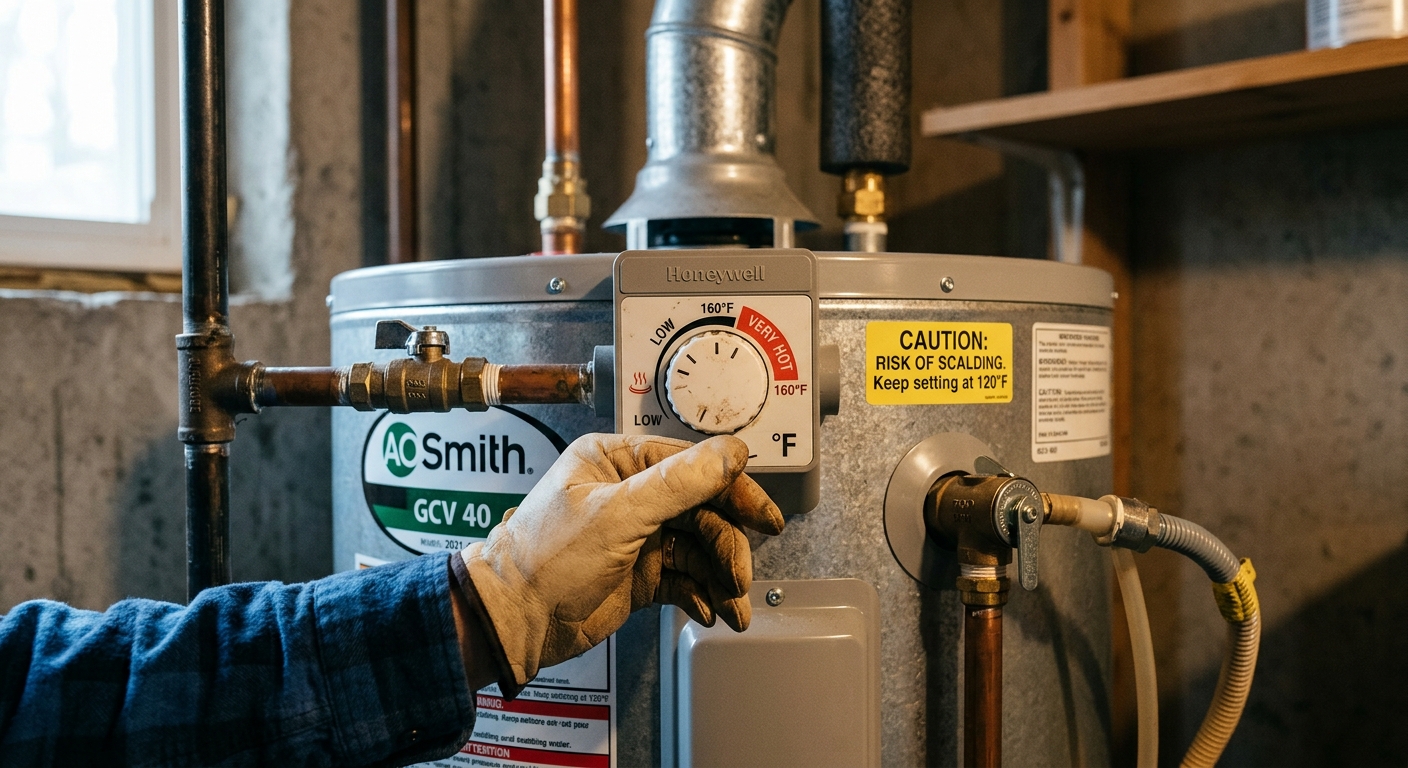
- For a gas water heater, find the dial on the gas valve near the bottom of the tank. It will have markings such as Hot, A, B, C, or actual degree labels. Turn it to the 120°F position or the lowest Hot setting if degrees are not marked.
- For an electric water heater, turn off the circuit breaker for the unit before proceeding. Remove the access panel cover using a screwdriver, fold back the insulation carefully, and locate the plastic thermostat dial. Most electric heaters have two thermostats, one upper and one lower. Set both to 120°F using a flathead screwdriver.
- Replace the insulation and access panel, then restore power at the breaker.
- Wait two to three hours for the tank to stabilize, then test the temperature at the tap farthest from the heater by running hot water for two minutes and using a cooking or candy thermometer. Adjust by five-degree increments if needed.
- Purchase an instant-read kitchen thermometer or a dedicated water temperature thermometer rated to at least 140°F if you do not already own one.
- Before adjusting anything, run the hot water at the faucet farthest from your water heater for two full minutes to purge any cooled water sitting in the pipes.
- Fill a cup and immediately check the temperature. Record this baseline reading to understand exactly how hot your water currently is.
- Adjust the thermostat dial toward 120°F using the steps from the Quick Fix approach above. If your dial is not marked in degrees, move it one notch lower than its current position.
- Wait two to three hours for the tank to fully reheat to the new setpoint, then retest at the same faucet using the same two-minute flush method.
- If the reading is above 125°F, turn the dial down slightly and retest after another two hours. If it reads below 115°F, nudge it up. The target range is 118°F to 122°F at the tap for optimal safety and efficiency.
- Purchase a thermostatic mixing valve, also called a tempering valve or anti-scald valve, rated for potable water. Common brands include Watts and Caleffi. Match the valve size to your supply line diameter, typically half an inch.
- Shut off the water supply to the heater and drain several gallons from the drain valve to relieve pressure.
- Install the mixing valve on the hot water outlet at the top of the heater according to the manufacturer’s instructions. The valve blends the outgoing hot water with cold supply water to deliver a consistent mixed temperature.
- Set the tank thermostat to 140°F to maintain Legionella control, then adjust the mixing valve’s output dial to 120°F.
- Restore water supply, check all connections for leaks, and verify the delivered temperature at your farthest tap using a thermometer after two to three hours.
- If you are not comfortable soldering or working with water supply lines, hire a licensed plumber for this step. Labor typically runs $100 to $150 and the whole job is usually done in under an hour.
Why It Works: The Benefits
The DOE estimates that reducing water heater temperature from 140°F to 120°F saves 4 to 22% on water heating costs, translating to roughly $30 to $90 per year for a typical household depending on fuel type and usage.
At 120°F, a serious burn requires minutes of exposure rather than seconds, dramatically reducing injury risk for children, elderly residents, and anyone who cannot quickly pull away from hot water.
Running at lower temperatures slows mineral scale accumulation on heating elements and tank walls, potentially adding one to three years to your water heater’s service life and reducing the frequency of element replacements.
Lower water temperatures reduce thermal stress on plastic fittings, flexible connectors, and pipe joints throughout your home, decreasing the chance of slow leaks or fitting failures over time.
Households with infants, toddlers, elderly family members, or anyone on medications that reduce pain sensation benefit significantly from the lower scald threshold, turning a two-minute adjustment into a meaningful safety measure.
💰 Savings Impact by Action
Lowering from 140°F to 120°F reduces water heating energy use by 4 to 22%, with 10% as a realistic midpoint for most households based on DOE data.
Reducing the temperature differential between tank water and the surrounding room cuts continuous standby heat loss by roughly 15% on a typical older tank.
Lower starting temperatures reduce heat wasted in distribution pipes during transit, saving an additional 5 to 10% in homes with long pipe runs.
Pairing a 140°F tank setpoint with a thermostatic mixing valve delivers up to 18% energy savings by allowing higher storage temps for bacterial control while limiting delivered temperature.
🏠 Key Concepts Explained
The Science Behind It
Water heaters maintain temperature by cycling on and off to counteract heat loss through the tank walls. This is called standby loss, and it is a constant drain on your energy bill even when nobody is using hot water. The rate of heat loss through the tank wall is governed by the temperature differential between the water inside and the air outside. Physics tells us that heat flows faster when this gap is larger. At 140°F in a 68°F utility room, the differential is 72 degrees. At 120°F, it drops to 52 degrees, a 28% reduction in the temperature driving force behind standby loss.
The specific energy savings depend on your tank’s insulation quality, its age, and how well the surrounding space is conditioned. Older tanks with thin insulation lose heat more aggressively, so they benefit the most from a setpoint reduction. Newer tanks built to ENERGY STAR standards already have better foam insulation, meaning the savings are smaller in absolute terms but still meaningful over months and years. The DOE’s range of 4 to 22% reflects this variability across different equipment ages and home configurations.
The Legionella question comes up frequently, and it is legitimate. The bacteria grow most aggressively between 77°F and 113°F and are killed when water is held above 122°F for an extended period. A properly functioning water heater set to 120°F keeps the entire tank body above the bacterial growth range, making it safe for healthy households. The 140°F recommendation applies specifically to homes with immunocompromised residents, very large storage tanks where cold and hot zones can stratify, or homes with long recirculation loops where the water temperature may drop significantly before reaching the tap.
Frequently Asked Questions
▼ I turned down my water heater but the water still feels scalding hot. What is going on?
Many water heater dials are poorly calibrated and do not accurately reflect the actual water temperature. Use a cooking thermometer at the farthest tap after a two-minute flush to check the real delivered temperature. If it reads above 125°F despite your adjustment, turn the dial down further in five-degree increments and retest after a two to three hour wait each time.
▼ Will lowering the temperature cause Legionnaires’ disease?
For most households, 120°F is safe. Legionella bacteria are killed above 122°F, and a tank set to 120°F maintains water well above the bacterial growth range of 77°F to 113°F. The risk is higher in large commercial tanks, systems with recirculation loops, or homes with immunocompromised residents. If any of those apply, keep the tank at 140°F and install a thermostatic mixing valve at the outlet to deliver 120°F water at the tap.
▼ Can renters adjust the water heater temperature?
It depends on your lease and whether the water heater is inside your unit or in a shared mechanical room. If the heater is inside your apartment and accessible to you, most landlords consider the temperature dial a routine adjustment similar to a thermostat. Still, it is worth a quick note to your landlord or property manager so they are aware. If the heater is shared or locked, request the adjustment in writing as a safety concern, especially if you have children.
▼ How long before I see savings on my energy bill?
The savings begin immediately on the first full billing cycle after the adjustment. For most households, water heating is billed as part of your overall gas or electric statement, so the change shows up within 30 days. The savings are modest per month, typically $3 to $8, but they compound to $30 to $90 per year with zero ongoing effort or maintenance required.
▼ My water heater does not have a clearly marked temperature dial. How do I find the right setting?
Gas heaters often use letter labels such as A through E or word labels such as Warm, Hot, and Very Hot, with Hot typically corresponding to roughly 120°F to 130°F. Set it to Hot and verify with a thermometer at the tap. Electric heaters almost always have a numbered dial behind the access panel, which requires a screwdriver and breaker shutoff to access. If you cannot locate a dial at all, check the owner’s manual online using the model number printed on the heater’s label.
Quick Tips
- Check both thermostats on an electric water heater. The upper and lower elements each have their own dial, and mismatched settings cause inefficient cycling and inconsistent water temperature.
- If you notice the hot water running out faster after lowering the temperature, your household’s hot-to-cold mixing ratio at the tap will shift. You may need to open the hot valve a little more, which is completely normal and does not mean the heater is undersized.
- Flush two to three gallons from the drain valve once a year to remove sediment buildup. This improves heating efficiency and makes your thermostat readings more accurate regardless of what setting you use.
- If you have a tankless water heater, the temperature adjustment is made directly on the digital control panel. Set it to 120°F and confirm at the tap, since tankless units are generally well calibrated from the factory.
Variations for Your Situation
- Apartment or Rental: If your water heater is inside your unit, the dial adjustment costs nothing and takes five minutes. Use a cooking thermometer to confirm the delivered temperature and document it with a photo. If the heater is shared or inaccessible, contact your landlord in writing citing scalding risk and the DOE recommendation for 120°F. Many landlords will comply quickly when framed as a liability issue for the property.
- Tight Budget (Under $20): The dial adjustment itself is completely free. If you do not own a thermometer, a basic cooking thermometer costs $8 to $12 at any grocery or hardware store and doubles as a kitchen tool. Skip the mixing valve entirely and focus on confirming your tap temperature with the thermometer. This zero-to-minimal-cost fix still captures the full energy savings.
- Older Home (Pre-1980): Water heaters in older homes are often original or only partially updated, with degraded insulation and poorly calibrated thermostats. These units lose more standby heat and benefit the most from a setpoint reduction. Be aware that very old tanks may have non-functional or stuck thermostats, making dial adjustments unreliable. If your thermometer test shows no change in tap temperature after a dial adjustment and a three-hour wait, have a plumber inspect the thermostat. If the unit is more than 15 years old, budget for replacement with a modern high-efficiency unit, which pays back in two to four years through energy savings alone.