Your home is the most expensive thing you own, and it runs on dozens of interconnected systems, from your HVAC and water heater to your roof and foundation. Without a plan, it is easy to forget the small, inexpensive tasks that prevent big, expensive failures. A dirty air filter that costs $8 to replace can cause your HVAC system to fail prematurely, turning a routine swap into a $5,000 to $12,000 compressor replacement. That is not a hypothetical. It happens to tens of thousands of homeowners every year.
The good news is that a simple, well-timed maintenance calendar can prevent most of those surprises. Studies from the National Association of Home Builders and consumer data from home warranty providers consistently show that homes with documented, routine maintenance schedules spend 25 to 35 percent less on emergency repairs over a 10-year period. More importantly, properly maintained HVAC systems, water heaters, and building envelopes operate 15 to 20 percent more efficiently than neglected ones, showing up directly on your monthly energy bills.
In this post, you will learn how to build a home maintenance calendar that fits your life, whether you want a simple paper checklist or a fully automated digital reminder system. We will cover the timing logic behind each task, the real cost of skipping them, and how to prioritize when money or time is tight. By the end, you will have a working system you can set up this weekend and actually stick to.
What You’ll Need
Click on an item below to shop for the recommended items for this recipe on Amazon.
As an Amazon Associate, we earn from qualifying purchases.
How to Do It
- Download a free 12-month calendar template or open a spreadsheet. Create one column per month and one row per home system: HVAC, plumbing, electrical, exterior, appliances, and safety devices.
- Assign each recurring task to its correct month using this baseline schedule: HVAC filter every 1 to 3 months, furnace tune-up in September or October, AC tune-up in April or May, gutter cleaning in November and April, water heater flush in October, dryer vent cleaning in February, smoke and CO detector tests in March and September, and exterior caulk inspection in May.
- Add your specific equipment by writing the brand, model, and install year next to each system row. For example, ‘Carrier AC, model 24ACC636, installed 2019.’ This makes it easy to look up manufacturer intervals and track warranty periods.
- Set a recurring alarm on your phone for the first Saturday of each month labeled ‘Check Home Calendar.’ Use that 5-minute check to see what that month requires and order any supplies in advance.
- After completing each task, write the date and a brief note in the cell. For example, ‘Oct 14, changed filter, MERV 8.’ This log becomes invaluable when selling the home or diagnosing recurring problems.
- Keep the calendar in a visible location, on the refrigerator, inside a kitchen cabinet door, or in a dedicated home binder with equipment manuals and warranty cards.
- Choose your platform. Google Calendar is free and works on any device. HomeZada ($9.99 per month) adds room-by-room inventory, maintenance logs, and estimated repair costs. Centriq (free tier available) lets you scan appliance barcodes to auto-populate service schedules from manufacturer data.
- Create a dedicated calendar called ‘Home Maintenance’ separate from your personal calendar. This keeps tasks visible without cluttering your schedule and allows you to share it with a spouse or partner.
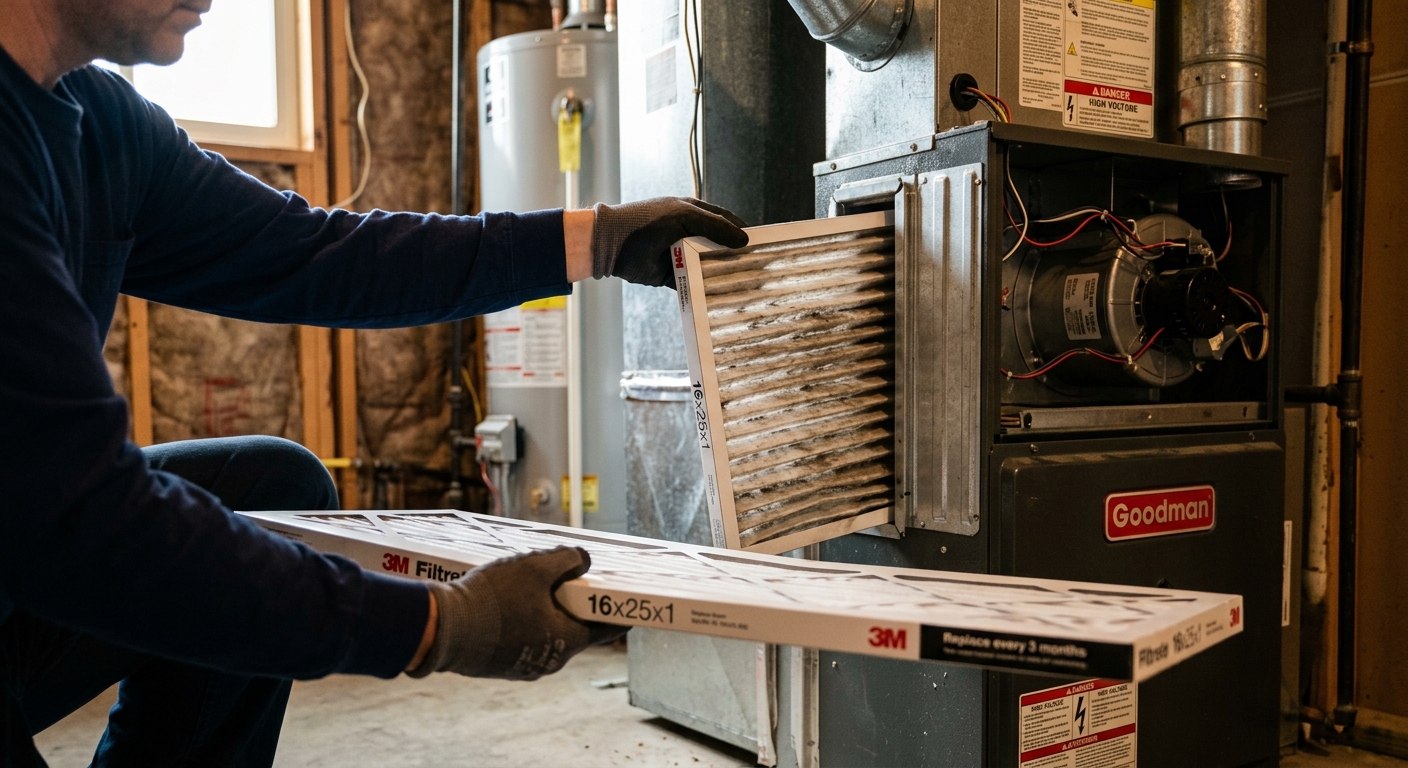
- Enter every recurring task as a repeating event with a reminder set 3 days in advance. Use specific event titles like ‘Replace HVAC Filter, MERV 8, 16x25x1’ so you know exactly what to buy without hunting for the size. Set monthly filter checks, semi-annual gutter cleaning, and annual appliance service events all at once in one setup session.
- Add a notes field to each recurring event with the last service date, the technician’s contact information if applicable, and the expected cost. Update this field immediately after completing each task so the record stays current.
- Photograph your equipment tags, filter sizes, water heater specs, and breaker box labels with your phone and store them in a shared cloud album linked to your home calendar. This eliminates the common problem of forgetting the filter size or water heater model number when you are standing in the hardware store.
- Once per quarter, spend 15 minutes reviewing the next 3 months of tasks. Reschedule anything that conflicts with travel, consolidate tasks that can be done on the same day, and order consumables like filters and batteries in bulk to reduce per-unit cost by 20 to 30 percent.
- Set up the digital calendar as described in the DIY approach, then identify the three professional anchors your home needs every year: HVAC tune-up in fall and spring ($80 to $150 each), plumbing inspection every 1 to 2 years ($100 to $200), and electrical panel inspection every 3 to 5 years ($150 to $300).
- Book your HVAC tune-ups in advance, ideally in August for fall heating prep and in March for spring cooling prep, before technicians are fully booked. Many HVAC companies offer a 10 to 15 percent discount for pre-booked annual service agreements.
- Build a vetted contractor shortlist with at least one licensed contact for HVAC, plumbing, electrical, and roofing. Store their numbers in your phone and in your home binder. Having a trusted contact before an emergency saves you from making rushed decisions and paying premium rates.
- Create a home maintenance budget line item in your household budget. The standard recommendation from financial planners is to reserve 1 to 2 percent of your home’s value annually for maintenance. On a $350,000 home, that is $3,500 to $7,000 per year. Track actual spending in your calendar app to see how you compare.
- After each professional service, scan or photograph the invoice and attach it to the corresponding calendar event. This creates a documented service history that is useful for warranty claims, home sales, and insurance documentation.
- Review the entire maintenance log once per year in January. Note which systems required unexpected repairs, check whether any equipment is approaching end of life based on install date and typical lifespan, and adjust your budget and calendar accordingly for the coming year.
Why It Works: The Benefits
Homeowners who follow a documented maintenance schedule report 25 to 35 percent fewer emergency repair calls over a decade. Emergency service calls carry a premium of $150 to $300 just for after-hours dispatch before any labor or parts.
Properly maintained HVAC systems, water heaters, and building envelopes use 15 to 20 percent less energy than neglected equivalents. On a $200 monthly energy bill, that is $360 to $480 in annual savings from maintenance tasks that cost far less to perform.
A well-maintained central AC system lasts 15 to 20 years versus 10 to 12 years for a neglected one. Replacing a central system costs $5,000 to $12,000, so extending its life by even 3 to 5 years through $100 to $200 per year in tune-ups delivers thousands in deferred capital expense.
Buyers and home inspectors notice maintained versus unmaintained homes. According to National Association of Realtors data, documented maintenance records can add 1 to 3 percent to a home’s perceived value and reduce negotiated price reductions after inspection by an average of $2,000 to $5,000.
A calendar eliminates the mental load of tracking what needs attention. Knowing your furnace was serviced in October and your gutters were cleared in November means you are not constantly wondering what you might have missed.
💰 Savings Impact by Action
Replacing filters on schedule reduces blower energy consumption by 10 to 15 percent and prevents premature system failure costing $5,000 or more.
A professional tune-up restores system efficiency by cleaning coils and calibrating refrigerant charge, cutting seasonal energy use by up to 12 percent.
Removing sediment annually restores heat transfer efficiency, reducing water heating energy use by up to 10 percent and extending tank life by 3 to 5 years.
Recaulking and replacing weatherstripping every 3 to 5 years prevents conditioned air loss responsible for up to 20 percent of heating and cooling waste.
A clean dryer vent reduces drying time per load by up to 25 percent, directly cutting appliance energy use and eliminating a leading residential fire hazard.
🏠 Key Concepts Explained
The Science Behind It
Home systems fail in predictable ways governed by physics and material science, not random bad luck. HVAC systems, for example, depend on unrestricted airflow to maintain proper heat transfer across the evaporator and condenser coils. When a filter becomes clogged, static pressure increases and the blower motor draws more current to compensate, running hotter and wearing faster. This is the same principle as trying to breathe through a cloth mask during exercise. The restriction does not stop the process, it just makes the system work much harder to achieve the same result.
Water and moisture are the primary forces of decay in residential construction. Gutters exist to direct water away from your foundation and fascia. When they clog, water overflows against the building envelope, saturating wood framing and causing rot that progresses at roughly 0.25 to 0.5 inches per year once established. A single cleaning costs $100 to $200 professionally. Replacing a rotted fascia board and soffit section runs $400 to $800. Repairing foundation water intrusion can reach $5,000 to $15,000. The timing of maintenance tasks is engineered around natural decay cycles. Cleaning gutters in November clears fall leaf debris before winter ice loads, and cleaning again in April removes any winter accumulation before spring rains peak.
Thermal cycling is a slower but equally important force. Every material in your home, from caulk and weatherstripping to roof flashing and pipe joints, expands and contracts with temperature changes. A typical residential building experiences 60 to 80 significant thermal cycles per year in most U.S. climates. Over 3 to 5 years, this fatigue cracks caulk seals and compresses weatherstripping to the point where it no longer seals. Scheduling an envelope inspection every spring means you catch these failures before heating or cooling season, when they would otherwise bleed conditioned air and raise your monthly bills by 10 to 20 percent.
Frequently Asked Questions
▼ I set up a maintenance calendar last year but never actually did the tasks. How do I build the habit?
The most effective fix is reducing friction. Move your calendar to a physical location you see daily, like the inside of your kitchen cabinet door, or add a monthly recurring alarm on your phone that simply says ‘Do 1 home task today.’ Pair the monthly check with something you already do, like paying bills or doing laundry. Start with just two or three high-priority tasks like filter changes and smoke detector tests until the habit forms, then expand.
▼ How do I know when my equipment is due for replacement versus just maintenance?
Use the average lifespan benchmarks from NAHB: central AC lasts 15 to 20 years, gas furnaces 15 to 20 years, water heaters 8 to 12 years for tank models, and roofing shingles 20 to 30 years depending on type. When equipment reaches 75 percent of its expected lifespan and requires a repair costing more than 50 percent of a new unit, replacement is usually the better financial decision. Track your install dates in your maintenance calendar from day one.
▼ I rent my home. Can a maintenance calendar still help me?
Yes, significantly. Renters are responsible for tasks that do not require modifying the unit: replacing HVAC filters if your lease requires it, testing smoke and CO detectors, cleaning the dryer lint trap and vent screen, and reporting early signs of leaks or damage to your landlord in writing. Documenting that you reported issues promptly protects your security deposit and establishes a record if disputes arise. Focus your calendar on tenant-controlled tasks and communication logs.
▼ What are the absolute highest-priority tasks if I can only do a few per year?
Prioritize in this order based on risk and ROI: replace HVAC filters every 1 to 3 months, test smoke and CO detectors twice per year, clean gutters in fall, have HVAC serviced annually before heating season, and flush the water heater once per year. These five categories prevent the most common and most expensive home failures. Everything else is important but secondary.
▼ My home is over 40 years old. Is the standard maintenance calendar still appropriate?
The standard calendar applies but needs additions specific to older construction. Add a plumbing inspection every 2 years to check for galvanized steel pipe corrosion, which causes water quality issues and pressure loss. Have your electrical panel evaluated if it has not been inspected in the last 10 years, especially if you have a Federal Pacific or Zinsco panel, which have documented safety concerns. Add attic insulation inspection to your spring exterior walk, as older homes often have settled or degraded insulation reducing R-value.
Quick Tips
- Buy HVAC filters, batteries, and smoke detector units in bulk once per year. Buying a 6-pack of filters at once typically cuts the per-unit cost by 20 to 30 percent compared to single purchases.
- Test smoke and carbon monoxide detectors when you change your clocks in March and November. This twice-yearly habit is easy to remember and meets the testing interval recommended by the National Fire Protection Association.
- Flush your water heater in October before heating season so it operates at peak efficiency during the months of highest energy use. Turn the thermostat to the Pilot setting, connect a garden hose to the drain valve, and flush until the water runs clear, typically 10 to 15 minutes.
- Take a slow walk around the exterior of your home every spring with a notepad. Look for caulk cracks at window and door frames, gaps at penetrations where pipes or wires enter the wall, damaged weatherstripping, and any signs of wood rot or moisture staining. Catching these visually early prevents structural repairs later.
Variations for Your Situation
- Apartment or Rental: Focus your calendar on the tasks under your control as a tenant. Replace HVAC filters if your lease or landlord permits it, clean your dryer lint screen after every load and the vent housing quarterly, test your smoke and CO detectors monthly, and document any issues you report to your landlord with dates and photos. Use a free app like Google Keep or a notes app to log communications. This protects your deposit and helps you identify patterns like a slow drain that suggests a bigger issue.
- Tight Budget (under $50 per year): Start with zero-cost and near-zero-cost tasks that deliver the highest ROI. Changing a $8 HVAC filter every 2 months costs under $50 annually and prevents the most common HVAC failures. Testing smoke detectors is free. Clearing dryer lint and checking visible caulk costs nothing. Cleaning gutters yourself with a $10 bucket and gloves takes 45 minutes and prevents hundreds in potential water damage. Build the habit with these first before adding paid services.
- Older Home (pre-1980): Layer additional inspections onto the standard calendar. In year one, invest in a one-time professional assessment of your electrical panel, plumbing lines, and attic insulation to establish a true baseline. Add galvanized pipe monitoring, check under sinks and around the water heater for rust-colored water, twice per year. Inspect window glazing compound and wood sills in spring, as single-pane windows common in this era lose their seals faster. Budget 1.5 to 2 percent of home value annually rather than the standard 1 percent, as older homes typically require more frequent intervention.