Few household sounds are as persistently maddening as a squeaky floor. Whether it wakes up the baby every time you cross the hallway at night or embarrasses you every time a guest walks through the living room, that creak is more than a nuisance. It is a symptom of your subfloor shifting, flexing, or pulling away from the structural joists beneath it – and ignoring it usually makes it worse over time.
The good news is that most squeaky floors under carpet can be fixed without any demolition. Specialized tools and techniques let you drive fasteners through carpet pile without damaging fibers, or inject powdered lubricant between layers to stop the friction causing the noise. No carpet removal, no flooring contractor, no weekend-long project. Many homeowners solve this problem in a single lunch break.
This guide covers two proven approaches: a true 15-minute fix using a squeak elimination kit, and a slightly more involved DIY method for persistent or widespread squeaks. You will also find the building science behind why floors squeak in the first place, troubleshooting answers for stubborn cases, and tips for hardwood floors covered by area rugs.
What You’ll Need
Click on an item below to shop for the recommended items for this recipe on Amazon.
As an Amazon Associate, we earn from qualifying purchases.
How to Do It
- Walk slowly across the squeaky area and mark the loudest spot with a piece of tape. The squeak is loudest directly over the problem fastener or panel edge.
- Use a stud finder to locate the nearest floor joist beneath the subfloor. Most joists run parallel and are 16 inches apart. Mark the joist location clearly.
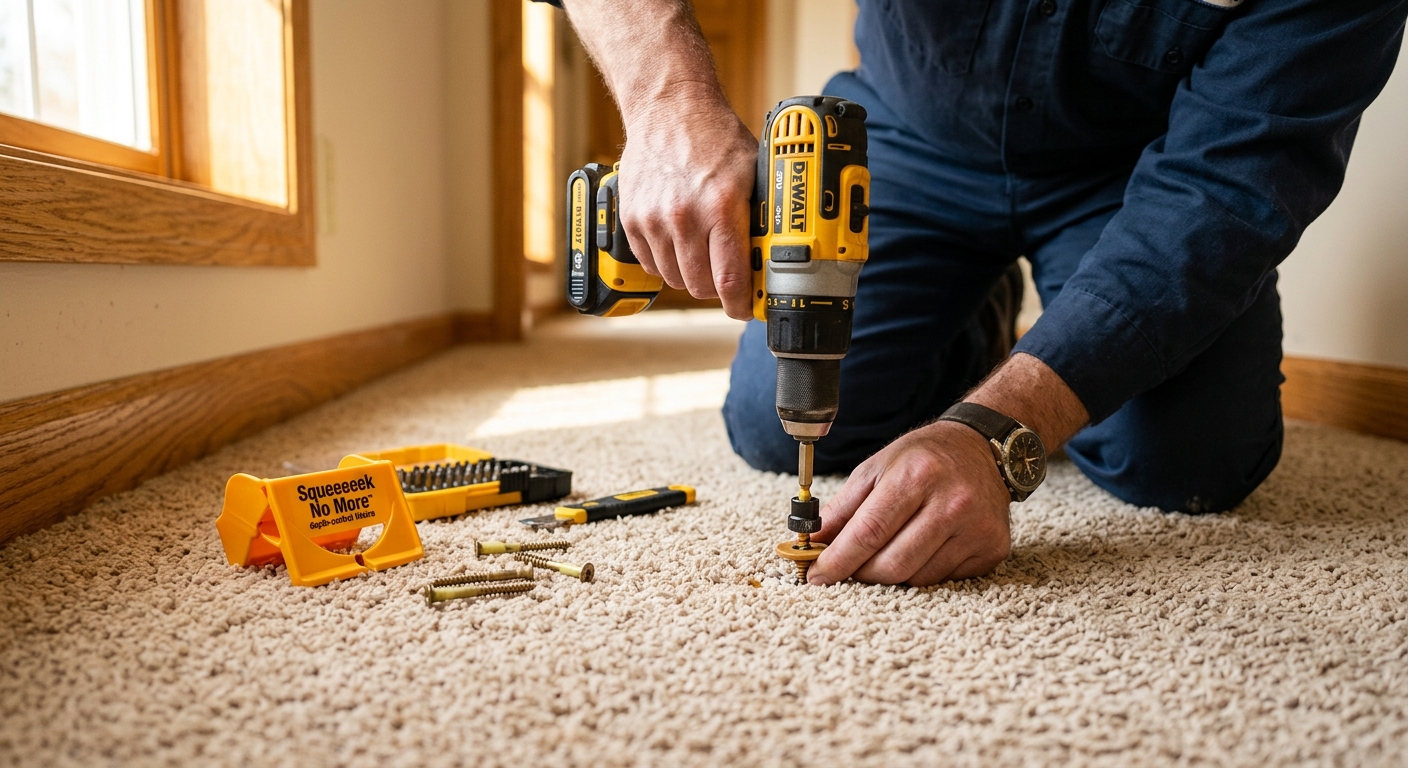
- Place the kit’s provided depth-control pilot tool over the marked spot, directly over the joist line. Press down firmly so the pilot holds the carpet fibers aside without cutting them.
- Drive the scored kit screw through the pilot guide using a drill set to low torque. The screw passes through carpet, padding, subfloor, and bites into the joist, pulling the subfloor tight.
- Snap off the scored screw head using the kit’s break-off tool or a pair of pliers. The remaining screw shank sits just below the carpet surface and is invisible.
- Walk the area again to confirm the squeak is gone. If a faint squeak remains, drive a second screw 2 to 3 inches from the first, still on the joist line.
- Have a helper walk the squeaky floor above while you observe from below. Watch and listen for movement at the subfloor-to-joist connection to pinpoint the exact location.
- Mark the problem area on the joist with a pencil. Measure the combined thickness of your subfloor and any underlayment layer, typically 3/4 inch to 1.5 inches total, so you choose a screw that will not punch through the finish floor above.
- Apply a thin bead of construction adhesive along the top edge of the joist where the subfloor has separated. This fills the gap and stops future movement at the source.
- Drive 1.25-inch to 1.5-inch coarse-thread drywall or wood screws up through the joist and into the subfloor at a slight angle, one every 6 to 8 inches along the problem span. Do not overtighten; snug is enough.
- Have your helper walk the area again while you verify no screws are protruding upward and that the squeak is eliminated. Allow the adhesive to cure for 24 hours for a permanent bond.
- If the squeak is between joists rather than at a joist, cut a wooden shim to fit the gap between the subfloor and the nearest blocking, coat it in construction adhesive, and tap it snugly into the gap from below.
- Purchase powdered graphite lubricant or plain talcum powder. Both are available at hardware stores for under $10.
- Locate the squeaky spot by walking the floor slowly and marking the loudest point with tape.
- Sprinkle a generous line of powder along the carpet seam, the carpet edge, or directly over the squeak location. Work the powder into the carpet pile with your fingers to help it work down toward the subfloor.
- Place a towel or cardboard over the area and walk back and forth firmly 10 to 15 times. This works the powder down between the subfloor layers where it lubricates the friction surfaces.
- Vacuum up any visible powder residue from the carpet surface once the squeak is reduced or eliminated.
Why It Works: The Benefits
A properly driven subfloor screw or a graphite treatment resolves the squeak on the first attempt in most cases, with no waiting period or curing time required.
Flooring contractors typically charge $200 to $800 to diagnose and fix subfloor squeaks, often requiring carpet removal and reinstallation. DIY kits cost $15 to $25 and cover multiple squeak locations.
Snap-off screw systems and powder lubricants are specifically designed to work through carpet pile without cutting, bunching, or permanently marking the fibers, preserving your flooring investment.
Leaving a loose subfloor panel unfixed accelerates joist wear and can allow moisture infiltration at panel seams. Addressing it early keeps the repair at $15 to $25 instead of a potential $1,000-plus subfloor replacement.
Squeaky floors are among the most commonly noted issues in buyer walkthroughs and home inspections. Fixing them before listing costs almost nothing and removes a common negotiating point for price reductions.
💰 Savings Impact by Action
A $15 to $25 kit replaces a $200 to $800 contractor visit, saving 90 to 97% of the repair cost in most standard squeak scenarios.
Fixing a loose subfloor fastener early costs under $25, while ignoring it until panel damage requires replacement can cost $1,000 or more, making early action 80% cheaper on average.
Buyers and inspectors flag squeaky floors in up to 10% of home sale negotiations, sometimes leading to price reduction requests of $500 to $2,000 that a $20 fix could prevent.
🏠 Key Concepts Explained
The Science Behind It
A floor squeak is essentially a friction event. Wood subfloor panels are fastened to joists during construction, but over time the fasteners loosen through a combination of foot traffic vibration, thermal expansion and contraction, and gradual wood shrinkage as lumber dries out after installation. Once the panel can lift even a fraction of an inch off the joist, each step creates a micro-gap that opens and closes, dragging wood across wood or wood across a nail shank. That dragging is the squeak.
Wood’s hygroscopic nature plays a major role in why this happens more in older homes and in climates with distinct seasons. In humid summers, subfloor panels absorb moisture and swell, which can pop nails slightly upward. In dry winters, the wood contracts and pulls away from the fastener, leaving a small gap. After several seasonal cycles, the original fasteners no longer hold the panel firmly against the joist, and movement becomes audible. Screws resist this pull-out cycle far better than nails because their threads grip wood fibers mechanically rather than relying on compression alone.
The powder lubricant approach works on a different principle. When two wood surfaces rub against each other, friction generates sound. Fine graphite or talc particles act as a dry lubricant that fills the microscopic valleys between the wood surfaces and allows them to slide without generating audible friction. This does not fix the underlying looseness, but it eliminates the noise produced by it. For squeaks caused by underlayment rubbing against a subfloor rather than a loose fastener-to-joist connection, powder is often more effective than any screw because there is no fastener problem to solve in the first place.
Frequently Asked Questions
▼ I drove the screw but the floor still squeaks in the same spot. What did I miss?
The most common reason is that the screw missed the joist. Use a stud finder again and verify joist location, then drive a second screw 1 inch to either side of the first. If the joist is confirmed and the squeak persists, the problem may be inter-layer friction rather than a loose fastener, so try the powder lubricant method in addition to the screw.
▼ My floor squeaks in a large area, not just one spot. Do I need a contractor?
Not necessarily. Widespread squeaking usually means the subfloor fasteners have backed out across an entire panel, which is common in homes 20 or more years old. Drive kit screws every 8 to 10 inches along the joist lines across the entire affected area. This is still a DIY job, just a longer one. If the subfloor also feels soft or spongy underfoot, that signals moisture damage and you should call a contractor before proceeding.
▼ Can renters fix squeaky floors without violating a lease?
The powder lubricant method is completely renter-safe because it leaves no permanent marks and is fully reversible. The screw kit method creates small, invisible penetrations in the carpet and subfloor that most landlords would consider minor maintenance, but review your lease or ask permission first. Avoid any approach that involves cutting carpet or accessing a crawlspace without landlord approval.
▼ My squeak is under hardwood, not carpet. Does this guide apply?
For hardwood covered by an area rug, the powder method works well. For exposed hardwood, you cannot use the carpet screw kit, but you can drive finish nails or hardwood flooring screws at an angle through the face of the board into the joist, then fill the hole with color-matched wood filler. Alternatively, a contractor can inject adhesive from below if you have basement access, which leaves the hardwood surface untouched.
▼ How do I find the joist if my stud finder gives inconsistent readings through the carpet?
Carpet and padding can confuse some stud finders. Try pressing the stud finder down firmly to compress the carpet before scanning, or use a strong rare-earth magnet to locate existing nail or screw heads in the subfloor, which are always on joist lines. Once you find one fastener, measure 16 inches in each direction to locate adjacent joists.
Quick Tips
- Mark multiple squeak spots before starting repairs, then fix them all in one session rather than making repeated trips to the hardware store.
- If using the kit method, keep your drill at the lowest torque setting to avoid stripping the scored screw before it reaches the correct depth.
- In two-story homes, squeaks on the upper floor are almost always subfloor issues, while squeaks on the main floor may involve the structure above a crawlspace or basement where access is easier.
- Seasonal squeaks that appear only in winter and disappear in summer are almost always caused by wood shrinkage and are best fixed in late fall when the floor is at its driest and the gap is at its widest.
Variations for Your Situation
- Apartment or Rental: Skip any method that involves drilling or driving fasteners and start with powdered graphite or talcum powder, which costs under $10, leaves no trace, and works well for friction-based squeaks. If the squeak is severe, notify your landlord in writing so any needed structural repair becomes their documented responsibility rather than yours.
- Tight Budget (under $15): Talcum powder or powdered graphite from a dollar store or pharmacy is your free or near-free first attempt. If that does not fully resolve the squeak, a single box of 1.25-inch coarse-thread drywall screws costs about $5 and can be driven through a small carpet cut using a sharp utility knife, then the carpet fibers pressed back into place.
- Older Home (pre-1980): Homes built before 1980 often used board subfloors rather than plywood panels, and the boards may have gaps between them that allow more movement. Start with the powder method to address inter-board friction, and supplement with screws driven into joists at every loud spot. Be especially cautious about soft spots, as older homes in humid climates frequently have subfloor rot near bathrooms and exterior walls that requires professional evaluation before any fastener repair.