Window air conditioners are workhorses that most homeowners completely ignore until the first brutal day of summer. You flip the switch, hear a rattle, wait ten minutes for cool air, and wonder why your electric bill is so high. The answer is almost always neglect: a clogged filter, dirty coils, and gaps around the unit that let in hot humid air even when the AC is running full blast.
A single hour of prep work before cooling season can reduce your unit’s energy consumption by 15 to 25%, extend its lifespan by several years, and dramatically improve how fast it cools your room. According to the Department of Energy, a dirty evaporator coil alone can reduce AC efficiency by 5 to 10%, and most window units go years without a coil cleaning. Add in a clogged filter and warm-air bypass gaps, and you could be paying 25% more per month than necessary.
This guide walks you through two approaches: a quick 30-minute refresh you can do right now with basic household supplies, and a more thorough DIY tune-up that addresses the unit inside and out. We will cover what to clean, what to look for, how to seal it in properly, and how to store it correctly so next summer starts off right.
What You’ll Need
Click on an item below to shop for the recommended items for this recipe on Amazon.
As an Amazon Associate, we earn from qualifying purchases.
How to Do It
- Unplug the unit completely before touching anything. Never clean or inspect a plugged-in window AC.
- Remove the front grille panel (usually snaps or slides off) and pull out the air filter. Rinse it under warm running water, gently scrubbing with a soft brush if visibly dirty. Let it dry fully before reinstalling.
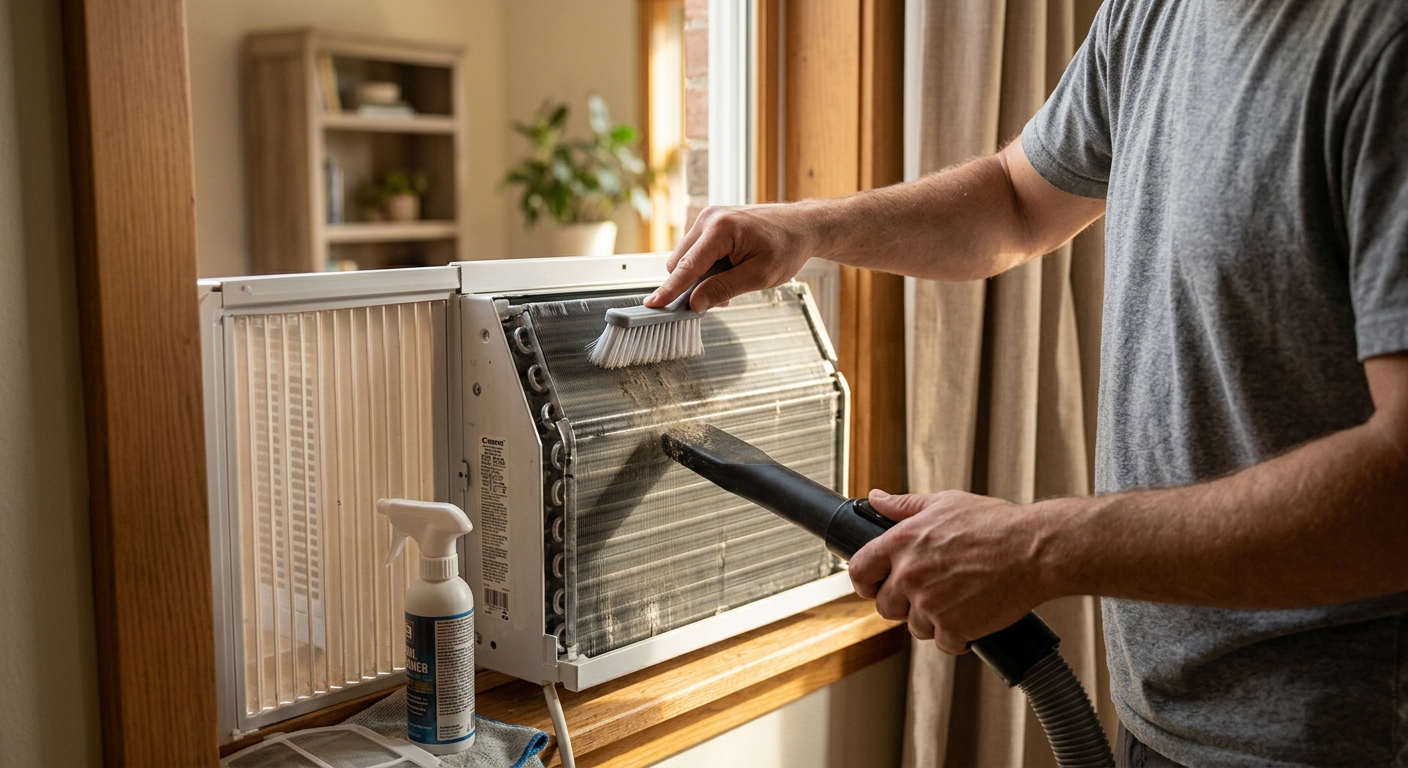
- Use a dry cloth or vacuum brush attachment to remove loose dust from the front grille, the visible evaporator fins, and the interior housing walls.
- Tilt the unit slightly toward the outside (if still installed) and look into the drain channels at the bottom. Use a straightened pipe cleaner or cotton swab to clear any debris from the drain holes so condensate flows out freely.
- Check the foam or rubber side panels and the seal between the unit and the window frame. Press any gaps closed by hand and apply foam weatherstrip tape to any spot where you can see daylight or feel outside air.
- Reinstall the clean dry filter, snap the grille back on, and plug the unit in. Run it on fan-only for 5 minutes to confirm airflow is strong and even before switching to cooling mode.
- Unplug the unit and remove it from the window. Carry it to a driveway or outdoor space where you can spray water and work comfortably.
- Remove the outer metal or plastic casing by unscrewing the screws along the bottom and sides. Set the casing aside. You will now see both the evaporator coil (front, cold side) and the condenser coil (rear, hot side).
- Spray both coils with a no-rinse AC coil cleaner foam (available at hardware stores for $8 to $15). Let it foam for 5 to 10 minutes to break down grease and biological growth. The foam drains away on its own, carrying contaminants with it.
- Use a fin comb ($8 to $12) to carefully straighten any bent aluminum fins on both coils. Bent fins block airflow and reduce heat transfer. Work gently from top to bottom in the direction of the fins.
- Clean the drain pan at the bottom of the unit with a 10% bleach solution and a sponge to kill mold and algae. Rinse with clean water. Confirm the drain port is fully open.
- Inspect the power cord and plug for cracking, fraying, or discoloration. If you see any damage, do not use the unit and replace the cord or the unit itself before next season.
- Reassemble the casing, reinstall the clean filter, and if storing the unit for winter, place it in its original box or a fitted AC storage cover to keep dust, pests, and moisture out until spring.
Why It Works: The Benefits
A clean, properly sealed window AC uses 15 to 25% less electricity than a neglected one. On a unit that costs $50 per month to run, that is $7 to $12 back in your pocket every month of the cooling season.
Clean coils and an unobstructed filter allow the unit to reach your set temperature 20 to 30% faster, reducing the long slog of a hot room after work on a summer afternoon.
Mold and bacteria grow readily in dirty drain pans and on clogged filters. A thorough cleaning removes these contaminants before they get blown into your living space all summer.
Compressors that run harder and hotter due to dirty coils wear out faster. Regular maintenance can add 3 to 5 years to a window unit that otherwise might fail in 8 to 10 years.
A clean evaporator coil operating at the correct temperature removes up to 30% more moisture from the air per hour compared to a fouled coil, making the room feel noticeably more comfortable at the same thermostat setting.
💰 Savings Impact by Action
Restoring full airflow through a clogged filter reduces runtime and energy draw by up to 15% per cooling cycle.
Removing fouling from evaporator and condenser coils restores heat transfer efficiency and cuts compressor runtime by 5 to 10%.
Eliminating warm air bypass around the unit reduces the heat load the AC must overcome, cutting runtime by up to 12%.
A clear drain restores full dehumidification capacity, reducing latent heat load and improving sensible cooling efficiency by roughly 5%.
🏠 Key Concepts Explained
The Science Behind It
A window air conditioner works by running a refrigerant in a closed loop between two coils. The evaporator coil inside your room absorbs heat from indoor air, cooling it down. That heat is carried by the refrigerant to the condenser coil on the outside, where it is dumped into the outdoor air. The efficiency of this whole process depends entirely on how well each coil can transfer heat. When dust, mold, or debris coats a coil, it creates a thin insulating barrier that forces the refrigerant to stay at a more extreme temperature to move the same amount of heat. The compressor works harder and longer, and your electricity meter spins faster.
Airflow is just as important as coil cleanliness. The evaporator coil needs a steady, unobstructed flow of warm room air passing over it to absorb heat efficiently. A clogged filter chokes that airflow, causing the coil surface temperature to drop below freezing. Ice forms on the coil, which further blocks airflow in a worsening spiral until the unit is blowing barely cool air from a block of ice. Cleaning the filter breaks this cycle and restores full heat absorption capacity.
The building envelope matters too. A window AC creates negative pressure in the room as it exhausts air outside. Without a tight seal around the unit, warm humid outdoor air is pulled in through every gap, adding latent heat load that the unit has to remove on top of the sensible heat already in the room. Sealing those gaps is the single highest-return action you can take in terms of immediate, measurable improvement in both comfort and energy use.
Frequently Asked Questions
▼ My window AC is blowing air but it is not getting cold. What is wrong?
The most common causes are a frozen evaporator coil, a dirty filter, or a refrigerant leak. First, turn the unit to fan-only for 30 minutes to melt any ice, then clean the filter and check the coils for blockage. If the unit still does not cool after that, the refrigerant charge is likely low and you need a licensed technician to inspect it.
▼ How often should I clean the filter on a window AC?
Every two weeks during heavy use, or once a month during lighter use. Hold the filter up to light after removing it. If you cannot see light through it clearly, it needs cleaning. A visibly gray or clogged filter can reduce airflow by 30 to 40% and cause the unit to ice over.
▼ Can I leave my window AC installed all winter instead of removing it?
You can, but it creates a significant energy penalty. Even a sealed window AC is a large thermal hole in your wall. Studies suggest a poorly sealed window unit can increase heating costs by 5 to 10% in cold climates. If you leave it in, use a fitted interior AC cover rated for winter use to block airflow and add an insulating layer.
▼ My unit is making a rattling noise. Is that something I can fix myself?
Often yes. Rattling is usually caused by a loose front grille, a vibrating side panel, or debris hitting the fan blade. Unplug the unit and check that all screws on the casing are tight, that the filter is seated properly, and that nothing is lodged near the fan. If the rattle persists and seems to come from inside the sealed compressor area, that is a sign of mechanical wear and the unit likely needs professional service or replacement.
▼ I see water dripping inside from the window AC. What is causing it?
Indoor dripping almost always means the unit is not tilted correctly toward the outside, or the drain channels are clogged. The condensate should flow backward and out. Check that the outer edge of the unit sits about one quarter inch lower than the indoor edge. Then clear the drain holes at the bottom of the unit with a pipe cleaner as described in the tune-up steps above.
Quick Tips
- Set a calendar reminder for April 1 to do your spring tune-up before the first heat wave catches you unprepared.
- Run the unit on fan-only mode for the first 10 minutes after a long storage period to let the compressor oil circulate before engaging the cooling cycle.
- Check that the unit tilts very slightly toward the outside when installed. A level or slightly indoor-tilted unit causes condensate to drip indoors rather than drain outside.
- Write the filter cleaning date on a piece of tape and stick it inside the grille. During heavy use months like July and August, aim to rinse it every two weeks.
Variations for Your Situation
- Apartment/Rental: Renters can do the full filter cleaning and weatherstripping without landlord approval since those are reversible. Avoid opening the unit casing without permission. Use a no-residue foam coil cleaner spray through the grille vents to clean the evaporator without disassembly, and add a removable foam AC draft stopper on the interior side to seal gaps without damaging the window frame.
- Tight Budget (under $15): Skip the coil cleaner and fin comb. Focus on washing the filter, vacuuming the grille and visible fins with a soft brush attachment, clearing the drain holes, and pressing weatherstrip foam tape into any visible gaps around the unit. These free and low-cost steps alone can recover 10 to 15% efficiency at virtually zero cost.
- Older Home (pre-1980): Older windows are often uneven or warped, which means standard foam accordion side panels leave large gaps. Cut rigid foam board insulation to fill irregular gaps and tape the seams with foil HVAC tape for a tighter, more durable seal. Also inspect older units carefully for frayed cords and cracked plugs before each season, as electrical insulation degrades over time.