That outlet that wobbles when you plug something in might seem like a minor cosmetic issue, but it is one of the most overlooked fire hazards in the average home. Loose outlets allow the plug blades to make intermittent contact with the internal receptacle contacts, which causes arcing – tiny electrical sparks that generate intense heat. According to the U.S. Fire Administration, electrical fires cause roughly 51,000 house fires per year, and loose or faulty receptacles are a significant contributor.
The problem typically starts with a loose mounting screw on the outlet itself, a worn-out receptacle that no longer grips plugs firmly, or a box that has shifted inside the wall. All three are fixable, and most homeowners can handle at least the first two with basic tools and under an hour of time. The key is knowing which problem you are dealing with before you start.
This guide walks you through diagnosing the exact cause of your loose outlet, the right fix for each scenario, and the safety steps you must take before touching anything inside an electrical box. We also cover when the job calls for a licensed electrician rather than a Saturday afternoon DIY session.
What You’ll Need
Click on an item below to shop for the recommended items for this recipe on Amazon.
As an Amazon Associate, we earn from qualifying purchases.
How to Do It
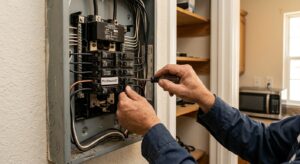
- Go to your electrical panel and flip the breaker for the circuit that controls the outlet. Use a non-contact voltage tester at the outlet to confirm power is off before touching anything.
- Remove the outlet cover plate by unscrewing the single center screw. Set the plate aside.
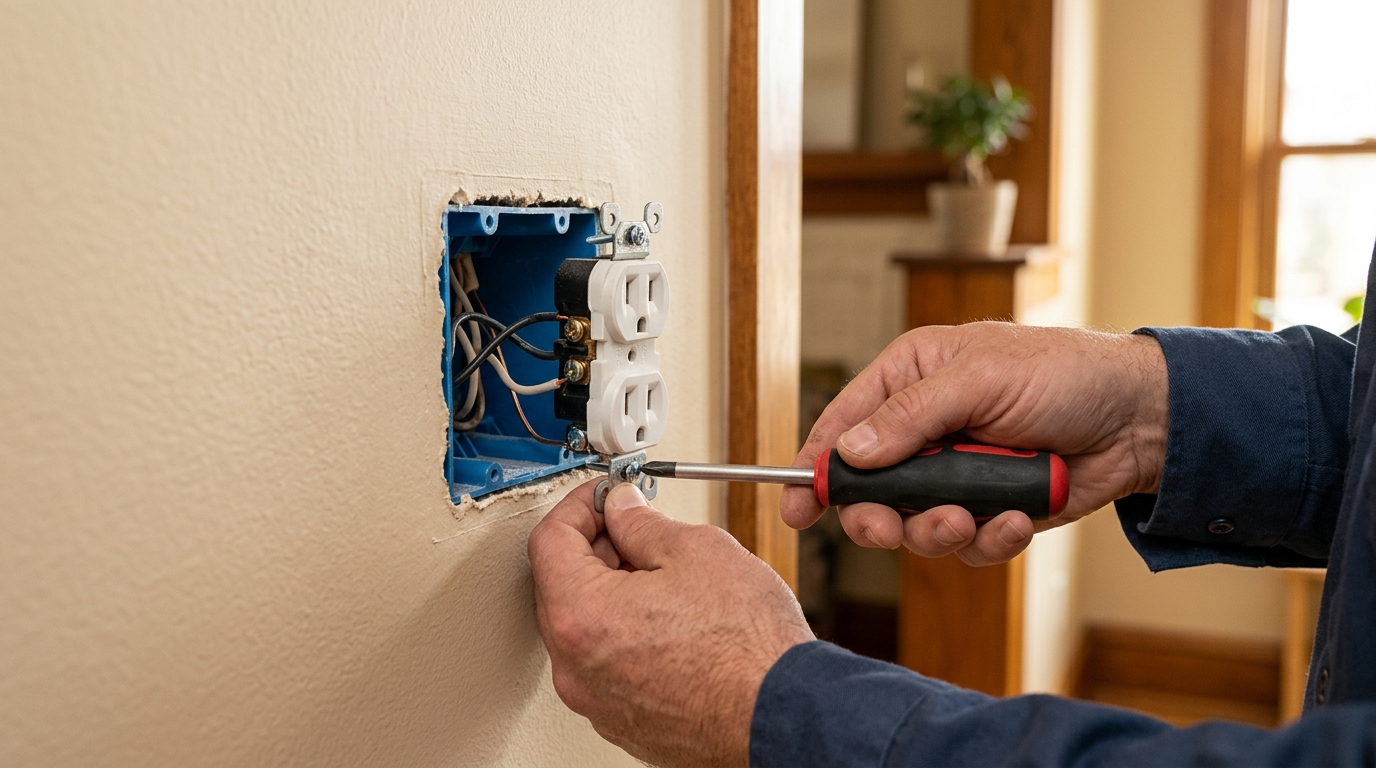
- Locate the two mounting screws, one at the top and one at the bottom of the outlet body, that secure the receptacle to the metal ears on the electrical box. Using a flathead screwdriver, tighten both screws snugly but do not overtighten or you may crack the receptacle body.
- If the outlet is still slightly rocking because the box is recessed too far behind the drywall, slide plastic outlet shims (also called outlet spacers, available for about $2 at any hardware store) over the mounting screws between the outlet ears and the box to fill the gap.
- Reinstall the cover plate, restore power at the breaker, and test the outlet by plugging in a lamp. Check that the outlet no longer moves when you insert or remove the plug.
- Turn off the breaker for the outlet circuit and verify with a non-contact voltage tester at the outlet. Do not skip this step.
- Remove the cover plate screw and the cover plate. Then remove the two mounting screws holding the receptacle to the box and gently pull the receptacle out, extending the wires enough to work comfortably, typically 4 to 6 inches.
- Take a photo of the wiring before disconnecting anything. Note which wires are on which terminals: the black hot wire goes to the brass screw, the white neutral wire goes to the silver screw, and the bare or green ground wire goes to the green screw.
- Purchase a matching replacement receptacle at a hardware store. Match the amperage (15A or 20A, printed on the old outlet), the number of poles, and whether it needs to be a GFCI type if the outlet is in a kitchen, bathroom, garage, or outdoor location.
- Disconnect the wires from the old receptacle. If they were back-stabbed into the push-in terminals, straighten a small paperclip or use a small flathead to press the release slot and free the wire. Reconnect all wires to the screw terminals on the new receptacle, wrapping clockwise so the screw tightens the connection as you turn it.
- Fold the wires carefully back into the box, push the new receptacle in, and tighten the mounting screws. Install the cover plate, restore power, and test with a plug-in outlet tester to confirm correct wiring (hot, neutral, and ground are all properly connected).
- Stop using the outlet immediately if you see scorch marks, smell burning plastic, or notice the breaker trips when the outlet is in use. Tape over the outlet and mark it clearly until a professional arrives.
- Call a licensed electrician and describe the symptoms specifically: outlet is loose, when it started, whether there are any burn marks or tripped breakers, and the approximate age of your home.
- Ask the electrician to inspect not just the loose outlet but the entire circuit, including the panel connection and any junction boxes on the same run. A loose outlet is sometimes a symptom of a larger wiring problem.
- Request a written estimate before work begins. A simple outlet replacement by an electrician typically runs $100 to $150. Reanchoring a loose box in the wall, running a new circuit, or upgrading to AFCI protection may cost $150 to $500 depending on your market.
- After the repair, ask the electrician to confirm the outlet is properly grounded and, if your home was built before 2000, discuss whether AFCI breaker upgrades on bedroom and living area circuits make sense given the age and condition of your wiring.
Why It Works: The Benefits
Loose connections account for a meaningful share of the 51,000 electrical fires reported annually in the U.S. Fixing a loose outlet removes one of the most common ignition sources in a home at a cost of under $15 in parts.
A stabilized outlet prevents children and adults from making incidental contact with exposed conductors inside a rocking box, reducing shock risk to near zero for that circuit.
Arcing and intermittent contact can damage sensitive electronics plugged into a faulty outlet. Fixing the outlet protects laptops, TVs, and appliances that would cost hundreds or thousands of dollars to replace.
A DIY outlet fix costs $5 to $15 in materials. A single electrician service call for the same job typically runs $100 to $200 before any parts, so one successful DIY repair pays for a full set of outlet hardware for the whole house.
Many homeowner insurance policies exclude fire damage caused by known and unaddressed electrical hazards. Fixing documented problems keeps your coverage intact and may be required during a home inspection or sale.
💰 Savings Impact by Action
Eliminating the arcing source at a loose outlet removes what electricians identify as one of the top three ignition causes in residential electrical fires.
A DIY outlet repair costs $5 to $15 in parts compared to $100 to $200 for a professional service call, saving roughly 90 to 93% of the total repair cost.
A properly seated, tight receptacle eliminates arcing-related voltage spikes that can damage or destroy sensitive electronics plugged into the circuit.
Arcing connections waste a small but measurable amount of energy as heat rather than useful power, and eliminating them restores full circuit efficiency.
🏠 Key Concepts Explained
The Science Behind It
Electricity flows through conductors only when there is continuous, low-resistance contact between metal surfaces. Inside a receptacle, spring-loaded brass contacts grip the blades of a plug to complete the circuit. When those contacts wear out or the whole receptacle moves in the box, the contact becomes intermittent. Each time the connection breaks and remakes under load, electrons must jump across a microscopic air gap. That jump is an arc, and it releases enormous energy in a tiny space, enough to vaporize metal and ignite surrounding combustibles.
Resistance heating compounds the problem. Even before full arcing begins, a loose wire connection or fatigued contact adds electrical resistance to the circuit. By Joule’s Law, heat generated is proportional to resistance multiplied by the square of current. A connection with even modest added resistance carrying 15 amps can generate significant localized heat over hours of use, gradually charring insulation and wood framing in a hidden, slow-motion way that neither a standard breaker nor a homeowner can detect until visible damage appears.
This is precisely why Arc Fault Circuit Interrupter breakers were introduced into the National Electrical Code starting in 1999 and have been progressively required in more rooms in every code cycle since. AFCIs detect the specific waveform signature of arcing and trip the circuit. However, they respond to sustained arcing patterns, not every single brief arc event. Physical repair of the outlet, meaning tight mechanical and electrical connections, remains the primary defense because it eliminates arcing at the source rather than responding to it after the fact.
Frequently Asked Questions
▼ I tightened the screws but the outlet still wobbles. What am I missing?
The electrical box itself is likely recessed too far behind the drywall surface, or the box is not anchored solidly to the stud or brace behind it. For a recessed box, add plastic outlet spacer shims between the outlet ears and the box face until the outlet sits flush. If the box itself moves when you push on it, the box needs to be re-anchored, which is a job for an electrician unless you are comfortable cutting into the drywall.
▼ The outlet works fine but plugs fall out on their own. Is that a fire hazard?
Yes, it can be. Plugs that do not grip firmly make intermittent contact under load, especially when cords are bumped or moved, which causes arcing. The receptacle contacts are worn out and the outlet should be replaced. It is an inexpensive fix using the DIY receptacle replacement approach in this guide and takes under 45 minutes.
▼ I see a little black mark around the outlet slots. Should I be worried?
Black or brown discoloration around the outlet slots or on the cover plate is a sign of heat damage from arcing and you should treat it as urgent. Turn off that circuit breaker now, tape over the outlet so no one uses it, and call a licensed electrician. Do not attempt a DIY repair when there is visible burn damage because the damage may extend into the box wiring and behind the wall.
▼ Can I fix a loose outlet if my home was built in the 1960s or 1970s?
Proceed with extra caution. Homes from that era may have aluminum branch circuit wiring, which appears silver rather than copper-colored inside the box. Aluminum wiring requires CO/ALR-rated devices and anti-oxidant compound at every connection; standard receptacles will not do. If you see silver wires, stop and call a licensed electrician. Additionally, older homes may have two-prong ungrounded outlets, which are a separate safety issue worth discussing with an electrician while you have them on-site.
▼ My breaker trips every time I use a specific outlet. Is that related to it being loose?
A tripping breaker combined with a loose outlet suggests active arcing or a short circuit condition on that circuit, not just a mechanical fit problem. Do not reset the breaker and continue using the outlet. Leave the breaker off, tape the outlet, and call an electrician. This symptom indicates a wiring fault that goes beyond what a DIY receptacle swap should address.
Quick Tips
- Always photograph the wiring inside an outlet box before disconnecting anything. A 10-second photo prevents a costly rewiring mistake.
- Use a plug-in outlet tester after any outlet repair to confirm that hot, neutral, and ground are correctly connected. They cost about $8 and take 5 seconds to use.
- If an outlet in a bathroom, kitchen, garage, or within 6 feet of a sink does not have a GFCI reset button on its face, replace it with a GFCI receptacle while you have the box open. It takes the same amount of time and costs about $15.
- Mark the back of your electrical panel with a permanent marker any time you confirm which breaker actually controls which outlet. Accurate labeling makes every future electrical job safer and faster.
Variations for Your Situation
- Apartment/Rental: Renters should not open electrical boxes without landlord permission, as it may violate the lease and local code. Instead, submit a written maintenance request describing the outlet as a safety hazard (loose, sparking, or burning smell) and keep a copy. Landlords are legally required to maintain safe electrical systems in virtually every U.S. state. If the landlord does not respond within a reasonable time (typically 7 to 14 days depending on your state), contact your local building or housing authority to request an inspection.
- Tight Budget (under $20): The tighten-the-screws approach costs nothing beyond a screwdriver you already own and eliminates the most common cause of outlet wobble in minutes. If you need to replace the receptacle, a standard 15A receptacle costs $3 to $6 at any hardware store. Add a $8 outlet tester and you have a complete repair kit for under $15. Skip the upgraded GFCI replacement for now and focus on the safety-critical fix first.
- Older Home (pre-1980): Older homes are more likely to have back-stabbed wiring connections, two-prong ungrounded outlets, or aluminum wiring, all of which require special handling. Before starting any repair, open the box and look carefully at the wire color and terminal connections. If the wires are silver-toned, stop and call an electrician. If the outlet has only two slots and no ground hole, budget $8 to $15 per outlet to upgrade to a GFCI receptacle, which is NEC-approved as a safety substitute for a missing ground when a new ground wire cannot be run.