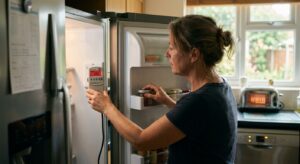
If you have ever opened an electric bill and wondered why it was so high even though you were careful about leaving lights off, a demand charge could be the culprit. Traditional residential billing charges you for kilowatt-hours (kWh), which measures how much total energy you consumed. A demand charge adds a second line item based on kilowatts (kW), which measures the highest rate at which you drew power during a specific window, usually the single busiest 15 or 30 minutes of the month.
Think of it like a highway. Energy (kWh) is the total number of cars that passed over the month. Demand (kW) is the worst traffic jam you created at rush hour. Utilities build and maintain power plants, transformers, and wires to handle the biggest jam, so they charge customers who cause one. Demand charges used to apply mostly to businesses, but they are now spreading to residential customers through demand-based rate plans, especially in Arizona, parts of California, Colorado, and a growing number of other states. Charges commonly run from about $5 to $20 per kW of peak demand, and some rates only count peaks during on-peak hours such as 4 p.m. to 9 p.m.
The good news is that demand charges reward behavior you can control. Because most demand windows are tied to late afternoon and evening hours, running your heavy appliances overnight can sharply reduce or even eliminate the peak that gets billed. This post explains how to read your rate plan, how to find your biggest demand spikes, and two practical approaches for pushing your usage to the hours when it costs the least.
What You’ll Need
Click on an item below to shop for the recommended items for this recipe on Amazon.
As an Amazon Associate, we earn from qualifying purchases.
How to Do It
- Log in to your utility account and find your rate plan name, then look up the on-peak hours and the demand charge per kW. Write down the window, such as 4 p.m. to 9 p.m. weekdays.
- Use the delay-start feature on your dishwasher, washing machine, and electric dryer so they begin after your on-peak window ends, ideally after 9 or 10 p.m.
- Set your EV charger or the car’s app to start charging at the beginning of the off-peak period rather than the moment you plug in.
- Stop running multiple big loads together during on-peak hours. Do not run the oven, dryer, and AC compressor at the same time; stagger them by at least 30 minutes.
- Pre-cool your home before the on-peak window by lowering the thermostat 2 to 3 degrees, then let it drift up slowly during peak hours instead of running the compressor hard.
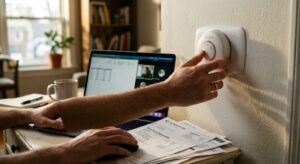
- Install a whole-home energy monitor on your electrical panel (clamp-on models are typically $100 to $250) or use your utility’s smart meter data to see which hours produce your highest kW readings.
- Review a full week of data and identify your top three demand spikes. Note what was running at each one, since it is usually the AC plus one or two heating appliances.
- Replace your thermostat with a smart or programmable model and program a pre-cool schedule plus a gentle setback during on-peak hours. Avoid sharp temperature recovery swings, which cause big compressor surges.
- Add smart plugs or a smart load controller to non-urgent loads such as a pool pump, water heater, or dehumidifier so they automatically run overnight.
- Set your water heater to heat during off-peak hours, and consider raising the tank to 130 to 140 degrees overnight so it can coast through the evening, using a timer or smart controller.
- Recheck your monitor after two weeks and compare your new peak kW to the old one to confirm the savings.
- Have an energy auditor or electrician review your panel capacity and annual interval data to estimate what a lower peak would be worth in dollars.
- Consider a home battery that discharges during the on-peak window to shave your peak, often with 5 to 13 kWh of storage for typical homes.
- Upgrade to a variable-speed heat pump or high-efficiency AC, which ramps up gradually and draws far less peak power than a single-stage unit.
- Replace an electric resistance water heater with a heat pump water heater, which uses roughly 60% less energy and has a much lower power draw.
Why It Works: The Benefits
Cutting a 12 kW peak to 7 kW on a $10 per kW charge saves $50 per month, or $600 per year, without using any less energy.
Many demand and time-of-use plans price overnight kWh at 40 to 60% less than evening kWh, so shifting loads saves on the energy portion too.
Charging a typical EV overnight on an off-peak rate can cost roughly $0.08 to $0.12 per kWh versus $0.25 to $0.40 on-peak, saving $300 to $700 per year for average drivers.
Staggering large appliances reduces the chance of tripping breakers and lowers strain on your electrical panel.
Moving use out of the evening peak reduces the need for the least efficient peaker power plants, which lowers system-wide emissions.
💰 Savings Impact by Action
Staggering large appliances can cut your billed monthly peak kW by 20 to 40%, directly reducing the demand charge.
Moving dishwasher, laundry, and EV charging to off-peak hours can lower the energy portion of the bill by 15 to 25% on time-of-use plans.
Cooling the home before the on-peak window reduces compressor runtime during peak hours by roughly 10 to 15%.
Automated thermostat and smart plug schedules deliver consistent savings of about 8 to 12% by removing the need to remember.
A variable-speed heat pump or heat pump water heater can cut peak draw and energy use by 25% or more versus older single-stage units.
🏠 Key Concepts Explained
The Science Behind It
Electricity is delivered through a grid that must always match supply to demand in real time. Wires, transformers, and generation capacity are sized for the highest moment of use, not the average. A house that pulls 15 kW for twenty minutes forces the utility to maintain 15 kW of capacity for that customer, even if the average draw is just 1.5 kW. Demand charges pass this capacity cost on to the households that create the peaks, which is why a short spike can cost more than hours of steady use.
Instantaneous power is measured in kilowatts, and demand billing typically averages it over a 15 or 30 minute interval to smooth out momentary surges like a compressor startup. Resistive loads such as electric ovens, dryers, and water heaters draw power constantly while on, so they can stack up quickly. Motor loads such as air conditioners have a brief inrush current when they start, which is why variable-speed equipment that ramps up gradually produces lower peaks.
Nighttime usage avoids demand charges because most plans only measure peak demand during on-peak hours, when system load is highest. Overnight, overall grid demand drops, generation is cheaper, and many utilities either exclude those hours from demand measurement or price them far lower. Cooling a home also works in your favor at night: outdoor air is cooler, so equipment runs more efficiently and the thermal mass of your walls and furnishings can store a little coolness to carry you through the following evening.
Frequently Asked Questions
▼ Why is my bill still high even though I shifted my usage to nighttime?
Check whether your plan measures demand only during on-peak hours or all day, since some plans count every hour. Also look for a ratchet clause that keeps a past high peak on your bill for months, and confirm that your AC or another large load is not still the one causing your highest spike.
▼ Can renters do this without landlord permission?
Yes. Delay-start settings on appliances, plug-in smart plugs, and thermostat scheduling (if you control the thermostat) all require no permanent changes. Plug-in EV chargers and portable monitors that read from the utility’s smart meter portal are also renter-friendly.
▼ How long before I actually notice savings on my bill?
You will typically see the change on your next bill, since demand charges are calculated every billing cycle. If your utility uses a ratchet clause, savings may take several months to fully appear, so compare bills across at least two to three cycles.
▼ What if my home is older than 30 years?
Older homes often have single-stage AC units and electric resistance appliances that create large spikes, so staggering loads and pre-cooling matter even more. Have an electrician confirm your panel can handle added devices like an EV charger, and consider a variable-speed heat pump when your system needs replacement.
▼ Do I even have a demand charge?
Look at your bill for a line labeled demand, kW, or peak demand, or check your utility’s website for your rate plan name. If you only see kWh charges and a flat service fee, you are likely on a standard rate and your savings would come from time-of-use pricing instead.
Quick Tips
- Call or log in to your utility and ask whether you are on a demand-based or time-of-use rate; many homeowners are on one without realizing it.
- Stagger big loads by at least 30 minutes rather than starting everything at once, since your billed demand is an average over a short interval.
- Pre-cool your home 2 to 3 degrees before the on-peak window and avoid dramatic thermostat setbacks that force the compressor to run at full power afterward.
- Use delay-start on dishwashers and washers, and run electric dryers overnight or on weekends if the rate allows.
- Check your interval data monthly during summer and winter, since peaks usually come from extreme-weather days.
Variations for Your Situation
- Apartment/Rental: Focus on what you control without modifying wiring. Use delay-start on the dishwasher and washer, schedule a smart plug for a space heater or dehumidifier, and run a window or portable AC pre-cool before on-peak hours. A $15 to $25 smart plug and a free utility portal are often all you need.
- Tight Budget (under $50): Do everything in the Quick Fix approach for free, then add one or two smart plugs ($10 to $15 each) for loads like a pool pump or space heater. Simply staggering your oven, dryer, and AC and using delay-start settings can lower your peak by 20 to 40% at no cost.
- Older Home (pre-1980): Expect higher baseline leakage and older single-stage equipment, so pre-cooling at night helps a lot but your house will warm faster. Prioritize air sealing and attic insulation to R-38 first, since a tighter shell holds overnight coolness longer and lowers the size of your evening peak.