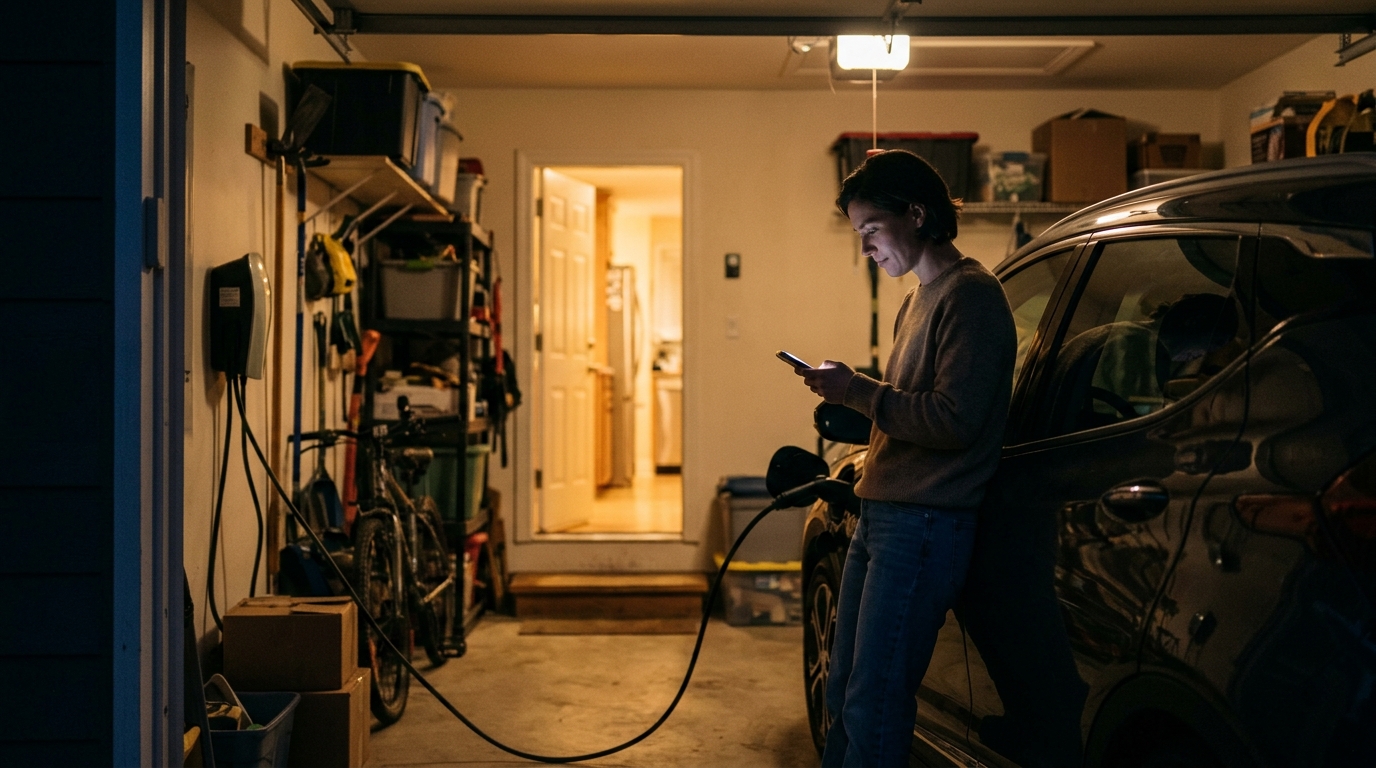
Here is a scenario that plays out in driveways every evening: you pull in around 6 p.m., plug in your EV, and go inside. Your car starts charging immediately, pulling 7 to 11 kilowatts from the grid during the exact hours when your utility charges its highest rates. If you are on a time-of-use (TOU) plan, that habit can cost you two to three times more per kilowatt-hour than charging just a few hours later.
The difference adds up fast. A typical EV driver covers about 12,000 miles a year and uses roughly 3,500 to 4,000 kWh to do it. At a peak rate of 35 cents per kWh, that is around $1,300 a year. At an off-peak rate of 12 to 15 cents, the same driving costs $450 to $600. That gap of $700 or more is money you are leaving on the table simply by not checking a schedule.
This post walks through how to find your utility’s off-peak window, how to set your car or charger to take advantage of it, and what to do if your situation is more complicated, such as renting, living in an older home, or being on a flat-rate plan. Most of the fixes take less than 30 minutes and cost nothing.
What You’ll Need
Click on an item below to shop for the recommended items for this recipe on Amazon.
As an Amazon Associate, we earn from qualifying purchases.
How to Do It
- Log into your utility account or call customer service and ask whether you are on a time-of-use rate and what your off-peak hours are. Write down the exact start and end times, and note whether weekends and holidays differ.
- Open your EV’s app or the in-car charging menu and find the scheduled charging or departure time setting. Set the charging start time to the beginning of your off-peak window, such as 9 p.m. or midnight.
- Set a target charge level, typically 80 percent for daily use, to protect battery longevity. Only charge to 100 percent before long trips.
- Enable the setting by location so the schedule applies at home but not when you charge at work or a public station.
- Test it for one night. Check the app the next morning to confirm charging began at the right time and reached your target.
- Check your utility’s website for approved or rebate-eligible smart chargers. Many utilities list specific models that qualify for incentives.
- Pick a Wi-Fi-enabled Level 2 charger that supports scheduling and utility rate syncing, such as models from ChargePoint, Wallbox, Emporia, or JuiceBox.
- Have a licensed electrician confirm your panel has capacity for a 40 to 50 amp, 240V circuit and install a dedicated breaker and outlet or hardwire the unit.
- Connect the charger to your home Wi-Fi, create an account in its app, and enter your utility’s off-peak hours or select your utility from the built-in rate list.
- Set a recurring schedule and a charge limit, then enable notifications so you are alerted if a session starts during peak hours.
- Apply for your utility rebate and, if available, enroll in a dedicated EV rate plan that may have an even lower overnight price.
- Ask your utility whether it offers a separate EV rate or a whole-house TOU plan with a super off-peak window, often 11 p.m. to 5 a.m.
- Download 12 months of usage data from your utility portal and use the utility’s rate comparison tool to estimate your new annual bill.
- If the EV rate wins, submit the switch request online or by phone. Some utilities require a second meter for EV-only billing, which may cost $300 to $1,000 to install.
- After switching, review your first two bills to confirm the off-peak window and rates match what you were told.
Why It Works: The Benefits
Shifting from a 35 cent peak rate to a 13 cent off-peak rate cuts the per-kWh cost by over 60 percent, which can save $500 to $800 per year for a typical driver.
On a TOU plan, off-peak charging keeps your highest-priced usage low, which also protects the rest of your household electricity from tier bumps.
Charging overnight reduces evening demand peaks, which helps utilities avoid firing up dirtier, costlier peaker plants and can mean a slightly cleaner energy mix.
Once a charging schedule is programmed, your car is ready every morning with no extra effort, and many vehicles remember the schedule by location.
Many utilities offer rebates of $200 to $500 on Level 2 chargers or special EV rates with off-peak prices as low as 8 to 10 cents per kWh.
💰 Savings Impact by Action
Moving charging from a 35 cent peak rate to a 13 cent off-peak rate cuts the per-kWh price by about 60 percent.
A driver using 3,800 kWh a year typically saves around 45 percent on total charging costs after switching to off-peak charging.
A typical $300 utility rebate covers about 30 percent of the cost of a $1,000 installed smart charger.
Capping daily charging at 80 percent reduces session length by about 20 percent, making off-peak windows easier to fit.
🏠 Key Concepts Explained
The Science Behind It
Electricity cannot be stored cheaply at grid scale, so utilities must produce exactly as much power as people use at every moment. In the early evening, demand surges as people return home, turn on lights, cook dinner, and run heating or cooling. To meet that surge, utilities bring online less efficient peaker plants that cost much more to run. Time-of-use pricing passes that real cost difference along to customers, which is why the same kilowatt-hour can cost 12 cents at 2 a.m. and 35 cents at 6 p.m.
An EV is one of the few household loads that is both large and flexible. A Level 2 charger pulls about 7.2 kW, roughly the same as running three electric dryers at once, but unlike a dryer, the car does not care exactly when it charges as long as it is full by morning. That flexibility is what makes load shifting so valuable. Moving 10 kWh of daily charging from peak to off-peak at a 20 cent price gap saves $2 a day, or about $730 a year.
Charging efficiency also plays a small role. Charging losses run about 10 to 15 percent as heat in the charger and battery, and they are slightly higher in very cold weather. Scheduling a session to finish right before you leave means the battery is already warm from charging, which helps cold-weather range and reduces how much power the car needs for preconditioning.
Frequently Asked Questions
▼ Why is my EV still charging during peak hours even though I set a schedule?
Check that the schedule is set to your home location and that no override is active, since many cars start charging immediately if you tap Charge Now. Also confirm the app and the car are synced, because a Wi-Fi drop can prevent schedule updates. If you use a smart charger, make sure both the car and charger are not set with conflicting schedules.
▼ Can renters do this without landlord permission?
Yes, in most cases. The built-in scheduler in your car requires no installation and works on any outlet. If you plug into a standard 120V outlet or a shared garage circuit, the car’s scheduler is your best tool, and you can also use a smart plug rated for the load only if the outlet is on a dedicated circuit. Ask your landlord before installing any new 240V outlet or charger.
▼ How long before I actually notice savings on my bill?
You will see the change on your next full billing cycle, typically 30 days. If you charge around 300 kWh a month and shift it to a rate that is 15 to 20 cents cheaper, expect $45 to $60 less per month. Check your utility’s online usage graph, which often shows hourly data so you can confirm the shift is working within a few days.
▼ What if my utility has a flat rate and no time-of-use plan?
Off-peak scheduling will not lower your bill on a true flat rate, but it can still help the grid and may qualify you for a utility program that pays you to charge at certain times. Look into whether a TOU or EV plan is offered, since many utilities allow you to opt in. Run the numbers using your last year of usage before switching to make sure you come out ahead.
▼ Does charging at night hurt my battery?
No. Charging time of day has no effect on battery health. What matters is the charge level, so avoid sitting at 100 percent for long periods and use a daily limit of 80 to 90 percent when possible.
Quick Tips
- Check your utility’s rates twice a year, since many change peak hours between summer and winter schedules.
- Use the departure time feature rather than a start time if your car supports it. The car calculates the latest start needed to hit your target and avoids unnecessary battery sitting at full charge.
- Charge to 80 percent for daily driving to reduce battery wear and shorten the session so it fits easily inside a narrow off-peak window.
- If you also run a dishwasher, dryer, or water heater, schedule them in the same off-peak window to multiply your savings.
Variations for Your Situation
- Apartment or Rental: Use your car’s built-in scheduler since it needs no installation, and ask your property manager about any shared charging stations with time-based pricing. If you use a 120V outlet, a Level 1 session of 10 to 12 hours can add 40 to 60 miles overnight, which covers most daily commutes.
- Tight Budget (under $50): Focus on the free steps: confirm your off-peak hours, set the in-car schedule, and lower your daily charge limit to 80 percent. The only cost is your time, and you can still capture most of the available savings.
- Older Home (pre-1980): Have an electrician check your panel capacity before adding a 240V circuit, since many older homes have 100 amp service that may not handle a 40 amp EV charger alongside the rest of the house. If the panel is tight, a smart charger with load management or a panel upgrade of $1,500 to $3,500 may be needed.
- Home With Solar Panels: Schedule charging during midday if you are on net metering, since your own solar production costs nothing, but check whether your utility credits exports at peak rates, in which case overnight off-peak may still be cheaper.