Every central air conditioning system pulls moisture out of your indoor air and has to send that water somewhere. That somewhere is a small PVC pipe called the condensate drain line, and it is one of the most overlooked parts of your entire HVAC system. On a typical summer day, your AC unit can produce 5 to 20 gallons of condensate water, all of which flows through a drain line roughly the diameter of a garden hose. Algae, mold, dirt, and debris accumulate inside that line over time, and when it clogs, the water has nowhere to go.
When a condensate drain backs up, water overflows from the drain pan beneath your air handler. Depending on where your air handler is located, that overflow can soak ceiling drywall, damage flooring, soak insulation, and create a perfect environment for mold growth. Water damage claims from HVAC condensate backups average $1,000 to $3,000, and mold remediation can add another $500 to $6,000 on top of that. Many modern systems have a float switch that shuts the system down when the pan fills up, which protects the home but leaves you without AC on the hottest day of the year.
The good news is that this is one of the easiest and cheapest preventive maintenance tasks a homeowner can do. This post covers exactly how to find your condensate drain line, how to clean it with a quick flush or a wet-dry vacuum, how to prevent clogs from forming in the first place, and when to call a professional. No special tools or HVAC knowledge required.
What You’ll Need
Click on an item below to shop for the recommended items for this recipe on Amazon.
As an Amazon Associate, we earn from qualifying purchases.
How to Do It
- Turn off your AC at the thermostat and at the air handler disconnect switch or breaker before starting.
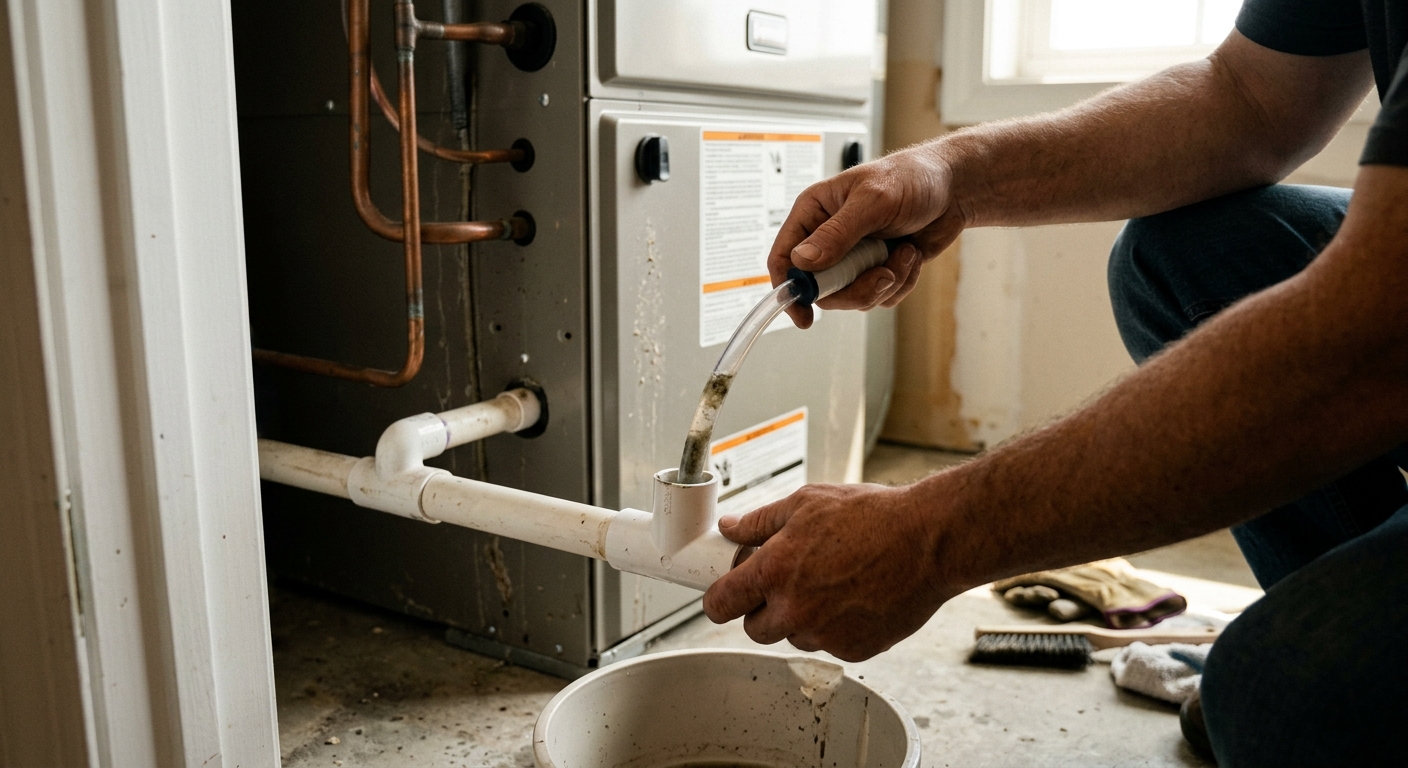
- Locate the condensate drain access port, a capped PVC pipe (usually 3/4-inch diameter) near the air handler, often labeled ‘condensate’ or ‘drain’. Remove the cap.
- Slowly pour 1/4 cup of distilled white vinegar directly into the access port. Vinegar is mildly acidic and kills algae and mold without damaging PVC or harming the drain system.
- Wait 30 minutes for the vinegar to work through the line, then flush with 1 cup of clean water to push the solution through.
- Locate the outdoor end of the drain line (usually exits through the exterior wall or near the outdoor unit) and confirm water is dripping out, confirming the line is clear.
- Replace the access cap, restore power, and return the thermostat to normal settings. Repeat every 1 to 3 months during cooling season.
- Turn off the AC at the thermostat and the breaker or disconnect switch. Use towels or a shallow pan to soak up any standing water in the secondary drain pan before proceeding.
- Go outside and find where the condensate drain line exits the house. It is typically a 3/4-inch PVC pipe coming through the foundation wall or exterior wall, often near the outdoor condenser unit.
- Seal the wet-dry vacuum hose tightly over the end of the outdoor drain pipe. Use duct tape or a rubber coupling to create a good seal so suction is not lost.
- Run the wet-dry vacuum on its highest suction setting for 2 to 3 minutes. The suction will pull the clog (algae plug, debris, or standing water) out from the outdoor end of the line.
- Return inside and pour 1/4 cup of distilled white vinegar into the indoor access port, followed by 1 cup of water, to flush any remaining residue and treat the line against future algae growth.
- Check the outdoor end again to confirm clean water flows freely. Inspect the secondary drain pan and dry it completely with towels. Replace the access cap, restore power, and monitor the system for the next hour to confirm normal operation.
- Call a licensed HVAC technician and describe the symptoms: standing water in the drain pan, AC not cooling, float switch tripped, or water stains near the air handler.
- Ask the technician to perform a nitrogen flush of the drain line, which uses compressed nitrogen to blast clogs out more thoroughly than a vacuum alone.
- Request inspection of the P-trap (if present) and the secondary drain pan for rust, cracks, or mold that may need pan treatment or replacement.
- Ask whether the technician can install a condensate drain line treatment tablet dispenser at the access port, which releases slow-dissolve algaecide tablets over the course of the season for around $10 to $20 per year.
- If mold is found inside the air handler cabinet or drain pan, request a coil and pan cleaning with an EPA-registered HVAC coil cleaner, which typically adds $50 to $150 to the service call but prevents spore circulation through the home.
Why It Works: The Benefits
A single condensate overflow event can cause $1,000 to $3,000 in drywall, flooring, and insulation repairs. Regular drain cleaning eliminates the most common cause of non-weather-related water damage in homes with central AC.
Emergency HVAC calls to clear a clogged drain and reset a float switch cost $150 to $300 on a normal day and significantly more on weekends or holidays. Spending $5 on distilled white vinegar twice a year makes those calls unnecessary.
A partially blocked drain causes the drain pan to hold standing water, which raises the humidity level around the evaporator coil. Higher coil humidity forces the system to work harder to dehumidify the air, increasing energy consumption by an estimated 5 to 10%.
Chronic moisture around the air handler cabinet accelerates rust on the cabinet, corrosion on electrical components, and deterioration of the insulation wrap on refrigerant lines. Keeping the drain clear helps the entire unit last closer to its 15 to 20 year rated lifespan.
A clean drain line means no standing water in the pan and no wet conditions around the air handler, eliminating a primary mold growth site. Mold remediation inside ductwork costs $500 to $2,000 and is entirely avoidable with routine maintenance.
💰 Savings Impact by Action
Routine drain cleaning prevents condensate overflow, which is responsible for the vast majority of non-weather HVAC-related water damage claims averaging $1,000 to $3,000 per incident.
An estimated 80% of no-cooling emergency calls in summer are caused by float switch trips from clogged drains, all of which are preventable with monthly or seasonal maintenance.
Eliminating standing water in the drain pan reduces humidity around the evaporator coil, recovering up to 8% in cooling efficiency lost to elevated coil moisture load.
Keeping the drain pan dry eliminates the primary moisture source for mold colonization in the air handler, reducing mold remediation risk by an estimated 90% for this specific cause.
🏠 Key Concepts Explained
The Science Behind It
Air conditioning works by passing warm indoor air across a very cold evaporator coil, typically chilled to 35 to 50 degrees Fahrenheit. When warm humid air contacts that cold surface, moisture condenses on the coil exactly the way water beads up on a cold glass of water on a humid day. This condensation drips off the coil and into the drain pan below. On a typical summer day in a humid climate, a 3-ton residential AC system may remove 15 to 20 gallons of water from the indoor air this way, and all of that water exits through the condensate drain line.
The interior of a condensate drain line is a uniquely hospitable environment for biological growth. The pipe stays consistently wet, is warm from surrounding ambient air, and is dark throughout its length. Algae, slime molds, and biofilm-forming bacteria colonize the pipe walls and slowly narrow the flow path. In high-humidity regions like the Southeast, a new drain line can develop a flow-restricting biofilm layer within a single cooling season without treatment. The clog typically forms near the indoor end of the line or at any low point where flow slows, and once established, it acts as a net that catches additional debris and accelerates the blockage.
The reason vinegar works as a preventive treatment is its acetic acid content, which disrupts the cell membranes of algae and mold at concentrations as low as 5%, which is the standard concentration of grocery store white vinegar. The acid does not damage PVC, glued fittings, or standard drain pan materials, making it safe for routine use. Wet-dry vacuum suction works for established clogs because it reverses the airflow direction in the pipe, pulling the plug of biological material toward the outdoor opening rather than trying to push it through. Most condensate line clogs are soft and yield to suction within two to three minutes of continuous vacuum pressure at the outdoor end.
Frequently Asked Questions
▼ My AC stopped working and there is water in the drain pan. What do I do first?
This is almost certainly a float switch trip caused by a blocked drain. Turn off the system at the thermostat, then use towels to remove the standing water from the pan. Immediately try the wet-dry vacuum method at the outdoor end of the drain line, which clears most clogs in under 5 minutes. Once the line is clear and the pan is dry, restore power and the float switch should reset automatically and allow the system to run.
▼ I poured vinegar down the drain but water is still not coming out the outdoor end. Is it fully blocked?
Yes, if no water drips from the outdoor drain opening after a vinegar flush and a cup of water, the line is likely fully or nearly fully blocked. Move to the wet-dry vacuum approach, sealing the vacuum hose tightly over the outdoor drain opening and running it on maximum suction for 2 to 3 full minutes. If suction alone does not clear it, call an HVAC technician to perform a nitrogen purge, which is more powerful than household vacuum suction.
▼ Can I use bleach instead of vinegar to clean my condensate drain?
Diluted bleach (one tablespoon per cup of water) is effective at killing algae and is commonly recommended, but it should only be used in systems where all drain components are PVC plastic. Bleach corrodes copper drain pans and can degrade certain rubber fittings over time. Distilled white vinegar is safer, effective at the same biological targets, and works for all drain configurations, which is why most HVAC manufacturers and technicians prefer it for routine maintenance.
▼ How do I find my condensate drain line if I have never seen it before?
Start at your indoor air handler (the large unit in the closet, basement, attic, or utility room). Look for a 3/4-inch white or gray PVC pipe exiting the bottom or side of the unit, usually with a removable cap or a T-fitting with a cap. Follow that pipe toward an exterior wall or floor drain. The outdoor exit is typically a short pipe stub coming through the exterior wall near the foundation, often near the outdoor condenser unit, dripping water when the AC is running normally.
▼ My house is new construction. Do I really need to worry about this?
Yes, new systems can develop algae clogs within the first full cooling season, especially in humid climates. Builders sometimes leave PVC shavings or debris inside drain lines during installation, which accelerate early clogging. Start your vinegar flush routine at the beginning of the first cooling season and add a drain pan treatment tablet as an extra precaution.
Quick Tips
- Take a photo of your condensate drain access port location and the outdoor exit point right now so you can find both quickly when you need them during a hot summer emergency.
- Set a recurring phone reminder for April 1 and July 1 each year labeled ‘AC drain flush’ so the task never gets skipped during cooling season.
- If your air handler is located in the attic, check the secondary drain pan quarterly. Attic air handlers have a longer way to fall if the overflow hits the ceiling below, and damage is typically more severe.
- Mark the outdoor end of your condensate drain line with a small piece of bright tape or paint so you can find it quickly when you need to attach a vacuum.
Variations for Your Situation
- Apartment or Condo: Renters typically cannot access the main condensate drain line, but you can look for a small plastic access panel near a fan coil unit or mini-split wall unit and check for standing water or musty odors near the unit. Report any water dripping from the unit or wet spots below it to your building manager immediately, as you are not responsible for drain maintenance but you are responsible for documenting and reporting it. For window AC units, clean the drain hole at the bottom rear of the unit with a pipe cleaner or cotton swab every 4 to 6 weeks during the cooling season.
- Tight Budget (under $20): The vinegar flush approach costs essentially nothing if you already have white vinegar at home. The only investment is a $10 to $15 pack of condensate pan tablets at the start of the season. If you do not own a wet-dry vacuum, borrow one from a neighbor or use a turkey baster to remove standing water from the pan in an emergency, then clear the clog with extended vinegar soaking (let it sit for 2 to 3 hours before flushing) rather than suction. This slower method works on partial clogs and is completely free.
- Older Home (pre-1980): Homes built before 1980 may have galvanized metal drain pans rather than plastic, and some may use older-style copper drain lines rather than PVC. Skip bleach entirely on these systems and stick to vinegar only. Inspect the metal pan carefully for rust-through holes or hairline cracks, as older pans are a common failure point independent of the drain line itself. If you find rust damage, replacing the pan (a $50 to $150 DIY job) is essential before the next cooling season.