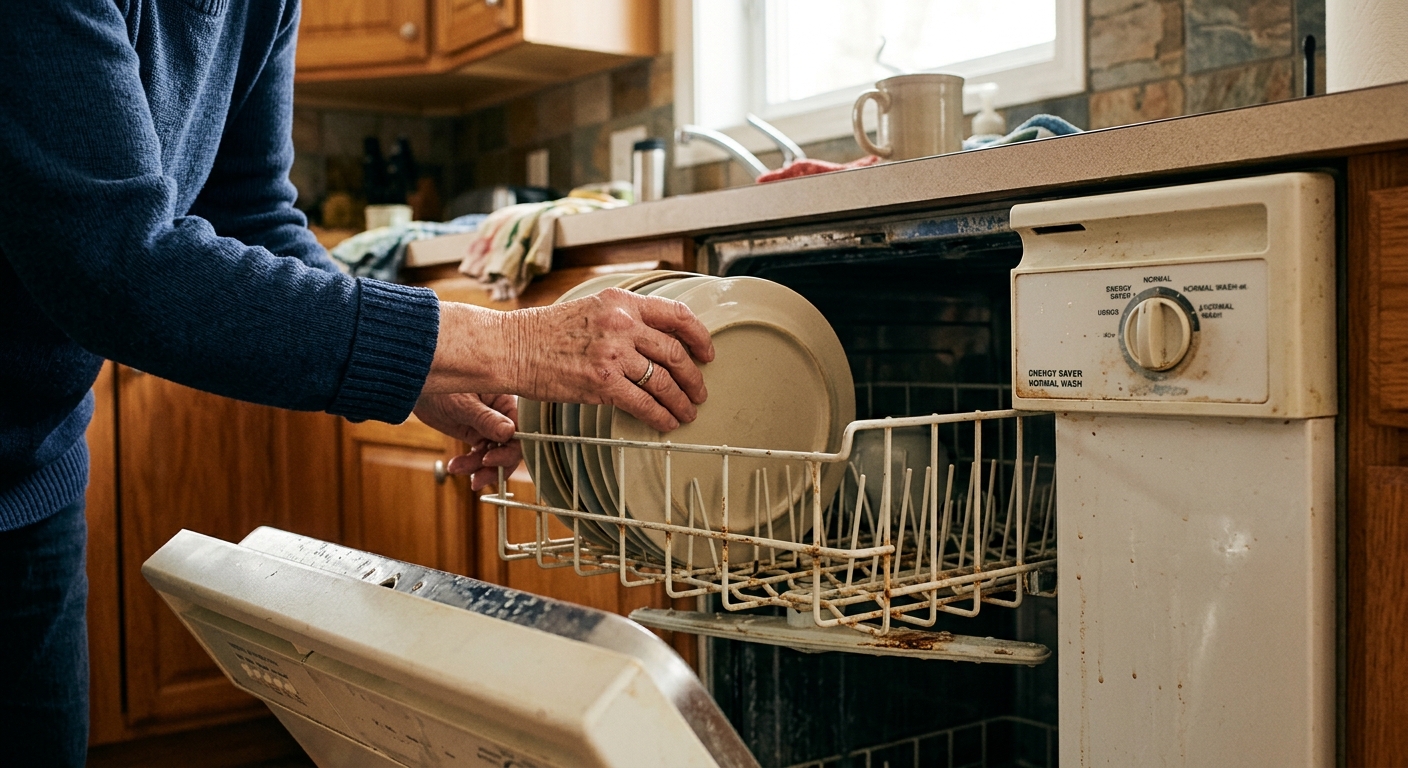
That old dishwasher humming away in your kitchen might feel like a reliable workhorse, but it could quietly be draining your wallet every single night. Dishwashers manufactured before 2013 were built to a much lower efficiency standard, using anywhere from 6 to 14 gallons of water per cycle compared to just 3 to 4 gallons for a modern ENERGY STAR-certified unit. Multiply that gap across 365 cycles a year and you’re looking at a serious difference in your water and energy bills.
The hidden cost goes beyond water. Older dishwashers rely on longer, hotter cycles and less efficient motors and heating elements to compensate for their design limitations. A typical pre-2000 dishwasher can consume 1,400 to 2,000 kWh of electricity annually, while a new ENERGY STAR model uses as little as 270 kWh per year. At the national average electricity rate of around $0.16 per kWh, that gap alone represents $180 to $280 in extra electricity costs every year, before you even factor in water.
This post walks you through exactly how to calculate what your current dishwasher is costing you, how to compare that against the purchase price of a new unit, and what steps you can take right now to reduce your costs whether you decide to upgrade or not. You’ll find real numbers, a simple payback calculation, and a tiered set of actions from free tweaks to a full replacement strategy.
What You’ll Need
Click on an item below to shop for the recommended items for this recipe on Amazon.
As an Amazon Associate, we earn from qualifying purchases.
How to Do It
- Check your water heater thermostat and lower it to 120 degrees F if it is currently set higher. This is safe for households without immune-compromised members and cuts water heating costs by 4 to 22% immediately.
- Switch to the air-dry or heated-dry-off setting on your dishwasher. Skipping the heated drying cycle alone saves 15 to 50% of the energy used per cycle, since the heating element runs continuously during that phase.
- Only run the dishwasher when it is fully loaded. A full load uses the same water and energy as a half-full load, so maximizing each cycle effectively cuts your per-dish cost in half.
- Use the ‘light wash’ or ‘eco’ cycle for everyday loads instead of the normal or heavy cycle. On older machines this can reduce cycle time by 20 to 30 minutes, lowering energy use meaningfully.
- Scrape food off dishes but skip pre-rinsing under the tap. Pre-rinsing can waste 6 to 20 gallons of hot water per load, often more than the dishwasher itself uses, and modern detergents are formulated to work without pre-rinsing.
- Find your dishwasher’s model number (usually on the inside door edge) and look up its energy guide label or DOE test data online. Note the listed kWh per year and gallons per cycle.
- Calculate your current annual operating cost: multiply the listed kWh per year by your electricity rate (found on your utility bill), then multiply the gallons per cycle by 365 and multiply by your water and sewer rate per gallon (also on your bill). Add these two numbers together.
- Look up the operating cost of a comparable ENERGY STAR dishwasher at energystar.gov. Most certified models list estimated annual operating costs around $35 to $50 per year all-in. Subtract this from your current annual cost to find your annual savings from replacing.
- Divide the purchase price of a new dishwasher (typically $450 to $700 for a reliable mid-range ENERGY STAR model) by your annual savings to get your simple payback period in years. If the result is under 7 years, replacement is financially justified on energy alone.
- Factor in repair risk: if your dishwasher is over 10 years old, add $150 to $300 to the cost of keeping it to account for the statistically likely repair within the next 2 years. This often shortens the effective payback period for a new unit to 2 to 4 years.
- If replacing, install the new unit yourself if you are comfortable with basic plumbing connections. Dishwashers connect to a standard hot water supply valve and a drain line under the sink. A DIY install saves $100 to $200 in labor. Turn off the water supply valve under the sink, disconnect the old supply line and drain hose, slide out the old unit, and reverse the process for the new one following the manufacturer’s instructions.
- Before purchasing, visit your local utility’s website or dsireusa.org to search for appliance rebates in your area. Many utilities offer $25 to $100 rebates on ENERGY STAR-certified dishwashers, and some state programs offer additional incentives.
- Choose an ENERGY STAR-certified model with an AEF rating of 0.87 or higher and a water use of 3.5 gallons per cycle or less. Brands like Bosch, Miele, and LG consistently rank at the top for efficiency and reliability.
- Purchase through a retailer that offers haul-away of the old unit (most big-box appliance departments do this at no charge or for $15 to $25), which saves you disposal effort.
- Schedule professional installation through the retailer or an independent plumber. Professional installation typically costs $100 to $200 and ensures the unit is level, the door seal is properly seated, and the drain is configured to prevent backflow.
- After installation, register the appliance for the manufacturer warranty and submit any utility or state rebate forms within the required window (usually 30 to 90 days from purchase date with a copy of the receipt and the ENERGY STAR certification label).
Why It Works: The Benefits
Replacing a pre-2000 dishwasher with an ENERGY STAR model can cut dishwasher electricity consumption by up to 230 kWh per year, saving $35 to $50 annually on electricity at average U.S. rates. Combined with water savings, total annual savings typically reach $60 to $120 per year.
An ENERGY STAR dishwasher uses 3 to 4 gallons per cycle versus 10 to 14 gallons for pre-2000 models. Running daily, that difference is 2,000 to 3,600 gallons saved per year, which translates to $20 to $50 annually depending on your local water and sewer rates.
Lowering your water heater from 140 degrees F to 120 degrees F, which becomes safe once you have a dishwasher with a booster heater, saves approximately 4 to 22% on water heating costs. For a typical household spending $250 to $600 per year on water heating, that is $10 to $130 in additional annual savings.
Modern dishwashers use sensor-driven wash cycles and more targeted spray patterns that actually clean better with less water and heat. Fewer rewash cycles and less handwashing mean you’re not offsetting the appliance savings with extra hot water use at the sink.
Dishwashers older than 10 to 12 years are entering their high-failure-rate period. Average repair costs run $150 to $300 per visit, and parts for older units can be difficult to source. A new mid-range unit ($400 to $700) eliminates this risk and typically comes with a 1 to 2 year manufacturer warranty.
💰 Savings Impact by Action
Disabling the heated dry cycle reduces per-cycle energy use by 15 to 50% since the drying element can draw up to 1,500 watts for 20 to 45 minutes.
Replacing a pre-2000 dishwasher with an ENERGY STAR model reduces total annual dishwasher energy consumption by 40 to 70% based on DOE comparative testing data.
Running only full loads instead of half-full loads effectively cuts your energy and water cost per dish by up to 50%, averaging about 20% in real-world bill reduction for most households.
Lowering your water heater from 140 to 120 degrees F once you have a dishwasher with a booster heater reduces water heating costs by 4 to 22%, averaging around 10% for a typical household.
Eliminating the habit of pre-rinsing under the tap saves 6 to 20 gallons of hot water per load, reducing associated water heating and water costs by roughly 8% annually for daily users.
🏠 Key Concepts Explained
The Science Behind It
The energy cost of running a dishwasher breaks down into three components: heating the incoming water, running the circulation pump and controls, and heating the air inside the tub for drying. Of these, water heating dominates, accounting for roughly 80% of total energy consumption per cycle according to DOE appliance testing. This is why gallons-per-cycle is the single most important efficiency number to look at. Less water to heat means dramatically less energy consumed, even if the machine runs for a similar duration.
Modern dishwashers achieve their efficiency gains primarily through smarter water use rather than better heating elements. Precision spray arms, soil sensors that adjust water volume to actual load dirtiness, and recirculation systems that filter and reuse wash water mid-cycle all combine to do more cleaning with fewer gallons. The internal booster heater is another important innovation: instead of requiring the home’s central water heater to deliver 140-degree water to the machine, the booster heater raises incoming 120-degree water to the sanitizing temperature only at the point of use and only for the duration needed, eliminating the standby heat loss of keeping an entire 40 to 80 gallon tank at the higher temperature all day.
The drying phase is where the largest easy win exists on any machine, old or new. Conventional heated dry uses a resistive heating element that can draw 900 to 1,500 watts continuously for 20 to 45 minutes, adding 0.3 to 1.1 kWh to each cycle. Condensation drying, used by most European-style dishwashers, achieves drying by rinsing with very hot water so that residual heat evaporates moisture onto the cooler stainless steel tub walls, requiring zero additional electricity. Simply opening the door a crack at the end of the wash cycle accomplishes a similar result on any machine and costs nothing.
Frequently Asked Questions
▼ How do I find out exactly how much my current dishwasher costs to run per year?
Find the model number on the inside door edge and search it on the DOE Appliance Standards database or the original Energy Guide label (often available on manufacturer support pages). Note the annual kWh estimate and multiply by your electricity rate per kWh from your utility bill. Then multiply the gallons-per-cycle rating by 365 and by your combined water and sewer rate per gallon. Add the two results together for your true annual operating cost.
▼ My dishwasher is 12 years old but seems to work fine. Is it really worth replacing?
A 12-year-old dishwasher is statistically near the end of its cost-effective life. Average dishwasher lifespan is 9 to 12 years, and repair costs in this period often exceed the value of extending the appliance’s life. Run the payback calculation in the DIY approach above: if your current unit uses more than 4 gallons per cycle and 400 kWh per year, the annual savings from a new ENERGY STAR model will likely pay back a $500 to $600 unit in 4 to 6 years while also eliminating repair risk.
▼ What if I have a well and septic system? Do the water savings still matter?
Yes, arguably more so. While you do not pay a metered water bill, every gallon that goes through your dishwasher is groundwater pumped by an electric well pump and treated water going into your septic system. Reducing water use extends septic system life, reduces pump cycling costs, and lowers the risk of system overload. The energy savings from heating less water remain identical to a municipal water connection.
▼ Can I get a tax credit for buying a new dishwasher?
As of 2024, dishwashers do not qualify for federal tax credits under the Inflation Reduction Act, which is focused on heating, cooling, and building envelope improvements. However, many state and local utility programs offer rebates of $25 to $100 for ENERGY STAR-certified dishwashers. Check dsireusa.org and your utility’s website to find what is available in your area before you buy.
▼ How long before I actually see lower bills after replacing my dishwasher?
You should see a measurable difference in your water and electricity bills within the first full billing cycle after replacement, typically 30 days. The savings will show up as a combination of lower electricity consumption and lower water volume on your respective utility bills. If your bills do not change, double-check that you have turned off the heated dry feature on the new machine and that your water heater thermostat has been adjusted to 120 degrees F.
Quick Tips
- Load dishes so spray arms can rotate freely. Blocked spray arms force longer cycles and leave dishes dirty, which leads to rewashing that doubles your energy use for that load.
- Use a dishwasher cleaner tablet once a month in an older machine. Mineral scale buildup on heating elements forces them to work harder and consume more electricity to reach the target temperature.
- Run the dishwasher late at night if your utility offers time-of-use pricing. Off-peak rates can be 30 to 50% lower than peak daytime rates in many markets, delivering meaningful savings with zero additional effort.
- If you are keeping an older dishwasher, consider plugging it into a smart outlet to measure its actual wattage draw per cycle. Devices like the Kill-A-Watt meter cost $25 and give you real consumption data for your specific machine rather than relying on estimates.
Variations for Your Situation
- Apartment/Rental: If you rent and the dishwasher is provided by your landlord, focus entirely on the free optimizations in the quick_fix approach: turn off heated dry, run only full loads, skip pre-rinsing, and use the eco cycle. These changes cost nothing and require no landlord permission. If your unit lacks a dishwasher and you are considering a countertop model, compact countertop dishwashers use only 2 to 3 gallons per cycle and cost $200 to $350, making them more efficient than handwashing for small households.
- Tight Budget (under $50): Skip the replacement calculation for now and focus on the zero-cost habit changes that deliver the highest return. Turning off heated dry, loading fully, and eliminating pre-rinsing can reduce your dishwasher-related energy and water costs by 20 to 35% with no spending. If you have $25, a Kill-A-Watt meter will give you exact consumption data to build a replacement business case for later. If you have $15, replacing old deteriorated door gaskets on an older machine can stop air leaks that force longer heating cycles.
- Older Home (pre-1980): Homes built before 1980 may have original galvanized or copper supply lines under the sink that are corroded or undersized, and drain connections may not include a high-loop or air gap required by current plumbing codes. Before replacing your dishwasher, inspect the supply shut-off valve under the sink to confirm it actually closes fully, as old valves often fail to seal completely. Budget an extra $50 to $100 to update the supply line, drain configuration, and shut-off valve at the same time as your dishwasher replacement. This is also an opportunity to verify your electrical outlet under the sink is a grounded three-prong type, which is required for safe appliance operation.