If you have ever added insulation to your attic and wondered why your energy bills barely budged, there is a good chance you skipped the most important step first: air sealing. Insulation slows heat transfer, but it does almost nothing to stop conditioned air from physically escaping through gaps, cracks, and penetrations in your home’s envelope. Those two problems require two different solutions, and when you tackle them in the right order, the combined effect is far greater than the sum of its parts.
The U.S. Department of Energy estimates that air leakage accounts for 25 to 40% of the energy used for heating and cooling in a typical home. Add inadequate insulation on top of that, and you are essentially trying to heat or cool a leaky bucket. Sealing those leaks first, then layering in proper insulation, creates a complete thermal barrier that works as a system rather than two disconnected fixes.
This guide walks you through exactly how to combine air sealing and insulation for maximum impact, whether you are a weekend DIYer with a caulk gun and an afternoon free, or someone ready to call in a professional for a whole-house energy upgrade. We will cover the building science behind why order matters, where the biggest opportunities are in most homes, and what kind of savings you can realistically expect to see on your utility bills.
What You’ll Need
Click on an item below to shop for the recommended items for this recipe on Amazon.
As an Amazon Associate, we earn from qualifying purchases.
How to Do It
- Buy one can of low-expansion spray foam (for gaps up to 3 inches) and one tube of paintable acrylic latex caulk. These two products handle 90% of accessible sealing jobs.
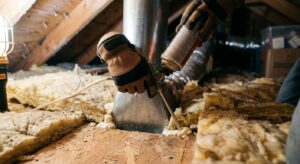
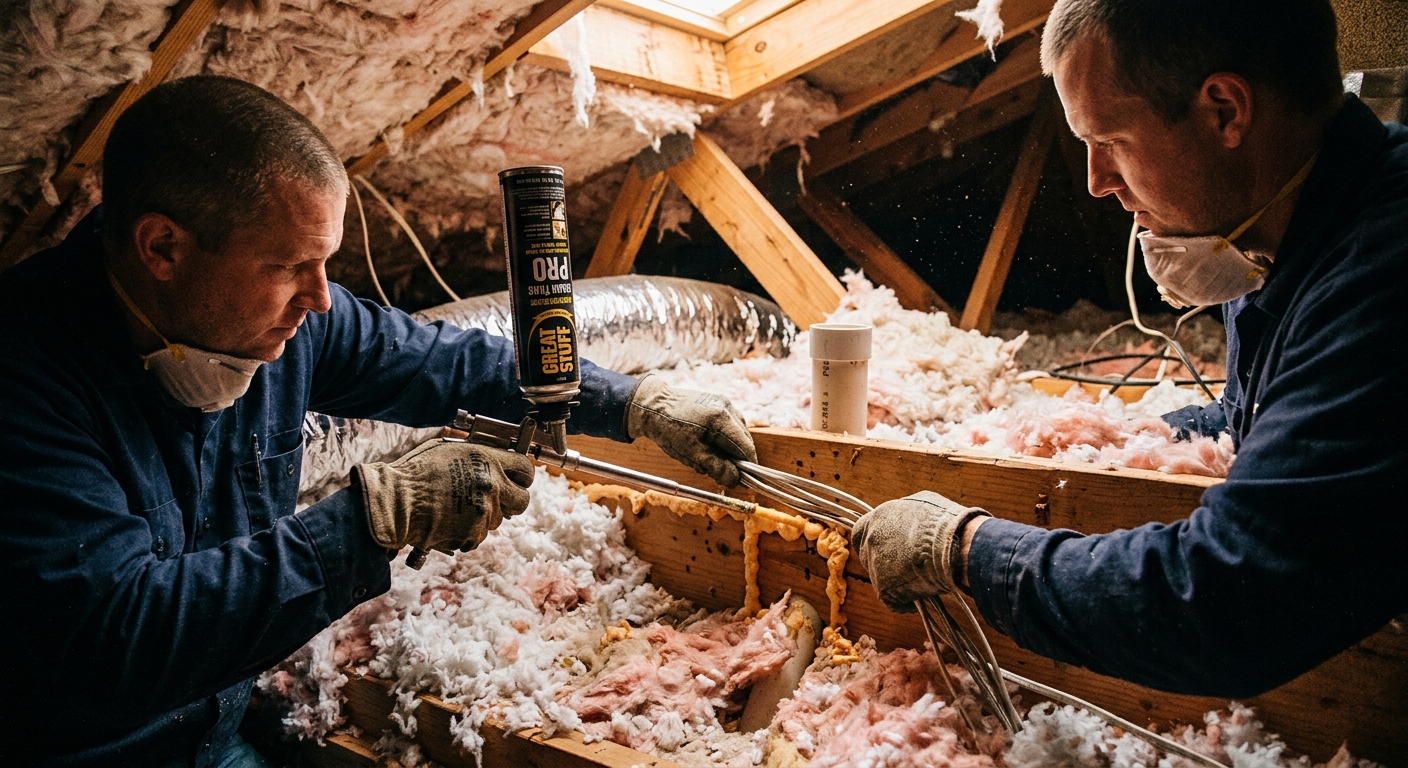
- Go into your attic on a cool morning. Use a flashlight to find and seal the top plates of interior walls, any gaps around plumbing pipes or electrical wires passing through the ceiling drywall, and the tops of interior partition walls. Apply foam to gaps larger than half an inch and caulk to smaller cracks.
- Seal all recessed light cans from above in the attic using either foam gaskets designed for recessed lights or fire-rated intumescent caulk around the perimeter of each can housing.
- Return to your living space and caulk around every window and door frame where the trim meets the wall, along baseboards on exterior walls, and around any penetrations (pipes, wires, vents) through exterior walls.
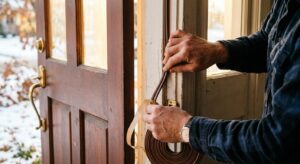
- Add door sweeps or threshold seals to any exterior door where you can see daylight underneath or feel cold air on a windy day.
- On a cold or windy day, do a final walkthrough with a lit incense stick or smoke pencil held near suspected leak points. Watch for the smoke to flutter or get pulled toward a gap, then mark those spots for a follow-up sealing pass.
- Measure your attic square footage and current insulation depth. Use the DOE’s ZIP-code insulation calculator (energystar.gov) to find your target R-value. Most U.S. climates call for R-38 to R-60 in the attic.
- Before adding any insulation, complete the full air sealing pass from the Quick Fix approach above, plus seal any larger attic bypasses (such as open tops of interior stud walls or gaps around flue pipes) with rigid foam board cut to fit and foamed in place.
- For flue pipes and chimneys, use sheet metal flashing and high-temperature caulk rated for 500 degrees F rather than regular spray foam, which can melt or off-gas near heat sources.
- Install baffles (cardboard or foam ventilation channels) from the eave vents to at least 12 inches above your final insulation level before adding any material. This preserves airflow from soffit to ridge and prevents moisture buildup.
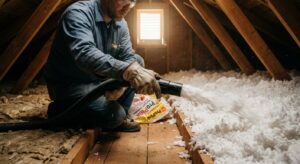
- Rent a blow-in insulation machine from a home improvement store (often free or low-cost with purchase of bags). Load with cellulose (recommended for DIY due to its air-sealing properties and recycled content) and blow to the depth matching your target R-value. Most cellulose needs about 3.7 inches per R-13.
- After completing the job, check that all attic hatch covers are also insulated and weather-stripped. An uninsulated hatch is like a hole in your ceiling and is one of the most commonly overlooked weak points in attic work.
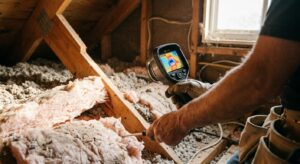
- Hire a BPI-certified energy auditor or RESNET HERS rater to perform a blower door test and thermal imaging scan. This diagnostic will identify your exact leakage rate and show heat loss patterns invisible to the naked eye, so the contractor seals the right spots rather than guessing.
- Request a detailed scope of work that includes: attic air sealing to all bypasses, dense-pack insulation in exterior wall cavities (which requires drilling small holes and blowing under pressure), attic insulation upgrade to R-value code for your zone, and crawlspace or basement rim joist sealing and insulation.
- Ask the contractor to specify materials: closed-cell spray foam for rim joists and irregular gaps (R-6.5 per inch), dense-pack cellulose or fiberglass for wall cavities (R-3.5 to R-4 per inch), and blown cellulose or fiberglass for attic floors.
- Before work begins, confirm the contractor will perform a post-job blower door test to verify results. A well-executed professional air sealing and insulation project should reduce leakage by 30 to 50% from baseline.
- Submit for the 30% federal Residential Clean Energy and Energy Efficiency tax credit (Form 5695) and any applicable utility rebates. File for rebates immediately after project completion since many programs have annual caps that fill early in the year.
Why It Works: The Benefits
Combining air sealing with insulation upgrades to current DOE code levels (R-38 to R-60 in attics depending on climate zone) can reduce total heating and cooling costs by 20 to 40%, saving a typical household $300 to $600 per year based on average U.S. energy spending.
Leaky envelopes create cold spots near exterior walls and drafty corners. Sealing and insulating together eliminates the pressure imbalances and conductive losses that cause those cold zones, making every room feel closer to your thermostat setting.
When your home holds conditioned air better, your furnace and AC run shorter, less frequent cycles to maintain setpoint. This can extend equipment life by several years and reduce maintenance costs, since short-cycling is one of the leading causes of early system failure.
Uncontrolled air infiltration pulls in pollen, dust, car exhaust, and humidity through gaps in the envelope. Sealing those gaps means outdoor air enters only through filtered ventilation paths, reducing allergens and humidity swings inside your home.
The Inflation Reduction Act provides a 30% federal tax credit (up to $1,200 per year) on qualifying insulation and air sealing materials. Many utilities also offer rebates of $100 to $500 for insulation upgrades, meaningfully shortening the payback period.
💰 Savings Impact by Action
Sealing attic bypasses before insulating reduces total house air leakage by up to 20%, allowing existing insulation to perform closer to its rated R-value.
Upgrading attic insulation to the DOE-recommended R-38 to R-60 reduces heating and cooling energy use by 10 to 15% in a typical single-family home.
Performing air sealing and insulation together delivers 30 to 40% total savings because sealing maximizes the effective performance of every inch of insulation added.
Sealing and insulating basement rim joists with closed-cell spray foam or rigid foam plus caulk reduces infiltration-related heat loss by up to 10% in two-story homes.
Adding dense-pack insulation to empty exterior wall cavities in pre-1980 homes can reduce wall heat loss by 60 to 70%, contributing 10 to 12% to total whole-house savings.
🏠 Key Concepts Explained
The Science Behind It
Heat moves in three ways: conduction (through solid materials), convection (through moving air and fluids), and radiation (through electromagnetic waves). Insulation primarily addresses conduction by trapping still air in a fibrous or foam matrix. But when air itself is moving through gaps in your building envelope, it bypasses the insulation entirely, carrying heat with it through convection. This is why a perfectly insulated wall with a one-inch gap at the top and bottom performs almost as poorly as an uninsulated wall on a windy day.
The stack effect amplifies this problem continuously. Because warm air is less dense, it rises and accumulates at the top of your home, creating slight positive pressure at the ceiling level and slight negative pressure at the floor level. This pressure differential pulls cold outside air in through every low crack and pushes warm interior air out through every high crack, running like a slow chimney around the clock. The taller your home and the greater the indoor-outdoor temperature difference, the stronger this effect. Sealing the top of the envelope, specifically the attic floor, delivers the biggest disruption to this cycle because it cuts off the primary exhaust path.
When you combine air sealing with insulation, you address both the conduction pathway and the convection pathway simultaneously. The sealed gaps stop the air movement that was carrying heat around your insulation, and the insulation slows the heat that would otherwise conduct through the building materials themselves. Research from Oak Ridge National Laboratory confirms that air sealing alone can improve the effective thermal performance of existing insulation by 20 to 40% without adding a single additional inch of material, because it allows the insulation to finally perform at close to its rated R-value rather than being short-circuited by airflow around it.
Frequently Asked Questions
▼ I added attic insulation last year but my bills are the same. What did I miss?
The most likely culprit is attic bypasses that were not sealed before the insulation was added. Open-top interior walls, plumbing chases, and recessed light cans allow warm air to pump directly into the attic regardless of how much insulation sits on the floor. You will need to pull back sections of insulation over suspected bypass locations to seal them, then replace the insulation. A thermal imaging camera (available for rent at some tool libraries) can help pinpoint the exact locations without removing everything.
▼ My house feels drafty even though I added weather stripping and new windows. What else should I check?
New windows and door weather stripping address only a small fraction of total envelope leakage. The bigger sources are typically attic bypasses, rim joists in the basement or crawlspace, recessed light cans, and gaps around plumbing and electrical penetrations through exterior walls. Have a blower door test performed to measure total leakage and use a smoke pencil during depressurization to find the actual locations. In most pre-1990 homes, the attic and basement rim joists together account for more than half of all air leakage.
▼ Can I do this in an older home that might have asbestos insulation?
Do not disturb existing insulation in a pre-1980 home until you have had it tested. Vermiculite attic insulation (a gray, pebble-like material) has a high probability of containing asbestos and should be tested by a certified lab before any work is done. Older fiberglass or cellulose is unlikely to contain asbestos but should still be evaluated if you are uncertain of the material. If asbestos is confirmed, hire a licensed abatement contractor to remove it before any sealing or insulation work proceeds.
▼ How do I know if I have enough insulation already and just need air sealing?
Take a ruler into your attic and measure the depth of existing insulation. If you have fiberglass batts, roughly 3.5 inches equals R-13 and 5.5 inches equals R-19. If you have blown cellulose, 3.7 inches is about R-13. Compare to the DOE recommended levels for your ZIP code at energystar.gov. If you are already at or above the recommended level, focus your budget entirely on air sealing, which is where you will get the better return. If you are below recommended levels, do both in order: seal first, then insulate.
▼ Will sealing my home too tightly cause moisture or air quality problems?
A well-sealed home requires intentional mechanical ventilation, and most building codes since 2012 require it in new construction for this reason. If your home is older and you achieve significant tightness (below about 5 ACH50 on a blower door test), consider adding or upgrading a bath exhaust fan that runs on a timer, or installing a heat recovery ventilator (HRV) to bring in fresh filtered air without losing the energy you have invested in conditioning it. For most DIY projects that achieve moderate sealing, existing natural ventilation is typically adequate, but have a combustion safety check done if you have any gas appliances.
Quick Tips
- Always air seal before insulating, never after. You cannot effectively seal attic bypasses buried under a foot of blown-in material.
- Cellulose insulation has slight air-resistance properties that fiberglass batts do not, making it a better choice for blown-in attic applications when combined with good air sealing.
- Focus your sealing effort on the attic floor and basement or crawlspace ceiling first. These two planes are where the stack effect does the most work and where your effort delivers the most return.
- Insulate and seal your attic access hatch. A standard pull-down attic stair has an R-value of about R-1 to R-2 and typically has zero air sealing. Prefabricated insulated hatch covers cost $30 to $80 and can deliver a measurable reduction in heating bills on their own.
Variations for Your Situation
- Apartment/Rental: Renters cannot modify central HVAC or add attic insulation, but meaningful air sealing is possible with landlord-friendly products. Focus on rope caulk (removable and leaves no residue) around leaky window frames, door draft stoppers at thresholds, outlet gaskets behind face plates on exterior walls, and adhesive-backed foam tape around drafty window sashes. These products cost $20 to $50 total, require no tools, and can reduce drafts noticeably. If your apartment has radiators or baseboard heat, adding reflective radiator panels behind units on exterior walls costs about $20 and can reduce heat loss through that wall by 20 to 30%.
- Tight Budget (under $50): Focus exclusively on the three highest-return sealing actions. First, buy a can of low-expansion spray foam ($8) and seal all attic penetrations you can safely access through an existing hatch. Second, caulk around all window and door frames with a $4 tube of paintable caulk. Third, add foam gaskets behind electrical outlet and switch plates on exterior walls, a pack of 10 costs about $3. These three steps together can reduce infiltration by 10 to 15% with no equipment rental, no professional help, and less than two hours of work.
- Older Home (pre-1980): Homes built before modern energy codes typically have 3 to 5 times more air leakage than a new home and often have wall cavities with no insulation at all. Start with a professional energy audit to establish a baseline blower door number and identify the highest-priority areas. Budget for both attic sealing and dense-pack wall insulation (blown in through small drilled holes), since wall cavities in older homes often contribute 15 to 20% of total heat loss. Check for knob-and-tube wiring before any insulation work: most insulation contractors and code authorities prohibit covering active knob-and-tube wiring with insulation because of fire risk. Rewiring those circuits may be a prerequisite to the insulation upgrade.