Every winter, millions of homeowners crank up the thermostat while their furnace fights a losing battle against invisible air leaks. The culprit is rarely a broken heating system or missing insulation in the walls. More often, it is the thin gap running around your front door, the worn seal on the back entry, or the cracked weatherstripping on a side door that has not been replaced in a decade. These gaps may look minor, but a door with failed weatherstripping can leak as much conditioned air as a four-inch hole punched straight through the wall.
According to the U.S. Department of Energy, air leaks account for 25 to 40 percent of the energy used for heating and cooling in a typical home. Doors and operable windows are among the most common and most fixable sources of that leakage. Replacing the weatherstripping on a single exterior door can reduce drafts by up to 90 percent at that opening, and a whole-house weatherstripping project often saves homeowners $150 to $300 per year on heating alone, depending on climate and fuel costs.
This post covers everything you need to seal your home like a professional, from a five-minute foam tape fix that costs $3 at any hardware store, to a proper kerf-in door seal replacement that lasts 10 to 20 years. You will learn which weatherstripping materials actually hold up, how to diagnose your worst leaks in minutes, and how to calculate your real payback period so you can prioritize the fixes that matter most.
What You’ll Need
Click on an item below to shop for the recommended items for this recipe on Amazon.
As an Amazon Associate, we earn from qualifying purchases.
How to Do It
- Hold a stick of incense or a thin piece of tissue near the door perimeter on a windy day to identify where air is moving. Mark leaky spots with painter’s tape so you know exactly where to focus.
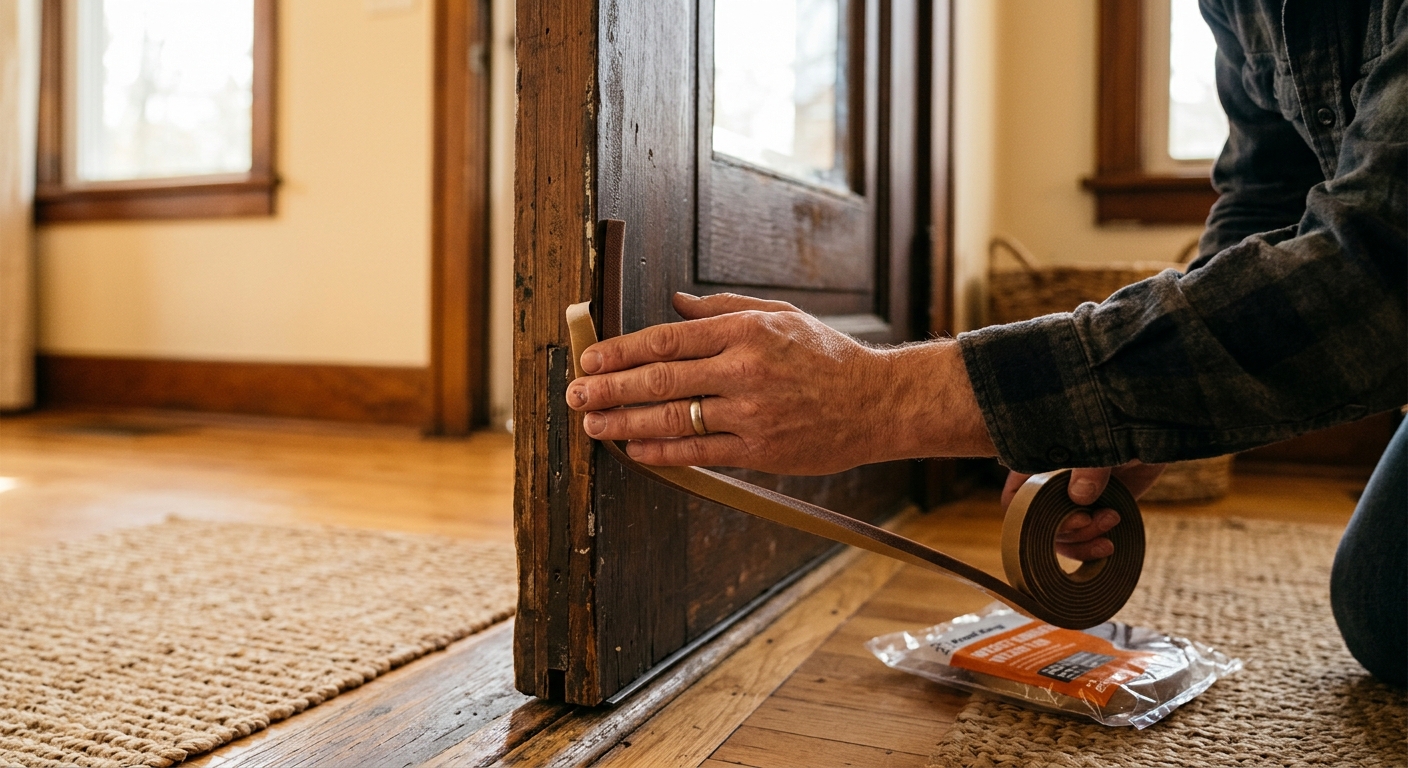
- Open the door fully and use a damp cloth to clean the door stop molding where the foam will adhere. Remove any old adhesive residue, dirt, or flaking paint. Dry the surface completely before applying tape.
- Measure the full perimeter of the door opening (two vertical sides plus the top horizontal section) and cut foam tape strips to length using scissors. Do not stretch the tape while cutting or applying it.
- Peel the backing from the foam tape and press it firmly onto the door stop molding along the side and top edges. Press firmly for 5 to 10 seconds per foot to activate the adhesive bond.
- Close the door slowly and check that it compresses the foam without binding or requiring extra force. If the door binds, you have used tape that is too thick. Switch to a thinner profile (3/16-inch is typically correct for most interior door stops).
- Add a door sweep to the bottom gap if air is also entering from below. A basic adhesive door sweep costs $6 to $12 and cuts under-door infiltration by 80 to 90 percent at that location.
- Use a flathead screwdriver or pry bar to carefully remove the existing weatherstripping from all three sides of the door frame. Pull staples or nails with pliers and scrape away any old adhesive or foam remnants. Inspect the door stop and jamb for rot or damage before proceeding.
- Measure the door height and width precisely. For spring bronze V-strip, cut strips 1/4 inch shorter than each measurement to allow the door to close without binding. For tubular vinyl bulb seal, cut to exact length.
- For spring bronze V-strip: open the flap of the V slightly with a flat tool so it will spring outward when the door closes. Nail or staple the strip to the door jamb with the open side of the V facing the exterior, using nails every 2 to 3 inches.
- For vinyl bulb seal with a kerf slot: use a utility knife to cut a clean channel (kerf) in the door stop if one does not already exist, then press the bulb seal spine into the kerf. It should snap in and stay without adhesive.
- Install a new heavy-duty door sweep or automatic door bottom on the bottom edge of the door itself. Adjust the sweep so it makes firm contact with the threshold without dragging excessively. Most adjustable sweeps use two screws on the door face for height calibration.
- Test the finished installation by closing the door, turning off interior lights, and shining a flashlight along the exterior perimeter at night. No visible light should pass through at any point. Adjust spring bronze tension or sweep height as needed until the seal is complete.
- Hire a licensed handyman or door specialist to assess whether the door slab itself is warped or whether the frame has shifted due to foundation settling or moisture. A gap that is wide at the top and narrow at the bottom almost always indicates a structural or hanging problem, not just a weatherstripping problem.
- Request that the professional adjust or replace the hinge system to bring the door back into square. Shimming the hinges by even 1/16 inch can close a gap that no amount of foam tape will fix.
- Ask for interlocking metal weatherstripping at the jambs, which provides the best possible air seal and is rated for 20 or more years. This type is mortised directly into the door edge and stop, requiring precise fitting but delivering nearly airtight performance.
- Have the threshold replaced or adjusted at the same time if there is a visible gap under the door that a sweep cannot fully bridge. An adjustable aluminum threshold with a vinyl seal insert can be raised or lowered after installation, giving you long-term flexibility.
Why It Works: The Benefits
Sealing air leaks at doors and windows can reduce annual heating and cooling costs by 15 to 25 percent. On a $1,200 annual energy bill, that translates to $180 to $300 in savings per year, often from a total material investment of under $30 for a whole house.
Cold drafts near doors and windows are one of the top comfort complaints homeowners have in winter. Proper weatherstripping eliminates the cold-air sensation near entry points, allowing thermostats to be set one to two degrees lower while maintaining the same perceived comfort level.
Every hour your furnace runs to compensate for a leaky door is an hour of wear on the blower motor, heat exchanger, and controls. Cutting infiltration losses can reduce furnace runtime by 10 to 20 percent in drafty homes, extending equipment life and delaying costly service calls.
Uncontrolled air leaks pull in outdoor pollutants, pollen, dust, and moisture along with the cold air. Sealing doors reduces this unfiltered air intake, which is especially valuable for households with asthma, allergies, or young children.
The same gaps that allow air infiltration also transmit outside noise. Homeowners near busy roads or neighborhoods frequently report a noticeable reduction in traffic and wind noise after replacing worn weatherstripping, with no additional investment.
💰 Savings Impact by Action
Properly weatherstripping all exterior doors reduces whole-house air infiltration by up to 20 percent, directly cutting heating fuel consumption.
Adding a door sweep to a door with no bottom seal eliminates the largest single gap on most exterior doors, accounting for up to 14 percent of door-specific heat loss.
Combining door weatherstripping with window caulking and attic bypasses can reduce total heating and cooling costs by 15 to 25 percent annually according to DOE data.
Eliminating cold drafts near doors allows homeowners to lower the thermostat set point by 1 to 2 degrees while maintaining comfort, saving an additional 3 to 6 percent on heating bills.
🏠 Key Concepts Explained
The Science Behind It
Air moves from areas of high pressure to areas of low pressure, and it does not care whether the path is a wide-open window or a hairline crack around a door frame. Building scientists measure this movement as air changes per hour (ACH), and a typical older home experiences one to two complete air changes every hour through gaps, penetrations, and leaky doors. Each air change means your heating system must warm an entire house-worth of cold outdoor air from scratch, which in a cold climate adds up to hundreds of dollars in fuel costs per year.
Weatherstripping works by eliminating the physical pathway that air uses to travel between inside and outside. When a good seal compresses against the door stop, it creates a zone of equal pressure at the gap, which stops net airflow even when wind pressure or the stack effect is pushing against the exterior of the door. Spring bronze V-strip is particularly effective because it maintains outward tension against the door edge as it closes, actively resisting the pressure differential rather than just passively filling space like foam does.
The thermal payoff goes beyond just stopping air movement. When cold outside air is no longer in contact with the warm interior surface of your door frame and door slab, the rate of conductive heat loss through those materials also drops. The result is a warmer door surface temperature, which radiates less heat loss into the room and reduces the cold-wall effect that makes a room feel chilly even when the air temperature reads correctly on the thermostat. This is why homeowners consistently report that rooms feel warmer after weatherstripping even before their heating bill reflects the change.
Frequently Asked Questions
▼ I replaced the weatherstripping but the door still feels drafty. What did I miss?
Check the bottom of the door first, since the gap under the door is often the largest single air leak and is easy to overlook. Also inspect the area where the door frame meets the surrounding wall and exterior siding, which may need caulk rather than weatherstripping. Use the incense-stick test with the door fully closed to find exactly where air is still moving.
▼ My new weatherstripping makes the door really hard to close or latch. What should I do?
The seal profile you chose is likely too thick for your gap size. Measure the actual gap with a feeler gauge and switch to a thinner profile, typically 3/16 inch for most modern doors with tight tolerances. If you installed V-strip, try flattening the V angle slightly with a flat tool so it exerts less outward pressure.
▼ Can renters replace weatherstripping without landlord permission?
In most cases, yes. Replacing like-for-like weatherstripping is considered routine maintenance in most jurisdictions, not a modification, and poses no damage risk to the property. However, if you rent, document the condition before you start with photos and consider notifying your landlord in writing so there is no dispute when you move out. Foam tape and door sweeps that attach with screws can be removed and restored to original condition in minutes.
▼ How long before I see the savings on my actual utility bill?
You will likely see a measurable reduction within the first full billing cycle after sealing multiple doors, which is typically 30 days. The savings are most visible on gas or oil bills during the coldest months, when your furnace is running most frequently. Comparing your usage in therms or CCF (not just the dollar amount, which fluctuates with fuel prices) against the same month the prior year gives the clearest picture.
▼ What if my door has a large, uneven gap that is wider on one side than the other?
Uneven gaps almost always mean the door is hanging out of square, either because a hinge has loosened, the frame has shifted, or the door slab has warped. No weatherstripping product will seal an uneven gap reliably. Tighten all hinge screws first and replace any with stripped holes using longer screws or wooden toothpick and glue trick to re-grip the wood. If the gap is still uneven after hinge adjustment, consult a carpenter about rehinging or replacing the door slab.
Quick Tips
- Do all your door sealing before the first cold snap of the season, when adhesives bond better in warmer temperatures. Below 40 degrees Fahrenheit, most adhesive-backed products will not cure properly and will peel off within weeks.
- Tackle your most-used exterior door first since it sees the most open-and-close cycles and is usually the most worn. Front and back entries typically account for 60 to 70 percent of door-related infiltration losses.
- Replace your door sweep and jamb weatherstripping at the same time. Fixing three sides of the door and ignoring the bottom gap leaves the biggest single source of under-door infiltration completely unaddressed.
- Take a photo of your old weatherstripping installed before removing it, so you can match the profile type exactly at the hardware store without guessing.
Variations for Your Situation
- Apartment/Rental: Renters cannot modify door frames or install kerf-in seals, but adhesive foam tape and stick-on door sweeps require no tools and leave no damage. Budget $8 to $15 for a full apartment door kit including foam tape for three sides and a peel-and-stick sweep for the bottom. Draft snakes placed at the base of leaky doors cost under $10 and provide an instant fix that requires zero installation.
- Tight Budget (under $50): A roll of 3/16-inch open-cell foam tape costs $3 to $5 and covers two to three doors. Start with your front and back entry doors only, add door sweeps for the bottom gaps at $6 to $12 each, and use a rope caulk product ($4 per roll) on any fixed window gaps. This entire package costs under $30 and addresses 80 percent of door-related infiltration in most homes without any special tools.
- Older Home (pre-1980): Homes built before 1980 often have doors that have been repainted many times, causing the door stop thickness to vary unpredictably and making adhesive products fail quickly. Prioritize spring bronze V-strip in these homes because it nails directly into wood and does not rely on adhesives. Also inspect the door frame itself for gaps where the frame meets the rough opening, as settling and shrinkage in older homes frequently opens up large cracks behind the casing that need caulk or foam backer rod in addition to weatherstripping.