Your kitchen is one of the biggest hidden contributors to summer cooling costs. Every time you preheat the oven to 400°F, boil a pot of pasta, or run the dishwasher right after dinner, you’re pumping heat and humidity directly into your living space. In a typical home, cooking can add 1,000 to 4,000 BTUs of heat per hour into the kitchen alone, forcing your air conditioner to remove that heat on top of everything else it’s already fighting.
The good news is that cooking-related heat gain is one of the most controllable sources of indoor heat in your home. Unlike heat that seeps through walls or windows, you decide when and how you cook. Small changes in timing, technique, and equipment can keep your kitchen 8 to 12 degrees cooler on a hot day and reduce how often your AC cycles on during and after meal prep.
This post covers everything from zero-cost habit changes you can start tonight to longer-term appliance upgrades that pay for themselves in energy savings. Whether you rent an apartment or own a house, there’s a realistic path to a cooler kitchen this summer.
What You’ll Need
Click on an item below to shop for the recommended items for this recipe on Amazon.
As an Amazon Associate, we earn from qualifying purchases.
How to Do It
- Shift oven-heavy cooking to before 11 AM or after 7 PM when outdoor temperatures are 10 to 20 degrees cooler and your AC has less background load to fight.
- Turn on your range hood fan before you start cooking, not after the heat builds up, and leave it running for 10 to 15 minutes after you finish to clear residual steam and heat.
- Match your pot and pan size to your burner size. A 6-inch pot on an 8-inch burner wastes up to 40% of the heat around the edges directly into the air.
- Keep the oven door closed while cooking. Every time you open it, the oven drops 25 to 50 degrees and must reheat, releasing a burst of hot air into the kitchen.
- Run the dishwasher on a delay timer set to start after 9 PM or before 6 AM. Dishwashers release significant heat and steam during the drying cycle, adding 500 to 1,000 BTUs to your kitchen at a time when your AC is already working hard.
- Batch-cook on one or two days per week instead of using the oven daily, reducing your total weekly oven-on time and the cumulative heat load on your cooling system.
- Test whether your range hood actually exhausts air outside by holding a tissue near the hood while it runs. If the tissue barely moves or if the hood has no exterior duct, it is recirculating and providing almost no heat relief. Note this as a priority upgrade.
- Clean your range hood filters if they are clogged with grease. A clogged filter reduces airflow by 30 to 50%, turning even a good hood into an ineffective one. Soak metal mesh filters in hot soapy water for 20 minutes, rinse, and dry.
- Purchase a countertop convection oven or air fryer ($50 to $150) for meals under 4 servings. These appliances use 1,200 to 1,800 watts versus a full oven’s 2,400 to 5,000 watts, and their smaller thermal mass means they stop radiating heat within minutes of shutting off.
- Add a portable induction cooktop ($40 to $100) for stovetop cooking during peak heat days. Induction generates almost no waste heat in the kitchen since the surface itself stays cool and energy goes directly into the pan.
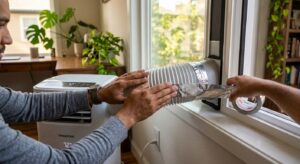
- Place a box fan in a nearby window exhausting outward while you cook to assist your range hood or supplement it if you have a recirculating hood. This creates negative pressure in the kitchen that pulls hot air out.
- Install a programmable outlet timer on your dishwasher (around $15 to $25) to automatically delay the start until overnight, eliminating dishwasher heat gain during evening hours without any habit change required.
- Replace a recirculating range hood with a ducted model exhausting directly outside. A 400 CFM ducted hood can remove nearly all cooking heat and moisture at the source. Expect to pay $150 to $400 for the hood and $150 to $500 for professional installation of the duct run.
- Upgrade to an induction range or cooktop. Induction cooking is 84% energy efficient versus 40 to 55% for electric resistance, meaning dramatically less waste heat enters your kitchen. A full induction range costs $700 to $1,500, with a payback period of 3 to 5 years on combined cooking and cooling savings.
- Have an HVAC technician assess whether adding a small exhaust fan or transfer grille between the kitchen and an exterior wall can improve overall kitchen ventilation without requiring full ductwork.
- Consider a mini-split in the kitchen if it runs hotter than the rest of the house by more than 5 degrees year-round. A single-zone 9,000 BTU mini-split ($700 to $1,200 installed) can handle kitchen heat load independently without burdening the whole-home system.
Why It Works: The Benefits
Reducing cooking-related heat gain can cut summer cooling costs by 5 to 20% depending on how often you cook and how well your current kitchen is ventilated. Homes in hot climates see the largest savings.
Proper range hood use combined with shifted cooking times can keep kitchen temperatures 8 to 12 degrees Fahrenheit cooler during and after meal prep, making the space genuinely usable in summer.
Every 10°F reduction in kitchen heat load can shorten AC runtime by 10 to 15 minutes per cooking session, reducing compressor wear and extending your system’s lifespan.
Venting cooking steam outdoors rather than letting it accumulate can reduce indoor relative humidity by 5 to 10 percentage points, improving comfort and reducing the risk of mold in poorly ventilated kitchens.
Switching from a conventional oven to a countertop convection or air fryer for small meals uses up to 50% less energy and generates far less waste heat, creating a double savings on both cooking and cooling costs.
💰 Savings Impact by Action
Shifting oven use outside peak heat hours (2 to 6 PM) reduces the combined outdoor plus internal heat load your AC fights by roughly 10% on those days.
Running a properly ducted 400 CFM range hood proactively removes up to 15% of daily kitchen heat gain before it disperses into the home.
Replacing full oven use with a countertop convection oven or air fryer for small meals cuts cooking-related heat output by up to 20% due to lower wattage and faster cook times.
Induction cooktops waste 50 to 60% less energy as ambient heat compared to gas burners, reducing stovetop heat rejection into the kitchen by up to 18%.
Delaying dishwasher cycles to overnight eliminates 500 to 1,000 BTUs of evening heat gain, reducing AC runtime by roughly 5% on days with evening loads.
🏠 Key Concepts Explained
The Science Behind It
When you cook, you are converting electrical or chemical energy into heat. The problem is that cooking appliances are not perfectly efficient at transferring that heat into food. A gas burner, for example, transfers only about 32 to 40% of its energy into the pot. The rest radiates outward as convective and radiant heat into the kitchen air. This wasted energy is called the appliance’s heat rejection rate, and it is a direct addition to your home’s internal heat gain that your air conditioner must remove.
Your AC does not just fight outdoor heat trying to get in. It also fights internal heat sources, including lighting, electronics, people, and cooking. Building scientists call this the internal load, and in a typical home during summer, it can account for 20 to 35% of total cooling demand. Cooking is one of the largest and most controllable contributors to that internal load. The Department of Energy estimates that cooking and food preparation account for roughly 3 to 5% of total home energy use, but their impact on cooling load is disproportionately large because nearly all that energy eventually becomes heat in your living space.
The physics of buoyancy explain why timing and ventilation matter so much. Hot air rises, and cooking creates thermal plumes that carry heat and moisture upward from burners and oven vents toward the ceiling and into adjacent rooms. A properly positioned range hood intercepts these plumes at the source before they mix with room air. Once heat and steam have mixed throughout the kitchen, removing them requires your entire HVAC system to process the whole room’s air volume, which is far less efficient than capturing heat at the point of generation. This is why hood placement, fan speed, and proactive activation make such a large difference in real-world performance.
Frequently Asked Questions
▼ My range hood is on but the kitchen still gets really hot when I cook. What am I doing wrong?
First confirm your hood is actually exhausting air outside and not just recirculating it. Hold a tissue or lighter flame near the hood grille and look for strong consistent airflow. If airflow seems weak, check whether the grease filters are clogged, as a dirty filter can reduce airflow by up to 50%. If the hood is ducted but still ineffective, the duct run may be too long or have too many bends, reducing its rated CFM significantly.
▼ I do not have an exhaust fan or range hood at all. What can renters do?
Place a box fan in the window nearest your stove set to exhaust outward, which creates negative pressure that draws cooking heat out of the room. Open a window in a far room simultaneously to give replacement air a path in. A portable induction cooktop reduces waste heat dramatically since the cooktop surface itself stays cool. These two steps together can reduce kitchen heat gain by 30 to 40% even without a hood.
▼ How long before I actually see these changes on my electric bill?
Habit changes like shifting cooking times and using smaller appliances typically show up within the first full billing cycle, usually 30 days. The savings are most visible during summer months when your AC is running frequently. Homeowners in hot climates who cook heavily report $15 to $40 per month in reduced cooling costs during peak summer by combining habit changes with countertop appliance use.
▼ Is cooking heat really a big enough deal to matter, or should I focus on insulation and windows first?
Insulation and air sealing have higher total savings potential and should be the first priority if they are lacking in your home. However, cooking heat is one of the few internal loads you can eliminate almost entirely at zero cost, which makes it worth addressing alongside those bigger projects. In well-insulated homes where the envelope is already efficient, internal loads like cooking become a larger share of the remaining cooling burden.
▼ My kitchen stays hot for hours after I am done cooking. Why and what can I do?
The oven, heavy pots, and cast iron cookware hold significant heat and continue radiating for 30 to 90 minutes after cooking ends. Leave the range hood running for at least 15 minutes after you finish, and if your kitchen has a door to the outside, open it briefly to flush hot air out. Avoid placing hot cookware on surfaces near the center of the room where radiated heat disperses widely. In the future, switching to lighter aluminum cookware for everyday meals reduces stored thermal mass significantly.
Quick Tips
- Use a lid on pots whenever possible. Covered pots boil 25 to 30% faster and release far less steam into the kitchen air.
- Grill or cook outdoors on the hottest days of the year. Moving a single weekend grilling session outside eliminates that entire internal heat load completely.
- Let oven-cooked food rest on the stovetop with the oven door open only after it has cooled for 10 minutes. Opening the oven door immediately after cooking dumps a concentrated wave of hot air into the kitchen.
- Use the microwave for reheating leftovers instead of the oven. A microwave uses 600 to 1,200 watts and runs for 2 to 5 minutes versus an oven’s 2,400 to 5,000 watts running for 20 to 30 minutes to reheat the same food.
Variations for Your Situation
- Apartment/Rental: Renters who cannot modify HVAC or install exhaust fans should focus on the two highest-impact zero-permission changes: a portable induction cooktop ($40 to $100) and a box fan exhausting through the kitchen window while cooking. Together these can cut kitchen heat gain by 35 to 45%. A countertop air fryer or convection oven ($50 to $150) eliminates full oven use for most weeknight meals.
- Tight Budget (under $50): Start with cleaning your existing range hood filters (free), shifting all oven cooking to before 11 AM or after 7 PM (free), and using pot lids consistently (free). Add a programmable outlet timer for the dishwasher at around $15 to $25. These zero-to-minimal-cost changes alone can reduce summer cooling bills by 5 to 10% with no equipment purchase required.
- Older Home (pre-1980): Kitchens in older homes often lack exhaust ventilation entirely or have only a recirculating hood, making cooking heat particularly difficult to remove. Prioritize adding a window exhaust fan ($25 to $60) dedicated to the kitchen before investing in any appliances. Older homes also tend to have less insulation and more air leakage, meaning cooking heat bleeds into adjacent rooms faster. A simple door curtain or temporary partition during cooking can help contain heat to the kitchen zone while the fan clears it.