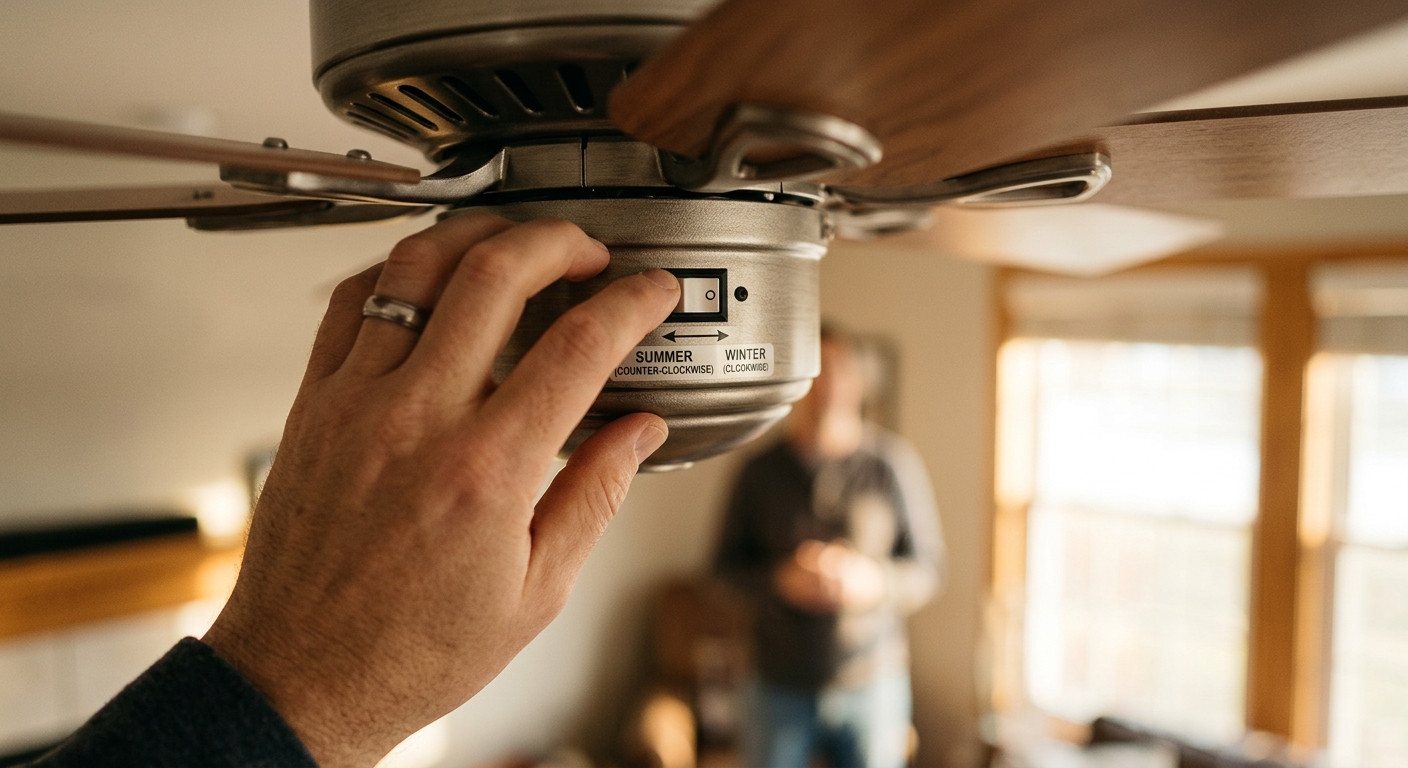
Your ceiling fan has a small switch on the motor housing that most homeowners have never touched. That switch reverses the blade direction, and getting it wrong means your fan is actively working against your heating or cooling system for half the year. In summer, blades should spin counterclockwise to push air straight down and create a wind-chill effect. In winter, they should spin clockwise at low speed to pull cool air up and gently push warm air down from the ceiling without creating a draft.
The Department of Energy estimates that using ceiling fans correctly and raising your thermostat by just 4 degrees Fahrenheit in summer can save up to 15% on cooling costs. In winter, the same fan running clockwise can reduce heating costs by up to 10% by redistributing warm air that pools near the ceiling. For a typical household spending $1,200 to $1,800 per year on heating and cooling, that adds up to $120 to $270 in real savings annually.
This post covers exactly how to set your fans for each season, what speeds work best in different room types, how to pair fan use with thermostat adjustments for maximum savings, and when it makes sense to upgrade to a more efficient fan model. Whether you have one fan or ten, these steps take less than five minutes per fan and cost nothing.
What You’ll Need
Click on an item below to shop for the recommended items for this recipe on Amazon.
As an Amazon Associate, we earn from qualifying purchases.
How to Do It
- Turn the fan off completely and wait for blades to stop spinning before touching anything.
- Locate the small direction switch on the side of the motor housing, usually a 1-inch toggle or slide switch.
- In summer, set the switch so blades spin counterclockwise when viewed from below. You should feel a direct downward airflow standing beneath the fan.
- In winter, flip the switch so blades spin clockwise when viewed from below. Run the fan on its lowest speed only to avoid creating a chilling draft.
- After switching to summer mode, raise your thermostat setpoint by 4°F. If you were comfortable at 74°F, try 78°F and adjust from there.
- Turn the fan off whenever you leave the room. Fans cool people, not air, so an unoccupied room gains nothing from a running fan.
- Identify which fans serve the rooms you occupy most: bedrooms, living room, and home office are the highest-priority targets.
- Purchase a compatible smart fan control switch or a universal smart remote receiver kit. Look for models rated for your fan’s wattage, typically 1.5 to 3 amps.
- Turn off the circuit breaker for the fan, then replace the existing wall switch or install the remote receiver in the fan’s canopy following the manufacturer’s wiring diagram. If the fan and light share a single wire, choose a controller designed for that configuration.
- Pair the controller with your smart home app and set a schedule: fans turn on 30 minutes before you typically arrive home and off automatically at your bedtime or when you leave.
- Use the app to set a reminder each spring and fall to switch fan direction. Some smart fans do this automatically, but manual fans still need the physical toggle.
- Combine the schedule with a matching thermostat adjustment. Program your smart thermostat to raise the cooling setpoint by 3 to 4°F during hours when fans are scheduled to run in occupied rooms.
- Check your existing fan’s label for wattage and CFM (cubic feet per minute) airflow rating. If the CFM-per-watt ratio is below 75, an ENERGY STAR fan will deliver meaningfully more airflow for the same electricity cost.
- Select an ENERGY STAR-certified fan sized for your room: fans with 42-inch blades work for rooms up to 144 square feet, 52-inch for up to 225 square feet, and 60-inch or larger for great rooms and open floor plans.
- Turn off the circuit breaker, remove the old fan, and install the new fan using the existing ceiling bracket if it is rated for fan use. Fan-rated junction boxes are required by code and are different from light-only boxes.
- Verify the new fan includes a reverse function and a remote or wall control with a low-speed setting for winter use.
- Install the fan with the blades 8 to 9 feet off the floor if ceiling height allows. Fans mounted less than 7 feet above the floor are a safety hazard. Use a downrod to achieve the correct mounting height in rooms with high ceilings.
- After installation, set the direction and thermostat as described in the Quick Fix approach, and note the fan’s wattage at each speed setting so you can calculate monthly operating cost.
Why It Works: The Benefits
Running a ceiling fan counterclockwise in summer and raising the thermostat 4°F saves up to 15% on cooling costs, roughly $60 to $135 per cooling season for an average home.
Clockwise fan rotation at low speed in winter redistributes stratified warm air, reducing heating costs by 5 to 10% by allowing the thermostat to be set slightly lower while maintaining comfort at floor level.
Breaking up thermal stratification in winter eliminates cold floors and hot ceilings, improving comfort without increasing thermostat settings. The difference between floor and ceiling temperature can drop from 8°F to under 2°F.
Every degree of thermostat setback reduces compressor runtime. Fewer runtime hours mean less mechanical wear on your AC unit, extending equipment life and reducing maintenance frequency.
Switching fan direction and adjusting the thermostat takes five minutes and costs nothing. Unlike insulation or equipment upgrades, savings start on the same day you make the change.
💰 Savings Impact by Action
Raising the cooling setpoint 4°F while using ceiling fans for wind-chill saves up to 15% on cooling costs per the Department of Energy.
Clockwise fan rotation at low speed redistributes stratified warm air and can reduce heating costs by up to 10% in rooms with ceilings 9 feet or taller.
Replacing a pre-2010 standard fan with an ENERGY STAR-certified model moves 20% more air per watt, reducing the fan’s own operating cost while delivering stronger wind-chill at the same speed.
Turning fans off in unoccupied rooms eliminates wasted fan electricity, which adds up to roughly 3 to 5% of total fan energy cost annually in a typical household.
🏠 Key Concepts Explained
The Science Behind It
The wind-chill effect is the core mechanism behind summer fan savings. When moving air flows across skin, it accelerates the evaporation of perspiration and increases convective heat loss from the body’s surface. This does not lower the actual air temperature in the room, but it lowers your perceived temperature by 4 to 6°F at typical indoor fan speeds. Because human thermal comfort is determined by perceived temperature rather than air temperature, you can raise the thermostat setpoint to match that perceived reduction and maintain identical comfort while the air conditioner runs significantly less.
In winter, the physics work differently. Heat naturally rises because warm air is less dense than cool air. In a room with an 8 or 9-foot ceiling, this stratification can create a temperature difference of 5 to 10°F between the floor where people live and the ceiling where heat accumulates uselessly. A ceiling fan spinning clockwise draws cool air upward from the center of the room and pushes it outward along the ceiling, which then displaces the warm air pooled there and forces it down along the walls. At low speed this gentle circulation does not create a perceptible draft at floor level, so occupants feel warmer without the thermostat being raised.
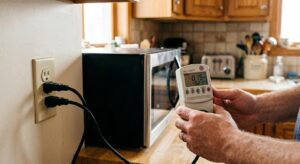
The energy math strongly favors fan use. A ceiling fan on medium speed consumes roughly 30 to 45 watts. A central air conditioner compressor draws 3,000 to 5,000 watts. If the wind-chill effect of the fan allows the thermostat to be raised by 4°F and reduces daily AC runtime by even one hour, the AC avoided consuming 3,000 to 5,000 watt-hours while the fan used only 30 to 45. That is a 67 to 166-to-1 energy return ratio. The only scenario where this math breaks down is when the fan runs in unoccupied rooms, where it produces no perceived cooling benefit while still drawing power.
Frequently Asked Questions
▼ How do I know which direction my ceiling fan is spinning?
Stand directly beneath the fan while it is running on medium speed and look up. Counterclockwise means the leading edge of each blade is moving to your left, and you should feel a direct downward airflow on your face. If you feel no downward draft, the fan is spinning clockwise and needs to be switched for summer use. Turn the fan off, wait for it to stop, and flip the direction switch on the motor housing.
▼ My fan does not have a direction switch. Can I still reverse it?
Older fans and some budget models have a fixed rotation direction with no reverse function. If yours lacks a switch on the motor housing and came with no remote that includes a reverse button, it likely cannot be reversed without replacing the motor. In this case, use the fan in summer only for wind-chill benefit, and simply turn it off in winter rather than running it the wrong direction.
▼ Will running my ceiling fan in winter actually lower my heating bill?
Yes, but the savings depend on your ceiling height and heating system type. Homes with ceilings 9 feet or taller and forced-air or baseboard heating see the most benefit because stratification is more pronounced and warm air is more wasted. Run the fan on low speed clockwise and see if your thermostat reaches setpoint faster than usual. If it does, your system is running less, and your bill will reflect that over a full billing cycle.
▼ Can I run the ceiling fan and the AC at the same time?
Yes, and this is the correct strategy for maximum savings. Running both simultaneously lets you raise the thermostat setpoint by 4°F while maintaining comfort, which more than offsets the small amount of electricity the fan uses. The mistake to avoid is running the AC at the same low setpoint with the fan on top of it, which just wastes the fan’s electricity without gaining any thermostat savings.
▼ Why does my fan wobble and make noise after I switched the direction?
Wobbling is almost always caused by loose blade bracket screws or slightly uneven blade weights, not the direction change itself. Tighten the screws on every blade bracket where it attaches to the motor hub, then check that all blades are at the same height using a yardstick held against the ceiling. Most fans include a small blade-balancing clip kit for fine-tuning. If wobbling persists after these steps, the fan may have a warped blade or a bent bracket that should be replaced.
Quick Tips
- Check fan direction every spring and fall when you change smoke detector batteries. Treating it as a seasonal maintenance task prevents months of running fans the wrong way.
- In bedrooms, a fan on medium speed creates enough airflow to allow most sleepers to tolerate a thermostat setpoint 2 to 3°F higher than they otherwise would, which adds up to meaningful savings overnight.
- If you cannot feel a noticeable downward breeze standing directly under your fan in summer on medium speed, the blade pitch is likely below 10 degrees and the fan is not moving enough air to provide meaningful wind-chill benefit.
- For open-plan living areas, position furniture so primary seating is within the fan’s blade diameter. Airflow drops off significantly beyond the blade edge, so sitting 10 feet outside a 52-inch fan provides little benefit.
Variations for Your Situation
- Apartment/Rental: Most apartments already have ceiling fans installed, so the quick fix direction switch approach is fully renter-safe and requires no landlord permission. Focus on the behavioral habit of turning fans off when leaving the room and raising your window AC or thermostat setpoint by 3 to 4°F when the fan is running. If your fan lacks a direction switch, purchase a universal remote receiver kit ($20 to $35) that installs inside the canopy without altering wiring, giving you speed control and in some models a reverse function, which is typically considered a non-permanent improvement that does not require landlord approval.
- Tight Budget (under $50): The direction switch flip and thermostat adjustment cost nothing and should be your first action. Beyond that, a basic smart plug timer ($10 to $15) can be paired with a plug-in floor or table fan to create a timed circulation schedule in rooms without ceiling fans. Focus on the bedroom first since nighttime comfort improvements allow the largest thermostat setback, typically 4°F for 8 hours, which is where the biggest savings percentage comes from.
- Older Home (pre-1980): Homes built before 1980 often have higher ceilings, greater air leakage, and less insulation, meaning thermal stratification in winter is more severe and wind-chill savings in summer are more valuable because the home heats up faster. Before investing in fan upgrades, confirm that existing ceiling fan boxes are fan-rated rather than light-rated, as older construction frequently used light-only boxes throughout. If the fan wobbles noticeably, assume the box is inadequate and have an electrician install a fan-rated brace kit ($15 to $30 for the brace, plus labor) before continuing to run the fan at higher speeds.